 d4
d4
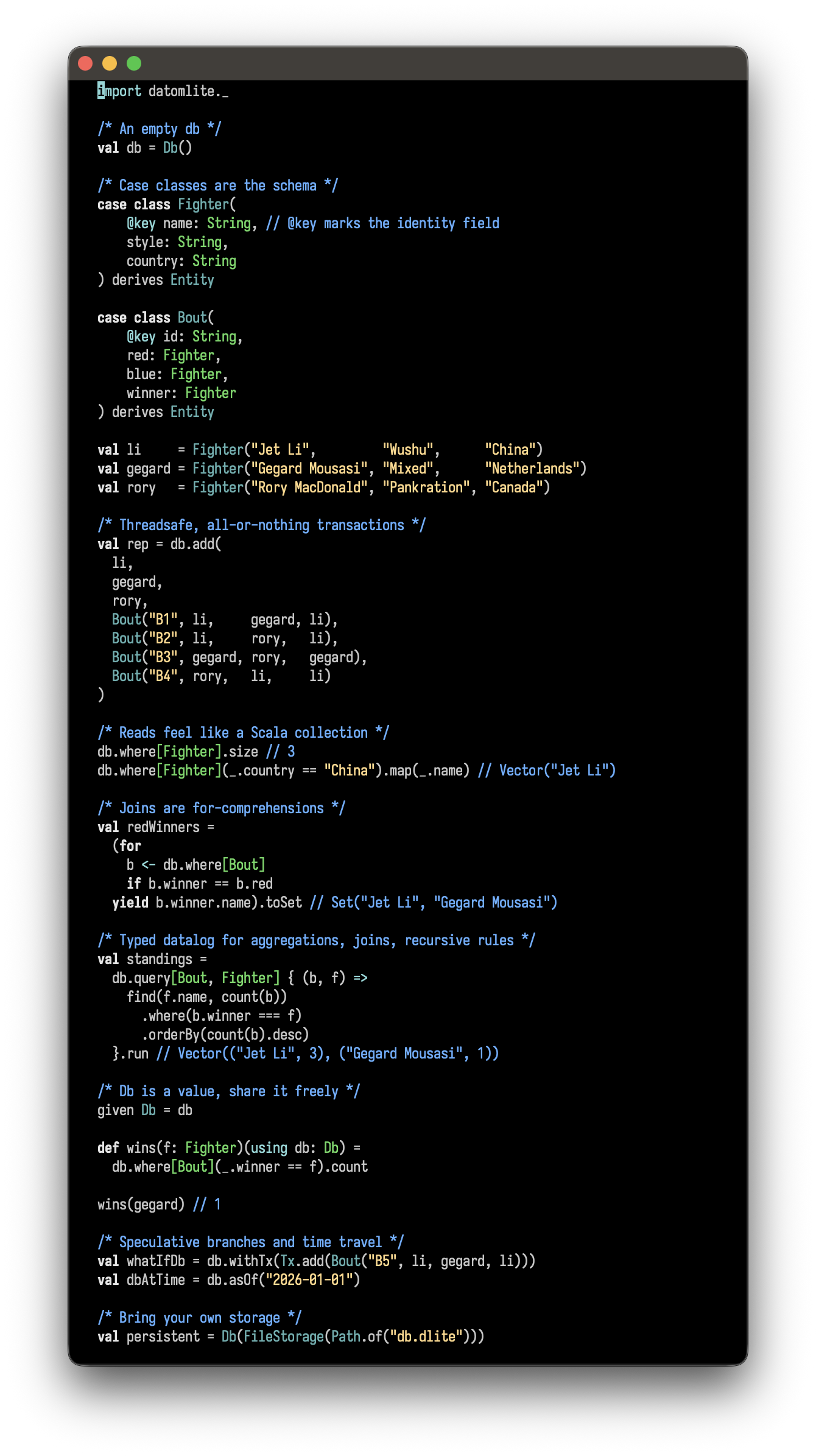
Lightweight, immutable database
datomlite is a zero-dep "DB-as-a-value" you can drop into your Scala 3 apps
- Zero deps, pure Scala 3.7+
- Cross-platform (JVM, JS, Native)
- Case classes are "the schema"
- Append-only log: every past state stays queryable
- Typed queries, compile-time checked
- Datalog that feels like plain Scala (no EDN, no DDL)
- Joins, refs, aggregations, window functions, recursive rules
- Easy time-travel and speculative transactions
- Named-tuple query results
- Implement
Storageand bring your own backend
"xyz.matthieucourt" %% "datomlite" % "0.1.0"
All you need:
import datomlite._
Try it in your REPL:
scala-cli repl --dep xyz.matthieucourt::datomlite:latest.release
Quick start
import datomlite._

/* Create an empty db */
val db = Db()

/* Just derive `Entity` on your case classes */
case class Person(@key email: String, name: String) derives Entity

/* Easy, threadsafe transactions */
db.add(Person("m@x.io", "Matt"), Person("a@x.io", "Alice"))

/* Your db feels like a collection */
db.where[Person].run
db.where[Person].size
db.where[Person](_.email == "m@x.io").one
db.where[Person].filter(_.name.startsWith("M")).take(5).toList
for p <- db.where[Person] do println(p.name)

db.upsert(Person("m@x.io", "Matthieu"))

/* Typed Datalog: joins, projections, aggs */
db.query[Person] { p =>
  find(p.name) where (p.email === "m@x.io")
}.run

db.retractWhere[Person](_.email == "m@x.io")
FAQ
Why datomlite?
First, for good-spirited fun and happy hacking. Second, I have long wanted a datastore "as-a-value" I can drop into my processes and throw my case classes
at, without first carving EDN, registering attributes, or learning a finicky ersatz Datalog DSL.
What is it under the hood?
Essentially, datomlite is a bunch of macro based niceties on top of an append-only log of (eid, attr, value) triples plus in-memory indices over the live
projection. Your case classes are shredded into triples on write and reassembled on read,
so queries feel like working with your original typed objects.
What indices does it maintain?
EAVT for live entity reads, AVET for value lookups, and a class index to enumerate entities of a Scala type. All are derived from the append-only log and updated in lockstep with each commit.
Does it support all of Datalog?
No. Recursion goes through named rules, negation is top-level conjunctions only, and there is no built-in unification beyond the DSL.
Differences from Datomic / Datascript?
- Case classes are "the schema". There is no
:db/ident, no attribute registration or otherwise separate cardinality/uniqueness facts. - Queries are typed Scala, not vectors of triples. Field access is compile-checked by the datomlite macros.
- Single-process, single-writer. No peer/transactor, no client API
Transaction guarantees?
- Atomicity. All asserts and retracts in a tx commit together or none do. A
UniqueViolationor any thrown exception inside a tx block aborts the whole thing with no partial state. - Linearizable commits. Each commit goes through a CAS on the live state.
- Snapshot reads. Every read call (
where,query,pull,byEid) dereferences the live state once at entry and operates on that immutable snapshot for its duration. - Optimistic multi-writers. Many threads can call
transactconcurrently. CAS losers rebuild against the new state and retry. In effect, there is no write lock or single-writer requirement.
What is the inspiration?
Although datomlite borrows ideas from Datomic, Datascript, Mentat and XTDB and is in the general orbit of Datalog flavoured triple stores, it puts particular (and to my knowledge novel) emphasis on type-safety and feeling 100% embedded into the host language.
In a sense, datomlite is "DB-as-a-value", but does not preoccupy itself with functional purity per se.
Updates
Suppose we add two pugilists to our database, "Jet Li" and "Masvidal". Adding them appends datoms and the live projection picks them up:
import datomlite._

case class Fighter(
  fName: String,
  lName: String,
  nickname: Option[String]
) derives Entity

val db = Db(
  Fighter("Jorge", "Masvidal", Some("Street Judas")),
  Fighter("Jet",   "Li",       None),
)
Unsurprisingly, we want to remove Masvidal:
db.retractWhere[Fighter](_.lName == "Masvidal")
db.where[Fighter].run
// Vector(Fighter("Jet", "Li", None))
The live projection drops Masvi, but the log still has every datom.
Example schema
We'll use these vanilla domain entities throughout for example purposes...
case class Department(@key code: String, name: String) derives Entity
case class Skill(@key name: String) derives Entity
case class Order(buyer: String, item: String, price: Long) derives Entity

case class Employee(
  @key email: String,
  name: String,
  dept: Department,
  salary: Long,
  skills: Set[Skill] = Set.empty,
  nickname: Option[String] = None
) derives Entity
Operations
Writes commit all-or-nothing and return a TxReport.
Reads capture one snapshot at entry.
Write:
db.add(values*)              assert one or more rows in one tx
db.retract(values*)          retract by full equality, misses are silent
db.retractWhere[A](https://github.com/mattlianje/datomlite/blob/master/pred)     find every match and retract in one tx
Read:
db.where[A]                  Query[A] over all rows of A
db.where[A](https://github.com/mattlianje/datomlite/blob/master/pred)            Query[A] filtered, indexed equality lowers to a probe
db.exists[A](https://github.com/mattlianje/datomlite/blob/master/pred)           Boolean, short-circuits
db.count[A](https://github.com/mattlianje/datomlite/blob/master/pred)            Long, no row materialization
.run / .one                  materialize to Vector / Option
val eng = Department("ENG", "Engineering")

/* Adding */
db.add(Employee("a@x.io", "Alice", eng, 100_000L))
db.add(
  Employee("b@x.io", "Bob",   eng, 120_000L),
  Employee("c@x.io", "Carol", eng, 150_000L),
)

/* Lookups */
db.where[Employee].run                            // Vector[Employee]
db.where[Employee](_.email == "m@x.io").one       // Option[Employee]
db.where[Employee](https://github.com/mattlianje/datomlite/blob/master/_.name.startsWith("M")).run    // Vector[Employee]

/* Retract */
db.retractWhere[Employee](_.email == "a@x.io")
db.retractWhere[Employee](_.email == "b@x.io")

/* Quick checks */
db.exists[Employee](_.email == "m@x.io")        // Boolean
db.count[Employee](https://github.com/mattlianje/datomlite/blob/master/_.name.startsWith("M"))      // Long
db.count[Employee]                              // Long
Query[A] is the lazy Iterable[A] that db.where[A] returns. You materialize it with .run (toVector) or .one (headOption).
db.where[Employee].toList
db.where[Employee].size
db.where[Employee].head
for e <- db.where[Employee] do println(e.name)
Each add/retract returns a TxReport with tx id and wall-clock time. Both feed asOf (see Time travel).
Keys and uniqueness
Often, we want to enforce uniqueness of data in our datastore. This this end, datomlite lets you mark uniqueness keys:
@key                   identity field
@unique                must be unique across the entity
db.upsert(values*)     find by key, retract prior, re-assert under same eid
.key(f)                chained, computed or composite key
.unique(f)             chained, additional unique field
.named("...")          chained, override the attribute prefix
Duplicate @key or @unique raises a UniqueViolation and aborts the tx.
case class User(
  @key email: String,
  @unique handle: String,
  name: String
) derives Entity

db.add(User("a@x.io", "shared", "Alice"))
db.add(User("b@x.io", "shared", "Bob"))
// UniqueViolation: 'shared' is taken
[!NOTE] Write your own
Entity.derivedgiven instances like below to create custom and/or composite uniqueness keys
case class Friend(a: Person, b: Person)
given Entity[Friend] = Entity.derived[Friend].key { f =>
  val Seq(x, y) = Seq(f.a.email, f.b.email).sorted
  (x, y)
}
Same simple name across packages collides on the prefix, override with .named:
given Entity[a.Person] = Entity.derived[a.Person].named("a.Person").key(_.email)
given Entity[b.Person] = Entity.derived[b.Person].named("b.Person").key(_.email)
Refs and cardinality
Currently in datomlite, cardinality is a property of the Scala type, not a separate declaration (which might be a bit controversial)
T          one datom per row
Option[T]  one datom on Some, nothing on None
Set[T]     one datom per element
R          one datom, value is the target eid (needs Entity[R] in scope, target needs @key)
Set[R]     one datom per target eid
=== joins across refs, card-one or card-many.
db.query[Employee, Department, Skill] { (e, d, s) =>
  find(e.email, s.name) where (
    e.dept === d &&
      d.name === "Engineering" &&
      e.skills === s
  )
}.run // Vector(("m@x.io","Scala"), ("m@x.io","Haskell"), ("a@x.io","Scala"))
Optional fields
For datomlite entities Option[T] writes a datom only on Some. None is absence, not a stored null.
val eng = Department("ENG", "Engineering")

val db = Db(
  Employee("m@x.io", "Matthieu", eng, 120_000L, nickname = Some("Matt")),
  Employee("a@x.io", "Alice",    eng, 110_000L),
)

db.where[Employee](https://github.com/mattlianje/datomlite/blob/master/_.nickname.contains("Matt")).run.map(_.email) // Vector("m@x.io")

db.where[Employee](_.nickname == None).run.map(_.email) // Vector("a@x.io")
In a typed query, find(e.nickname) projects the inner type, emits a row only when present.
db.query[Employee] { e =>
  find(e.email, e.nickname)
}.run
// Vector(("m@x.io", "Matt"))
Tx blocks: batch multiple ops
You'll often want to batch transaction that are to run sequentially, and datomlite supports this
db.tx { b => ... }            mixed add/retract/upsert in one tx
b.add / b.retract / b.upsert  inside the block
b.retractWhere[A](https://github.com/mattlianje/datomlite/blob/master/pred)       finds matches, appends a retract
b.upsertWhere[A](https://github.com/mattlianje/datomlite/blob/master/pred)(f)     reads matches, applies f, appends an upsert
db.retractWhere / db.upsertWhere(pred)(f)   one-shot tx versions
Tx.batch(steps*)              hold steps as a value
db.transact(tx)               apply a Tx value
Steps run in order against state-so-far, share one tx id, all-or-nothing.
db.tx { b =>
  b.upsertWhere[Employee](_.email == "m@x.io")(_.copy(name = "Matthieu"))
  b.add(Order("m@x.io", "book", 20L))
}
retractWhere / upsertWhere inside the block:
db.tx { b =>
  b.retractWhere[Order](_.buyer == "ghost@x.io")
  b.upsertWhere[Employee](_.email == "m@x.io")(_.copy(salary = 130_000L))
}
You can also postpone a transaction and run it later as below:
val tx = Tx.batch(
  Tx.add(Order("m@x.io", "book", 20L)),
  Tx.add(Order("m@x.io", "pen",   5L)),
)
db.transact(tx)
From a transaction you'll get back TxReport
this carries
tx, time, adds, retracts, addedEids
Listen for db changes
You often want to respond to changes made to your datastore, which is why datomlite has .listen.
The callback fires after each successful commit with the TxReport (tx id, adds, retracts, addedEids). Reads inside see the just-committed state. Use it for cache invalidation, outbox pushes, WebSocket fan-out, audit logs, or any side effect that should trail a write.
db.listen { rep =>
  println(s"tx ${rep.tx.value}: +${rep.adds.size} -${rep.retracts.size}")
}
[!NOTE] Snapshots and
withTxbranches (see Time travel) are read-only,listenis a no-op
Predicates as index probes
You will have noticed datomlite operations with predicates feel like operations on plain collections.
Under the hood, when you use predicates, datomlite's macros lift plain equality to index-probed queries (so you aren't scanning all your triples)
db.where[Employee](_.email == "m@x.io").run // <-- index probe
db.where[Employee](https://github.com/mattlianje/datomlite/blob/master/_.name.startsWith("M")).run // <-- slow scan
[!NOTE] Only equality lowers to a probe.
startsWith,>, regex etc. all become full scans.
Notably (and powerfully), Ref fields are walked inline, even when nested:
db.where[Employee](_.email == "m@x.io").one.get.dept.name
db.where[Employee](_.dept.name == "Engineering").run // <-- two hop index probe
db.where[Employee](_.dept == Department("ENG", "Engineering")).run
Card-many value fields support .contains as an index probe:
case class Tagged(
  @key name: String,
  tags: Set[String]
) derives Entity

val tdb = Db(
  Tagged("matt", Set("fp", "scala")),
  Tagged("ali",  Set("ml")),
)

tdb.where[Tagged](https://github.com/mattlianje/datomlite/blob/master/_.tags.contains("fp")).run.map(_.name) // Vector("matt")
Queries
For querying, you have two surfaces: (1/2) for-comprehensions over where for plain stitching on a shared scalar, and (2/2) db.query[...] for projections, joins, aggregations, windows, and rules with compile-time field checks.
For-comprehension joins
Stitch where[A] results together with normal Scala for-comprehensions, no DSL.
db.add(Order("m@x.io", "book", 20L), Order("a@x.io", "lamp", 90L))

(for
  e <- db.where[Employee]
  o <- db.where[Order](_.buyer == e.email)
yield (e.name, o.item)).run
// Vector(("Matt", "book"), ("Alice", "lamp"))
[!NOTE] Every join here is a nested loop. Reach for
db.query[...]once you need projections, multi-entity joins, or indexed equality.
Typed queries
The full surface: projections, multi-entity joins, aggregations, windows, rules. Each type parameter binds a row, find(...) projects, where(...) constrains. Combine with && / ||, compare with ===, !==, >, <, >=, <=. Field access is compile-checked, where is optional.
db.query[Employee] { e =>
  find(e.name) where (e.email === "m@x.io")
}.run
// Vector("Matt")

db.query[Employee] { e =>
  find(e.name)
}.run
// Vector("Matt", "Alice", "Bob")
|| distributes over &&. Disjuncts run as separate passes, call .distinct for set semantics.
db.query[Employee] { e =>
  find(e.name) where (e.email === "m@x.io" || e.email === "b@x.io")
}.run
// Vector("Matt", "Bob")
Joins on a ref use ===, on a shared scalar use field equality:
db.query[Employee, Department] { (e, d) =>
  find(e.email, d.name) where (
    e.dept === d &&
      d.name === "Engineering"
  )
}.run
// Vector(("m@x.io","Engineering"), ("a@x.io","Engineering"))

db.query[Employee, Order] { (e, o) =>
  find(e.name, o.item) where (
    e.email === o.buyer && o.price > 50L
  )
}.run
// Vector(("Alice","lamp"), ("Bob","chair"))
Typos list available fields at compile time which is nice:
db.query[Employee] { e => find(e.emial) where (e.email === "x") }
does not compile: `emial` is not a field of Employee. Available: email, name, dept, salary
Reusable constraints are functions returning Constraint:
def engineers(d: Row[Department]): Constraint = d.name === "Engineering"
def expensive(e: Row[Employee], min: Long): Constraint = e.salary > min

db.query[Employee, Department] { (e, d) =>
  find(e.email) where (
    engineers(d) && expensive(e, 100_000L) && e.dept === d
  )
}.run
Named-tuple rows
Pass named args to find(...) and the row is a NamedTuple with those exact labels and types.
val rows = db.query[Employee, Department] { (e, d) =>
  find(name = e.name, dept = d.name, salary = e.salary)
    .where(e.dept === d)
    .orderBy(e.salary.desc)
}.run
// Vector[NamedTuple[("name","dept","salary"), (String, String, Long)]]

rows.head.name             // "Bob"
rows.map(_.salary).sum     // 270000L
for case (name = n, salary = s) <- rows if s > 100_000L
yield s"$n earns $s"
Aggregations
datomlite comes with built-in "sugar" for groupBy + fold over the query rows. Aggregator terms (count, sum, avg, min, max) sit inside find(...), bare find vars become the group keys (no GROUP BY), wrong types are compile errors.
count(t) / countDistinct(t)        Long
sum(t) / avg(t)                    Numeric[T]
min(t) / max(t)                    Ordering[T]
db.query[Employee, Order] { (e, o) =>
  find(e.name, sum(o.price)) where (e.email === o.buyer)
}.run
// Vector(("Matt",20), ("Alice",90), ("Bob",60))
For one-entity rollups, stay in Scala:
Query[A].groupBy(f)       Map[K, Vector[A]] with .agg extension
Query[A].countBy(f)       Map[K, Long]
db.add(
  Order("m@x.io", "book", 20L),
  Order("m@x.io", "pen",   5L),
  Order("a@x.io", "lamp", 90L),
)

db.where[Order].groupBy(_.buyer).agg(_.map(_.price).sum)
// Map("m@x.io" -> 25, "a@x.io" -> 90)

db.where[Order].countBy(_.buyer)
// Map("m@x.io" -> 2, "a@x.io" -> 1)
Sort and paging
Order and slice on the Query itself, no need to .run then sortBy in Scala.
.orderBy(term.asc | term.desc, ...)   typed query, sort keys must be in find(...)
.orderBy(f) / .orderByDesc(f)         where[A] surface, by selector
.limit(n) / .offset(n)
db.query[Employee] { e =>
  find(e.name, e.salary)
    .where(e.salary > 100_000L)
    .orderBy(e.salary.desc)
    .limit(2)
}.run
// Vector(("Bob",150000), ("Matt",120000))

db.where[Employee].orderBy(_.salary).limit(2).run
db.where[Order].orderByDesc(_.price).offset(10).limit(10).run
Pull to shape query results
Pull is for shaping results. The closure picks the fields you want and walks refs to pull sub-shapes, all against a single snapshot.
This is especially handy when you want a nested output without writing a join, or to skip materializing heavy entities just to read a few fields.
.pull(f) / .pullOne(f)    project rows through Pull[A]
db.byEid[A](https://github.com/mattlianje/datomlite/blob/master/eid)          reconstruct an entity from a raw eid
db.pullByEid[A](https://github.com/mattlianje/datomlite/blob/master/eid)(f)   pull by raw eid
p.field                   read a single attribute
p.refField(sub)           nested pull through a card-1 ref
p.value                   reconstruct the whole entity
p.reverse[E](https://github.com/mattlianje/datomlite/blob/master/_.field)     walk a ref backwards, MultiPull[E]
db.where[Employee](_.email == "m@x.io").pullOne(_.dept(_.name))
// Some("Engineering")

db.where[Employee](_.dept.name == "Engineering").pull(e => (e.email, e.name))
// Vector(("m@x.io", "Matt"), ("a@x.io", "Alice"))
By eid (from TxReport.addedEids or the log):
val rep = db.add(Employee("m@x.io", "Matt", Department("ENG", "Engineering"), 120_000L))
val eid = rep.addedEids.head

db.byEid[Employee](https://github.com/mattlianje/datomlite/blob/master/eid)
// Some(Employee(...))

db.pullByEid[Employee](https://github.com/mattlianje/datomlite/blob/master/eid)(e => (e.name, e.dept(_.name)))
// Some(("Matt", "Engineering"))
Both return None for missing or wrong-type eids.
Reverse refs
Walks a ref backwards from p to every E pointing at p. Card-one or card-many.
db.where[Department](_.code == "ENG")
  .pullOne(d => d.reverse[Employee](https://github.com/mattlianje/datomlite/blob/master/_.dept).map(_.name))
// Some(Vector("Matt", "Alice"))
Nests inside larger pull trees:
db.where[Department](_.code == "ENG").pullOne { d =>
  (d.name, d.reverse[Employee](https://github.com/mattlianje/datomlite/blob/master/_.dept).map(e => (e.name, e.skills.map(_.name))))
}
// Some((
//   "Engineering",
//   Vector(
//     ("Matt",  Vector("Scala", "Haskell")),
//     ("Alice", Vector("Scala")),
//   ),
// ))
Without reverse, a flat query plus regrouping pass is needed, and anyone with empty skills drops to the inner join:
val triples = db.query[Department, Employee, Skill] { (d, e, s) =>
  find(e.name, s.name) where (d.code === "ENG" && e.dept === d && e.skills === s)
}.run
// Vector(("Matt", "Scala"), ("Matt", "Haskell"), ("Alice", "Scala"))
Time travel through past states
datomlite lets you (for a given "current" DB), read any past state or branch off a speculative transaction.
In both cases the live Db remains untouched
db.asOf(tx)               rewind to a tx id
db.asOf(time)             rewind to a Time
db.asOf("2026-01-15")     takes any ISO-8601
db.snapshot               freeze current state
db.withTx(tx)             speculative branch
val rep1 = db.add(Employee("c@x.io", "Carol", Department("ENG", "Engineering")))
val rep2 = db.add(Employee("d@x.io", "Dan",   Department("ENG", "Engineering")))

db.where[Employee].count                    // 5
db.asOf(rep1.tx).where[Employee].count      // 4, before Dan
db.asOf(rep2.time).where[Employee].count    // 5, by wall-clock
ISO-8601 strings accept Z or ±HH:MM, default UTC:
db.asOf("2026-01-15").where[Employee].count             // by date
db.asOf("2026-01-15T10:30:00Z").where[Employee].count   // by instant
Snapshot vs what-if:
val snap   = db.snapshot
val whatIf = db.withTx(Tx.add(Employee("e@x.io", "Eve",
                                       Department("ENG", "Engineering"))))

snap.where[Employee].count        // 5, unchanged
whatIf.where[Employee].count      // 6, includes Eve
db.where[Employee].count          // 5, live untouched
History of every entity
You can call .log on any datomlite to get the full history of triples... or .history/.historyOf to get the history of
specific entities.
db.log                    every datom in tx order
db.historyOf(a)           trail for the entity currently matching a
db.history(eid)           trail for an eid, survives retraction
Each datom carries tx, time, Op.Assert | Op.Retract and nothing is overwritten.
val eng = Department("ENG", "Engineering")

val rep1 = db.add(Employee("m@x.io", "Matt", eng, 120_000L))
val rep2 = db.upsert(Employee("m@x.io", "Matthieu", eng, 130_000L, nickname = Some("Matt")))
db.retractWhere[Employee](_.email == "m@x.io")

db.log
// every Datom across every tx, with (eid, attr, value, tx, time, op)

db.historyOf(Employee("m@x.io", "Matthieu", eng, 130_000L, nickname = Some("Matt")))
// empty, no live entity matches

db.history(rep1.addedEids.head)
// full assert/retract trail for that eid
Diff two databases
When your database is a value, you can do fun things like diff it against another database, or the same database with some speculative transactions that have been applied to it.
a.diff(b) returns DbDiff(added, retracted) over the live (eid, attr, value) triples. Composes with snapshot, withTx, asOf from the same lineage (see Time travel).
val before = db.snapshot
db.upsertWhere[Employee](_.email == "m@x.io")(_.copy(name = "Matthieu"))

val d = before.diff(db)
d.added.map(_.v)        // Vector("Matthieu")
d.retracted.map(_.v)    // Vector("Matt")
Pairs with withTx for what-if:
val eng = Department("ENG", "Engineering")
val whatIf = db.withTx(Tx.add(Employee("e@x.io", "Eve", eng, 100_000L)))
db.diff(whatIf).added   // datoms Eve would add
Negation as anti-join
With datomlite not(c) is the "anti-join". A row passes if and only if substituting it into the negated subgoal produces no matches.
/* employees with no orders */
db.query[Employee, Order] { (e, o) =>
  find(e.name) where not(e.email === o.buyer)
}.run
not(...) only sits in the top-level conjunction. No ||, no not(not(...)). Every variable inside not must be scoped by the outer positive part (Datalog-safe negation).
Existential subgoals (semi-joins)
When writing queries, you often ask yourself: "does at least one such row exist?", but don't want to bring the matched row into your output (like in a semi-join).
To this end datomlite queries can have exists[A] { row => ... } which binds a fresh row scoped to the constraint body, without projecting it.
/* orders whose buyer exists as a registered Employee */
db.query[Order] { o =>
  find(o.item) where exists[Employee] { e => e.email === o.buyer }
}.run
Window functions
Like with aggregations, datomlite's window functions are just sugar on top of datalog so you don't have to hand-roll such windowing on Scala vectors.
db.query[Employee, Department] { (e, d) =>
  find(
    d.name,
    e.name,
    e.salary,
    rank()           over partitionBy(d).orderBy(e.salary.desc),
    sum(e.salary)    over partitionBy(d)
  ).where(e.dept === d)
}.run
Available functions:
rowNumber()                          Long,        1-indexed, needs orderBy
rank()                               Long,        ties share rank, next rank skips
denseRank()                          Long,        ties share rank, next rank does not skip
lag(t, n = 1) / lead(t, n = 1)       Option[T],   None past partition edge
sum/min/max/avg/count(t).over(spec)  input type,  broadcast over the partition
db.query[Employee, Department] { (e, d) =>
  find(d.name, e.name, rowNumber() over partitionBy(d).orderBy(e.salary.desc))
    .where(e.dept === d)
    .orderBy(d.name.asc)
}.run.filter(_._3 == 1L) // top earner per dept
Rules
A Rule[A, B] is a named, reusable predicate between two rows, callable inside any where(...) as if you'd inlined its body.
Multiple bodies act as Datalog disjunction (any one holds).
Recursive rules (body references self) evaluate to a fixed point.
Rule.reaches[A](https://github.com/mattlianje/datomlite/blob/master/_.field)              transitive closure of one self-ref field
Rule[A, B](https://github.com/mattlianje/datomlite/blob/master/bodies*)                   multi-body Datalog without recursion
Rule.recursive[A, B] { self => ... }  recursive Datalog, naive fixed-point
rule(src, dst)                        call inside any where(...)
Self-ref closure (Rule.reaches)
"All entities reachable from src along one ref field". Walks the AVET edge directly, no fixed-point.
case class Node(
  @key id: String,
  children: Set[Node]
) derives Entity

val db = Db()
val d = Node("d", Set.empty)
val c = Node("c", Set(d))
val a = Node("a", Set(c))
val b = Node("b", Set.empty)
db.add(Node("root", Set(a, b)))

val reachable: Rule[Node, Node] = Rule.reaches[Node](https://github.com/mattlianje/datomlite/blob/master/_.children)

db.query[Node, Node] { (s, t) =>
  find(t.id) where (s.id === "root" && reachable(s, t))
}.run.toSet
// Set("a", "b", "c", "d")
Either side can be bound. With t.id === "d" you get every ancestor of d. With both unbound, every reachable pair. The field must be a self-ref (A or Set[A]), a typo or non-ref field is a compile error.
Multi-body rules (Rule[A, B])
Each body is a constraint over the head row params. Multiple bodies act as Datalog disjunction: a pair satisfies the rule if any one body holds.
case class User(@key email: String, role: String) derives Entity
case class Doc(@key slug: String, owner: String, public: Boolean) derives Entity

val canRead: Rule[User, Doc] = Rule[User, Doc](
  (u, d) => d.owner === u.email,
  (u, d) => d.public === true,
  (u, d) => u.role === "admin"
)

db.query[User, Doc] { (u, d) =>
  find(u.email, d.slug) where canRead(u, d)
}.run
Same call shape as a recursive rule, no self parameter.
Recursive rules (Rule.recursive)
The closure receives the rule itself, so a body can call back into it for the recursive case. Evaluation is fixed-point and always terminates over the finite fact domain.
Let's imagine we have a hierarchy of officers...
case class Off(
  @key name: String,
  boss: Option[String]
) derives Entity

val db = Db()
db.add(Off("Napoléon", None))
db.add(Off("Davout",   Some("Napoléon")))
db.add(Off("Ney",      Some("Napoléon")))
db.add(Off("Murat",    Some("Napoléon")))
db.add(Off("Friant",   Some("Davout")))
db.add(Off("Gudin",    Some("Davout")))
db.add(Off("Lasalle",  Some("Murat")))
db.add(Off("Marchand", Some("Ney")))

val ancestor: Rule[Off, Off] =
  Rule.recursive[Off, Off] { self =>
    Seq(
      (anc, desc) => desc.boss === anc.name,
      (anc, desc) => exists[Off] { mid =>
        desc.boss === mid.name && self(anc, mid)
      }
    )
  }
Subordinates of "Davout":
db.query[Off, Off] { (anc, desc) =>
  find(desc.name) where (anc.name === "Davout" && ancestor(anc, desc))
}.run.toSet
// Set("Friant", "Gudin")
"Lasalle"'s reporting line:
db.query[Off, Off] { (anc, desc) =>
  find(anc.name) where (desc.name === "Lasalle" && ancestor(anc, desc))
}.run.toSet
// Set("Murat", "Napoléon")
In SQL: recursive CTE.
WITH RECURSIVE ancestor(anc, desc) AS (
  SELECT boss, name FROM off WHERE boss IS NOT NULL
  UNION
  SELECT a.anc, o.name
  FROM ancestor a JOIN off o ON o.boss = a.desc
)
SELECT desc FROM ancestor WHERE anc = 'Napoleon';
Directed graph (Roads)
case class Place(@key code: String) derives Entity

case class Road(
  from: Place,
  to: Place
)
given Entity[Road] = Entity.derived[Road].key(r => (r.from.code, r.to.code))

val db = Db()
Seq("PAR", "LYO", "MAR", "NCE", "BOR").foreach(c => db.add(Place(c)))

def road(a: String, b: String): Unit =
  db.add(Road(Place(a), Place(b)))

road("PAR", "LYO")
road("LYO", "MAR")
road("MAR", "PAR")   // cycle
road("LYO", "NCE")
road("PAR", "BOR")

val reachable: Rule[Place, Place] =
  Rule.recursive[Place, Place] { self =>
    Seq(
      (s, t) => exists[Road] { r => r.from === s && r.to === t },
      (s, t) => exists[Place] { mid =>
        exists[Road] { r => r.from === s && r.to === mid } && self(mid, t)
      }
    )
  }

/* Everywhere reachable from Paris. The cycle means PAR reaches itself */
db.query[Place, Place] { (s, t) =>
  find(t.code) where (s.code === "PAR" && reachable(s, t))
}.run.toSet
// Set("LYO", "MAR", "PAR", "NCE", "BOR")
Undirected graph (Friends)
Sort endpoints in the key so Friend(a, b) == Friend(b, a). knows is two bodies (one per orientation), connected is the closure. Seven people, six edges, two components:
case class Person(@key handle: String) derives Entity

case class Friend(
  a: Person,
  b: Person
)
given Entity[Friend] = Entity.derived[Friend].key { f =>
  val Seq(x, y) = Seq(f.a.handle, f.b.handle).sorted
  (x, y)
}

val db = Db()
Seq("alice", "bob", "carol", "dave", "erin", "frank", "grace")
  .foreach(h => db.add(Person(h)))

def edge(x: String, y: String): Unit =
  db.add(Friend(Person(x), Person(y)))

edge("alice", "bob")
edge("alice", "carol")
edge("bob",   "dave")
edge("carol", "dave")
edge("dave",  "erin")
edge("frank", "grace")

/* `knows` is symmetric, two bodies one per orientation */
val knows: Rule[Person, Person] =
  Rule[Person, Person](
    (x, y) => exists[Friend] { f => f.a === x && f.b === y },
    (x, y) => exists[Friend] { f => f.a === y && f.b === x }
  )

/* `connected` is the closure over `knows`. Same shape as `ancestor`, undirected */
val connected: Rule[Person, Person] =
  Rule.recursive[Person, Person] { self =>
    Seq(
      (x, y) => knows(x, y),
      (x, y) => exists[Person] { mid => knows(x, mid) && self(mid, y) }
    )
  }

/* Alice's cluster */
db.query[Person, Person] { (x, y) =>
  find(y.handle) where (x.handle === "alice" && connected(x, y))
}.run.toSet
// Set("bob", "carol", "dave", "erin")

/* Frank is in a separate component */
db.query[Person, Person] { (x, y) =>
  find(y.handle) where (
    x.handle === "alice" && y.handle === "frank" && connected(x, y)
  )
}.run
// Vector()
Persistence and custom backends
FileStorage ships for JVM and Native. Restart with the same path, the log replays.
import datomlite.*
import java.nio.file.Path

val eng = Department("ENG", "Engineering")

val db = Db(FileStorage(Path.of("db.dlite")))
db.add(Employee("m@x.io", "Matt", eng, 120_000L))

/* kill the JVM, restart with the same path */
val db2 = Db(FileStorage(Path.of("db.dlite")))
db2.where[Employee].one
// Some(Employee("m@x.io", "Matt", Department("ENG","Engineering"), 120000, Set(), None))
Bring your own backend in two methods:
trait Storage:
  def load(): Vector[Datom]                 /* once at boot */
  def append(datoms: Vector[Datom]): Unit   /* after each committed tx */
[!WARNING] Durability is best-effort. A crash between the in-memory CAS and the on-disk append loses that one tx on replay. But, in a datascript-ish way you can implement
Storagewithfsyncsemantics if you need stronger guarantees.
Sharing the db across threads
Db is a plain value, pass it anywhere. Concurrent reads and writes are safe.
val db: Db = Db()

def loadAll(db: Db): Vector[Employee] = db.where[Employee].run

given Db = db
def countAll(using db: Db): Long = db.where[Employee].count
db.snapshot freezes current state. db.withTx(...) is a what-if branch. Both are read-only (see Time travel).
Debug: pretty-print state and log
Print the live state or the raw log to stdout.
db.pretty                 live state grouped by entity class
db.prettyLog(color)       tab-aligned log: tx | time | eid | attr | value | op
Build / Contribute
Scala, Mill and a JVM. PRs welcome, please keep it zero-dep.
make compile
make test
make repl
make fmt
Comments