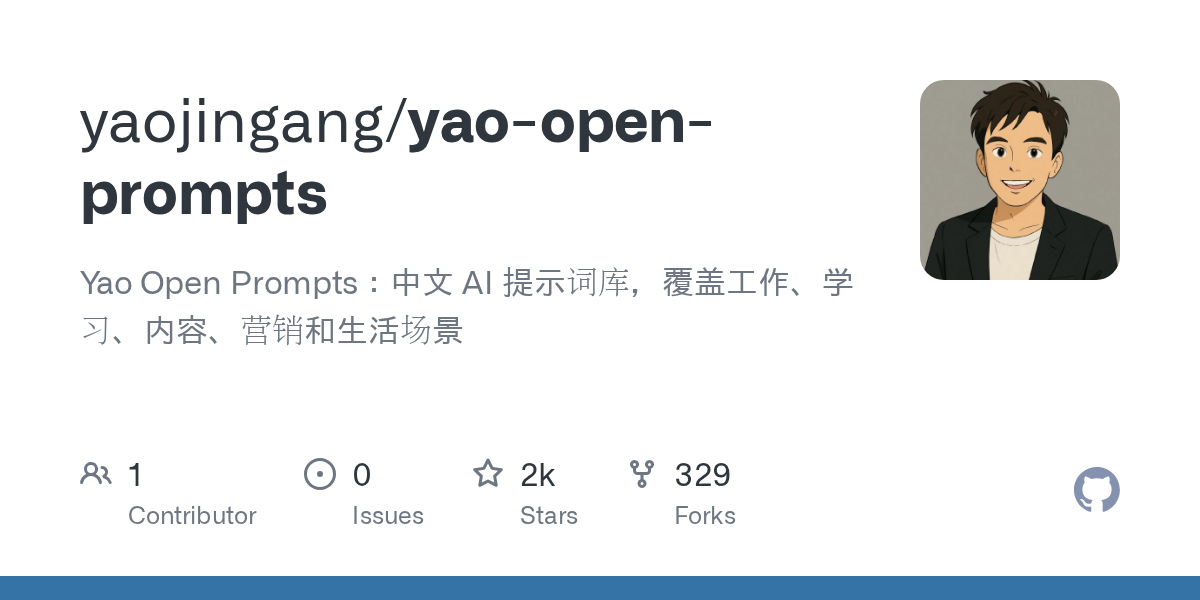
Finding high-quality Chinese AI prompts for real work tasks is harder than it should be. Most prompt collections online are either too generic, buried in tutorial content, or scattered across dozens of short social media posts. If you need something specific—like a contract generation prompt, a product prototype framework, or a GEO marketing template—you often have to build it yourself. Yao Open Prompts tackles this by organizing 117 production-ready Chinese prompts into a single, searchable library organized by actual use cases.
The approach here is straightforward: prompts are grouped by scenario rather than by technique. The maintainer extracted these prompts from a larger collection called "姚金刚提示词合集" and reorganized them around real workflows. Each prompt lives in its own Markdown file with frontmatter metadata—title, category, subcategory, author, version, and status tags. This structure makes it easier to find what you need and easier to maintain over time.
Several design choices stand out. Series content gets merged into thematic collections instead of scattered across individual files—so "50个 Nano Banana 创意提示词" stays as one file rather than fifty. The project maintains a complete English mirror with 117 translated prompts, which matters if you work across languages. There's also a clear licensing strategy: CC BY 4.0 for the prompt content itself, with third-party content first placed in a references folder until authorization is confirmed. Python scripts handle catalog generation and quality checks, which keeps the repository organized as it grows.
What you actually get is a library spanning nine categories. The largest is AI内容 (AI Content) with 50 prompts covering writing, social media, video scripts, and presentation design. AI营销 (AI Marketing) has 28 prompts focused on GEO, structured data, and growth analysis. AI学习 (AI Learning) offers 11 prompts for study methods, Feynman questioning techniques, and memory training. AI工作 (AI Work) provides 10 prompts for business scenarios including contract generation, sales, customer service, and product prototyping. The remaining categories are smaller but targeted: AI方法 (8 prompts on meta-prompting and reverse engineering), AI教育 (4 for children's education), AI生活 (2 for personal scenarios), AI编程 (1 for architecture), and AI思考 (3 for critical thinking).
Two featured prompts worth noting: the RTF Meta Prompt System V0.6 builds a reusable workflow for generating high-quality prompts using the RTF framework (Role, Task, Format). The Wide Knowledge Infographic Generator transforms text into visual infographics optimized for social media and presentations.
What it doesn't do is just as important. This is a prompt library, not a tool or API—you copy the text and paste it into whatever AI model you're using. There's no built-in evaluation system to measure prompt effectiveness, no community voting or rating mechanism, and no automatic integration with specific AI platforms. The content skews heavily toward Chinese-language use cases, so English-dominant users may find less immediate value unless they specifically need Chinese-language outputs. The maintainers also note that tutorial content, screenshots, and video references were intentionally removed from the prompt files themselves—those live in separate reference directories if needed.
Trying it out is simple. You browse the catalog, pick a prompt that matches your scenario, copy the text, replace the placeholder variables with your own information, and test it in your model. No installation required. The README has the full usage workflow and catalog link.
This fits if you need ready-to-use Chinese prompts for business, marketing, or content work and prefer browsing a structured library over piecing together prompts from social media. If you need integrated tools, multilingual coverage, or automated prompt testing, you'd look elsewhere. The source is on GitHub with a live navigation site at the project website.
Comments