中文 · English ↓
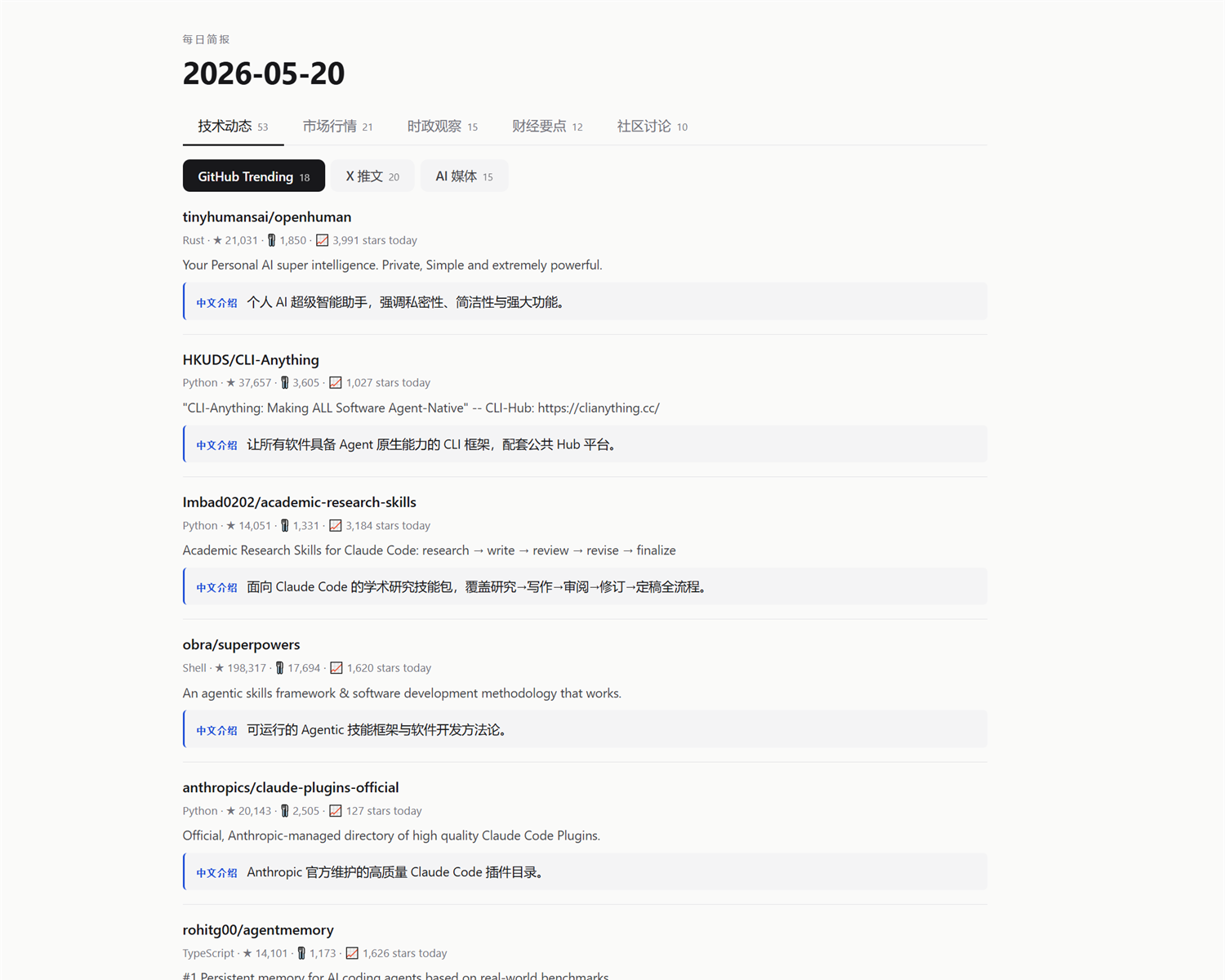
你的私人 AI 每日简报,跑在你自己掌控的基础设施上。 23 个数据源 · LLM 摘要 · 21 个股票/加密标的技术指标 + AI 交易点评 · 中英双语 · 5 个 LLM 后端可选。
三种部署任选:🚀 5 分钟 Fork 到 GitHub Actions · 💻 本地一键装 · 🤖 一句话让 AI Agent 帮你装。
🌐 Live demos — 📰 leiting-eric.github.io/DailyBrief(A 方式 · GitHub Actions + Pages) · 📰 daily.leiting.tech(B 方式 · 本地服务器部署)
✨ 核心特性
- 🌍 全网多源聚合:23 个数据源覆盖硅谷科技、AI 前沿、全球财经、国际时政、中文社区,一份报告通吃
- 📈 21 个标的实时行情:美股 / 加密 / 港股 / 商品外汇 / 宏观信号,附 SMA / RSI / MACD 技术指标 + LLM 每日交易点评
- 🤖 5 个 LLM 后端可插拔:Claude CLI / Anthropic / OpenAI / DeepSeek / MiniMax,一个环境变量切换,不绑死任何家
- 🌐 中英双语:
REPORT_LOCALE=en一切——数据源、prompt、UI 文案、Bullish/Bearish stance 全套切英文 - 🚀 部署灵活:GitHub Actions(零基础设施)/ 本地系统调度器 / 自托管服务器三选一,互不冲突可并存
- 🆓 数据源零 API key:所有源走免费公开端点(RSS / 公开 JSON),不需要付费订阅
- 🔒 不绑定第三方阅读服务:Feedly / Inoreader / Pocket 那些都不沾,你看了什么是你自己的事
- 📁 单文件 HTML:CSS + JS 全内联,无外部依赖,scp 上服务器直接当首页
📚 信源图谱
23 个数据源(zh 模式)/ 22 个(en 模式),分布如下:
🧑💻 技术动态
- GitHub Trending · 热榜每日刷新
- AI 媒体(merged):OpenAI / DeepMind / Hugging Face Blog / TLDR AI / Smol AI / Latent Space / MIT Tech Review
- X 推文(attentionvc-ai):精选 AI 圈大佬动态
📈 市场行情(非新闻源,21 个标的)
- 美股 / ETF:SPY / QQQ / AAPL / MSFT / NVDA / GOOGL / TSLA / META
- 加密:BTC / ETH / SOL(附 alt.me 加密恐慌贪婪指数 + CoinGecko 总览)
- 中港:BABA / PDD / JD / 0700.HK
- 商品外汇:GC=F(黄金)/ CL=F(WTI 原油)/ USDCNY=X
- 宏观信号:^VIX / ^TNX(10Y 美债)/ DXY(美元指数)
🌍 时政观察
BBC / Guardian / NYT / NPR / DW 中文 / Al Jazeera / The Diplomat — 7 家主流国际媒体的 World 频道
💰 财经要点
Bloomberg / WSJ / FT / BBC Business / Economist — 5 家全球财经主力
💬 社区讨论
- zh 模式:V2EX 热榜 / LinuxDo 热帖
- en 模式:Hacker News / Reddit r/stocks(自动替换上面两个)
完整列表 + 启用状态:
npm run sources查看;改源 → 编辑sources.config.json。
🚀 三种部署方式选一种
| 方式 | 适合谁 | 你需要 | 几分钟搞定 |
|---|---|---|---|
| A. GitHub Actions + Pages | 没服务器、不想常开电脑 | 一个 API key(Anthropic / OpenAI / DeepSeek / MiniMax 任一) | ~5 分钟(推荐) |
| B. 本地一键装 | 有常开的电脑/服务器、想极致便宜 | Node 20+,可选 Claude Code 登录 | ~3 分钟 |
| C. 给 AI Agent 一句话 | 懒、想让 Cursor / Codex / Claude Code 帮你装 | 同上 | 一句话 |
A. GitHub Actions + Pages(零基础设施,推荐)
Fork 这个 repo(GitHub 右上角 Fork 按钮)
进 Fork 的 repo → Settings → Actions → General → Workflow permissions 设为 Read and write permissions
Settings → Pages → Build and deployment → Source 选 "Deploy from a branch",分支
gh-pages/ 路径/ (root)(第一次跑完才会出现 gh-pages 分支,先建 secret 再触发一次即可)🔑 配置 LLM 后端 —— 这步是关键。每个后端都要一个 secret + 对应的
LLM_BACKENDvariable(不只是 secret),按下表对照填:⚠️ 最常踩的坑:只加了 secret(比如
DEEPSEEK_API_KEY)忘了加LLM_BACKENDvariable —— workflow 默认LLM_BACKEND=anthropic,所以无论你填的是哪家的 key,运行时都会报ANTHROPIC_API_KEY required。两个都要加。你想用 Secrets 标签加 Variables 标签加 LLM_BACKEND大致成本 🟣 Anthropic Sonnet(默认,prompt 按 Sonnet 调优) ANTHROPIC_API_KEY不填或填 anthropic~$0.03-0.05 / 天,月 < $2 🐋 DeepSeek(便宜大碗,中文友好) DEEPSEEK_API_KEYdeepseek~$0.01-0.02 / 天,月 < $1 🟢 OpenAI OPENAI_API_KEYopenaigpt-4o-mini ~$0.02 / 天 🔵 MiniMax MINIMAX_API_KEYminimax类似 DeepSeek 量级 🌀 中转站 / 反代 / 其他 OpenAI 兼容服务(Moonshot / SiliconFlow / OpenRouter / 自建 Claude 反代 / 本地 Ollama / LM Studio 等) LLM_API_KEYopenai(极少数 Anthropic 协议反代填anthropic)看服务方定价 位置:Settings → Secrets and variables → Actions,左边切换 Secrets / Variables 两个标签。
🌀 选了最后��行"中转站"的额外步骤:Variables 还要加
LLM_BASE_URL(中转站给的 endpoint,如https://api.moonshot.cn/v1)和LLM_MODEL(如moonshot-v1-8k)。不确定协议?默认LLM_BACKEND=openai覆盖 95% 中转站;如果跑挂报 404 / 协议错误再改成anthropic。(可选)同页 Variables 再加:
LLM_MODEL—— 覆盖该 backend 的默认模型(不填用.env.example里列的默认)LLM_BASE_URL—— 自定义 endpoint。选了上面"中转站"那行的话必填;本地 Ollama 填http://localhost:11434/v1、LM Studio 填http://localhost:1234/v1REPORT_LOCALE——zh(默认)或en,控制数据源 + UI + prompt 全套切英文REPORT_TZ—— IANA 时区名(默认 UTC),例Asia/Shanghai/America/Los_Angeles。同时影响触发时间和日期标签REPORT_HOUR—— 触发的小时(基于REPORT_TZ),默认8(早 8 点)。逗号分隔可多次触发,如8,18= 早 8 + 晚 6REPORT_DAYS—— 触发的星期(cron 风格,0=周日 ...6=周六),默认*(每天)。例1-5= 工作日;1,3,5= 周一三五
Actions 标签 → 选 "Daily Brief" workflow → Run workflow 手动触发一次
跑完后报告在 https://<你的用户名>.github.io/<repo-名字>/���之后默认每天 REPORT_TZ 时区的 08:00 自动更新(不设 REPORT_TZ 就是 UTC 08:00)。
⏰ 触发机制:GitHub Actions 的 cron 只接受 UTC,所以工作流 cron 设置为每小时跑一次,里面有一个
gate任务用REPORT_TZ把当前小时和REPORT_HOUR/REPORT_DAYS对照——匹配才往下跑 build,否则秒退。这样不论你在哪个时区都能精准命中本地时间,夏令时也自动跟着切换(IANA 时区数据库内置)。
常用 schedule 配方:
| 想要 | REPORT_HOUR |
REPORT_DAYS |
|---|---|---|
| 每天 08:00(默认) | 不填或 8 |
不填或 * |
| 每天早晚两次(8 + 18 点) | 8,18 |
* |
| 工作日 09:00 | 9 |
1-5 |
| 周一/三/五 早 7 晚 9 两次 | 7,21 |
1,3,5 |
| 每 6 小时一次 | 0,6,12,18 |
* |
只想要默认每天 08:00 本地时间,只填 REPORT_TZ 一个变量就够了(如 Asia/Shanghai),其他全部留空。
💸 成本估算:GitHub Actions 公开 repo 完全免费。Pages 公开 repo 也免费。唯一花钱的就是 LLM API 调用——DeepSeek 月成本不到 $1,Anthropic Sonnet < $2。
⚠️ 用 GH Actions 模式就意味着用不了本地
claudeCLI——Claude Code 的 OAuth 登录在你本机,GitHub 的服务器看不到。如果你已经在 Max 订阅里,建议两���路并行:本地装(B 方式)用 Claude CLI 跑你自己的服务器版本,GH Actions 用 DeepSeek 跑 Pages 公开版本。两份报告独立,互不影响。
🐛 A 方式常见坑
"Upgrade or make this repository public to enable Pages" —— GitHub Pages 在 Free 账户的 Private repo 上不可用。Settings → General → Danger Zone → Change visibility 改 Public。Actions Secrets 在 Public repo 里依然加密保护,对其他人不可见
Variable name 报 "alphanumeric only" —— 输入
LLM_BACKEND时下划线被中文输入法替换成了全角_(U+FF3F)。切到英文输入法 Shift+-重打第一次跑完才能选 Pages source —— Pages 设置页要求选已存在的分支,但
gh-pages是首次 workflow 跑成功后才创建出来。顺序:配 secret → 触发 workflow → 跑完 → 回 Settings → Pages 选gh-pagesAction 红 X 怎么看具体原因 —— 点失败的 build → 左边列出每个 step → 找有红 X 的那步点开看 log。最常见两类:
401/402= API key 拼错或没余额;403= workflow permissions 没设成 Read and write报错
ANTHROPIC_API_KEY (or generic LLM_API_KEY) is required,但我填的是别家的 key —— 经典 secret/variable 不配对。Workflow 默认LLM_BACKEND=anthropic,光填DEEPSEEK_API_KEY/OPENAI_API_KEY不够,必须同时去 Variables 标签加LLM_BACKEND=deepseek/openai。从 v1.x 起启动期会直接告诉你哪个 key 已设、应该把LLM_BACKEND改成什么配齐了 secret + variable 还是报同样的错 —— 99% 是配置放错了作用域。GitHub 上有两个长得几乎一样的页面:
- ✅ Settings → Secrets and variables → Actions(页眉是 "Repository secrets" / "Repository variables")—— 本项目默认走这里
- ⚠️ Settings → Environments → <某个 environment>(页眉是 "Environment secrets" / "Environment variables")—— 这里的值只有当 workflow job 显式声明了
environment: <name>才会注入;本项目默认 workflow 没声明,所以放这里运行时拿不到
排查方法:进配置页面看页眉。如果写的是 "Environment ..." 你有两种修法任选其一:
- 简单做法(推荐):把所有 secret 和 variable 从 Environment scope 移到 Repository scope(路径:Settings 左栏 → "Secrets and variables → Actions",注意不要从 "Environments" 进),workflow 不用改。特别提醒:secret(如
DEEPSEEK_API_KEY/ANTHROPIC_API_KEY)因为隐藏了值,最容易被忘掉只搬 variable 不搬 secret,导致换了个新错误("key 未设置")。两边都要搬完整 - 保留 Environment 的做法:编辑
.github/workflows/daily.yml,在gate和build两个 job 各加一行environment: <你的环境名>(两个都要加,因为gate也读vars.REPORT_TZ等变量),名字必须跟 Settings → Environments 里建的一字不差。适合想用 environment 做审批门禁 / branch 限制的人
跑了 30 秒就挂(其他情况) —— LLM API 返 400 / key 没余额 / 配额耗尽。看 step "Generate today's report" 的 log
B. 本地一键装
# Linux / macOS
curl -sSL https://raw.githubusercontent.com/leiting-eric/DailyBrief/main/bootstrap.mjs | node

# Windows PowerShell
irm https://raw.githubusercontent.com/leiting-eric/DailyBrief/main/bootstrap.mjs | node -
这条命令会自动:
- 检查 Node / git / claude CLI 是否就位(没装 claude CLI 只发警告,可继续走 API 后端)
git clone到~/daily-brief(Windows:%USERPROFILE%\daily-brief)npm install- 注册系统定时(Windows Task Scheduler / macOS launchd / Linux cron,默认 08:00 本地时间)
- 写
~/.daily-brief-config记录项目路径 - 在
~/.claude/建符号链接让 Claude Code 的 skill 和 slash command 全局可用 - 跑一次
npm run dry-run烟测
🎁 Claude Code 用户额外福利:装完后任意目录都能 /run-daily、/check-daily,描述问题("日报又挂了")也能触发 daily-brief skill 自动加载。其他 agent(Cursor / Codex)没有 skill 加载机制,但定时任务跑得起来。手动触发用:
| 平台 | 手动触发 |
|---|---|
| Windows | Start-ScheduledTask -TaskName DailyBrief |
| macOS | launchctl start com.daily-brief |
| Linux | node scripts/run-daily.mjs(cron 不支持手动触发) |
自定义路径 / 触发时间:
node bootstrap.mjs --target /custom/path --at 07:30
LLM 后端:默认走本地 claude CLI(首次需在浏览器登录一次:echo "hi" | claude --print --model sonnet,登录后永久生效)。不用 Claude Code,或想换模型 / 换家 / 接中转,都在 .env.local 里改 —— 完整可复制的配置示例见下方 🤖 LLM 后端配置。
C. 给 AI Agent 一句话装
无论你用哪个 AI Agent(Claude Code / Cursor / Codex / Continue.dev / OpenClaw 等),把下面这段发给它:
帮我装这个开源项目,按 README 的"本地一键装"流程跑 bootstrap,完成后告诉我下次自动触发的时间: https://github.com/leiting-eric/DailyBrief
项目里有 AGENTS.md(通用 agent 协议)+ .claude/skills/daily-brief/SKILL.md(Claude Code 专属,更详细),Agent 装���后能直接帮你诊断"今天报告没出来"、"加个新数据源"这类问题。
📋 前置要求
- Node.js 20+ + npm + git(B/C 方式本地需要;A 方式不需要——GH Actions 容器自带)
- 一个能跑的 LLM(任选其一):Claude Code CLI 已登录 / Anthropic / OpenAI / DeepSeek / MiniMax 任一家的 API key
- 平台:Windows 10/11、macOS 12+、Linux(任一平台都支持,定时机制自动适配)
🔧 手动安装
# 1. clone + 依赖
git clone https://github.com/leiting-eric/DailyBrief.git
cd DailyBrief
npm install

# 2. 配置 LLM 后端
#    默认 claude CLI(如果没登录会引导你登录):
echo "say hi in Chinese" | claude --print --model sonnet
#    或用其他 backend:cp .env.example .env.local 编辑 LLM_BACKEND 和对应 API key

# 3. 注册定时 + 启用全局 skill
node scripts/install.mjs --global
# 也可指定时间:node scripts/install.mjs --at 07:30 --global

# 4. 立即触发一次测试
# Windows:  Start-ScheduledTask -TaskName DailyBrief
# macOS:    launchctl start com.daily-brief
# Linux:    node scripts/run-daily.mjs
下次触发时机:
- 🪟 Windows — 系统会自动唤醒电脑(如在睡眠),跑完再回睡
- 🍎 macOS — launchd 不会主动唤醒,电脑睡着的话跳过这次(需要
pmset wake schedule���合) - 🐧 Linux — cron 同理,挂起期间不跑
🛠️ 日常命令
| 命令 | 用途 | 耗时 |
|---|---|---|
npm run daily |
手动完整跑一次 | 5-8 min |
npm run dry-run |
只抓取不调 LLM,验证数据源 | ~30s |
npm run render [date] |
改了 CSS/排版后重渲染 | <1s |
npm run regen-trading [date] |
重做交易部分 | ~2 min |
npm run regen-enrich <cat:sub> [date] |
补缺失的中文摘要 | ~30s |
npm run open |
在 Chrome 打开今日报告 | 即时 |
npm run quota-report |
看各 LLM backend 用量统计 | 即时 |
npm run sources |
列出所有数据源(按 locale 标注启用/过滤状态) | 即时 |
npm run sources:check |
仅校验 sources.config.json schema(适合 CI / pre-commit) |
即时 |
📊 数据源配置
数据源以 JSON 数组形式集中存储在项目根的 sources.config.json —— 唯一配置入口,不需要改 TypeScript 代码即可加/禁/调整源。每条记录的字段:
| 字段 | 必填 | 说明 |
|---|---|---|
id |
✓ | 全局唯一短标识(dispatch.ts 用 id 路由到对应 fetcher) |
name |
✓ | UI 显示名 |
type |
✓ | rss / api / scrape |
url |
✓ | RSS feed 或 API endpoint |
category |
✓ | tech / finance / politics,决定 L1 tab |
subcategory |
tech 下的 L2 分组(github-trending / ai-news / x-viral / cn-community);finance 下统一 news |
|
enabled |
默认 true,设 false 跳过抓取(保留记录便于回滚) |
|
useCurl |
若该源被 Cloudflare TLS-fingerprint 拦了 Node undici,设 true 让 rss.ts 走 curl 子进程 |
|
lang |
zh 表示源内容是中文 — enrich 阶段会跳过它(无需把中文翻译成中文) |
|
locales |
数组,标明该源出现在哪些 report locale 下。默认 ["zh", "en"] |
|
notes |
任意备注(如"被废弃因为 feed 死了"),运行时忽略 |
加一个 RSS 源
- 编辑
sources.config.json,追加一条记录 - 跑
npm run sources:check校验 schema npm run dry-run抓一次验证拉取正常- 下次
npm run daily自动包含
🌐 Locale 模式(zh / en)
通过 REPORT_LOCALE 环境变量切换:
# .env.local
REPORT_LOCALE=zh    # 默认 — 中文 mode,含 V2EX / LinuxDo / DW 中文等中文源
# REPORT_LOCALE=en  # 英文 mode — 自动过滤掉 zh-only 源,挂上 en-only 源
每个源在 JSON 里的 locales 字段决定它在哪些模式下出现:
["zh"]— 仅中文 mode(V2EX / LinuxDo / DW 中文)。英文用户读不懂,英文 mode 自动 drop["en"]— 仅英文 mode(Hacker News / r/stocks 英文社区源,替代中文社区源)。zh mode 不显示["zh", "en"](默认)— 两 mode 都参与(BBC / Bloomberg / WSJ / NYT 全球英文源 + AI 资讯源)
当前启用源(enabled: true)按 locale 分布:
| Locale | 启用源数 | 主要构成 |
|---|---|---|
zh |
23 | 20 个全球英文源(附中文摘要)+ 3 个中文专属(V2EX / LinuxDo / DW 中文) |
en |
22 | 20 个全球英文源 + 2 个英文社区(Hacker News + r/stocks) |
英文 mode 完整切换:HTML UI 文案、enrichment / digest / trading-commentary 三套 prompt、stance 词("偏上行/偏下行/中性" → Bullish/Bearish/Neutral)、日期格式(zh-CN → en-GB)、Markdown 输出 —— 全部跟着 REPORT_LOCALE 切。中文社区源在英文 mode 下被自动过滤掉。
🤖 LLM 后端配置
项目通过 LLM_BACKEND 环境变量切换后端。默认 claude-cli —— 直接复用 Claude Code 已登录的认证,不需要额外配 API key。不用 Claude Code、或想走自己的 API key,按下表切换。
配置文件在哪
本地安装:所有 LLM 配置都在仓库根目录的 .env.local(被 gitignore 了,安全存 key)。第一次没有这个文件就 cp .env.example .env.local,编辑器打开按 backend 解开对应几行即可。改完保存就生效,不用���启 shell —— 所有入口脚本(npm run daily / regen-trading / regen-enrich)第一行都会 dotenv 预加载它。
GitHub Actions 部署:不需要 .env.local,改成在 Settings → Secrets and variables → Actions 里加(见上面 A 方式 第 4 步)。
支持的 backend
| backend | API key 环境变量 | 默认 model | base URL |
|---|---|---|---|
🎯 claude-cli (默认) |
不需要,复用 Claude Code OAuth | sonnet |
— |
🟣 anthropic |
ANTHROPIC_API_KEY |
claude-sonnet-4-6 |
api.anthropic.com |
🟢 openai |
OPENAI_API_KEY |
gpt-4o-mini |
api.openai.com/v1 |
🐋 deepseek |
DEEPSEEK_API_KEY |
deepseek-v4-flash |
api.deepseek.com/v1 |
🔵 minimax |
MINIMAX_API_KEY |
MiniMax-M2.7 |
api.minimax.io/v1 1 |
1 中国大陆访问设 MINIMAX_BASE_URL=https://api.minimaxi.com/v1。
本地 .env.local 最小配置示例(任选一组复制走)
# 默认:复用本机 claude CLI(Max 订阅最划算)
#   什么都不用填,留空 .env.local 即可

# Anthropic API
LLM_BACKEND=anthropic
ANTHROPIC_API_KEY=sk-ant-...
# LLM_MODEL=claude-sonnet-4-6        # 可选,默认即此

# DeepSeek(便宜,中文友好)
LLM_BACKEND=deepseek
DEEPSEEK_API_KEY=sk-...
# LLM_MODEL=deepseek-v4-flash        # 可选

# OpenAI
LLM_BACKEND=openai
OPENAI_API_KEY=sk-...
# LLM_MODEL=gpt-4o-mini              # 可选;想用更大模型填 gpt-4o / gpt-4.1 等

# MiniMax
LLM_BACKEND=minimax
MINIMAX_API_KEY=...
# MINIMAX_BASE_URL=https://api.minimaxi.com/v1   # 国内访问用这条

# 中转 / 反代 / OpenAI 兼容服务(Moonshot / SiliconFlow / OpenRouter / Ollama / LM Studio …)
LLM_BACKEND=openai                   # 协议是 openai 兼容就填 openai
LLM_API_KEY=<中转给的 key>
LLM_BASE_URL=https://api.moonshot.cn/v1
LLM_MODEL=moonshot-v1-8k             # 中转/自托管必须显式指定 model

# Anthropic 协议反代(claude-relay 之类)
LLM_BACKEND=anthropic
ANTHROPIC_API_KEY=<反代 key>           # 也可写成 LLM_API_KEY
ANTHROPIC_BASE_URL=https://你的反代/    # 也可写成 LLM_BASE_URL
通用覆盖项
LLM_MODEL=<id>—— 任意 backend 的 model 都能用这个变量覆盖默认(如LLM_MODEL=gpt-4o走 openai 的更大模型)<BACKEND>_BASE_URL—— 走自托管代理 / 兼容服务(如 LM Studio / Ollama 跑 OpenAI 兼容接口 →LLM_BACKEND=openai+OPENAI_BASE_URL=http://localhost:1234/v1)LLM_API_KEY/LLM_BASE_URL—— 通用别名,专用变量没设时 fallback 到这里。用 Moonshot / SiliconFlow / OpenRouter / 自建反代等非预设服务时推荐用���对,避免OPENAI_API_KEY这样的语义错位
验证配置是否对
改完 .env.local 不想等 5-8 分钟的完整 daily 跑完才知道 key 通不通?跑这个 ~30 秒、只用 1 次 LLM 调用的小指令:
npm run regen-enrich -- finance:news
通了会看到 [regen-enrich] enrichment done in 28s, matched 12/12;不通会在 1 秒内被启动校验拦下并告诉你具体怎么修(哪个 key 没填 / LLM_BACKEND 该写啥)。
怎么选
| 你的情况 | 推荐 backend |
|---|---|
| 已经在用 Claude Code(任意订阅等级) | claude-cli — 零配置,按你订阅的等级走 |
| 不用 Claude Code,只想低成本跑日报 | openai 配 gpt-4o-mini、或 deepseek 配 deepseek-v4-flash(更便宜) |
| 中文摘要质量优先,预算可放宽 | anthropic 配 claude-sonnet-4-6 |
| 国内网络访问,要规避 GFW | deepseek 或 minimax(都是国内厂商) |
切 backend 不需要改代码:所有 prompt 都在 lib/ai/prompts.ts 抽离,跟 backend 无关;JSON 错误兜底(jsonrepair)也是 backend-agnostic。切完后跑一次 npm run daily,进 logs/llm-calls.jsonl 看新 backend 的调用记录。
🌐 自托管部署(可选)
每次 npm run daily 跑完,自动把新 HTML 推到自己的服务器,访客打开 https://your-domain/ 就能看到当天最新报告。默认不启用,环境变量不设就跳过。
一次性服务器准备
假设服务器跑 Ubuntu + nginx + 已申请域名,登录用户有 sudo NOPASSWD:
# 服务器上
sudo mkdir -p /var/www/your-domain && sudo chown -R www-data:www-data /var/www/your-domain
/etc/nginx/sites-available/your-domain.conf:
server {
    listen 80;
    server_name your-domain;
    root /var/www/your-domain;
    index index.html;
    location / { try_files $uri $uri/ =404; }
}
启用 + 自动签 SSL:
sudo ln -s /etc/nginx/sites-available/your-domain.conf /etc/nginx/sites-enabled/
sudo nginx -t && sudo systemctl reload nginx
sudo certbot --nginx -d your-domain --agree-tos --redirect
本地启用 auto-deploy
.env.local(gitignored)加两行:
DEPLOY_HOST=user@your-server-ip
DEPLOY_PATH=/var/www/your-domain
之后:
- ✅ 每次
npm run daily跑完,自动 scp 当天 HTML 到服务器 + 刷新index.html - ✅
npm run deploy [YYYY-MM-DD]手动推任意一天 - ✅ 部署失败不阻断 daily 本身(HTML 已经在本地
daily_reports/落盘,可重跑npm run deploy补推)
💡 Claude Code 集成
装好后任意目录(不必 cd 进项目)打开 Claude Code 都可用:
| 触发 | 行为 |
|---|---|
/run-daily |
立即触发 daily 并后台监听到完成。从任意目录都行 |
/check-daily |
查任务状态 + 报告文件 + 配额 |
| 描述问题("日报又挂了"、"X 推文为啥没更新"等) | daily-brief skill 的关键词触发自动加载,让 Claude 直接懂这个项目 |
实现机制:scripts/install.mjs --global 在 ~/.claude/ 下建符号链接,指向项目内的 .claude/skills/daily-brief/SKILL.md 和 .claude/commands/ 文件——单一源,编辑项目文件等于编辑用户级 skill。当 symlink 因权限受限失败时(如 Windows 无开发者模式),自动 fallback 到 copy。~/.daily-brief-config 记录项目实际路径,让 slash command 在任意 cwd 都能找到项目。
📁 项目结构
daily-brief/
├── lib/
│   ├── sources/        # RSS / API / curl 抓取器;新加源在这里
│   ├── ai/             # 可插拔 LLM 后端 + 提示词(lib/ai/backends/ 下每个 backend)
│   ├── trading/        # Yahoo Finance + 技术指标
│   ├── output/         # 渲染层 (HTML / Markdown)
│   └── utils.ts        # 小工具(todayKey / getReportTz)
├── scripts/
│   ├── _env.ts         # dotenv 预加载(被所有入口脚本第一个 import)
│   ├── daily.ts        # 主管线
│   ├── dry-run.ts      # 只抓取不调 LLM,验证数据源
│   ├── render.ts       # 重渲染
│   ├── regen-*.ts      # 局部重跑(trading / enrich)
│   ├── quota-report.ts # LLM 用量统计
│   ├── sources.ts      # `npm run sources` — 列源 + 校验 JSON
│   ├── run-daily.mjs   # OS 调度器调用的包装(含自动 deploy + open)
│   ├── open-report.mjs # 打开最新报告(跨平台)
│   ├── build-site.mjs  # 生成 GH Pages 静态站 (index + archive)
│   ├── deploy.mjs      # scp 到远端 nginx 服务器(可选)
│   ├── install.mjs     # 注册定时任务(Win/Mac/Linux 自适应)
│   └── uninstall.mjs   # 卸载
├── sources.config.json # 数据源唯一配置入口
├── daily_reports/      # 输出 (gitignored)
│   └── 2026-05-15/     # 每日一个子目录,内含 .html (主) / .json (缓存) / -articles.json (缓存)
│                       #   .md 默认不生成,可在 .env.local 设 OUTPUT_MARKDOWN=true 开启
├── logs/               # 运行日志 (gitignored)
├── .github/workflows/  # GitHub Actions 工作流(A 方式部署)
└── .claude/
    ├── skills/         # Claude Code 操作 skill
    └── commands/       # slash commands
🗑️ ��载
node scripts/uninstall.mjs
# 移除:定时任务 (Task Scheduler / launchd / cron) + ~/.claude/ 下的链接 + ~/.daily-brief-config
# 不动:项目文件、daily_reports/、logs/、power plan 设置
# 想彻底清理就 rm -rf 整个项目目录
🛠️ 自定义 / Fork
改源、改时间、改排版、加新栏目 —— 见 FORKING.md。
🙏 致谢
本项目在 LINUX DO 开源社区分享推广,感谢佬友们的反馈与建议。
📝 License
MIT
📰 daily-brief · your own AI-curated daily news brief in 10 minutes
↑ 中文 · English
Your own AI-curated daily news brief, on infrastructure you control. 23 sources · LLM summaries · 21-ticker market panel with SMA/RSI/MACD signals + AI commentary · bilingual (zh/en) · 5 swappable LLM backends.
Three deployment paths, pick one: 🚀 5-min GitHub Actions fork · 💻 local one-liner install · 🤖 have an AI agent install it for you.
🌐 Live demos — 📰 leiting-eric.github.io/DailyBrief (path A · GitHub Actions + Pages) · 📰 daily.leiting.tech (path B · self-hosted server)
✨ Core features
- 🌍 Multi-source aggregation — 23 sources spanning Silicon Valley tech, AI frontier, global finance, international politics, and developer communities. One report covers it all.
- 📈 21 live tickers — US stocks / crypto / HK / commodities / macro signals, with SMA / RSI / MACD indicators + daily LLM-written trading commentary
- 🤖 5 swappable LLM backends — Claude CLI / Anthropic / OpenAI / DeepSeek / MiniMax. One env var to switch, no vendor lock-in.
- 🌐 Bilingual (zh/en) — set
REPORT_LOCALE=ento flip the entire stack: sources, prompts, UI text, Bullish/Bearish stance labels — all switch. - 🚀 Flexible deployment — GitHub Actions (zero infra) / local OS scheduler / self-hosted server — pick one or run them in parallel
- 🆓 Zero data-source API keys — every source uses free public endpoints (RSS / public JSON), no paid subscriptions
- 🔒 No third-party reader lock-in — Feedly / Inoreader / Pocket all profile your reading; this project never talks to them. Your reading habits stay yours.
- 📁 Single-file HTML output — CSS and JS inlined, no external dependencies, scp'able onto a server as
index.html
📚 Source roster
23 sources in zh mode / 22 in en mode, organized as:
🧑💻 Tech
- GitHub Trending · refreshed daily
- AI media (merged): OpenAI / DeepMind / Hugging Face Blog / TLDR AI / Smol AI / Latent Space / MIT Tech Review
- X posts (attentionvc-ai): curated AI thought-leader feed
📈 Markets (21 tickers, not news)
- US stocks / ETFs: SPY / QQQ / AAPL / MSFT / NVDA / GOOGL / TSLA / META
- Crypto: BTC / ETH / SOL (+ alt.me Fear & Greed index + CoinGecko macro)
- China / HK: BABA / PDD / JD / 0700.HK
- Commodities / FX: GC=F (gold) / CL=F (WTI crude) / USDCNY=X
- Macro signals: ^VIX / ^TNX (10Y Treasury) / DXY
🌍 World
BBC / Guardian / NYT / NPR / DW Chinese / Al Jazeera / The Diplomat — 7 major international outlets' World feeds
💰 Finance
Bloomberg / WSJ / FT / BBC Business / Economist — 5 global finance heavyweights
💬 Community
- zh mode: V2EX top threads / LinuxDo trending
- en mode: Hacker News / Reddit r/stocks (auto-substituted)
Full list + enabled status: run
npm run sources. To edit sources, modifysources.config.json.
🚀 Pick one deployment path
| Path | Who it's for | What you need | Setup time |
|---|---|---|---|
| A. GitHub Actions + Pages | No server, don't want to keep a laptop running | One API key (Anthropic / OpenAI / DeepSeek / MiniMax) | ~5 min (recommended) |
| B. Local one-liner | Have an always-on machine; want it cheapest | Node 20+, optionally Claude Code login | ~3 min |
| C. Have an AI agent install it | Lazy; want Cursor / Codex / Claude Code to handle setup | Same as B | One sentence |
A. GitHub Actions + Pages (zero-infra, recommended)
Fork this repo (Fork button, top-right of GitHub)
Settings → Actions → General → Workflow permissions → set to Read and write permissions
Settings → Pages → Build and deployment → Source → "Deploy from a branch" → branch
gh-pages/ path/ (root)(thegh-pagesbranch only exists after the first successful workflow run — configure secrets first, trigger once, then come back)🔑 Configure the LLM backend — this is the critical step. Each backend needs a secret AND the matching
LLM_BACKENDvariable (not just the secret). Pick one row:⚠️ Most common mistake: adding only the secret (e.g.
DEEPSEEK_API_KEY) and forgetting theLLM_BACKENDvariable. The workflow defaultsLLM_BACKENDtoanthropic, so whatever key you set, the run will crash withANTHROPIC_API_KEY required. Both pieces are required.You want Secret to add LLM_BACKENDvariableRough cost 🟣 Anthropic Sonnet (default; prompts tuned for it) ANTHROPIC_API_KEYleave unset or anthropic~$0.03-0.05/day, <$2/month 🐋 DeepSeek (cheap, China-friendly) DEEPSEEK_API_KEYdeepseek~$0.01-0.02/day, <$1/month 🟢 OpenAI OPENAI_API_KEYopenaigpt-4o-mini ~$0.02/day 🔵 MiniMax MINIMAX_API_KEYminimaxSimilar to DeepSeek 🌀 Proxy / aggregator / any OpenAI-compatible service (Moonshot, SiliconFlow, OpenRouter, self-hosted Claude relay, local Ollama / LM Studio, ...) LLM_API_KEYopenai(useanthropiconly if the proxy speaks Anthropic protocol — rare)Depends on provider Location: Settings → Secrets and variables → Actions. The page has two tabs — Secrets for keys, Variables for
LLM_BACKEND.🌀 Extras if you picked the last "proxy" row: also add
LLM_BASE_URL(the endpoint your proxy gave you, e.g.https://api.moonshot.cn/v1) andLLM_MODEL(e.g.moonshot-v1-8k) under Variables. Not sure which protocol? DefaultLLM_BACKEND=openai— covers 95% of proxies; switch toanthropiconly if you get 404s or protocol errors.(Optional) On the same Variables tab, add:
LLM_MODEL— override the backend's default model (otherwise uses the default listed in.env.example)LLM_BASE_URL— custom endpoint. Required if you picked the "proxy" row above. For local Ollama usehttp://localhost:11434/v1, LM Studiohttp://localhost:1234/v1REPORT_LOCALE—zh(default) oren— switches sources + UI + LLM prompts as a setREPORT_TZ— IANA timezone name (default UTC); e.g.Asia/Shanghai/America/Los_Angeles. Drives both the trigger time and the date label.REPORT_HOUR— hour(s) to fire inREPORT_TZ, default8(08:00). Comma-separated for multiple, e.g.8,18= 8 AM and 6 PMREPORT_DAYS— day-of-week filter (cron-style,0=Sunday ...6=Saturday), default*(every day). E.g.1-5= weekdays;1,3,5= Mon/Wed/Fri
Actions tab → "Daily Brief" workflow → Run workflow to trigger manually for the first time
Once the workflow turns green, your report lives at https://<your-username>.github.io/<repo-name>/. After that, it refreshes daily at 08:00 in REPORT_TZ (or 08:00 UTC if REPORT_TZ is unset).
⏰ How the schedule works: GitHub Actions cron is UTC-only, so the workflow runs hourly and uses a
gatejob to check if the current hour inREPORT_TZmatchesREPORT_HOUR/REPORT_DAYS. If so, the build job proceeds; otherwise it exits in seconds. This lets the schedule track any local timezone precisely, and handles DST transitions automatically (via the IANA tz database).
Common schedule recipes:
| You want | REPORT_HOUR |
REPORT_DAYS |
|---|---|---|
| Every day at 08:00 (default) | unset or 8 |
unset or * |
| Twice daily (8 AM + 6 PM) | 8,18 |
* |
| Weekdays at 09:00 | 9 |
1-5 |
| Mon/Wed/Fri at 7 AM + 9 PM | 7,21 |
1,3,5 |
| Every 6 hours | 0,6,12,18 |
* |
If you just want the default (08:00 local daily), set only REPORT_TZ (e.g. Asia/Shanghai) and leave the rest at defaults.
💸 Cost summary: GitHub Actions on public repos is free. Pages on public repos is free. The only thing you pay for is LLM API calls — DeepSeek runs under $1/month, Anthropic Sonnet under $2.
⚠️ GH Actions mode can't reuse a local
claudeCLI login — your Claude Code OAuth token lives on your machine, GitHub's runners can't see it. If you have a Max subscription, run both paths side by side: path B locally (uses Claude CLI), path A on GitHub Actions (uses DeepSeek). Independent reports, no interference.
🐛 Common gotchas
"Upgrade or make this repository public to enable Pages" — Free-tier GitHub Pages requires a public repo. Settings → General → Danger Zone → Change visibility → Public. Your Actions Secrets remain encrypted and invisible to others even on public repos.
"Variable name can only contain alphanumeric characters" — most likely the underscore in
LLM_BACKENDgot autocorrected by a CJK input method to a full-width_(U+FF3F). Switch to English input, retype Shift+-, or copy-paste.Pages source dropdown doesn't show
gh-pages— that branch only exists after the first successful workflow run. Order: configure secret → trigger workflow → wait for green → go back to Settings → Pages.Where to read a failed run — Actions tab → click the red X → left sidebar lists each step → click the failing one to expand its log. Most common causes:
401/402(API key wrong or out of credit),403(workflow permissions still set to "Read only").Error:
ANTHROPIC_API_KEY (or generic LLM_API_KEY) is required— but I set a different provider's key — classic secret-without-variable mismatch. The workflow defaultsLLM_BACKEND=anthropic; settingDEEPSEEK_API_KEY/OPENAI_API_KEYalone is not enough — you also need to add the matchingLLM_BACKEND=deepseek/openaiunder Variables. As of v1.x the startup check prints exactly which key it found and whichLLM_BACKENDvalue to set.I added both the secret and variable, still the same error — 99% sure your values went into the wrong scope. GitHub has two near-identical-looking pages:
- ✅ Settings → Secrets and variables → Actions (header reads "Repository secrets" / "Repository variables") — this is the default this project uses
- ⚠️ Settings → Environments → <some environment> (header reads "Environment secrets" / "Environment variables") — values here are only injected when a workflow job declares
environment: <name>; the default workflow doesn't, so anything stored here is invisible at runtime
Open your config page and check the section header. If it says "Environment ..." you have two fixes, pick one:
- Simple fix (recommended): move every secret and variable from Environment scope to Repository scope (Settings sidebar → "Secrets and variables → Actions" — don't enter via "Environments"). No workflow edit needed. Watch out: secrets like
DEEPSEEK_API_KEY/ANTHROPIC_API_KEYhide their values, so it's easy to "move" only the visible variables and forget the secrets — then you trade the old error for a new one ("key is not set"). Move both, completely. - Keep-the-environment fix: edit
.github/workflows/daily.ymland addenvironment: <your-env-name>to BOTH thegateandbuildjobs (both, becausegatereadsvars.REPORT_TZetc. too). The name must exactly match the environment you created under Settings → Environments. Useful if you want environment-based approval gates or branch restrictions.
Fails after ~30s (other cases) — LLM API returned 400, the key has no credit, or quota is exhausted. Check the "Generate today's report" step's log.
B. Local one-liner install
# Linux / macOS
curl -sSL https://raw.githubusercontent.com/leiting-eric/DailyBrief/main/bootstrap.mjs | node

# Windows PowerShell
irm https://raw.githubusercontent.com/leiting-eric/DailyBrief/main/bootstrap.mjs | node -
This script will:
- Check that Node / git / claude CLI are on PATH (claude CLI missing is a warning, not an error — you can use an API backend instead)
git cloneto~/daily-brief(Windows:%USERPROFILE%\daily-brief)npm install- Register the OS scheduler (Windows Task Scheduler / macOS launchd / Linux cron, default 08:00 local time)
- Write
~/.daily-brief-configrecording the project path - Symlink the Claude Code skill + slash commands into
~/.claude/so they work from any directory - Run
npm run dry-runas a smoke test
🎁 Claude Code bonus: after install, any Claude Code session anywhere can use /run-daily and /check-daily. Describing a problem in plain English ("today's report didn't come out") also auto-loads the daily-brief skill. Other agents (Cursor / Codex) don't have a skill auto-load mechanism, but the scheduled task still runs at the OS level. Manual triggers:
| Platform | Command |
|---|---|
| Windows | Start-ScheduledTask -TaskName DailyBrief |
| macOS | launchctl start com.daily-brief |
| Linux | node scripts/run-daily.mjs (cron doesn't support manual trigger) |
Custom install path / time:
node bootstrap.mjs --target /custom/path --at 07:30
LLM backend: defaults to the local claude CLI (first time you'll need to log in once in a browser: echo "hi" | claude --print --model sonnet — once is forever). To skip Claude Code, change the model, switch providers, or point at a proxy — edit .env.local. Copy-paste recipes are in 🤖 LLM backend configuration below.
C. Have an AI agent install it for you
Whichever AI agent you use (Claude Code / Cursor / Codex / Continue.dev / OpenClaw / etc.), send it this prompt:
Please install this open-source project following the README's "local one-liner" path with bootstrap, and tell me when the next auto-trigger will fire: https://github.com/leiting-eric/DailyBrief
The repo includes AGENTS.md (universal agent protocol) and .claude/skills/daily-brief/SKILL.md (Claude Code-specific, more detailed). After install, the agent can help diagnose things like "today's report didn't come out" or "add a new source".
📋 Requirements
- Node.js 20+, npm, git (local for paths B/C; path A runs in GitHub's containers — no local install needed)
- One working LLM (any of): Claude Code CLI logged in, OR Anthropic / OpenAI / DeepSeek / MiniMax API key
- Platform: Windows 10/11, macOS 12+, Linux (any platform — scheduler picks the matching mechanism)
🔧 Manual install
# 1. Clone + dependencies
git clone https://github.com/leiting-eric/DailyBrief.git
cd DailyBrief
npm install

# 2. Pick an LLM backend
#    Default = claude CLI (will guide you through login if not done):
echo "say hi" | claude --print --model sonnet
#    Or use a different backend: cp .env.example .env.local
#    and set LLM_BACKEND + the matching API key

# 3. Register the scheduler + enable the global skill
node scripts/install.mjs --global

# 4. Test trigger immediately
# Windows:  Start-ScheduledTask -TaskName DailyBrief
# macOS:    launchctl start com.daily-brief
# Linux:    node scripts/run-daily.mjs
Sleep-wake behavior at next trigger time:
- 🪟 Windows — wakes the computer if asleep, runs, returns to sleep
- 🍎 macOS — launchd doesn't wake from deep sleep; skipped if asleep (configure
pmset wake scheduleseparately if needed) - 🐧 Linux — cron doesn't wake either; skipped if suspended
🛠️ Daily commands
| Command | Purpose | Time |
|---|---|---|
npm run daily |
Full pipeline (fetch + LLM + render) | 5-8 min |
npm run dry-run |
Fetch only, no LLM — validates sources | ~30s |
npm run render [date] |
Re-render HTML after editing CSS/layout | <1s |
npm run regen-trading [date] |
Re-do the trading section only | ~2 min |
npm run regen-enrich <cat:sub> [date] |
Fill in missing summaries for a subgroup | ~30s |
npm run open |
Open today's report in Chrome | instant |
npm run quota-report |
Per-backend LLM usage summary | instant |
npm run sources |
List all sources with locale / enabled status | instant |
npm run sources:check |
Validate sources.config.json schema (good for CI / pre-commit) |
instant |
📊 Source configuration
Sources live as a JSON array in sources.config.json at the project root — the single source of truth. Add / disable / re-categorize feeds without touching TypeScript. Per-entry fields:
| Field | Required | Notes |
|---|---|---|
id |
✓ | Short unique identifier (used by dispatch.ts to route to the right fetcher) |
name |
✓ | Display name in the UI |
type |
✓ | rss / api / scrape |
url |
✓ | RSS feed URL or API endpoint |
category |
✓ | tech / finance / politics — drives the L1 tab |
subcategory |
L2 grouping (github-trending / ai-news / x-viral / cn-community for tech; news for finance) |
|
enabled |
Default true; set to false to skip without deleting the record |
|
useCurl |
true if the source's host blocks Node's TLS fingerprint (Cloudflare); the fetcher will shell out to curl |
|
lang |
zh means the source is already in Chinese — enrich skips it (no need to translate Chinese into Chinese) |
|
locales |
Array listing which REPORT_LOCALE the source appears in. Default ["zh", "en"] |
|
notes |
Free-form (e.g. "removed because feed died"); ignored at runtime |
Adding an RSS source
- Append an entry to
sources.config.json - Run
npm run sources:checkto validate schema npm run dry-runto confirm the fetch works- The next
npm run dailypicks it up automatically
🌐 Locale mode (zh / en)
Switch with the REPORT_LOCALE environment variable:
# .env.local
REPORT_LOCALE=zh    # default — Chinese mode, includes V2EX / LinuxDo / DW Chinese
# REPORT_LOCALE=en  # English mode — drops zh-only sources, picks up en-only ones
Each source's locales field decides which mode it appears in:
["zh"]— zh mode only (V2EX / LinuxDo / DW Chinese). English readers can't read these, so auto-dropped in en mode.["en"]— en mode only (Hacker News / r/stocks etc., picked up to replace Chinese community sources). Not shown in zh mode.["zh", "en"](default) — appears in both modes (BBC / Bloomberg / WSJ / NYT / AI media)
Currently enabled sources by locale:
| Locale | Enabled sources | Mix |
|---|---|---|
zh |
23 | 20 global / English sources (with LLM-generated Chinese summaries) + 3 Chinese-only (V2EX / LinuxDo / DW Chinese) |
en |
22 | 20 global / English sources + 2 English community (Hacker News + r/stocks) |
The full en-mode switch covers: HTML UI text, the three LLM prompt sets (enrichment / digest / trading commentary), stance labels (Bullish/Bearish/Neutral vs. 偏上行/偏下行/中性), date format (zh-CN ↔ en-GB), Markdown output. Chinese community sources are auto-hidden in en mode since the audience can't read them.
🤖 LLM backend configuration
The project switches backends via the LLM_BACKEND environment variable. Default is claude-cli — it reuses your existing Claude Code login, no API key needed. To use your own API key with another provider, set up .env.local:
Where the config lives
Local install: everything goes in .env.local at the repo root (gitignored — safe place for keys). First time? cp .env.example .env.local, open it in your editor, uncomment the rows you need. Changes take effect on next run, no shell restart — every entry script (npm run daily / regen-trading / regen-enrich) dotenv-loads the file on its first line.
GitHub Actions deploy: no .env.local needed — set values under Settings → Secrets and variables → Actions instead (see Path A step 4 above).
Supported backends
| backend | API key env var | Default model | Base URL |
|---|---|---|---|
🎯 claude-cli (default) |
None — reuses Claude Code OAuth | sonnet |
— |
🟣 anthropic |
ANTHROPIC_API_KEY |
claude-sonnet-4-6 |
api.anthropic.com |
🟢 openai |
OPENAI_API_KEY |
gpt-4o-mini |
api.openai.com/v1 |
🐋 deepseek |
DEEPSEEK_API_KEY |
deepseek-v4-flash |
api.deepseek.com/v1 |
🔵 minimax |
MINIMAX_API_KEY |
MiniMax-M2.7 |
api.minimax.io/v1 1 |
1 Inside mainland China, set MINIMAX_BASE_URL=https://api.minimaxi.com/v1.
Minimal .env.local recipes (pick one and copy)
# Default: reuse local claude CLI (best deal if you have a Max subscription)
#   Leave .env.local empty — done.

# Anthropic API
LLM_BACKEND=anthropic
ANTHROPIC_API_KEY=sk-ant-...
# LLM_MODEL=claude-sonnet-4-6           # optional — this is the default

# DeepSeek (cheap, strong on Chinese)
LLM_BACKEND=deepseek
DEEPSEEK_API_KEY=sk-...
# LLM_MODEL=deepseek-v4-flash           # optional

# OpenAI
LLM_BACKEND=openai
OPENAI_API_KEY=sk-...
# LLM_MODEL=gpt-4o-mini                 # optional; use gpt-4o / gpt-4.1 for bigger

# MiniMax
LLM_BACKEND=minimax
MINIMAX_API_KEY=...
# MINIMAX_BASE_URL=https://api.minimaxi.com/v1   # use this from mainland China

# Proxy / aggregator / OpenAI-compatible service (Moonshot / SiliconFlow / OpenRouter / Ollama / LM Studio …)
LLM_BACKEND=openai                       # most proxies speak OpenAI protocol
LLM_API_KEY=<key from your provider>
LLM_BASE_URL=https://api.moonshot.cn/v1
LLM_MODEL=moonshot-v1-8k                 # always explicit for proxies / self-hosted

# Anthropic-protocol relay (claude-relay etc.)
LLM_BACKEND=anthropic
ANTHROPIC_API_KEY=<relay key>            # or use LLM_API_KEY
ANTHROPIC_BASE_URL=https://your-relay/   # or use LLM_BASE_URL
Universal overrides
LLM_MODEL=<id>— works for any backend (e.g.LLM_MODEL=gpt-4oto use OpenAI's bigger model)<BACKEND>_BASE_URL— for self-hosted proxies or OpenAI-compatible services (e.g. LM Studio / Ollama →LLM_BACKEND=openai+OPENAI_BASE_URL=http://localhost:1234/v1)LLM_API_KEY/LLM_BASE_URL— generic aliases, used as fallback when the provider-specific vars aren't set. Use this pair for Moonshot / SiliconFlow / OpenRouter / self-hosted proxies — anything not in the preset list — so you don't have to misuseOPENAI_API_KEYjust to reach a non-OpenAI service
Verify the config is good
Don't want to wait 5-8 min for a full npm run daily just to learn your key is wrong? This 30-second, 1-LLM-call command tells you fast:
npm run regen-enrich -- finance:news
Working: [regen-enrich] enrichment done in 28s, matched 12/12. Broken: the startup check stops it within 1 second and prints exactly what to fix (which key is missing, which LLM_BACKEND value to use).
How to pick
| Your situation | Recommended backend |
|---|---|
| Already using Claude Code (any subscription tier) | claude-cli — zero config, billed against your subscription |
| Not on Claude Code, want it cheapest | openai with gpt-4o-mini, or deepseek (cheaper still) |
| Chinese summary quality matters most | anthropic with claude-sonnet-4-6 |
| Need to bypass China's network restrictions | deepseek or minimax (both are domestic providers) |
Switching backends needs no code changes: all prompts are factored out in lib/ai/prompts.ts independently of any backend; JSON repair fallback (jsonrepair) is backend-agnostic. After switching, run npm run daily once and look at logs/llm-calls.jsonl for the new backend's call log.
🌐 Self-hosted deployment (optional)
After each npm run daily, automatically scp the fresh HTML to your own server; visitors hit https://your-domain/ and see today's report. Disabled by default — leave the env vars unset to skip.
One-time server setup
Assumes Ubuntu + nginx, domain configured, login user has sudo NOPASSWD:
# On the server
sudo mkdir -p /var/www/your-domain && sudo chown -R www-data:www-data /var/www/your-domain
/etc/nginx/sites-available/your-domain.conf:
server {
    listen 80;
    server_name your-domain;
    root /var/www/your-domain;
    index index.html;
    location / { try_files $uri $uri/ =404; }
}
Enable + auto-issue SSL:
sudo ln -s /etc/nginx/sites-available/your-domain.conf /etc/nginx/sites-enabled/
sudo nginx -t && sudo systemctl reload nginx
sudo certbot --nginx -d your-domain --agree-tos --redirect
Enable auto-deploy locally
In .env.local (gitignored), add:
DEPLOY_HOST=user@your-server-ip
DEPLOY_PATH=/var/www/your-domain
Then:
- ✅ Every
npm run dailyauto-scp's the new HTML to the server and refreshesindex.html - ✅
npm run deploy [YYYY-MM-DD]to push any specific date manually - ✅ A deploy failure doesn't break the daily run itself (HTML is already on disk in
daily_reports/;npm run deployretries it)
💡 Claude Code integration
After install, any directory (no need to cd into the project) running Claude Code can use:
| Trigger | Behavior |
|---|---|
/run-daily |
Triggers daily immediately, monitors in the background until done. Works from any directory. |
/check-daily |
Checks task state + report files + quota |
| Describing a problem ("today's report didn't come out", "why didn't X posts update") | Auto-loads the daily-brief skill so Claude understands the project context |
How it works: scripts/install.mjs --global symlinks files in ~/.claude/ pointing at the project's .claude/skills/daily-brief/SKILL.md and .claude/commands/ — single source, editing the project files is editing the user-level skill. If symlinks aren't permitted (Windows without Developer Mode), it falls back to copying. ~/.daily-brief-config records the absolute project path so slash commands find it from any CWD.
📁 Project structure
daily-brief/
├── lib/
│   ├── sources/        # RSS / API / curl fetchers; add new sources here
│   ├── ai/             # Pluggable LLM backends + prompts (lib/ai/backends/ per backend)
│   ├── trading/        # Yahoo Finance + technical indicators
│   ├── output/         # Rendering (HTML / Markdown)
│   └── utils.ts        # Tiny shared helpers (todayKey / getReportTz)
├── scripts/
│   ├── _env.ts         # dotenv preload — imported FIRST by every entry script
│   ├── daily.ts        # Main pipeline
│   ├── dry-run.ts      # Fetch-only validation (no LLM)
│   ├── render.ts       # Re-render from cached data
│   ├── regen-*.ts      # Targeted re-runs (trading / enrich)
│   ├── quota-report.ts # LLM usage stats
│   ├── sources.ts      # `npm run sources` — list + validate sources.config.json
│   ├── run-daily.mjs   # OS scheduler wrapper (daily + log + deploy + open)
│   ├── open-report.mjs # Cross-platform "open latest" helper
│   ├── build-site.mjs  # GH Pages static-site generator (index + archive)
│   ├── deploy.mjs      # scp HTML to a remote nginx host (opt-in)
│   ├── install.mjs     # Cross-platform scheduler registration
│   └── uninstall.mjs   # Removal
├── sources.config.json # Single source of truth for the source registry
├── daily_reports/      # Output (gitignored)
│   └── 2026-05-15/     # One subdir per day, contains .html (main) / .json (cache) / -articles.json (cache)
│                       #   .md not generated by default; set OUTPUT_MARKDOWN=true in .env.local to enable
├── logs/               # Run logs (gitignored)
├── .github/workflows/  # GitHub Actions workflow (path A deployment)
└── .claude/
    ├── skills/         # Claude Code operational skill
    └── commands/       # Slash commands
🗑️ Uninstall
node scripts/uninstall.mjs
# Removes: scheduled task (Task Scheduler / launchd / cron) + ~/.claude/ symlinks + ~/.daily-brief-config
# Leaves alone: project files, daily_reports/, logs/, power plan settings
# For a full cleanup: rm -rf the project directory
🛠️ Customize / Fork
Change sources, schedule, layout, add new panels — see FORKING.md.
🙏 Acknowledgments
This project is shared on the LINUX DO open-source community. Thanks to the community members for feedback and suggestions.
📝 License
MIT
Comments