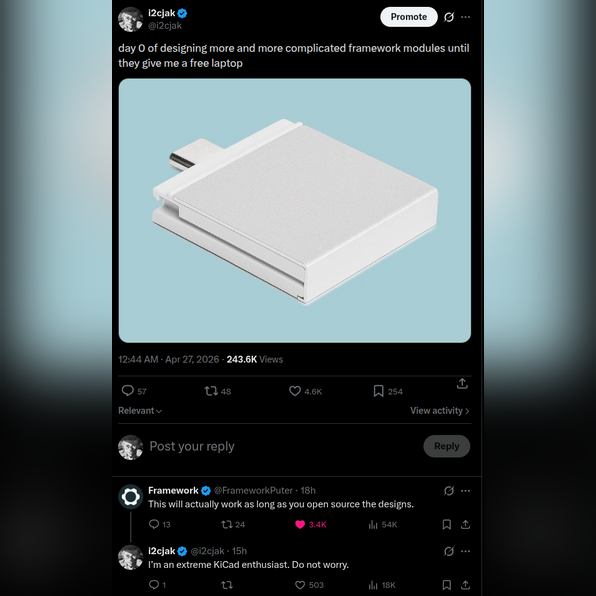
Framework_Expansion_Cards is a GitHub repository maintained by i2cjak, a hardware engineer and social media poster known for his engagement with Framework Laptop’s expansion card ecosystem. The project is not software in the conventional sense—it does not run on a device or perform automated tasks. Instead, it is a public, chronological log of daily expansion card design concepts, each published as a standalone directory in the repo. The stated goal, as captured in the README, is for i2cjak to design one new Framework Expansion Card per day until he receives a “REALLY NICE” Framework laptop. The project’s tone is self-aware and satirical, blending hardware design documentation with internet-era performance—complete with screenshots of social media posts (“poasts”) as proof of commitment. It reflects a specific kind of technical hobbyist culture: one where design exploration, public accountability, and vendor engagement intersect.
What it does
- Publishes a new expansion card concept every day, starting from Day 1 (Wi-Fi HaLow)
- Organizes each design into its own subdirectory (e.g.,
./Day_01_Wi-Fi-HaLow/,./Day_02_Four_Port_USB_C/) - Includes conceptual schematics, interface notes, and component-level ideas—not production-ready PCBs or gerbers
- Hosts supporting images (e.g.,
img/poast.png,img/day1.png) that document social media announcements and progress - Uses Python only as the listed GitHub language—no Python code appears in the repository, and no scripts are included or required to view or use the content
The repository contains no build system, no configuration files, and no runtime dependencies. It is a static collection of markdown files, images, and occasional reference diagrams. There are no CI/CD pipelines, no tests, and no packaging. The “Python” language tag on GitHub likely reflects incidental use of Python in local tooling (e.g., image generation or metadata scripting), but no such code is present in the committed files.
Getting it running
There is no software to install or execute. The repository is intended to be viewed as a website or browsed locally via a file manager or terminal. To access it:
git clone https://github.com/i2cjak/Framework_Expansion_Cards.git
cd Framework_Expansion_Cards
Then open README.md in any text editor or render it on GitHub. Each day’s directory contains a README.md (e.g., Day_01_Wi-Fi-HaLow/README.md) with design notes and references. No compilation, no virtual environment setup, and no pip install is needed or possible—the project is documentation-first.
If you want to view the images referenced in the README (e.g., img/poast.png), they are stored under the img/ directory and load automatically when viewed on GitHub. Local rendering of images depends on your markdown previewer supporting relative src paths.
Who this is for
This repository is for people interested in the conceptual and community-driven side of modular laptop hardware. It serves as a real-time case study in how individuals interact with open-hardware platforms—not by waiting for official releases, but by publicly speculating, designing, and pressuring vendors through visibility. Engineers curious about expansion card interface constraints (PCIe x1, USB-C alternate modes, I2C, UART) may find value in the interface notes embedded in daily READMEs. Educators or students studying hardware product development could use the repo as an example of iterative, public-facing design documentation.
It is also for Framework Laptop users who follow the ecosystem closely. The project highlights unofficial demand signals: Wi-Fi HaLow (IEEE 802.11ah), multi-port USB-C hubs, and other niche-but-plausible cards that haven’t appeared in Framework’s official catalog. These concepts surface tradeoffs—power delivery limits, thermal envelope, mechanical clearance—that are rarely discussed outside engineering forums.
The project does not target end users looking for plug-and-play hardware. None of the cards are manufactured, tested, or certified. There are no BOMs, no KiCad projects, no firmware, and no vendor part numbers listed in a machine-readable format. If you need a working expansion card, this repo offers ideas—not implementations.
How it compares
Framework’s official expansion cards—such as the 4K DisplayPort, Wi-Fi 6E, or NVMe Storage cards—are fully validated, supported, and sold through their store. They undergo thermal, electrical, and mechanical testing. Framework_Expansion_Cards offers none of that. It is a speculative counterpart, not a replacement.
Other community hardware efforts—like the Framework Community Expansion Cards project (a separate, unofficial GitHub org)—focus on collaborative, production-ready designs with shared tooling and version control for PCBs. That effort includes KiCad files, gerbers, and BOMs. i2cjak’s project does not.
There is no direct software alternative, since this isn’t software. It is more comparable to a design journal than a tool. Similar in spirit—but not structure—to blogs like The Hardware Journal or Circuit Digest’s concept series, though those lack the daily cadence and vendor-targeted framing.
The project has 60 GitHub stars as of its most recent activity. That number reflects niche but consistent interest from hardware-adjacent audiences: tinkerers, Framework owners, and people who follow X.com (formerly Twitter) hardware discourse. It is not a library, not a framework, and not a CLI tool—it is a timestamped archive of intent.
Framework_Expansion_Cards does not ship hardware, generate schematics automatically, or integrate with CAD tools. It contains no Python scripts, no automation, and no installation instructions beyond git clone. It is a public commitment, rendered in markdown.
Comments