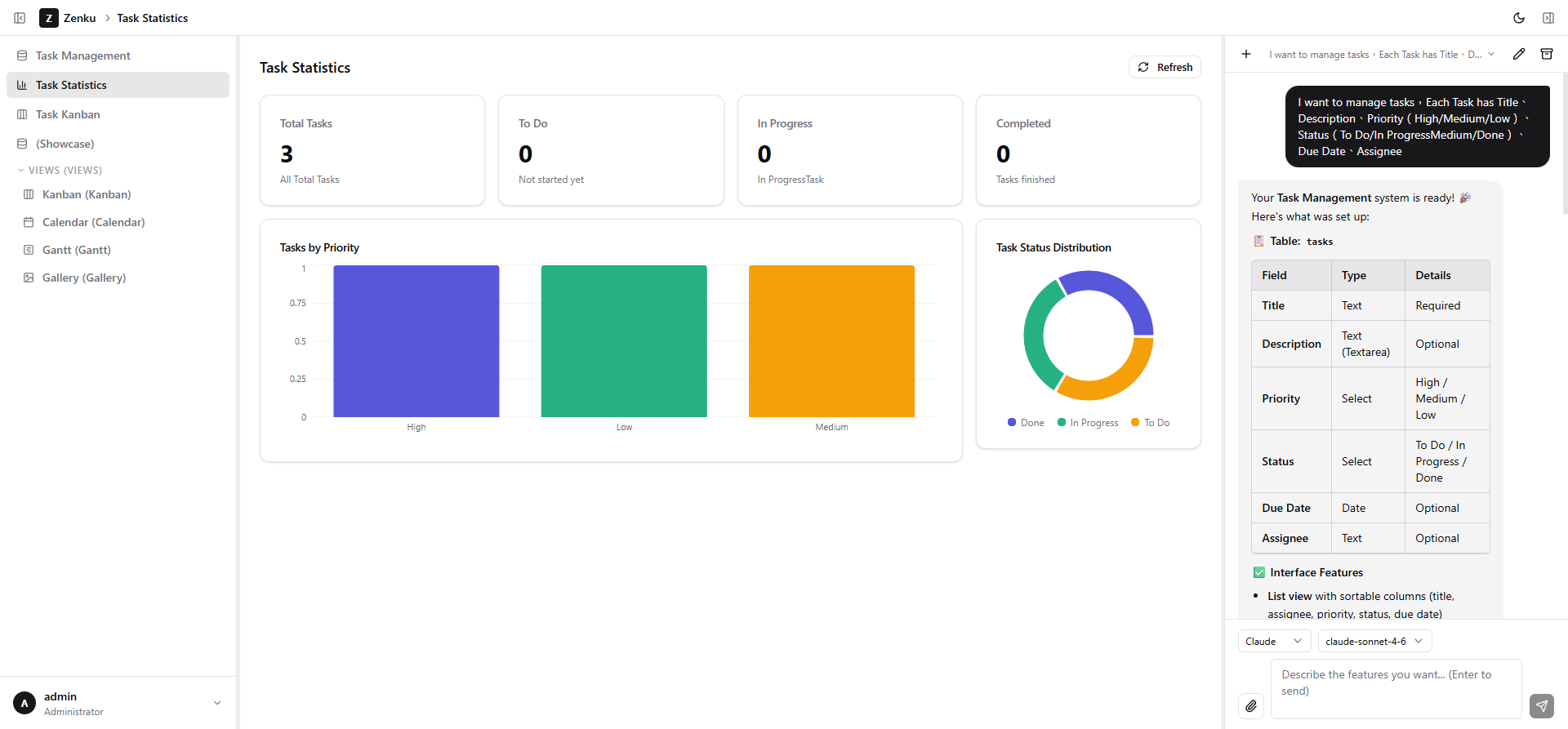
Zenku-v2 is an open-source, AI-first no-code engine for building data applications through natural language conversation. It targets the gap between traditional low-code platforms—where users drag components but still need technical knowledge—and fully automated code generators, which often produce static, unmaintainable output. Zenku-v2 instead uses a Multi-Agent Architecture to evolve database schemas, UI layouts, and business logic in real time, responding to prompts like “I need a CRM” or “Create a project tracking system with a Gantt chart.” It is designed to support production use, with native drivers for SQLite, PostgreSQL, and Microsoft SQL Server (MSSQL), and includes features like dynamic UI rendering and an undo system called the Design Journal. Developed in TypeScript, it is hosted on GitHub under the repository antonylu0826/zenku-v2, which currently has 30 stars.
Core features
Zenku-v2 distinguishes itself through architectural choices and built-in capabilities—not just AI integration, but how that AI is structured and constrained. Its most concrete features include:
- Specialist agent system: Dedicated agents for schema design, UI layout, SQL query generation, business logic, and testing—all coordinated by a central Orchestrator.
- Dynamic view engine: Supports Kanban, Gantt, Calendar, Timeline, Dashboard, and Form views, all rendered on-the-fly from JSON definitions.
- Real-time business logic engine: Enables validation rules (e.g., “prevent saving if stock < demand”), automation, and webhook triggers (e.g., to n8n).
- Design Journal: A built-in “Time Machine” that lets users undo any AI-generated change, including schema migrations or UI edits.
- MCP (Model Context Protocol) support: Allows external AI tools to interact with and control the Zenku instance programmatically.
These are not abstract promises—the README documents actual agent names (schema-agent, ui-agent, query-agent), real UI components (TableView, GanttView), and concrete integration points (e.g., n8n webhooks). The architecture diagram in the README uses Mermaid syntax to show how the Orchestrator routes tasks between agents, confirming that this is a deliberate, layered system—not a single LLM prompt wrapper.
Getting it running
Zenku-v2 provides two primary paths to local setup: npm-based development and Docker. Both require no compilation of frontend assets by hand or manual database provisioning.
For local development:
git clone https://github.com/antonylu0826/zenku-v2.git
cd zenku
npm install
cp .env.example .env
# Edit .env with your DB credentials and API key
npm run dev
The app launches at http://localhost:5173. The .env file supports switching databases using DB_TYPE=mssql, DB_TYPE=postgres, or DB_TYPE=sqlite, with corresponding host, user, and password fields. SQLite requires no external service—PostgreSQL and MSSQL assume local instances are already running.
For containerized deployment:
docker-compose up -d
This command pulls and starts the required services, including the Express-based backend (@zenku/server) and the React frontend (@zenku/web). The monorepo uses npm workspaces, and the three main packages—@zenku/server, @zenku/web, and @zenku/shared—are explicitly defined in the README, confirming the separation of concerns.
No CLI installer or PyPI package exists. There is no mention of cloud hosting, managed instances, or SaaS plans—the project is self-hosted only.
Who this is for
Zenku-v2 suits developers and technical product managers who want to prototype or ship internal data tools quickly but retain control over infrastructure, data ownership, and logic evolution. It is not aimed at non-technical business users who expect a hosted, click-and-deploy interface. The need to edit .env, choose a database driver, and understand agent roles implies a baseline familiarity with backend services and relational concepts. Use cases described in the README—building a project tracking system with Gantt support, enforcing inventory validation rules, or connecting to n8n workflows—reflect mid-sized operational needs: internal CRMs, order management dashboards, or lightweight ERP extensions. It fits teams that already use PostgreSQL or MSSQL in production and want to avoid building CRUD layers from scratch.
How it compares
Zenku-v2 differs from low-code platforms like Retool or ToolJet in that it does not rely on prebuilt connectors or visual canvas editing—it generates and updates structure through language, backed by autonomous agents. It also differs from code-generation tools like Lovable or Baserow’s AI mode, which produce static output; Zenku-v2 maintains a live, editable state with versioned changes via the Design Journal. Compared to fully open frameworks like Directus or Payload, Zenku-v2 shifts responsibility from manual schema definition and UI composition to conversational specification—though it still requires Node.js and database administration. It is lighter than LangChain-based custom agents (which demand significant prompt engineering), but heavier than simple SQL-to-UI tools like Sisense or Metabase—Zenku-v2 is not a BI dashboard engine, nor does it claim to replace them.
Zenku-v2 is a TypeScript monorepo with 30 GitHub stars, supporting SQLite, PostgreSQL, and MSSQL, and is available at https://github.com/antonylu0826/zenku-v2.
Comments