Rust Meow is a small Tauri desktop client backed by a local whatsmeow process. The SolidJS webview owns presentation and virtualized lists; the Tauri Rust core owns the typed desktop boundary; the Go sidecar remains the sole owner of WhatsApp state, history reduction, media, and the durable databases.
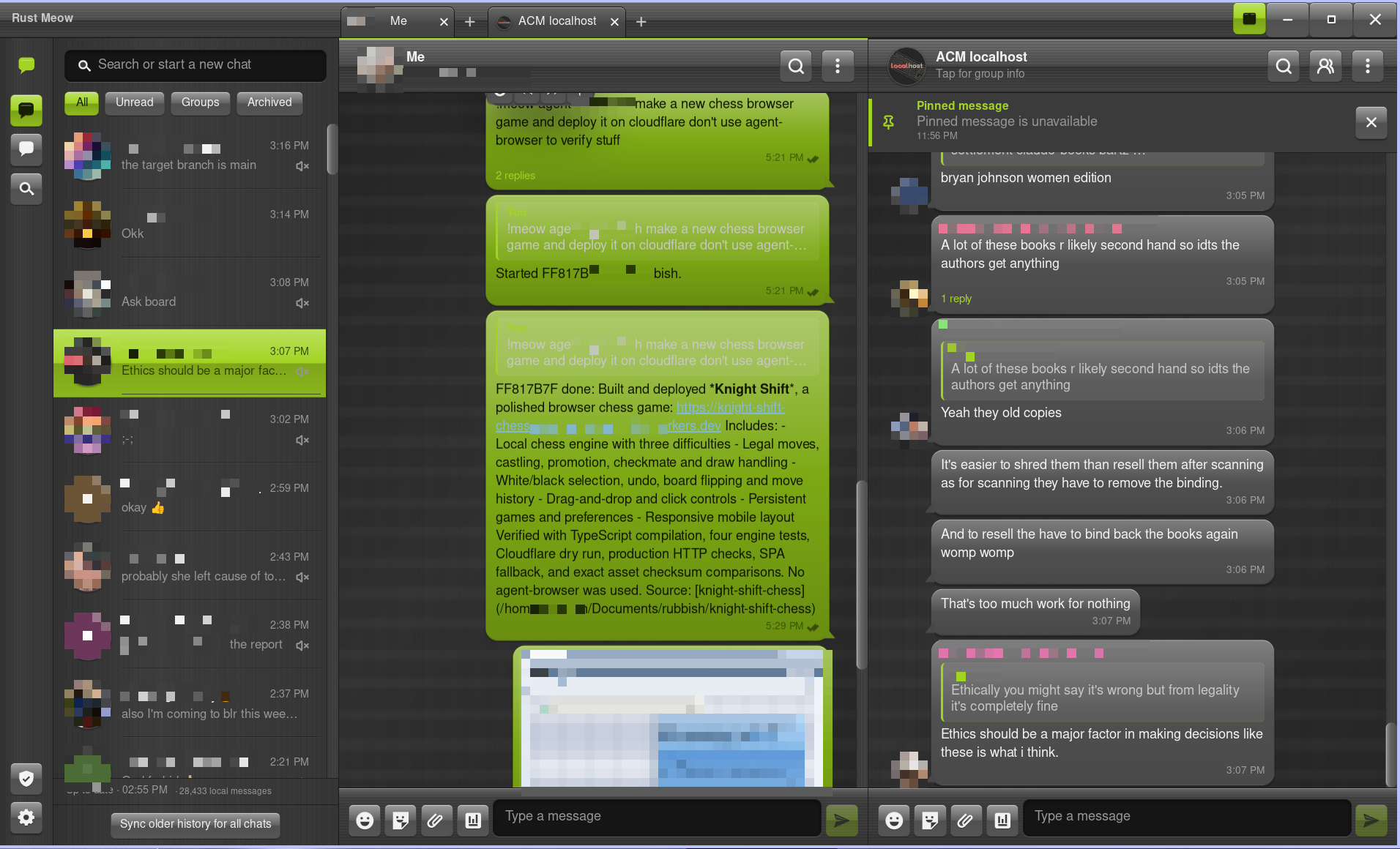
The Tauri app under tauri/ is the primary desktop on this branch. The GPUI
implementation under desktop/ remains available as the behavioral reference
during migration. This is still a private-testing build, not a production-ready
WhatsApp Desktop replacement; the exact parity and release gates live in
docs/TAURI_PARITY.md.
Architecture
SolidJS + TanStack Virtual (Tauri webview)
              typed invoke + ordered Channel events
Tauri Rust core
              4-byte BE length + protobuf v20 Envelope
Go sidecar (whatsmeow)
              session.db + client.db + bounded media cache
Only protobuf frames are written to sidecar stdout. Diagnostics go to
backend.log. Frames are capped at 8 MiB, and the versioned Hello handshake
must finish before other RPCs or events are accepted. The Tauri core reuses the
existing Rust bridge, path, and sticker modules, while Rust protobuf bindings
are generated directly from proto/bridge.proto.
Prerequisites
- Go 1.25 or newer
- the repository Rust toolchain and Cargo
- Node.js plus pnpm 10.28.2
- Tauri v2 Linux development packages, including WebKitGTK 4.1 headers
dpkgtooling to create the Linux.deb
Install the pinned frontend dependency graph with:
make deps
Run it
The deterministic fake backend needs no account and is the fastest UI loop:
make dev-fake
It provides 10,000 chats, paged messages, pairing events, and periodic live messages. It does not prove real pairing, persistence, receipts, or media transport.
Build and run against the real Go sidecar with:
make dev
On Windows, run this from Git Bash. The Makefile builds and launches
build/rust-meow-backend.exe; using the explicit .exe path prevents Windows
from selecting an older extensionless or adjacent sidecar.
The first clean launch displays a QR code. Scan it from WhatsApp > Linked
devices > Link a device. Use RUST_MEOW_DATA_DIR to isolate a QA profile;
the backend takes an OS-level profile lock and fails a second process closed.
Checks and builds
| Command | Result |
|---|---|
make check |
Go tests/vet, strict TypeScript, and warning-free all-target Tauri Rust lint |
make test |
Go tests, minified frontend build, and Tauri Rust tests |
make build |
Unbundled size-optimized Tauri executable with adjacent stripped sidecar |
make release-linux |
Native x86-64 or arm64 .deb containing the stripped Go sidecar |
make legacy-test |
GPUI regression tests |
make legacy-release |
Previous GPUI release layout |
GitHub's Release workflow builds downloadable installers for Linux x86-64
and ARM64 (.deb and AppImage), macOS Intel and Apple Silicon (.dmg), and
Windows x86-64 (NSIS .exe and .msi). Run it manually from the Actions tab
for test artifacts. Pushing a v* tag builds the same matrix and publishes the
installers to that tag's GitHub Release. The macOS artifacts are ad-hoc signed;
Windows and macOS production code signing/notarization still require release
credentials. Linux x86-64 releases also include a portable .tar.gz containing
the rust-meow executable and its required rust-meow-backend sidecar.
make build writes tauri/src-tauri/target/release/rust-meow and places a
stripped static sidecar next to it. make release-linux detects the native Linux
architecture, stages the target-triple-suffixed sidecar expected by Tauri, and
writes the package beneath:
tauri/src-tauri/target/<target-triple>/release/bundle/deb/
The bundle-only config is tauri/src-tauri/tauri.bundle.conf.json. Keeping
externalBin there means normal fake development does not require a staged Go
binary. A release is not validated merely because it bundles: unpack it and
prove the installed app starts its adjacent sidecar and completes protocol v20
Hello without RUST_MEOW_BACKEND.
The 2026-07-22 Linux x86-64 release measurement is:
| Artifact | Exact bytes |
|---|---|
| Tauri executable | 6,016,104 |
| stripped static Go sidecar | 22,229,154 |
| combined executable payload | 28,245,258 |
.deb package |
10,673,232 |
That combined payload is 48.94% smaller than the measured 55,320,882-byte
GPUI-plus-sidecar baseline. The final .deb SHA-256 is
f69724eb32eef434a7df2cf47d340d1797eacc61ef2e1c99369455ff0b48b7cd;
its manifest, two mode-755 executables, desktop entry, and 32/128/256-pixel
icons were verified after unpacking. A prior adjacent-layout smoke reached
pairing after Hello without a backend override, rejected a second app instance,
and reaped the sidecar on window close. Cross-platform, clean-machine, and
current-artifact launch tests remain release gates.
Data and safety
Private state uses the existing rust-meow platform data directory. It
contains linked-device credentials and must never be attached to bug reports.
RUST_MEOW_BACKEND can select a development sidecar; RUST_MEOW_DATA_DIR and
RUST_MEOW_CONFIG_DIR select isolated locations.
On Unix, startup creates or repairs the profile and cache directories to mode 0700 and database/log files to mode 0600. An advisory profile lock prevents two backend processes from opening the same databases. Logout stops account-scoped background work, unlinks the device, clears both SQLite databases including the FTS5 index, checkpoints and vacuums them, and removes managed avatar/media caches before a fresh pairing client is exposed. This is application-level deletion of active files, not a forensic guarantee against backups, filesystem snapshots, or storage-device wear levelling.
This is an unofficial client built on WhatsApp's linked-device protocol. Keep it to private testing until the packaging, lifecycle, platform, accessibility, security, and feature gates in the parity ledger are proven. In particular, an app/sidecar update must remain atomic because different protocol versions fail closed by design.
More implementation detail, direct commands, troubleshooting, and QA guidance
are in tauri/README.md.
Comments