
gray
A minimal, modular AI agent harness.
Start small. Extend anything.
Website · Changelog · Releases
Gray is a tiny agent core — streaming tool calls over SSE, JSONL sessions, self-managing context — that you extend only when you need to: skills, stdio plugins, cron. Any OpenAI-compatible provider works out of the box. No plugin marketplace, no roadmap promises.
| One binary, no runtime | musl-static on Linux, Rust-static on macOS. curl | sh lands you in a REPL; gray update self-updates. |
| Any provider, your keys | OpenAI, Anthropic, Google, OpenRouter, DeepSeek, Groq, Mistral, xAI — anything OpenAI-compatible, local models via Ollama — with Anthropic-style prompt caching on Claude models. Searchable model picker over the bundled models.dev catalog. |
| Sessions that survive | JSONL transcripts in ~/.gray/sessions with parent-id branching. -c reopens the latest, /resume picks any of them. Interrupted turns keep what reached memory. |
| Context that manages itself | The window auto-resolves from your provider, gray auto-compacts before the limit and retries once on overflow. /compact forces it by hand. |
| Bash only | The default surface is bash — read, search, edit, run, all through bash. The model schedules its own recurring work by running gray cron add … through bash. Ctrl-C cancels a runaway turn. |
| Extend the harness | Skills from SKILL.md, or sidecar plugins over stdio (frozen wire v1). |
Install
curl -fsSL https://gray.alignment.id/install.sh | sh              # stable
curl -fsSL https://gray.alignment.id/install.sh | sh -s -- beta   # bleeding edge, rebuilt on every main push
or from source:
cargo build --release -p gray # harness core (image paste included)
harness core: CLI, TUI (with image paste), provider, sessions, tools, cron.
Windows
Native Windows 11 x64 — no WSL, no Linux distro, no elevation. Git for Windows supplies the shell for tool calls; Gray does not install it or WSL. In PowerShell:
irm https://gray.alignment.id/install.ps1 | iex                                            # stable
& ([scriptblock]::Create((irm https://gray.alignment.id/install.ps1))) -Channel beta      # beta
The installer verifies the zip against the release SHA256SUMS before touching
anything. For an offline install keep dist/install.ps1 and
dist/install-native.ps1 together and run
.\dist\install.ps1 -ArchivePath .\gray-stable-x86_64-windows.zip -Sha256 <digest>.
-Native is accepted and is already the default. Pass -Wsl for the
compatibility route that installs the Linux build inside WSL. Native installs
never fall back to WSL. Artifacts are unsigned — the digest catches corruption,
not publisher identity. Close Gray and rerun the installer to update; self-update
is refused on native Windows. Gateway and cron execution are unsupported and
refused explicitly; cron jobs can still be managed as files. See the
native installation guide.
macOS binaries are Rust-static but not notarized — curl-installed binaries run fine, browser downloads may hit Gatekeeper quarantine.
Quick start
gray
First run drops you straight at the prompt. Configure whenever you feel like it:
| command | what it does |
|---|---|
/provider |
pick a provider — API key, free tier, or local |
/key openrouter |
paste an API key right in the CLI (input hidden), stored per-provider in ~/.gray/auth.json |
/login |
log this machine in to gray.alignment.id — optional, and nothing is gated on it |
/whoami |
show the account the stored registry token belongs to |
/logout |
revoke the registry token and forget it |
/model |
searchable picker over the bundled models.dev catalog |
Account (optional)
gray.alignment.id holds the plugin registry. An account is not required to run gray, and nothing in the CLI is gated on one — the token only names you on registry calls.
gray login                 # walks you through it, then prompts for the code
gray login <code>          # same, non-interactive
gray whoami                # who the stored token belongs to
gray logout                # revokes the token, then forgets it
Mint a code at gray.alignment.id/account
(sign in with GitHub, Google, or Discord, then "Generate CLI login code"). It
is one-time and expires in 5 minutes. The token lands in
~/.gray/registry-token.json (mode 0600). Point gray at a local registry with
GRAY_REGISTRY_URL=http://127.0.0.1:4000/api.
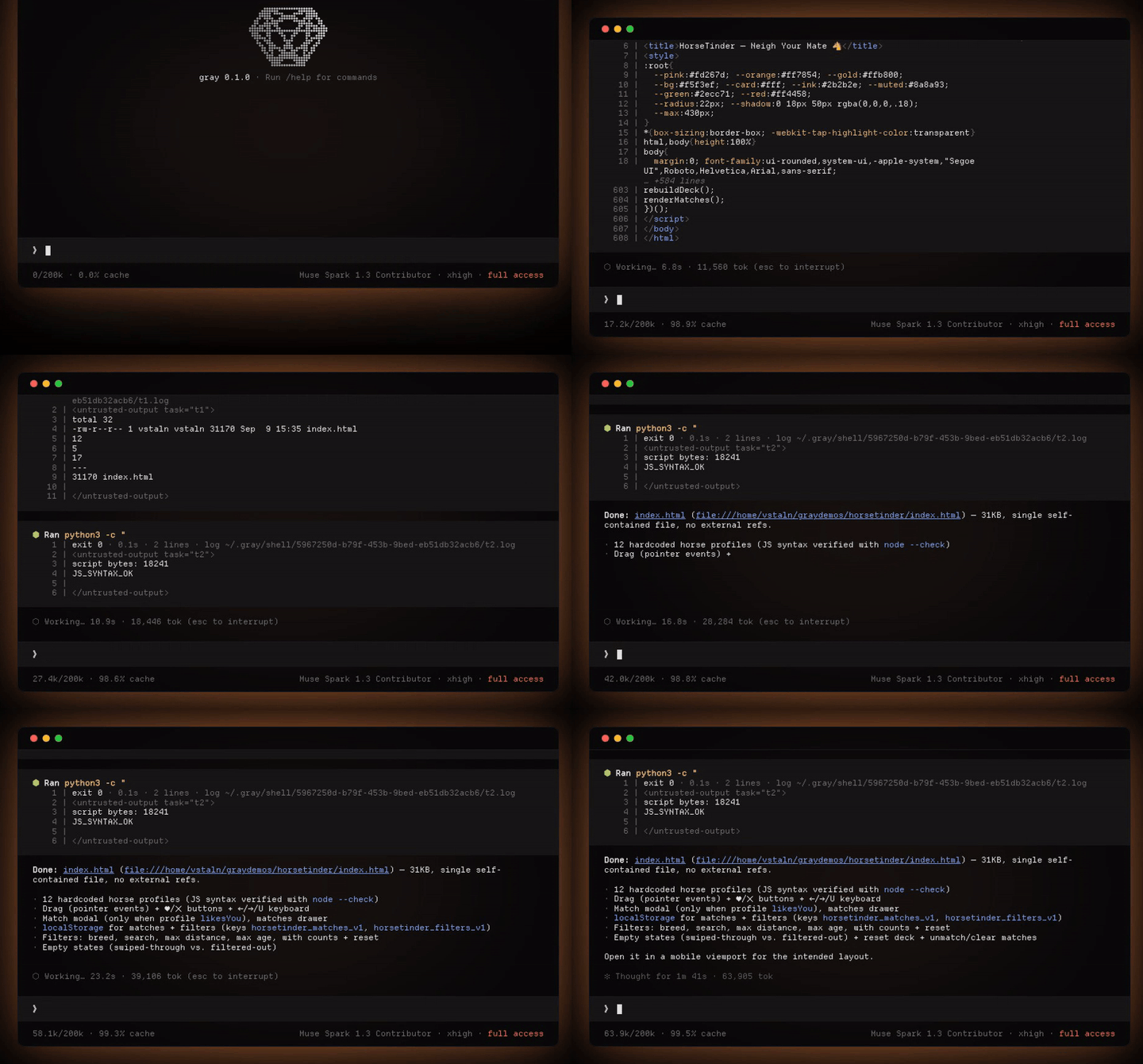
Watch it go
Small core, open world
Bring your provider, tools, and skills. Keep only what you use.
Background shell jobs
The AI can start independent commands without waiting for them to finish:
{"command":"cargo test", "background":true, "timeout":600}
Or let short commands finish normally, yielding a job ID only if still running:
{"command":"cargo test", "yield_ms":1000, "timeout":600}
Multiple jobs run concurrently (up to 32 per tool instance). Use the same bash
tool with action: "list", or action: "status", "output", or "cancel" plus
job_id. Status/output calls return immediately. Jobs are session-scoped;
finished outputs remain retrievable, with a bounded history of 128 jobs.
Completion notices reach the AI between model rounds. If the AI has already finished its turn, notices arrive on the next user turn—jobs do not hold the turn open or trigger an unsolicited model call. Cancellation and the total runtime timeout still terminate the owned process tree; quitting Gray stops managed jobs. Jobs are not restored after restart, but their logs remain.
Without background or yield_ms, bash retains its blocking behavior. Only
start jobs concurrently when they are independent; don't run competing writes
or builds against the same output directory.
Run the commands somewhere else
One setting moves every shell command off this machine:
// ~/.gray/config.json
{ "exec_prefix": "docker exec -i dev sh -s" }
exec_prefix (or GRAY_EXEC_PREFIX) is a program that ends in a shell
reading its script from stdin, so one value covers both a local container and
a remote box:
docker exec -i dev sh -s |
commands run inside the dev container |
ssh box sh -s · ssh -p 2222 'my box' sh -s |
commands run on a remote host |
| unset (default) | commands run in your own shell |
The command crosses as text, so nothing re-quotes it: $VAR, globs,
pipes, heredocs and quoting reach the far shell exactly as written. Gray's own
non-interactive environment (GIT_TERMINAL_PROMPT=0, GRAY_SESSION_ID,
GRAY_CWD_REPORT, …) is exported across the boundary too, because neither
ssh nor docker exec forwards it.
What does not cross: paths. current_dir is applied to the local client
process, so a remote command starts in that account's login directory — cd
first if it matters, and note that files the model edits on the far side are
not the ones on your laptop.
Commands
Slash commands autocomplete: Enter completes and fires, Tab inserts for editing — suffixes too, so /context r suggests reserve.
/new · /resume [id|--last|--all] |
fresh conversation, or reopen a previous one |
/model [id] · /provider · /key [provider] |
models, providers, keys — without leaving the chat |
/compact [instructions] |
summarize context (auto-compacts near the limit) |
/undo · /retry |
drop the last exchange · drop it and ask again |
| type during a turn | steers the running turn at its next model step (never cancels) |
/context [tokens|auto] |
inspect or set the window — 128k, 1m, auto to clear |
/thinking · /effort [level] |
toggle reasoning, pick the effort |
/usage |
session tokens & cost |
/skills · /skills [name] [args] |
list skills, run one |
/plugin <subcommand> |
list · search · install · remove · update · enable · disable · check |
/agentsmd |
edit the full system prompt in the built-in editor (show, reset too) |
/feedback <text> |
save feedback locally + open a prefilled GitHub issue |
/help · /quit |
you know these |
Outside the REPL, gray doctor reports whether this machine is set up right —
home, credential, model, context window and its source, shell, exec prefix,
gateway, plugins — and exits non-zero if a check fails. Add --online to also
reach the provider (a GET /models, no tokens). It never changes anything.
CLI surface
gray itself plus six subcommands — everything else is a slash command away:
| subcommand | what it does |
|---|---|
gray resume [--last|--all] [SESSION_ID] |
resume a conversation — picker, most-recent, or by id/prefix |
gray plugin <list|search|install|remove|update|enable|disable|check> |
manage plugins |
gray cron <list|add|remove|show> |
recurring/one-shot jobs (fired by the gateway, serve, a tick host, or the REPL) |
gray gateway <run|status|start|stop|restart|install|uninstall> |
the daemon that fires cron with no REPL open — cron ticker + control socket, supervised as a user service |
gray sessions prune |
session store maintenance |
gray update |
update gray to the latest release |
Global flags: -p/--print (one-shot), -c/--continue (reopen latest), --session <ID>, --context-window <TOKENS>, --context-reserve, --context-keep, --dump-manifest, --json (machine-readable print mode).
--json print mode writes one JSON record per event and exits with the failure class: 0 success, 1 the turn failed (do not retry), 3 provider/network death (retrying the turn usually succeeds). The error record carries code (auth_failed, rate_limited, bad_request, context_overflow, server_error, stream_broken, connection_failed, timeout, loop_detected, cancelled, serialization, turn_failed), retryable, message, and a hint naming the command that fixes it — so harnesses branch on the class instead of parsing prose.
Extend
Make gray yours via skills, plugins, providers, and config.
Skills — SKILL.md bodies discovered in your global (~/.gray/skills) and project (.gray/skills) directories, plus a few conventional shared skill locations. /skills lists them, /skills [name] [args] pastes one into the chat and runs it (/skill is an alias). The model gets the fresh <available_skills> list every turn and reads matches with bash (cat <location>) — no skill tool, tools stay bash-only.
Plugins — sidecar child processes speaking newline-delimited JSON over stdio, with timeout and crash degradation. gray.yml profiles order built-ins and sidecars; plugins/echo/ is a copy-paste reference implementation.
/undo rewinds the conversation only: the last thing you said and everything
the model said after it leave both the context and the saved session (the
pre-undo transcript is kept in ~/.gray/sessions/archive/). Files the model
wrote are untouched — that is git's job, not the transcript's. /retry is the
same rewind with your message sent again, so a wrong turn costs one command
instead of a retyped paragraph.
Scheduling
The agent stores recurring work with gray cron add "<schedule>" "<prompt>" (manage with gray cron list/show/remove). Jobs fire when something ticks the store — the gateway daemon, gray cron serve, a gray cron tick host (cron/systemd timer), or an open REPL.
Gateway — gray gateway install writes a user service (runit on Void, systemd --user elsewhere; install --print previews) running gray gateway run: a 60s cron ticker plus a control socket at $GRAY_HOME/gateway.sock answering identify/status (one JSON line in, one out — a connectable socket with a well-formed answer is liveness). gray gateway status reports daemon + service + ticker health and exits 1 when down; start/stop/restart drive the service, uninstall removes it. The daemon claims $GRAY_HOME/gateway.pid (O_EXCL, start-time-checked against PID reuse), records why it stopped in gateway.state.json, and drains an in-flight fire up to 65s on SIGTERM.
Safety
gray executes shell commands from the model. There is no command guard and no approval prompt: the model's bash runs what it writes, with your user's privileges. There is no container or VM isolation — run gray in a container/VM for untrusted work, or point exec_prefix at a box that is already isolated: the model still has no approval prompt, but the blast radius is that box, not your workstation. Security reports: SECURITY.md.
Persistence note: REPL sessions keep raw transcripts at 0600 under ~/.gray/sessions for exact resume — including any secret that crossed a tool call. gray -p print mode scrubs secrets before persisting. Plan backups, snapshots, and disk access accordingly.
Context window & auto-compact
The window resolves as: --context-window / GRAY_CONTEXT_WINDOW → auto-fetched provider value → LiteLLM model table → hardcoded fallback. Inspect with /context, set with /context 128k (or 1m; auto clears).
When usage nears the limit (tokens > window − 16k reserve), gray summarizes history into a 2-message summary before the next turn — the same flow as manual /compact — and on context_length / max_tokens overflow errors it compacts and retries once. Auto is the default; no flag needed.
Layout
| crate | role |
|---|---|
gray |
REPL · onboarding · config · TUI · JSONL session store (src/session_store.rs, parent-id branching) · cron (src/cron/) |
gray-core |
agent loop · events · messages |
gray-provider |
OpenAI-compatible SSE streaming, retries, prompt caching |
gray-tools |
bash · read · write · edit · grep · find · ls · shell control (profile-selectable) |
gray-plugin |
plugin trait · manifest · gray.yml profile loader |
gray-pkg |
plugin package management |
gray-markdown |
streaming markdown renderer for the TUI |
Design notes: streaming first — text deltas, tool calls, and usage arrive as typed events over SSE. Logs go to ~/.gray/logs/gray.log (GRAY_LOG=debug for the firehose).
Environment
The essentials — everything else is one --help or doc page away.
| var | meaning |
|---|---|
GRAY_HOME |
config root (default ~/.gray) |
GRAY_API_KEY / OPENAI_API_KEY |
API key — env beats stored keys |
GRAY_MODEL · GRAY_BASE_URL |
defaults before ~/.gray/config.json is consulted |
GRAY_CONTEXT_WINDOW |
override the window in tokens — 128000, 128k, 1m, or auto |
GRAY_NO_UPDATE_CHECK=1 · GRAY_AUTO_UPDATE=1 |
silence the startup update check, or background self-update |
GRAY_LOG |
error…trace (default info) |
GRAY_EXEC_PREFIX |
run every shell command through this program (docker exec -i dev sh -s, ssh box sh -s); the saved exec_prefix is the durable form |
GRAY_PARALLEL_READS |
0 runs every tool sequentially (default: read-only tools concurrent, input order preserved) |
Platform support
| OS / arch | binary | notes |
|---|---|---|
| Linux x86_64 / aarch64 | musl-static | fully supported — systemd user service (Linux-only) |
| macOS arm64 / x86_64 | Rust-static, not notarized | curl-installed binaries run fine; browser downloads may hit Gatekeeper quarantine |
| Windows x86_64 | native, Windows 11+ | Git Bash supplies the shell; gateway/cron execution unsupported |
"Zero runtime deps" means no sidecar services — you still need sh, curl / wget, tar, and sha256sum / shasum for the installer.
Stability
The 1.x stability contract (CLI flags, session JSONL schema, plugin wire v1, ~/.gray layout) takes effect at 1.0 — on 0.x these are best-effort. Not stable: the TUI, internal crate APIs, gray-markdown. Per-release changes: CHANGELOG.md. Rollback is publisher-side today (manifest re-point); user-side gray update --to <version> is planned.
Ideas and designs informed by the projects listed in THIRD_PARTY_NOTICES.md — thanks to those projects and their authors.
A naming note: cargo install gray belongs to another crate, so the install path is the installer script above (or a source build). The binary stays gray.
MIT © 2026 vstaln
Comments