
English | Русский

Your own AI agent. Your server, your memory — one command and it just works.
curl -fsSL https://raw.githubusercontent.com/smixs/iva/main/install.sh | bash
What it is
Iva is a personal AI agent that lives in your Telegram and runs on a server you own. Install it with one command, then just talk to it — by text or by voice. It answers, and it remembers: your tasks, decisions, the people and projects you mention. The longer you use it, the better it knows you.
No dashboard to log into, no SaaS account, no per-message meter running. The code and the memory sit on your machine. You bring your own model key, and you pick the model.
Why Iva
OpenClaw, Hermes, nanobot — there are a lot of good personal agents out there. So why build another one? Because every one of them hands you the same pile of decisions: which model, which memory, which search, how to deploy, how to wire it together. Too much choice is the real problem.
So I made the choices. I test agents, models, stacks and harnesses all the time, keep what's actually best, and fold it into Iva — so you get the result without doing the research. The goal is one thing: a cheap, fast, reliable agent for every day, the kind that pings you with your morning digest on its own.
- The best of every agent, in one. I've been at this a while. The good ideas from across the field, tested and assembled, set up with sane defaults — that's what installs when you run the command.
- Open all the way down. Open-source code on open-source models. The open models — DeepSeek, Kimi, GLM — are genuinely good now: you pick one by name, your key, no markup, no closed vendor moving the price under you.
- One command, and it works. Telegram for the chat, Deepgram for voice, a tree-shaped memory, nightly rollups — already picked, wired and configured. The Linux Mint of AI agents.
Lots of agents out there. This one's mine — now it's yours too.
What it can do
| 🎙️ Voice & video | Transcribes voice notes and video circles, understands speech in many languages (Deepgram nova-3). |
| 🧠 Long-term memory | Remembers your conversations and tidies them up on its own, every night. |
| 🔎 Fast recall | Finds the right note in seconds — straight over plain files, no index to rebuild. |
| ⏰ On a schedule | Day or week digests, recurring jobs. Can check your inbox and send you a summary, on time. |
| 🔔 Reminders | Tell it what and when, and it won't let you forget. |
| 🤖 Your choice of model | DeepSeek, Kimi, GLM and other open models — switch any time. |
| 🌐 Does more | Searches the web (free Tavily/Exa key), opens pages, drives a browser, connects to MCP servers. |
| 🎭 A character | Change its tone and rules right in the chat — it rewrites itself. |
Everything the best agents have — voice, search, skills, MCP — Iva has too. The difference is what happens underneath.
Memory — the part that compounds
Most agents forget you the moment the context window fills up. Iva doesn't. Its memory is shaped like a tree — and the name Iva means willow in Russian.
        🪵  TRUNK   — year + cards on people, projects, decisions (the durable picture)
       ╱  ╲
      🌿 BRANCHES   — monthly summaries, built from weeks, built from days
     ╱      ╲
    🍃 LEAVES        — the full, word-for-word transcript of each day
- Leaves — every day's raw transcript, kept verbatim.
- Branches — short summaries: first per day, then a week folded from days, a month from weeks.
- Trunk — it all converges into the big picture: the year, plus fact cards on the people, projects and decisions that matter.
Every night Iva does the gardening itself: it summarizes the leaves and folds them up the branches. So it can recall word-for-word what was said on a specific Tuesday and tell you what you spent the whole month on.
It's "low-context memory" by design. Iva never loads its whole history into the model. Always in context is one tiny CORE file (who you are, your standing preferences, active goals); everything else is pulled in only when a task needs it, found by a literal search over the files.
The heavy memory systems — Papr, mem0, MemGPT/Letta — buy semantic recall with an embedding model plus a vector or graph database to run, sync and pay for. Iva spends its complexity budget at the other end: it structures memory when it's written (the nightly rollup and the entity cards) so reading it back can stay a plain search. The trade is honest — this wins on local-first, zero-infrastructure, fully inspectable, git-diffable memory for a personal vault. If you ever outgrow it, adding a real index is the upgrade path, not a rewrite.
What that buys you:
- Zero infrastructure — no vector DB, no embedding model, no graph server. Memory is Markdown files.
- Fully yours and readable — open any memory in a text editor, grep it, diff it in git.
- Cheap and private — lives on your disk, nothing shipped to a third-party memory service.
- Easy to fix — when memory is wrong, you edit a file. No re-indexing, no stale-embedding mystery.
Memory is the part I've worked on the longest — first agent-second-brain, then the autograph typed-graph skill, and all of it folded into Iva. The tree above is a hierarchical summary DAG: it compacts older days while keeping a pointer back to every original — the idea at the heart of the LCM: Lossless Context Management paper (Ehrlich & Blackman, 2026), plus my own vision and a lot of practice on top. It's one of the best memory designs you'll find in a personal agent today — and it runs on open models you own, no subscription required.
How it works
Telegram  ──(long-polling, getUpdates)──►  Iva (eve agent on your host)  ──►  vault (Markdown files)
                                                                              ▲
                                          systemd timers ─ nightly rollups ───┘
No public domain, no webhook, no reverse proxy. Iva polls Telegram from inside, so it runs on any plain server. At night, systemd timers roll the day's transcript up into summaries and back up the vault to a private git repo.
Providers & cost
Iva is free and open-source. You pay only for a server and a model subscription:
Server — any small always-on box (a VPS with ~1–2 GB RAM, around $5/mo), or your own computer if you keep it on.
Model — pick one provider, both OpenAI-compatible, your own key:
- OpenCode Zen (Go) — around $5/mo, leaner limits. Cheapest start.
- Ollama Cloud — around $20/mo, higher limits.
Inside either, you choose the model (DeepSeek recommended). No markup over the provider's price.
Voice — Deepgram for transcription (free starter credit).
Install
Open a terminal on your server (or your own computer).
Paste the command and hit Enter:
curl -fsSL https://raw.githubusercontent.com/smixs/iva/main/install.sh | bashThe installer asks your language first (English or Russian), then walks you through each key with a direct link — paste them when prompted. Once it asks, send your bot any message so Iva learns who you are and answers only you.
Done. Message your bot in Telegram — Iva replies.
More on running it on a VPS: DEPLOY.md.
Talking to Iva
Message the bot like a normal chat — text or voice. Commands work right in the chat:
| Command | What it does |
|---|---|
/task buy milk |
add a task |
/tasks |
show the task list |
/digest |
day summary |
/new |
start the conversation fresh |
/help |
list of commands |
/restart |
restart if it ever hangs |
Privacy
The code and the memory stay on your server. The vault is its own private git repo — set the
remote once and your memory backs itself up. Keys live in .env, never in the code, and the bot
answers only the Telegram IDs you allow (it stays silent to everyone else by default).
Honest about the boundary: the model and voice transcription run through cloud APIs (the ones you picked and pay for). Self-hosted means your code and memory — not the model weights.
What Iva does not do
So you know exactly what you're getting:
- Telegram only. No web app or dashboard — the chat is the whole interface.
- Replies in the language you chose at install. Switchable, but it's one language at a time.
- Memory backup is a
git pushto a repo you create once — not a managed cloud sync. - Search is literal, not semantic. It greps your files; there's no vector/embedding recall.
- Single user. One owner, one vault — not a team or multi-tenant assistant.
- Pre-1.0. It works and it's in daily use, but it's young. Expect rough edges, report them.
Star it
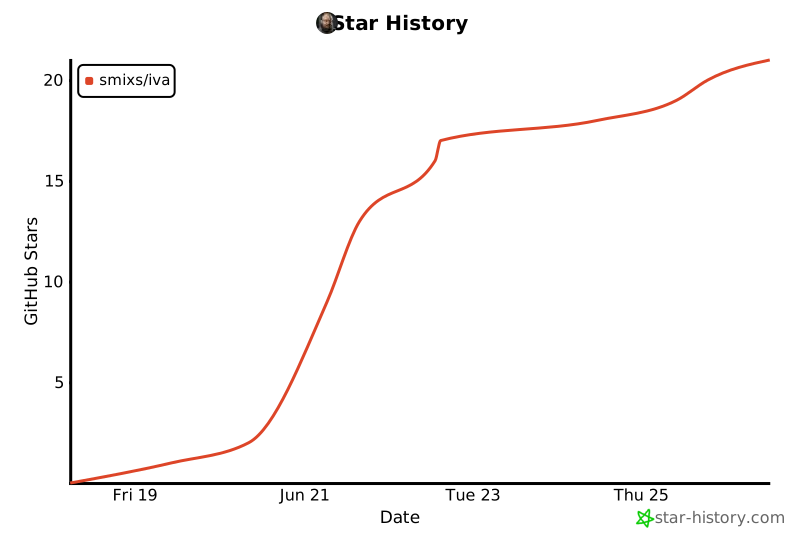
If Iva is useful to you, a ⭐ genuinely helps other people find it — that's the whole marketing budget.
Built on
eve (the agent framework), autograph (the typed-graph memory skill), and the ideas from agent-second-brain.
Comments