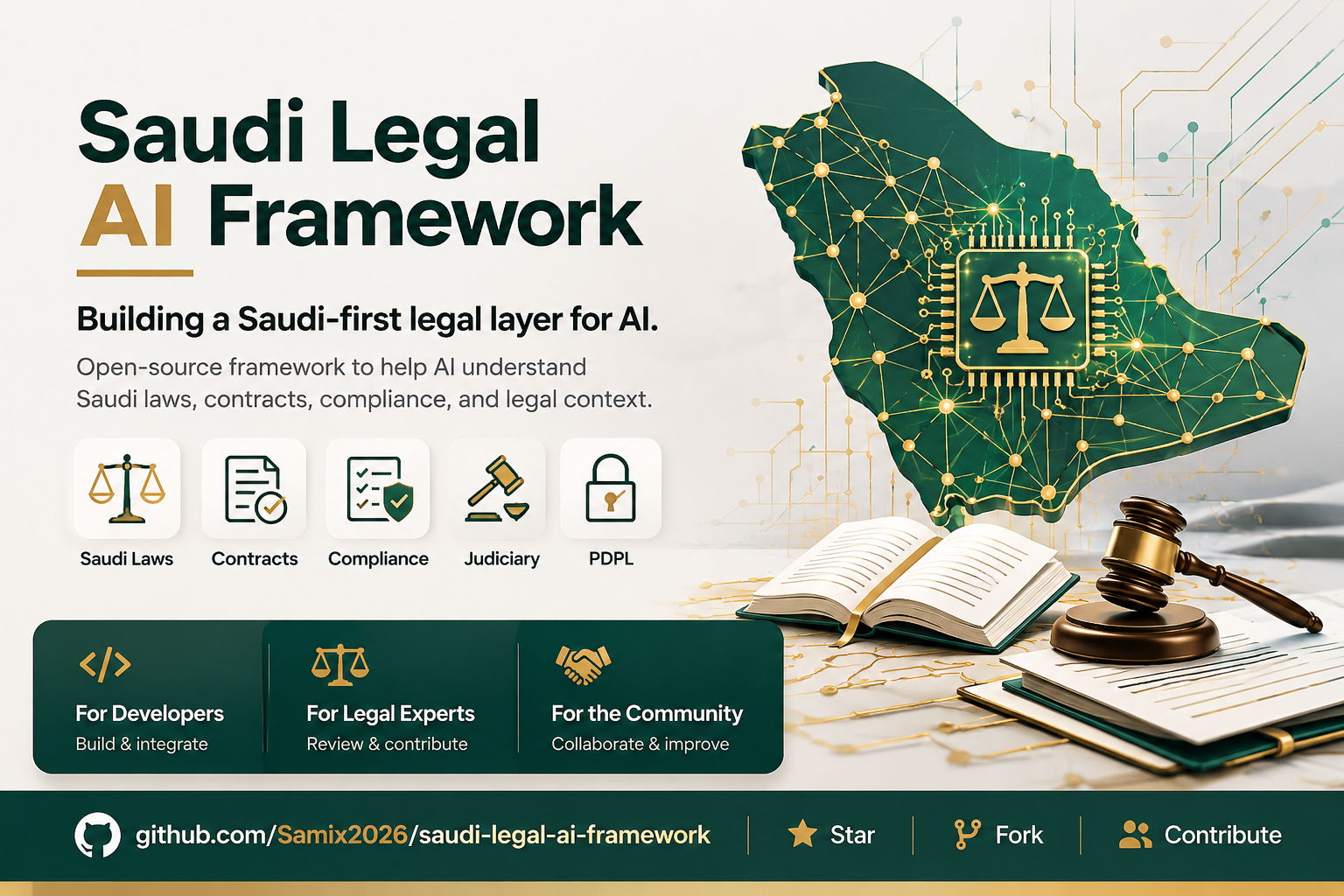
The saudi-legal-ai-framework tackles a specific blind spot in modern AI assistants. Large language models are predominantly trained on Western legal corpora, which means they often misapply concepts when asked about Saudi Arabian law. The framework provides structured skills, prompt templates, and verified legal references to steer AI reasoning toward Saudi-specific legal principles.
This isn't a full legal practice management system. It's a documentation layer—organized sets of instructions that help AI assistants understand Saudi court specializations, reference the correct Royal Decrees, and distinguish between types of commercial claims. The README emphasizes this is research material, not legal advice, requiring supervision by licensed Saudi attorneys.
What's inside
The framework organizes Saudi legal knowledge into reusable components:
Saudi-grounded skills — Five domain-specific reasoning guides covering contract review, labor law, commercial disputes, compliance, and legal drafting. Each skill steers AI toward Saudi law rather than defaulting to Western precedents.
Bilingual prompt templates — Ready-to-use instruction patterns in both Arabic and English. These work across Claude, ChatGPT, Gemini, or any instruction-following model without modification.
Verified legal sources — Reference summaries linking claims to official Saudi regulations. The framework tracks citations to Royal Decrees, court system rules, and Sharia-based principles that Western-trained models typically overlook.
Contract risk datasets — A 16-column CSV schema with structured examples for different sectors. The dataset includes verification lifecycle tracking, meaning entries are drafted, community-reviewed, then verified.
Judicial decision extraction — Structured data from scanned Saudi court decisions, with 19-field extraction schemas. Currently includes 5 extracted cases from 1435H rulings.
How it works
The framework follows a layered architecture where each component can be used independently or combined. Legal sources and court decisions feed into datasets, which inform the AI skills and prompt templates. A key design principle is independence between layers—you can drop a single prompt into an AI conversation without needing the full stack.
The technical stack is lightweight: Python for validation scripts, Markdown for documentation, and CSV for datasets. No containerized services or complex dependencies are required to use the prompts and skills. The project includes CI workflows for dataset validation and contribution guidelines, but the core deliverable is documentation that can be copied directly into AI assistant contexts.
The data flow moves from official legal sources and scanned judicial PDFs through OCR processing, indexing, and finally into structured extraction formats. This creates a pipeline from raw Saudi legal materials to AI-consumable knowledge.
Who it fits / Who it doesn't
This project suits legal professionals, compliance teams, or AI practitioners working specifically with Saudi Arabia. The bilingual Arabic-English structure suggests it's built for practitioners who need to interface with both local and international stakeholders. The explicit disclaimer about requiring licensed attorney supervision indicates it's aimed at supplementing, not replacing, professional legal work.
It's less suitable for developers seeking a plug-and-play API or for jurisdictions outside Saudi Arabia. The framework's heavy reliance on Saudi-specific court systems, Royal Decrees, and Sharia principles limits its applicability elsewhere. Additionally, the project status shows Phase 2 (Knowledge Base) and Phase 3 (AI Workflows) are still in progress, so expect incomplete coverage.
Setup, briefly
The framework requires only Python for the validation scripts. No Docker containers or complex installations are needed to use the core skills and prompt templates. Check the repository for the developer requirements file and script usage details.
Bottom line
Compared to generic legal AI tools like LexisNexis or Westlaw (which focus heavily on U.S. and European law), this framework fills a geographic specialization gap. While tools like Harvey AI or Casetext offer general legal reasoning, they lack the Saudi-specific grounding that matters for accurate Sharia-based legal analysis. The project sits at an early stage with 13 GitHub stars, but its structured approach to legal AI localization could serve as a model for other regional legal frameworks. The source is on GitHub.
Comments