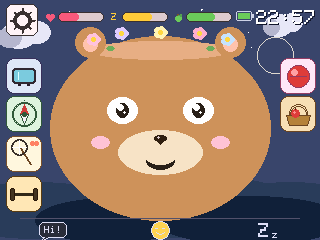
Virtual pets are a familiar concept—think Tamagotchi or mobile apps—but the landscape is shifting toward AI integration and connected devices. Most modern solutions rely on cloud services, subscriptions, or smartphone apps, trading privacy and simplicity for advanced features. Pixel-Pets takes a different path: it’s a fully offline, open-source virtual pet family built entirely on M5Stack hardware, with AI features running locally when possible.
What sets this project apart is its commitment to local processing and educational transparency. Developed by a 10-year-old maker with assistance from Claude AI, every line of firmware is available for inspection and modification. The ecosystem includes three main pet variants—Muffin (CoreS3 + LLM module), Visu (CoreS3 alone), and Goo-Goo (Core2)—plus an optional pocket-sized companion called Pip. All share a single codebase, yet target-specific features like voice control or front-camera selfies are handled through compile-time flags.
The trade-offs are clear. By going all-in on local execution, Pixel-Pets avoids cloud dependencies, subscriptions, and data tracking—a significant win for privacy-focused families. However, this approach means hardware limitations: the most advanced features (voice, camera) are locked to the CoreS3 platform, and the offline AI pipeline requires additional setup. The project also demands more hands-on involvement than a commercial toy; flashing firmware and configuring settings is part of the experience.
That said, the project ships with a rich feature set that feels surprisingly complete for a DIY effort. The pet is “world-aware,” pulling real-time weather, location, and astronomical data via Wi-Fi, then caching it locally so it works offline. ESP-NOW peer-to-peer networking lets two pets exchange gifts without a router, and the Pip accessory acts as a treat-thrower with haptic feedback. Mini-games, scene travel, and a parental session limiter round out the package. For makers, it’s a compact study in embedded interaction design: shared logic across multiple targets, touch/IMU/button integration, and optional offline voice pipelines.
If you want to try it, you’ll need M5Stack hardware (CoreS3, Core2, or M5StickC PLUS2) and a willingness to flash firmware via PlatformIO or pre-built binaries. The README contains detailed, per-pet setup guides—from the easiest (Goo-Goo) to the most involved (Muffin with its Module-LLM expansion). No cloud accounts are required, but adult supervision is recommended for assembly and initial configuration.
Pixel-Pets fits as a privacy-respecting, hackable alternative to commercial virtual pets—a project that’s as much about the making as the playing. The source is on GitHub.
Comments