Why CLI Tools Matter for AI Coding Agents
AI coding assistants operate in a fundamentally different environment than traditional IDEs. Where human developers rely on rich GUI experiences with hover tooltips and click-to-navigate features, LLMs work through text streams and limited tool access. This creates a gap: language servers like gopls excel at delivering IDE-grade precision but speak JSON-RPC protocols that don't translate well to terminal-based agents. The result is inefficient token usage, with agents burning API calls to read raw files just to understand code relationships. A new class of tools is emerging to bridge this divide—optimizing for LLM consumption patterns rather than human interaction models.
Enter gograph
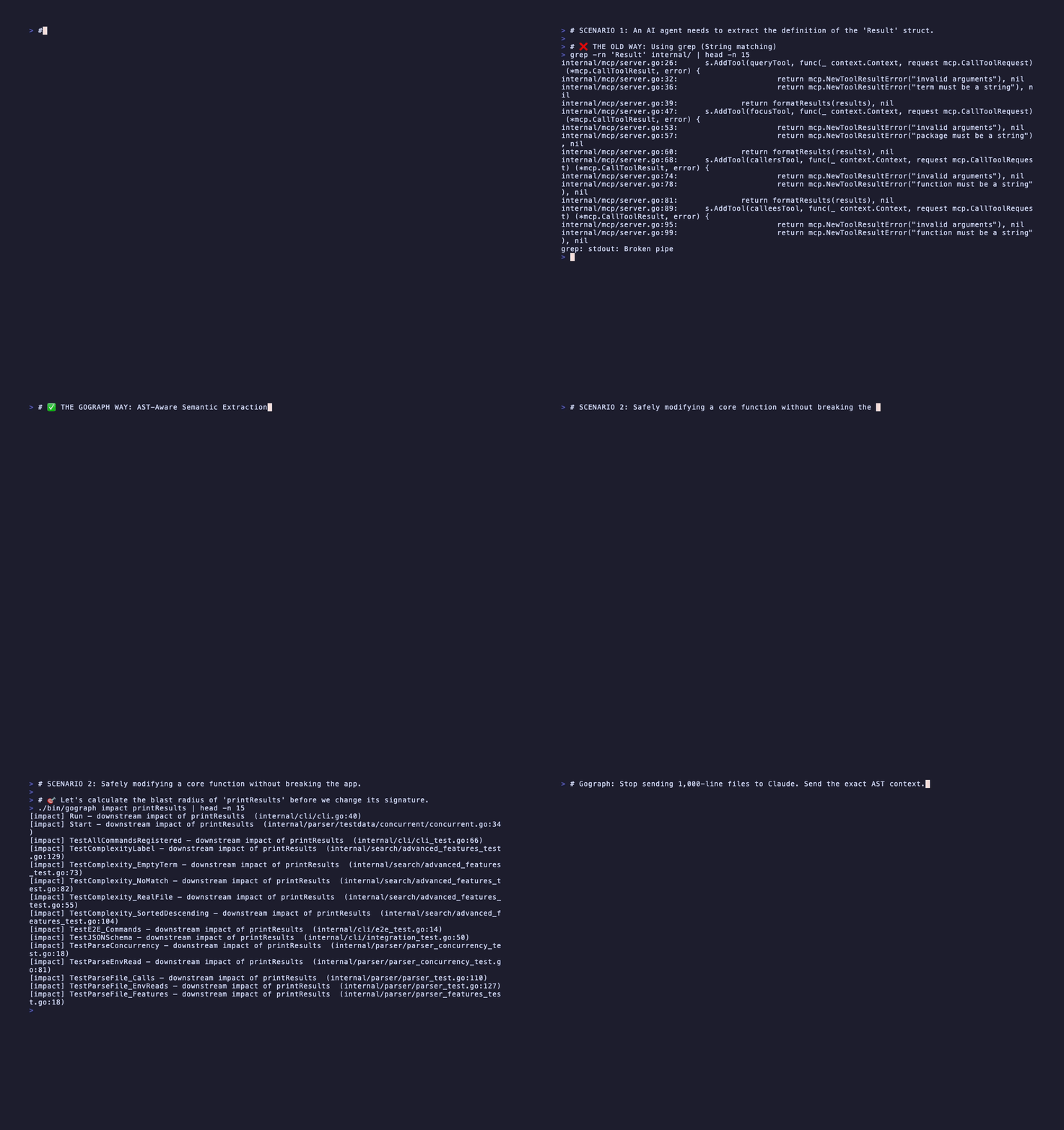
gograph is a CLI tool that builds a compact, queryable graph of Go codebases, designed specifically for AI agents operating in terminal environments. Rather than returning file coordinates that require additional tool calls, it extracts actual code snippets and structures in formats LLMs can consume directly. The project positions itself as complementary to gopls—where the language server targets human IDE workflows, gograph optimizes for token-efficient navigation. With 128 GitHub stars and written in Go for performance, it indexes packages, symbols, calls, routes, and code-quality signals into a local graph that agents can query without burning context on raw file reads.
The interesting bits
The first notable design choice is the emphasis on LLM-optimized output. Commands like gograph context "ValidateToken" return a bundled response containing the node information, source code, callers, callees, and related tests—all formatted for immediate consumption. This contrasts with language servers that might return file.go:42:10 and force the agent to make additional reads. The second standout is the reverse tracing capability: gograph trace "parse failed" performs a reverse breadth-first search from an error string upward through the call stack to find entry points, while gograph errorflow maps error paths from definition to HTTP handlers. These graph-traversal operations aren't available in standard language servers without custom tooling. Finally, the architecture boundary enforcement system lets teams define allowed import relationships through .gograph/boundaries.json, enabling automated enforcement of clean architecture principles in CI pipelines.
Caveats
gograph is explicitly scoped as a Go-only tool—the author notes it was built for personal workflows and doesn't attempt multi-language support, though the architecture is described as extensible. The README candidly describes heuristic extraction as "navigation aids, not authoritative program analysis," meaning routes, SQL queries, test relations, and error mappings may miss edge cases. The tool also acknowledges it cannot replace compiler correctness or guarantee finding every dynamic call. Users need compilable packages for precise mode, and the project avoids AI/model API calls, SaaS backends, or telemetry, keeping everything local but limiting some potential integrations.
If you want to run it
Installation is straightforward with either Homebrew (brew install ozgurcd/tap/gograph) or direct Go install (go install github.com/ozgurcd/gograph/cmd/gograph@latest), though the tool requires running gograph build after code changes to generate the local graph database. The project is MIT licensed and actively maintained, with configuration options for Claude Code and Cursor integrations.
The source is on GitHub.
Comments