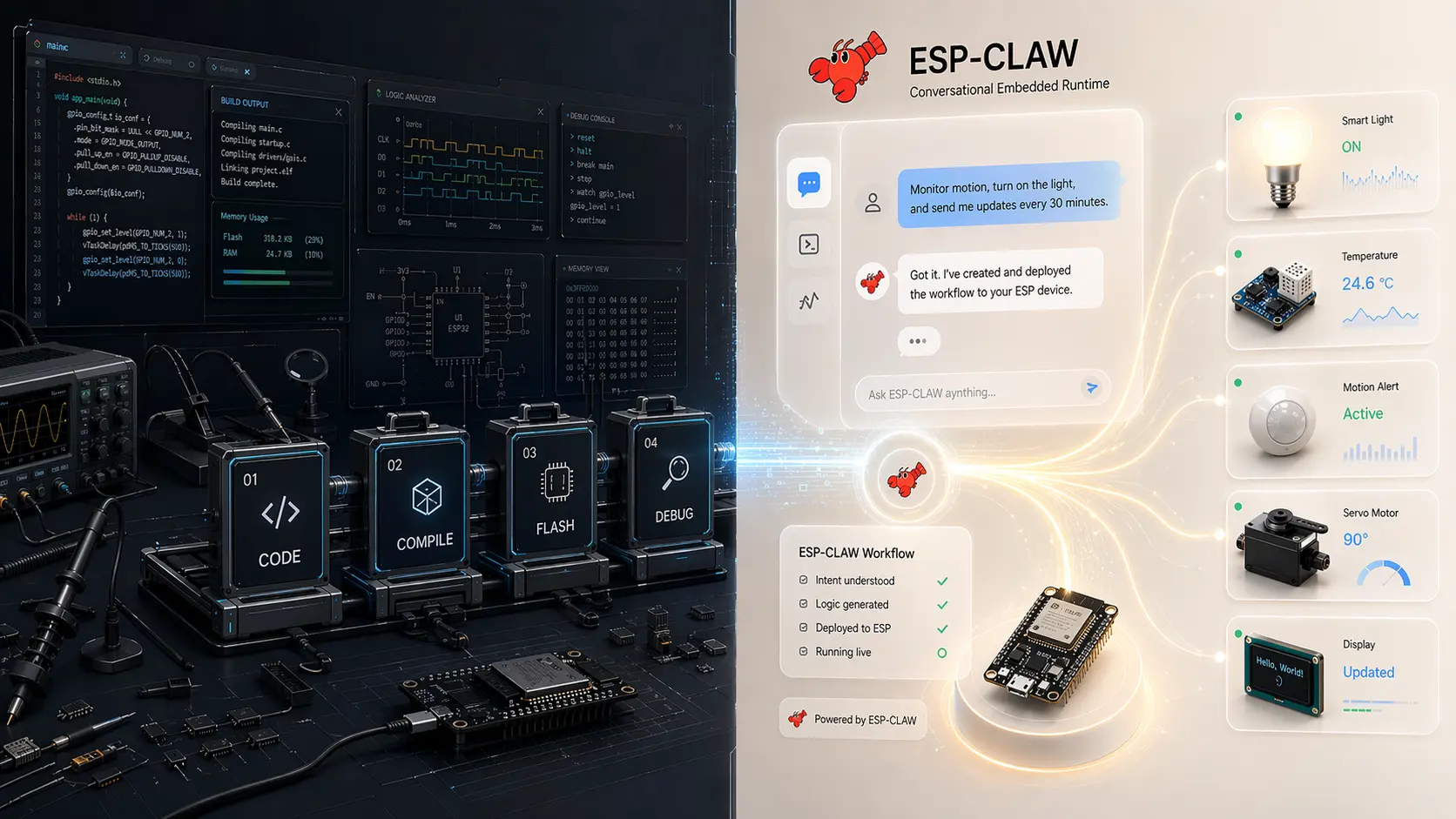
ESP-Claw is a lightweight AI agent framework designed specifically for Espressif’s ESP32-series microcontrollers. Developed by Espressif Systems, it implements what the project calls “Chat Coding”: a method of defining device behavior through natural language chat interfaces, with logic executed locally on the device. Unlike traditional IoT firmware—where behavior is hardcoded or configured via rigid web UIs—ESP-Claw enables dynamic, conversational control and adaptation, all while running fully offline on low-cost hardware. It reimagines the ESP32 not as a passive sensor or actuator, but as an edge-native agent capable of sensing, reasoning, and acting—without relying on cloud inference or constant network connectivity. The framework is written in C, optimized for resource-constrained environments, and builds on concepts from OpenClaw while adapting them for embedded use.
Core features
ESP-Claw delivers several tightly integrated capabilities centered on local intelligence and human-device interaction:
- Chat-driven behavior definition: Users interact via IM-style interfaces (e.g., Telegram or custom chat frontends) to describe tasks—like “turn on the LED when motion is detected”—and ESP-Claw loads and executes Lua-based logic dynamically, without firmware reflash.
- Event-driven agent loop: The system responds to hardware interrupts (GPIO changes, timer expirations, sensor readings) and software events (chat messages, MCP calls) with sub-10ms latency on typical ESP32-WROOM-32 setups.
- Structured on-device memory: Instead of unstructured logs or cloud-stored state, ESP-Claw organizes device memory into typed, queryable structures—e.g.,
sensor_reading,user_preference, orexecuted_action—all retained locally. - MCP (Model Context Protocol) support: It implements both MCP server and client roles, allowing interoperability with external tools (e.g., LLM orchestration layers) while keeping core decision-making on-device.
- Out-of-the-box components: Includes built-in support for common peripherals (I²C, SPI, UART), Bluetooth LE, Wi-Fi management, and pre-integrated Lua runtime—no need to write drivers from scratch.
All features are documented in the official tutorial and demonstrated in video form in the README, though those videos are embedded assets and not hosted on public video platforms.
Getting it running
ESP-Claw is not distributed as a precompiled binary or package manager dependency. It is a firmware framework intended to be built and flashed onto ESP32-series chips using Espressif’s ESP-IDF development environment. The project’s Build from Source guide outlines the required steps:
- Install ESP-IDF v5.3 or later (tested with v5.3.1)
- Clone the repository:
git clone https://github.com/espressif/esp-claw.git cd esp-claw - Set up the build environment:
./install.sh . ./export.sh - Configure and build:
idf.py menuconfig # select target board, Wi-Fi credentials, chat backend (e.g., Telegram) idf.py build - Flash and monitor:
idf.py -p /dev/ttyUSB0 flash monitor
For users without local tooling, the project offers an online flashing tool that generates custom firmware binaries via web UI—though this requires uploading a configuration JSON and does not support arbitrary code injection.
There is no Docker image, npm package, or Python installer. Deployment assumes familiarity with embedded C toolchains and Espressif hardware.
Who this is for
ESP-Claw targets developers and hardware tinkerers who want to prototype AI-augmented IoT behavior without cloud dependencies. It suits use cases where latency, privacy, or offline operation is non-negotiable: industrial edge sensors that must react before network round-trips, educational kits demonstrating agent-based reasoning, or assistive devices that process voice or environmental cues locally. It is also relevant for teams exploring MCP-compliant agent architectures and want a reference implementation that runs on sub-$5 silicon. It is not aimed at users seeking no-code dashboard builders, cloud-connected SaaS IoT platforms, or high-level Python abstractions—it assumes comfort with C, Make/IDF workflows, and bare-metal constraints.
How it compares
Compared to general-purpose embedded AI frameworks like Edge Impulse or SensiML, ESP-Claw prioritizes interactive agent logic over model training or sensor analytics pipelines. It does not include on-device ML model inference; instead, it defers to Lua scripts and external LLMs (via MCP) for decision logic. Against heavier agent runtimes like MicroAgent or Embedded Rust-based agents (e.g., agent-sdk-rs), ESP-Claw is more tightly coupled to ESP32 hardware and Espressif’s ecosystem—but lighter in memory footprint and build complexity. It shares design DNA with OpenClaw, but unlike that Python-based desktop project, ESP-Claw is rewritten in C and designed for <512KB RAM devices. It also differs from ESP-IDF’s native esp_http_client or esp_mqtt examples by embedding a full agent lifecycle—not just connectivity.
ESP-Claw has 617 GitHub stars and is actively maintained by Espressif, with documentation available in English and Chinese. It is licensed under the Apache-2.0 license.
The project is hosted at https://github.com/espressif/esp-claw and documented at https://esp-claw.com.
Comments