Security Research and Defense Framework for QR Code Threat Analysis
Status & Badges
Overview
QR-SHIELD is a research-grade Python framework for analyzing QR-code-related security risks and supporting defensive evaluation. It helps security researchers, detection engineers, and defensive practitioners study QR-code threat scenarios, develop validation methods, and improve awareness of emerging risks in the QR ecosystem.
Core Mission: Translate security research into practical defensive capability.
This project is built for:
Security researchers analyzing QR code threats
Detection engineers designing defensive signatures
Academic institutions studying emerging attack patterns
Authorized penetration testers validating defensive controls
Cybersecurity professionals building threat intelligence
Project Philosophy
QR-SHIELD operates on the principle that understanding relevant threat patterns is essential to building effective defenses. By studying how QR codes can be abused in controlled research settings, the project supports stronger detection systems, improved awareness, and more resilient security implementations.
⚠️ Legal and Ethical Notice
This software is provided for authorized security research, defensive testing, and educational purposes only.
Prohibited Uses
Using QR-SHIELD for any of the following is strictly forbidden:
Phishing campaigns or social engineering attacks
Unauthorized credential exposure or session access
Malware delivery or distribution
Fraud or financial crimes
Unauthorized access to systems or accounts
Any illegal activity
The author and contributors assume no responsibility for misuse or illegal activity conducted with this software.
See ETHICS.md, DISCLAIMER.md, and SECURITY.md for complete legal information.
Features
Core Capabilities
QR Code Session Acquisition
Multi-platform support: Discord, WhatsApp, Signal, Telegram
XPath-based QR detection with cascading fallbacks
Automated QR refresh handling
Post-login session detection
Session Capture and Replay
localStorage session capture (Discord, Signal, Telegram)
Profile-based session capture (WhatsApp)
Session restoration in isolated browsers
Interactive session manipulation
Browser Automation
Selenium 4 integration with automated driver management
Firefox-based automation
User agent rotation
Headless and visible browser modes
Extensible Module System
Plugin architecture for custom modules
Dynamic module discovery
Reusable execution contexts
Clean CLI integration
Research-Grade CLI Framework
Interactive command shell
Command history and resource files
Debug, development, and verbose modes
Modular command system
HTTP Server Integration
Template-based page serving
Dynamic port binding
Thread-safe operation
Jinja2 template support
Architecture Overview
QR-SHIELD
├── Core Runtime (Python 3.10+)
│   ├── Module System (Plugin Architecture)
│   │   ├── Grabber Modules (Session Acquisition)
│   │   └── Post Modules (Session Interaction)
│   ├── Browser Automation (Selenium 4)
│   ├── CLI Framework
│   └── Configuration System
├── Research Modules
│   └── Multi-platform Implementations
└── HTTP Server (Template Rendering)
See ARCHITECTURE.md for detailed technical breakdown.
Use Cases
Security Research
Analyze QR code threat surfaces
Develop threat detection signatures
Study credential exposure scenarios
Research emerging attack patterns
Detection Engineering
Build QR-based threat detection systems
Develop behavioral analytics
Create controlled security simulation environments
Validate security controls
Defensive Security
Authorized penetration testing
Security awareness training
Defensive control validation
Incident response planning
Academic Research
Study QR code security
Analyze platform vulnerabilities
Document security patterns
Publish findings and recommendations
Research Objectives
Threat Analysis: Characterize QR code attack vectors and threat models
Detection Development: Engineer detection mechanisms for QR-based threats
Defensive Hardening: Identify and implement defensive techniques
Awareness: Build security consciousness around QR code risks
Knowledge Sharing: Publish findings to advance the field
Repository Structure
qr-shield/
├── README.md                          # Project overview
├── ARCHITECTURE.md                    # Technical architecture
├── CONTRIBUTING.md                    # Contribution guidelines
├── CODE_OF_CONDUCT.md                 # Community standards
├── ETHICS.md                          # Ethical guidelines
├── SECURITY.md                        # Security policy
├── DISCLAIMER.md                      # Legal disclaimer
├── RESPONSIBLE_DISCLOSURE.md          # Vulnerability disclosure
├── THREAT_MODEL.md                    # Threat analysis
├── ROADMAP.md                         # Development roadmap
├── CHANGELOG.md                       # Version history
├── INSTALL.md                         # Installation guide
├── USAGE.md                           # Usage documentation
├── FAQ.md                             # Frequently asked questions
├── LICENSE                            # Community Research License
├── NOTICE                             # Dual Licensing Summary
├── COMMERCIAL-LICENSE.md              # Commercial licensing terms
│
├── core/                              # Main package
│   ├── app.py                         # Application entry point
│   ├── Cli.py                         # CLI dispatcher
│   ├── module.py                      # Module execution
│   ├── plugin_manager.py              # Module discovery
│   ├── browser.py                     # Selenium integration
│   ├── Settings.py                    # Settings loader
│   ├── ui.py                          # UI utilities
│   ├── color.py                       # Color definitions
│   ├── utils.py                       # Utility functions
│   ├── db.py                          # Database registry
│   │
│   ├── config/                        # Configuration system
│   │   ├── models.py                  # Config dataclasses
│   │   ├── loader.py                  # Config loader
│   │   └── defaults.py                # Default values
│   │
│   ├── modules/                       # Extensible module system
│   │   ├── grabber/                   # Session acquisition
│   │   │   ├── discord.py
│   │   │   ├── whatsapp.py
│   │   │   ├── signal.py
│   │   │   └── telegram.py
│   │   └── post/                      # Session interaction
│   │       ├── discord.py
│   │       ├── whatsapp.py
│   │       ├── signal.py
│   ��       └── telegram.py
│   │
│   ├── registry/                      # Module registry
│   │   └── modules.py
│   │
│   ├── templates/                     # Jinja2 templates
│   │   └── phishing_page.html
│   │
│   ├── www/                           # Web assets
│   │   ├── discord/
│   │   ├── signal/
│   │   ├── telegram/
│   │   └── whatsapp/
│   │
│   └── Data/                          # Static data
│       ├── banners.txt
│       └── version.txt
│
├── docs/                              # Documentation
│   ├── architecture.md
│   ├── installation.md
│   ├── usage.md
│   ├── threat-model.md
│   ├── security.md
│   └── images/
│
├── tests/                             # Test suite
│   └── test_settings.py
│
├── sessions/                          # Session storage
├── profiles/                          # Browser profiles
├── pyproject.toml                     # Python project config
├── requirements.txt                   # Dependencies
└── qrshield.py                        # CLI entry point
Quick Start
Installation
Prerequisites:
Python 3.10 or later
Firefox browser
pip package manager
Basic Installation:
git clone https://github.com/dreamed000/QR-SHIELD.git
cd qr-shield
pip install -r requirements.txt
python qrshield.py
For development and contribution, install the optional dev dependencies:
pip install -e ".[dev]"
See INSTALL.md for detailed installation instructions.
First Run
python qrshield.py
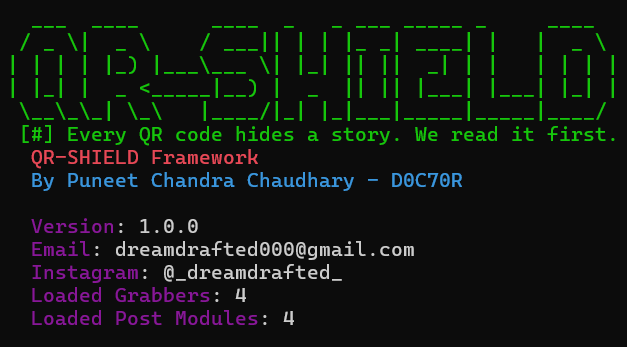
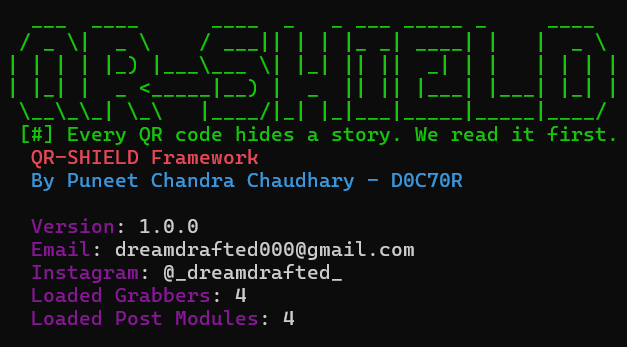
You will see the QR-SHIELD banner and an interactive prompt. From there, you can use commands such as help, list, use, options, set, run, and sessions.
Example workflow:
qrshield> list
qrshield> use grabber/discord
qrshield> run
Help System
qrshield> help
qrshield> list
qrshield> info grabber/discord
qrshield> use grabber/discord
Configuration
Environment Variables
QRSHIELD_FIREFOX_BINARY- Firefox executable pathFIREFOX_BINARY- Fallback Firefox pathWSL_DISTRO_NAME- WSL detection
On Windows PowerShell, the same setting can be applied at runtime with:
$env:QRSHIELD_FIREFOX_BINARY = "C:\path\to\firefox.exe"
Runtime Modes
python qrshield.py --debug      # Debug mode with tracebacks
python qrshield.py --dev        # Development mode with module reload
python qrshield.py --verbose    # Verbose logging
python qrshield.py -q           # Quiet mode (no banner)
Resource Files
Execute commands from file:
python qrshield.py -r commands.rc
Direct Command Execution
python qrshield.py -x "use grabber/discord; run"
Threat Model
QR-SHIELD implements research into the following threat scenarios:
Session Exposure via QR Code
Observing active sessions during QR-based authentication
Evaluating secondary verification controls
Credential Exposure Analysis
Reviewing exposure paths from captured sessions
Understanding token management risks
Post-Exposure Assessment
Evaluating behavior after session exposure
Understanding platform response patterns
Attack Surface Analysis
Identifying QR-specific security considerations
Documenting platform-specific weaknesses
See THREAT_MODEL.md for complete threat analysis.
Security Considerations
Design Principles
Isolation: Research activities should be conducted in isolated, controlled environments
Visibility: Operations should be traceable and auditable
Containment: No persistent changes to systems under evaluation
Consent: Only use against systems you own or have explicit authorization to test
Responsible Use
Only operate on systems you control or have written authorization to test
Inform relevant parties before conducting authorized testing
Document all testing activities
Report findings through responsible disclosure channels
Never conduct unauthorized access
See SECURITY.md and RESPONSIBLE_DISCLOSURE.md.
Documentation
| Document | Purpose |
|---|---|
| README.md | Project overview and quick start |
| ARCHITECTURE.md | Technical architecture and design |
| INSTALL.md | Installation and setup |
| USAGE.md | Detailed usage documentation |
| THREAT_MODEL.md | Threat analysis and attack vectors |
| SECURITY.md | Security policy and considerations |
| ETHICS.md | Ethical guidelines and principles |
| DISCLAIMER.md | Legal disclaimer |
| RESPONSIBLE_DISCLOSURE.md | Vulnerability disclosure process |
| FAQ.md | Frequently asked questions |
| CONTRIBUTING.md | Contribution guidelines |
| CODE_OF_CONDUCT.md | Community standards |
Roadmap
Version 1.0.0 (First Public Release)
✅ First public GitHub release
✅ Modern Python packaging and developer workflow
✅ Python 3.10+ support
✅ Multi-platform support (Discord, WhatsApp, Signal, Telegram)
Planned Features
See ROADMAP.md for detailed development plans.
Versioning
QR-SHIELD follows Semantic Versioning.
Version Format: MAJOR.MINOR.PATCH
MAJOR: Breaking changes or significant rewrites
MINOR: New features or substantial improvements
PATCH: Bug fixes and minor improvements
See CHANGELOG.md for version history.
Citation
If you use QR-SHIELD in your research, please cite:
@software{qrshield2026,
  author = {Chaudhary, Puneet Chandra},
  title = {QR-SHIELD: Security Research Framework for QR Code Threat Analysis},
  year = {2026},
  version = {1.0.0},
  url = {https://github.com/dreamed000/QR-SHIELD},
  note = {First public release}
}
See CITATION.cff for additional citation formats.
Author
Puneet Chandra Chaudhary
GitHub: @dreamed000
Email: dreamdrafted000@gmail.com
ORCID: 0009-0005-7220-2327
Disclaimer
This software is provided "as-is" without warranty or liability. Use is at your own risk and subject to applicable laws and regulations. The author assumes no responsibility for misuse, damage, or illegal activity.
See DISCLAIMER.md for complete legal terms.
Status
Project Status: Active Development and Maintenance
Security: Actively maintained
Documentation: Regularly updated
Bug fixes: Prioritized
Features: Community-driven
Last Updated: July 2026
Repository: github.com/dreamed000/QR-SHIELD
Comments