HUMINT and social network analysis toolkit platform for cybercrime investigation.
Build the graph of actors, personas, groups and the trust between them — where every line of it traces back to an exhibit.
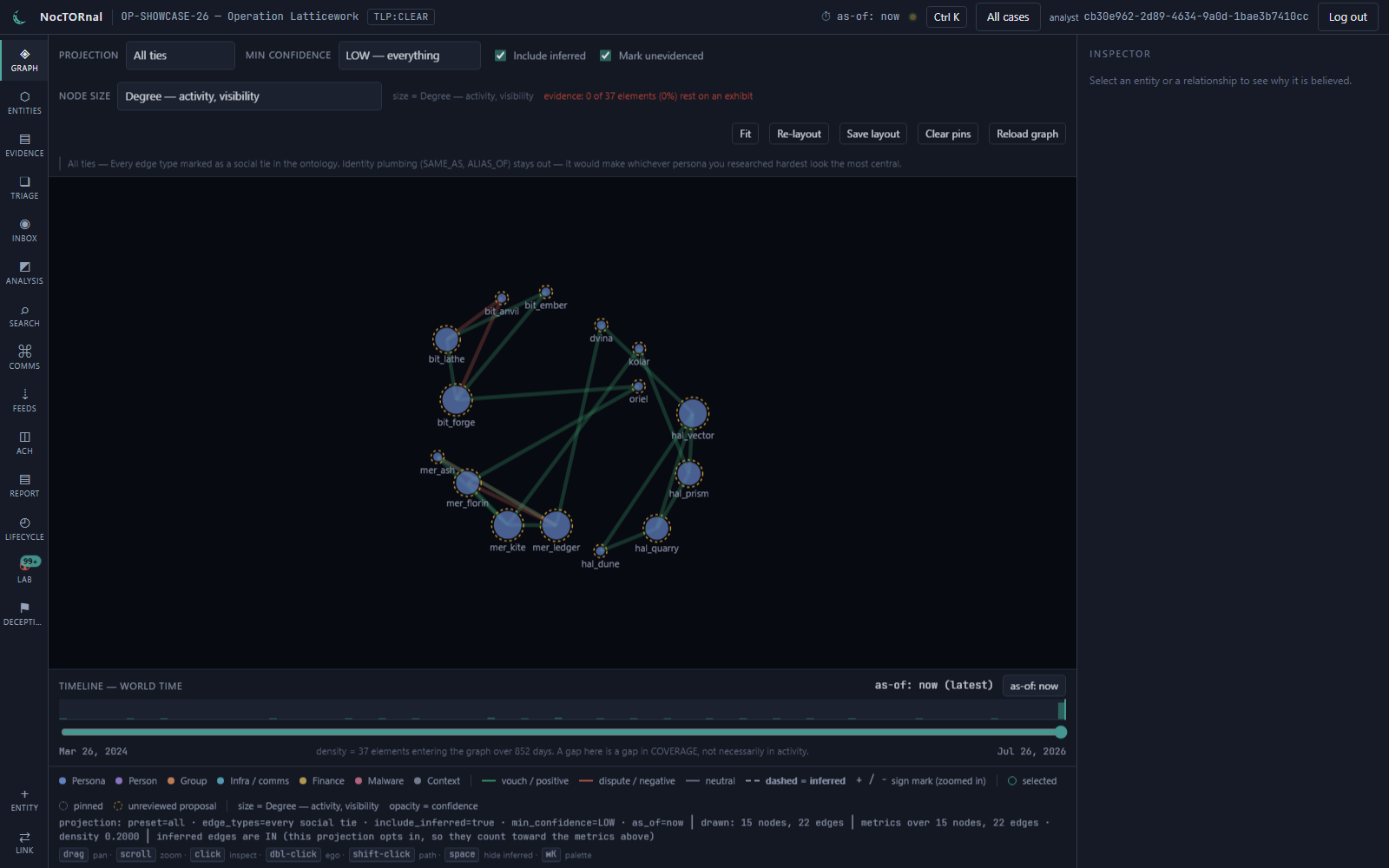
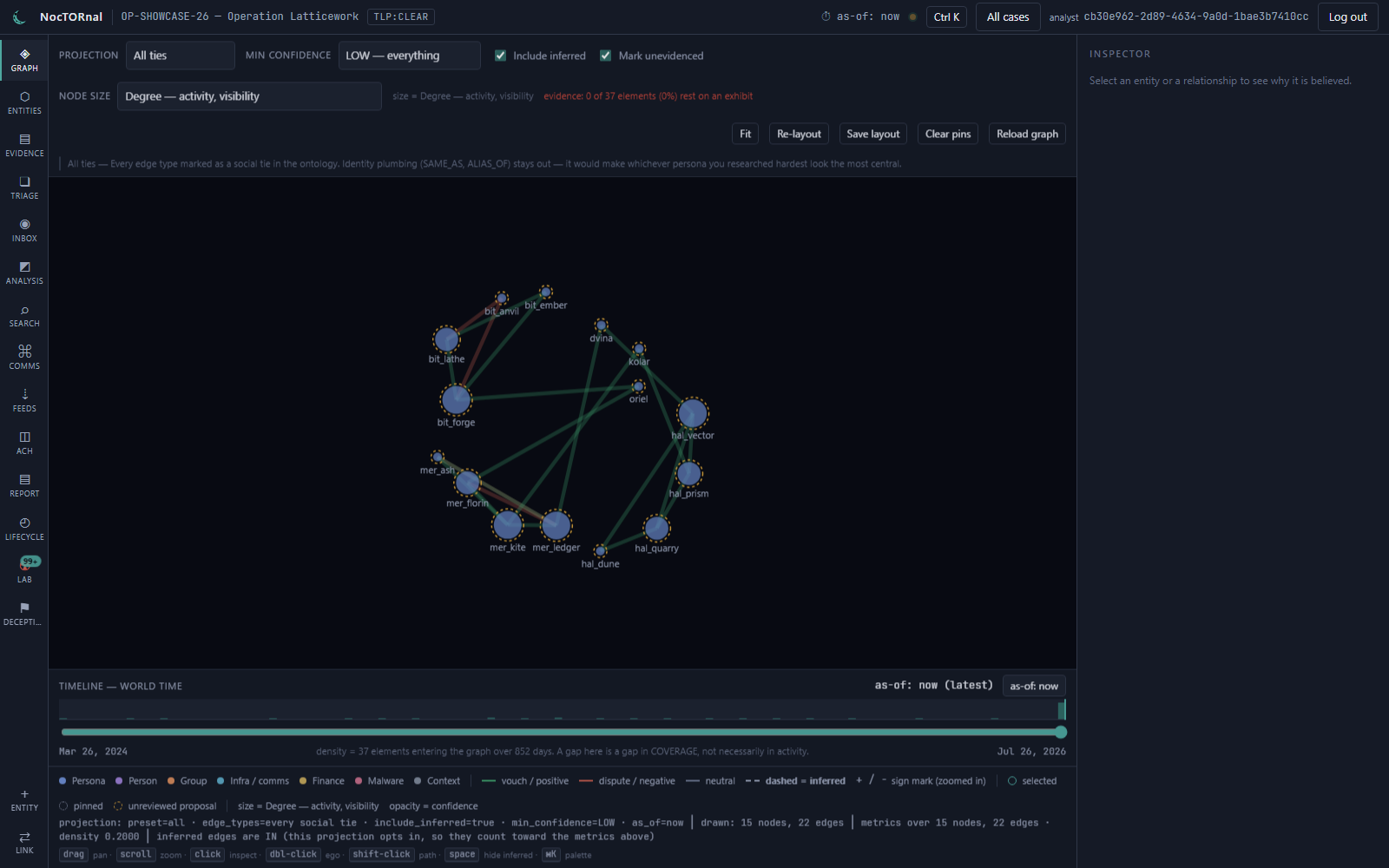
Every screenshot in this README is a live render of the bundled TLP:CLEAR synthetic showcase case. Every actor, handle, domain and phone number in it is fiction.
⚠ READ THIS FIRST — capability is not authorisation
This software is unaudited, has never been operated against real targets, and is not certified for evidential use. Nothing in it grants permission to do what it makes possible.
Every capability here was built to a specification, not to a legal authority. The build refuses several operations until an operator declares a policy — and a declaration is a string this software stores, not a fact it verifies. A false or absent declaration produces a working system and an unlawful deployment, and the difference is invisible from inside the code.
If you are the person who has to sign this off, go straight to
docs/18-legal-review-pack.md— the register reorganised as a decision document: every question, its option set, the consequence of each choice, what the build does while it waits, and a row to write the answer in.Nothing here is legal advice. It is an inventory of the places where legal advice is required, written by the people who built the code so the assumptions do not live only in their heads.
Five blocking items, none of them a software problem
| What is built | What is assumed, and is not true until somebody makes it true | |
|---|---|---|
| L1 | A sample store that ingests attacker-supplied binaries | That a prohibited-content policy exists, written with counsel, covering preservation-vs-destruction. Given enough attacker-chosen files, one will eventually contain material whose possession alone is an offence — that is the normal failure mode of the problem domain, not a hypothetical. REJECTED currently destroys the bytes, which is the wrong answer where preservation is required; reject(purge_bytes=False) exists and nothing selects it automatically. |
| L2 | Stealer-log ingest holding data on thousands of uninvolved people | That a lawful basis exists, that victim-notification duties are understood, and that the retention period is real. 90 days is a placeholder somebody typed. |
| L3 | A persona vault that will drive a covert account into a forum | That operating that persona is authorised in each jurisdiction. Accessing a system with credentials registered under a false identity engages computer-misuse law in several jurisdictions regardless of intent. |
| L4 | Message-level capture, including group channels and call recordings | That interception law, one-party vs two-party consent, and retention of uninvolved third parties' content are settled. provenance_class records which kind of capture it was; it cannot confer authority for any of them. |
| L5 | Web capture of phishing infrastructure | That fetching attacker infrastructure is authorised, and — separately — that entering any input into a phishing page, including canary credentials, is covered. That may constitute unauthorised access. The schema refuses to record a submission without a written authority reference. |
Plus eight operator determinations and thirteen factual claims that
came from documentation or reasoning rather than an authoritative source
— including platform identifier mappings, which change, and where a stale
mapping produces confident false attribution rather than a visible
error. See docs/16-legal-and-external.md.
What it is
Analysts working organised cybercrime spend most of their time on a question that is social, not technical: who trusts whom, and why? Which broker vouched for which affiliate. Which escrow both sides accept. Which handle on this forum is the same human as that handle on that channel — and how confident is anyone, really.
NocTORnal is the case system for that work. It is closest in spirit to Maltego's pivoting and i2 Analyst's Notebook's link charts, with UCINET's seriousness about the underlying network mathematics. What it adds is the thing those tools leave to discipline: provenance that cannot be skipped.
Every node attribute and every relationship is anchored to a row in an assertion ledger carrying a source, an Admiralty reliability/credibility grading and a timestamp. There is no code path that writes a graph element without one — enforced by a database trigger, not a convention. Ask any node on the chart "why do you say that?" and you get a chain back to a WORM-locked exhibit with an unbroken custody log.
That single decision changes what the tool is for. A link chart is a picture of what somebody believed. This is a case file that survives disclosure.
Who it is for: cybercrime units building ransomware affiliate structures or initial-access brokerage; CTI teams who need attribution work a lawyer can read; financial-crime investigators following the social layer above mule networks; and anyone who has had a link chart questioned and been unable to answer "where did that line come from?"
What you actually do with it
The four investigations it was built for
1 · Ransomware affiliate structure. You have twenty handles across
three forums and a leak site. Who is the same person? Who vouched for
whom, and when did that vouch turn into a rip-off accusation? NocTORnal
keeps IDENTITY (the handle you observed) separate from PERSON (the
human you assessed) and joins them with a reversible attribution carrying
a confidence — so "we think these five handles are one operator" is a
claim you can show your working for, and withdraw without losing the
underlying observations.
2 · Initial-access brokerage. The interesting actor is rarely the loudest. Betweenness and Burt's constraint find the broker whose removal disconnects two crews; key-player analysis then tells you that removing two named brokers achieves less than removing one, because they redundantly bridge the same pair. That is a different answer from "the top two by centrality", and it is the one that matters operationally.
3 · Business email compromise. A finance team paid an invoice to the
wrong account. You have the mail, a phishing page and a phone call. The
Received chain gives you the sender's real IP as observed by your own
relay — with the trust boundary drawn, so nobody attributes the case to a
forged upstream hop. The capture ties the screenshot to the redirect chain
and the TLS certificate. The call record keeps the spoofed caller ID and
the carrier's attestation apart, so the bank's real number never lands on
the attacker's node.
4 · Fraud and mule networks. The transactions are the easy part. The social layer above them — who recruited whom, which escrow both sides accept, which guarantor turns up in unrelated disputes — is what the sociogram is for.
A session, start to finish
- Open a case. It carries a legal basis, a retention date, a review date and a TLP classification. Every element inside inherits that floor.
- Put in what you have. Paste a forum profile, upload an exhibit,
drop in a vendor contact block, attach a
.eml. Extraction runs and raises proposals — it does not touch the graph. - Triage. Accept, reject or defer. An acceptance writes an assertion carrying the machine's rationale and an Admiralty grading, so the graph never forgets a machine suggested it.
- Look at the shape. Choose a projection — which edge types count as a social tie — and run the metrics. Drag the timeline to see what was believed last month.
- Test your explanation. Put the competing hypotheses in the ACH matrix and score them against the evidence. The one that survives is the finding; the ones that did not go in the report beside it.
- Release it. Build the report at a target classification. Anything above it is structurally withheld — not redacted afterwards. The egress gate decides whether the document may leave, and records the decision either way.
Where it fits against what you already use
| vs. Maltego | Maltego is better at breadth-first OSINT pivoting from a transform marketplace. NocTORnal is a case system: it keeps the assertion ledger, the custody chain and the classification model that a disclosure exercise needs. |
| vs. i2 Analyst's Notebook | i2 has the mature chart-drawing and decades of trained analysts. NocTORnal makes provenance non-optional and ships the SNA maths (Leiden, Burt, key-player) rather than leaving it to a separate tool. |
| vs. a Neo4j project | A graph database gives you the graph. Everything here that is hard — the assertion layer, the five-part access gate, TLP-gated egress, WORM custody, retention and legal hold — is the part you would then have to build. |
| vs. a spreadsheet | Honestly, a spreadsheet is fine for ten actors. The moment somebody asks "why do you say that?" about row 400, it is not. |
What it is not
- Not an OSINT collection suite. It ingests; it is not a scraper farm. Collection adapters exist for RSS and the ingest API, and the rest is deliberately your problem — see the legal items above.
- Not an attribution oracle. There is no "is this the same person?" button. There is a model that makes your reasoning explicit and reversible.
- Not a malware sandbox. The lab holds samples safely and records detonation requests; nothing in this build detonates anything.
- Not deployable against real material today. Five legal decisions gate that, and no amount of code closes them.
Install
Two supported paths. Both are one command, and both are safe to re-run.
powershell -ExecutionPolicy Bypass -File .\release\install.ps1
macOS / Linux
chmod +x release/install.sh && ./release/install.sh
The -ExecutionPolicy Bypass and the chmod are not optional: the
default Windows policy is Restricted, a script extracted from a zip
carries Mark-of-the-Web, and an unzipped .sh has no execute bit.
What the installer does, reporting each step rather than assuming it:
- finds Python 3.12+, or tells you exactly how to get it
- checks Docker is installed, the engine is running, and Compose v2 is present
- creates
.venvand installs the two workspace packages - generates a fresh TOTP key and ingest pepper into
.env.local(mode 600) and never overwrites an existing one - starts Postgres, Redis, MinIO and Mailpit, then waits for the database to actually accept connections
- applies all 52 Alembic migrations
- offers to create your first account, printing the password once with a QR code to scan
- starts the API and opens the console
Detail and troubleshooting: release/INSTALL.md.
Prerequisites
| Minimum | Notes | |
|---|---|---|
| Python | 3.12 | 3.13 is what it is developed and tested on daily |
| Docker Desktop | with Compose v2 | runs Postgres, Redis, MinIO, Mailpit |
| RAM | 8 GB | ~3 GB for the four containers |
| Disk | 5 GB | images, database, object store |
| OS | Windows 10/11, macOS 12+, Linux | PowerShell 5.1 is supported and specifically tested for |
| GnuPG | optional | only for verifying PGP signatures on contact blocks |
Ports: 5432, 6379, 9000, 9001, 1025, 8025, 8000. A collision on any fails the Compose start; 5432 is the usual offender if you already run Postgres locally. Nothing needs internet access after install, except the optional YARA rule fetch.
First run
The installer leaves you at a sign-in page with the account it created.
# A second terminal needs no exports — bootstrap.py reads .env.local.
.venv/bin/python scripts/bootstrap.py create-user \
    --email you@example.org --name "Your Name"
On Windows that is .venv\Scripts\python. Then seed the showcase case
every screenshot below comes from:
.venv/bin/python scripts/bootstrap.py demo-network \
    --owner-email you@example.org --code OP-SHOWCASE-26
.venv/bin/python scripts/seed_deception_demo.py --case OP-SHOWCASE-26
If TOTP rejects every code, your host clock is out of step. Diagnose with
bootstrap.py totp-diagnose, or get in anyway withbootstrap.py session, which prints a URL that opens the console already signed in. That login is recorded in the audit trail as MFA-bypassed, because a session that appeared from nowhere would be worse than no session at all — and step-up-gated actions (merge, export, purge, sample download) stay refused until you have a real TOTP login.
Verifying the install
DATABASE_URL="postgresql+psycopg://noctornal:dev_only_change_me@localhost:5432/noctornal" \
  .venv/bin/python -m pytest apps/api/tests packages/ontology -q
Expect 1269 passed, 0 skipped. Without DATABASE_URL you will see
roughly 700 skips instead — half the suite is database-gated by design.
That is a correct result, not a broken install.
The tour
Sociogram
WebGL rendering over sigma.js. Projections decide which edge types
count as a social tie — identity plumbing (SAME_AS, ALIAS_OF) stays
out, or whichever persona you researched hardest looks the most central.
Inferred edges render dashed and are excluded from metrics unless a
projection opts in. The bar along the bottom is world time: drag it and
the graph becomes what was believed on that date.
Structural analysis
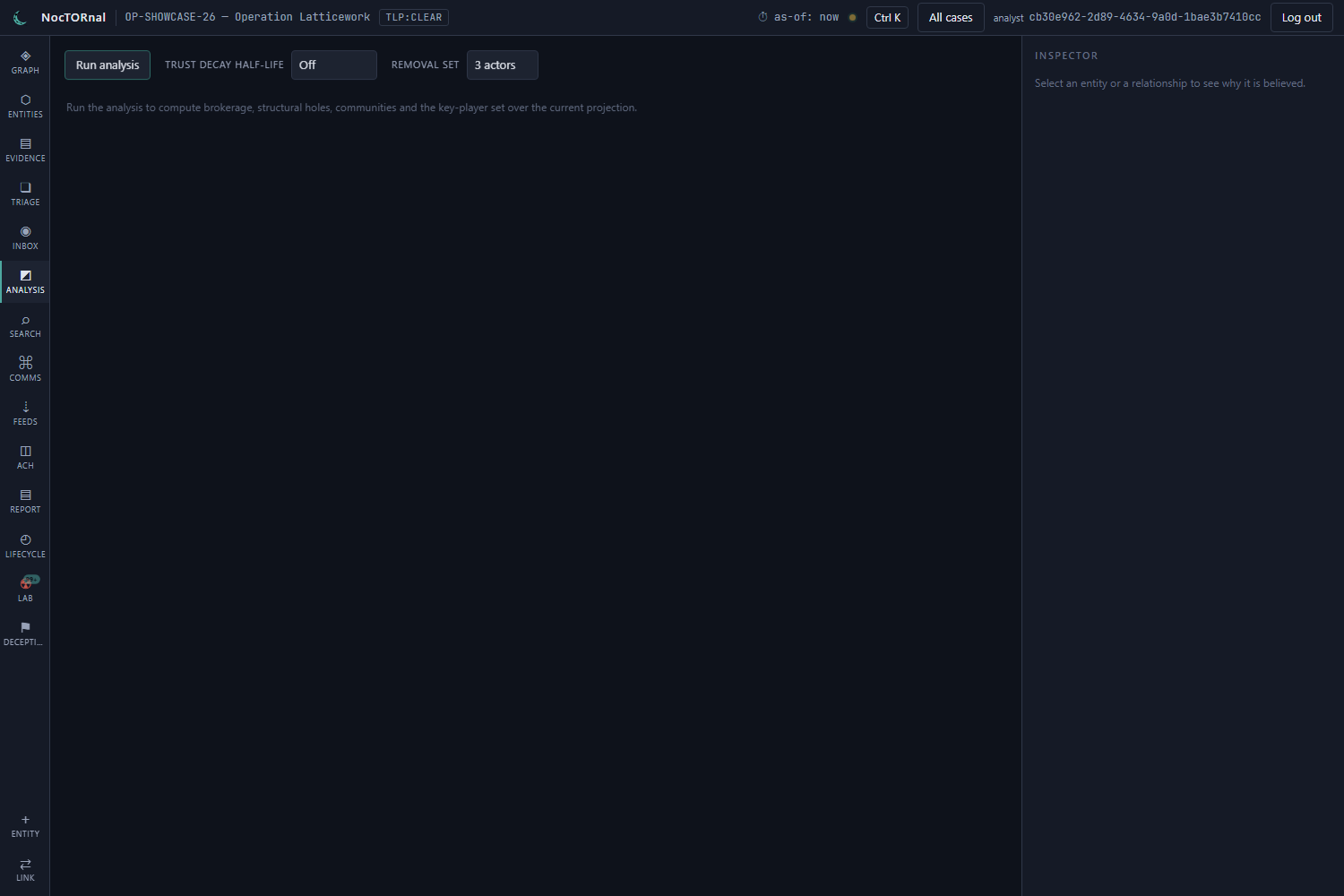
Betweenness, eigenvector, k-core, Burt's constraint and Leiden communities
via igraph's C core. Key-player analysis is a set problem, not the
top-n by centrality: two brokers who redundantly bridge the same two
crews are worth less together than either alone, and the panel says so
rather than ranking them 1 and 2.
Evidence and chain of custody
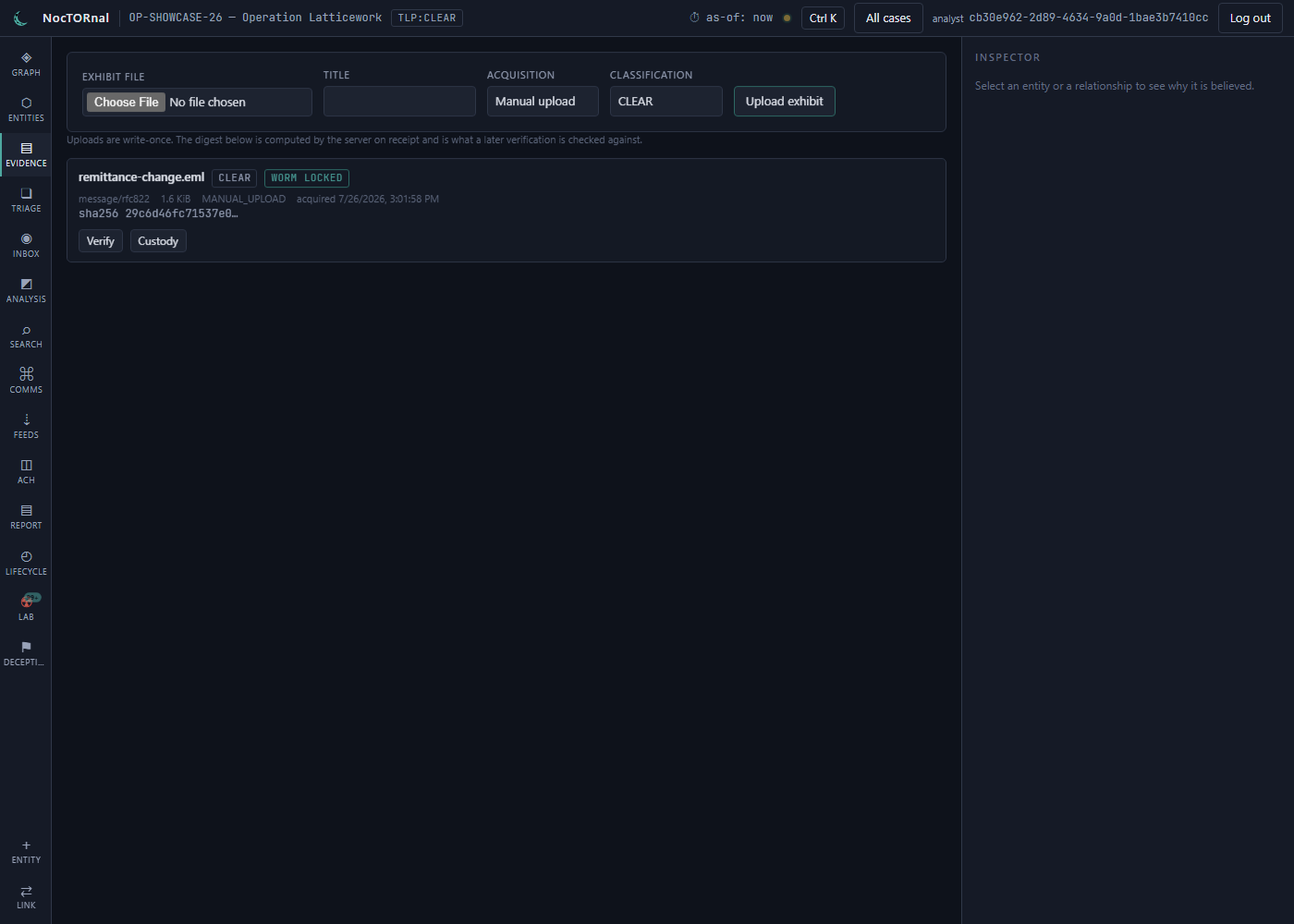
SHA-256 and BLAKE3 at ingest; MinIO object lock in COMPLIANCE mode, so not even a root credential can alter an exhibit before retention expires; an append-only hash-chained custody ledger that records every touch, including reads.
Competing hypotheses (ACH)
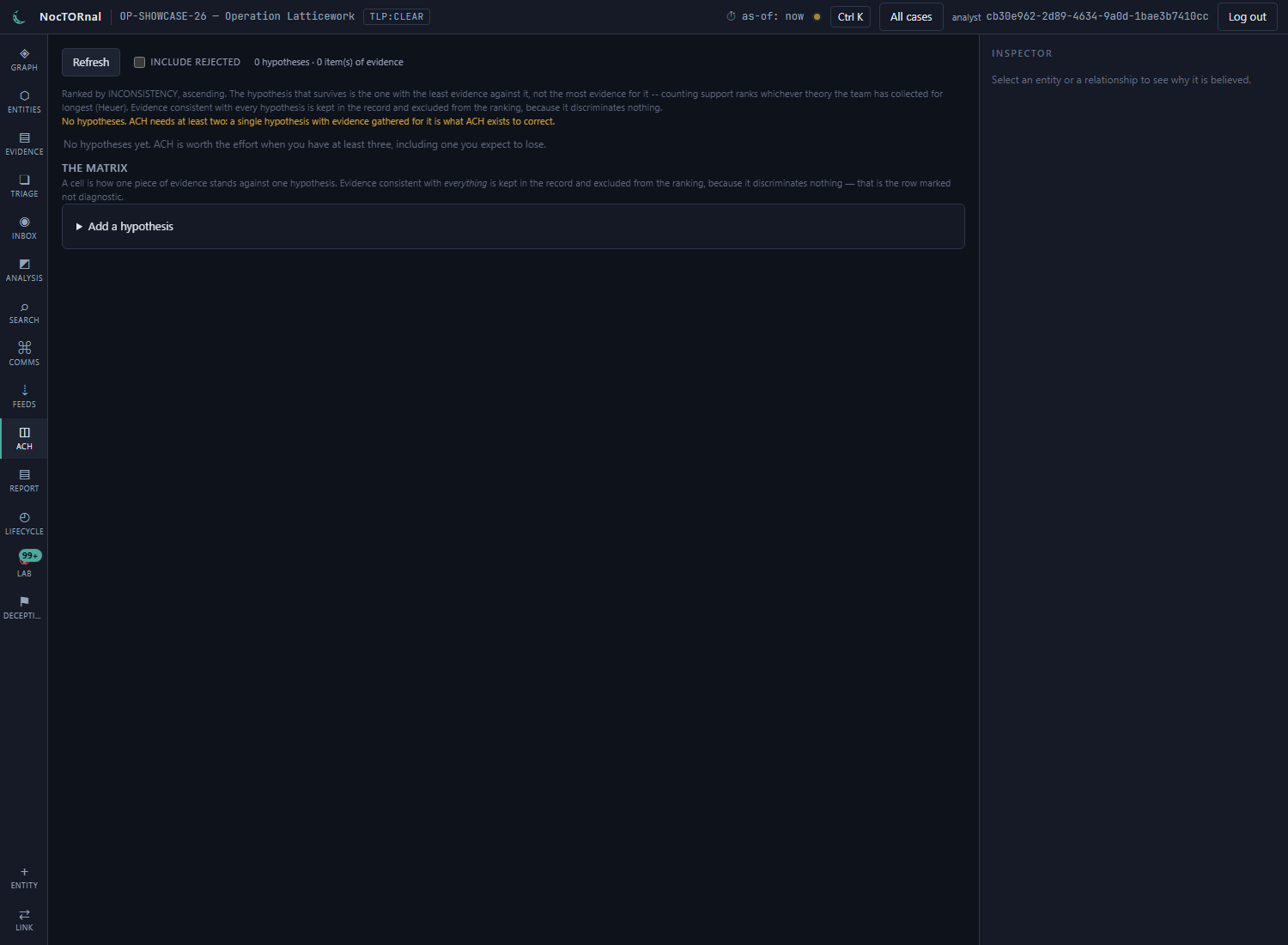
Hypotheses scored against evidence explicitly, and a report carries the alternatives that were ruled out beside the one that was not. An analytic line without its rejected competitors is an assertion, not an assessment.
Deception — phishing, BEC and vishing
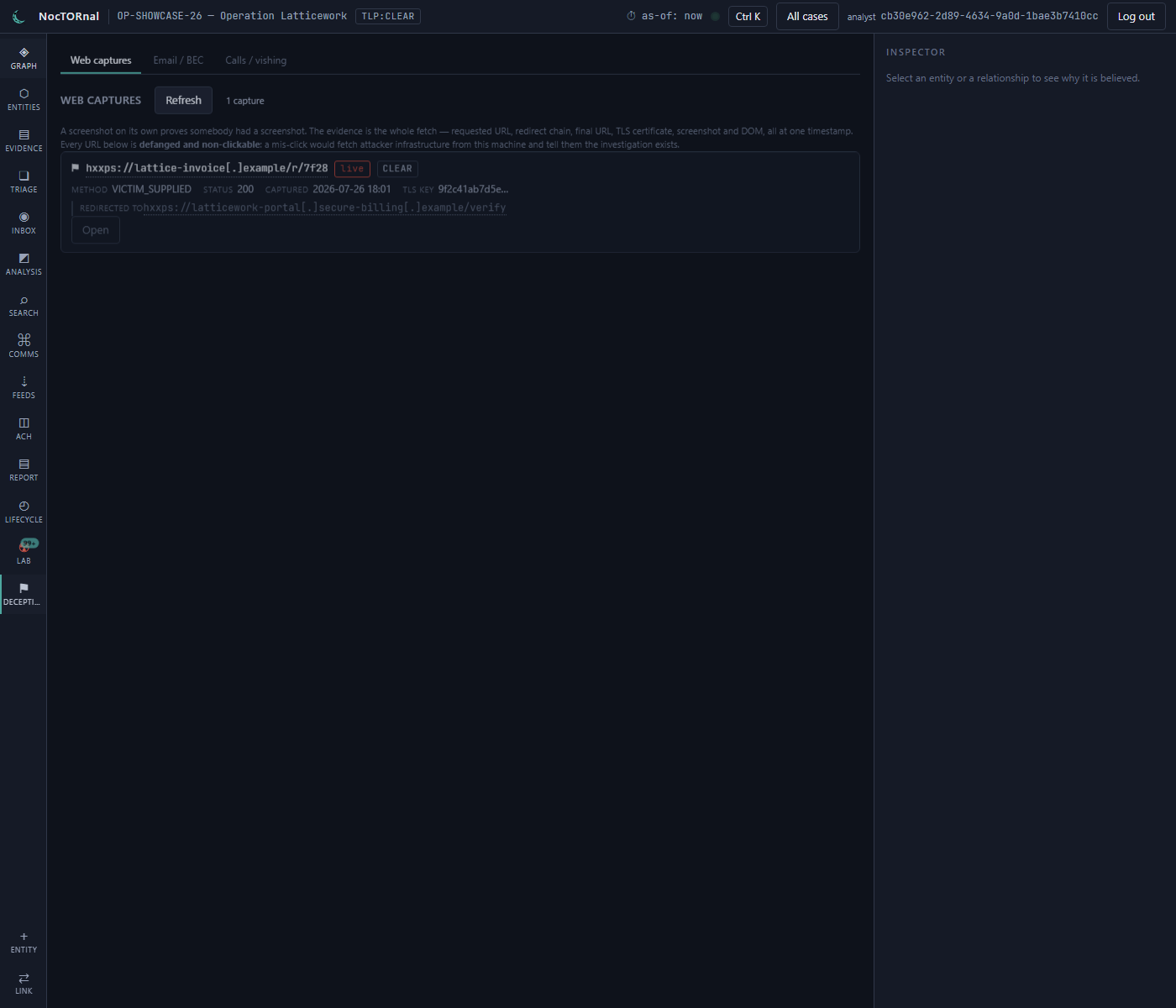
Captures where the screenshot, redirect chain and TLS certificate are
one indivisible exhibit. BEC email with the Received chain drawn
recipient-first and its trust boundary marked, because everything
above that hop is attacker-writable. Call records that keep the spoofable
caller ID and the durable carrier attestation in separate, separately
labelled blocks — collapsing them is how a crime gets attributed to
whoever's number the attacker picked. Every URL defanged and
non-clickable. See docs/19.
Malware lab
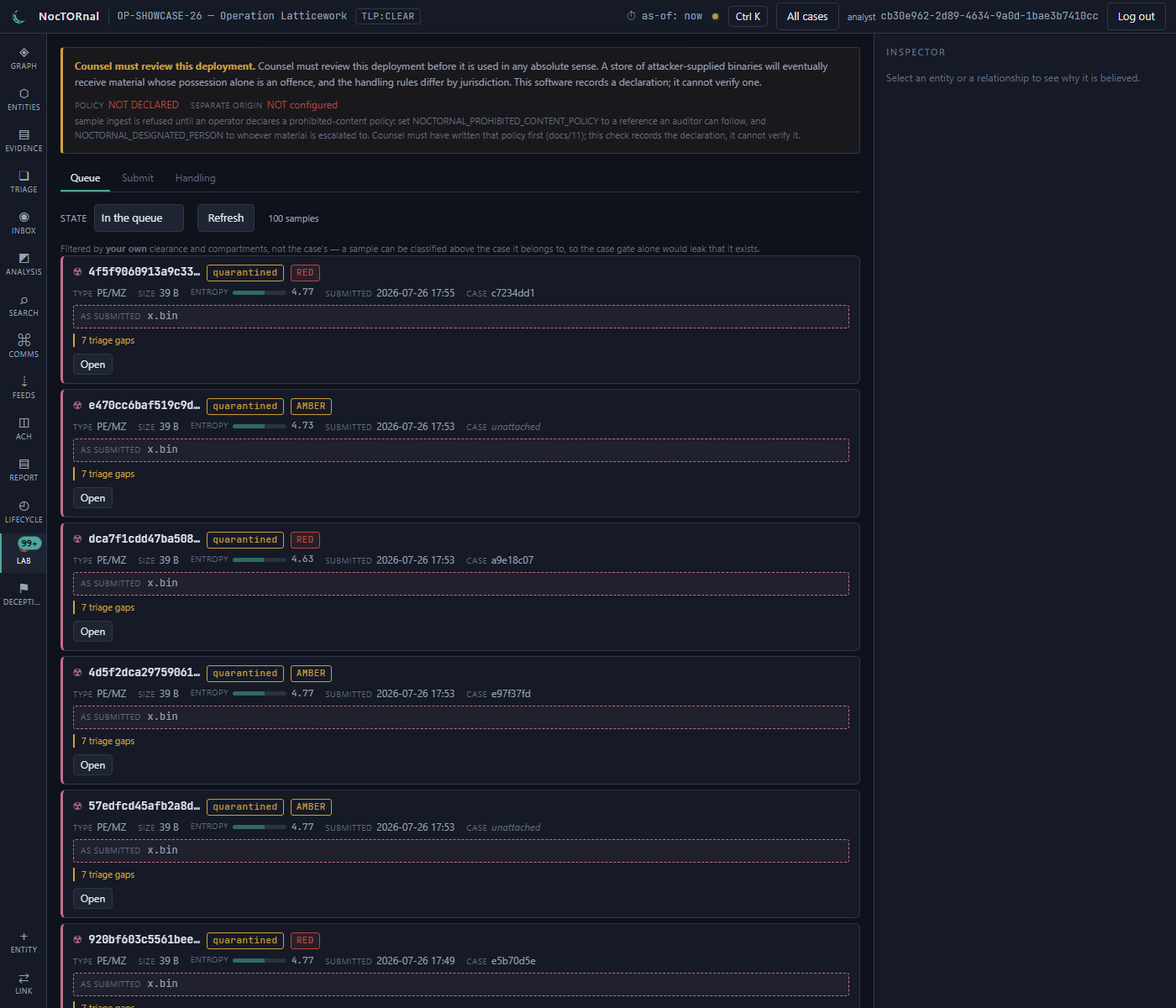
Metadata renders; bytes never do. Samples are encrypted at rest and
downloadable only from a separate origin. Detonation requests that
would send anything outside the boundary require a named authoriser and a
written reason — a database CHECK, not a code review.
Channels and contact blocks
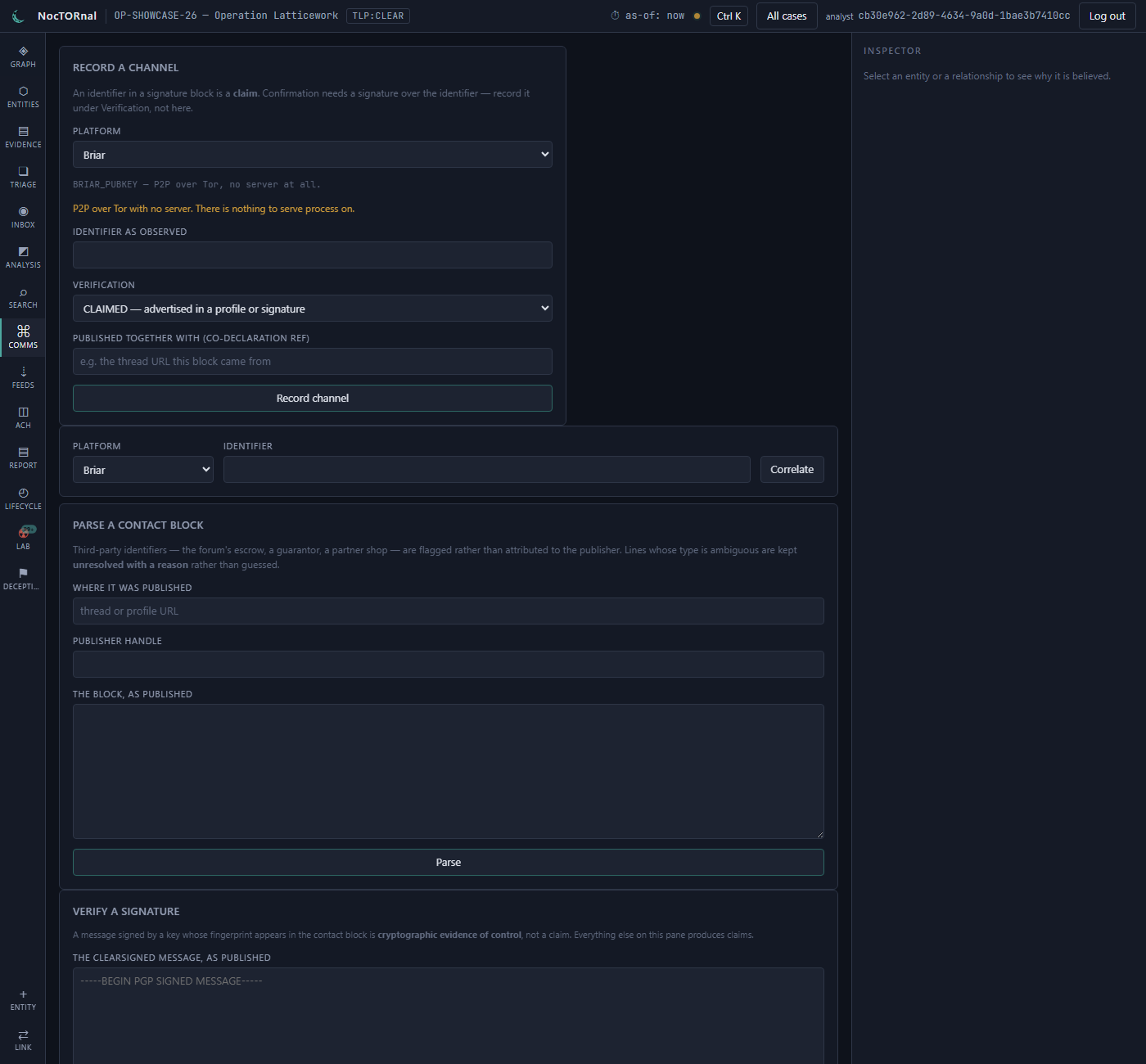
Durable identifiers, not displayed ones. Tox indexes the 64-hex public key because the nospam rotates at will; Telegram indexes the numeric id, namespaced by id space, because usernames are recycled. A pasted vendor contact block is parsed with the escrow's identifier attributed to the escrow, not to the vendor.
Lifecycle and governance
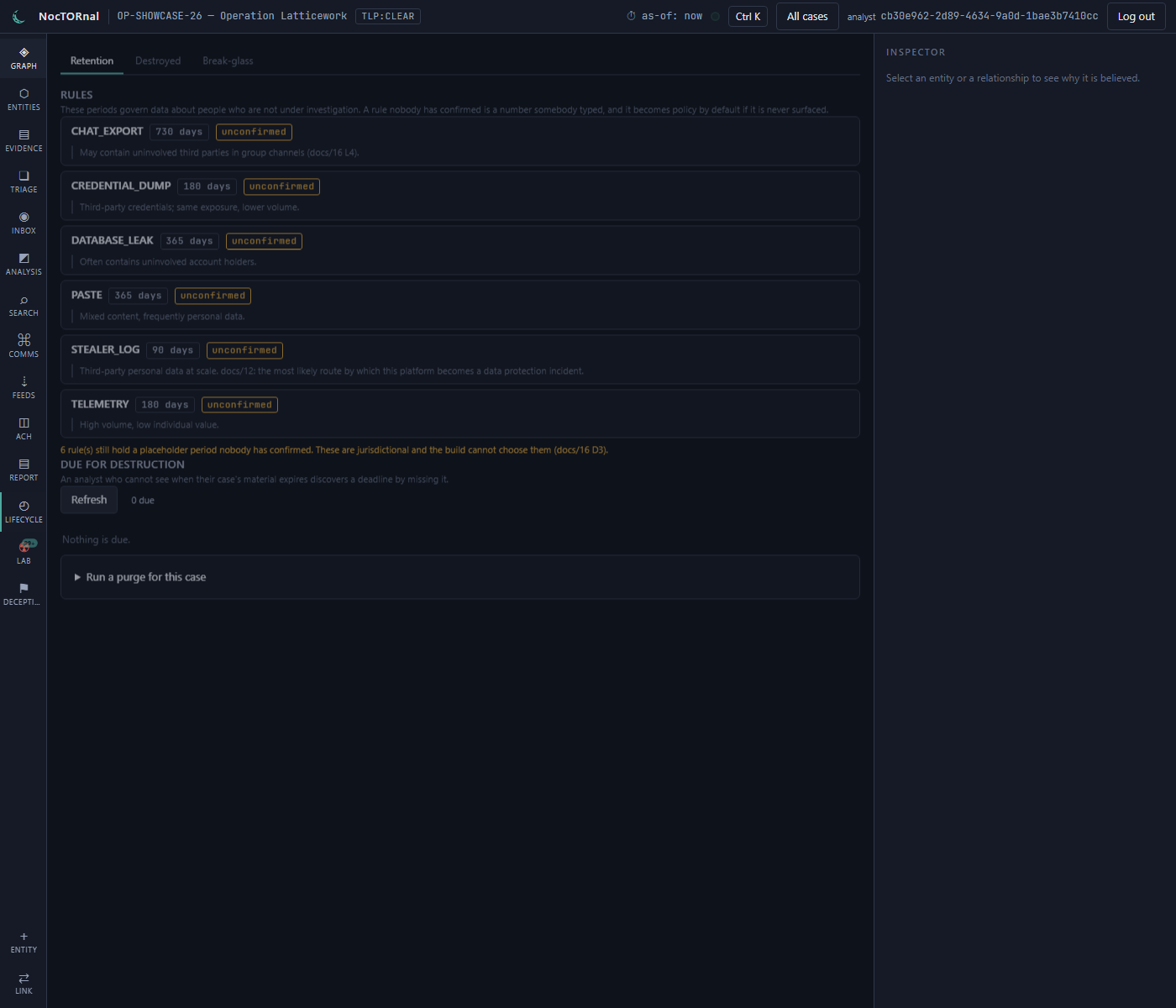
Retention schedules; legal holds that override every deletion path; purge tombstones that outlive what they describe; break-glass access that is loud, dual-controlled and time-boxed.
Entity list
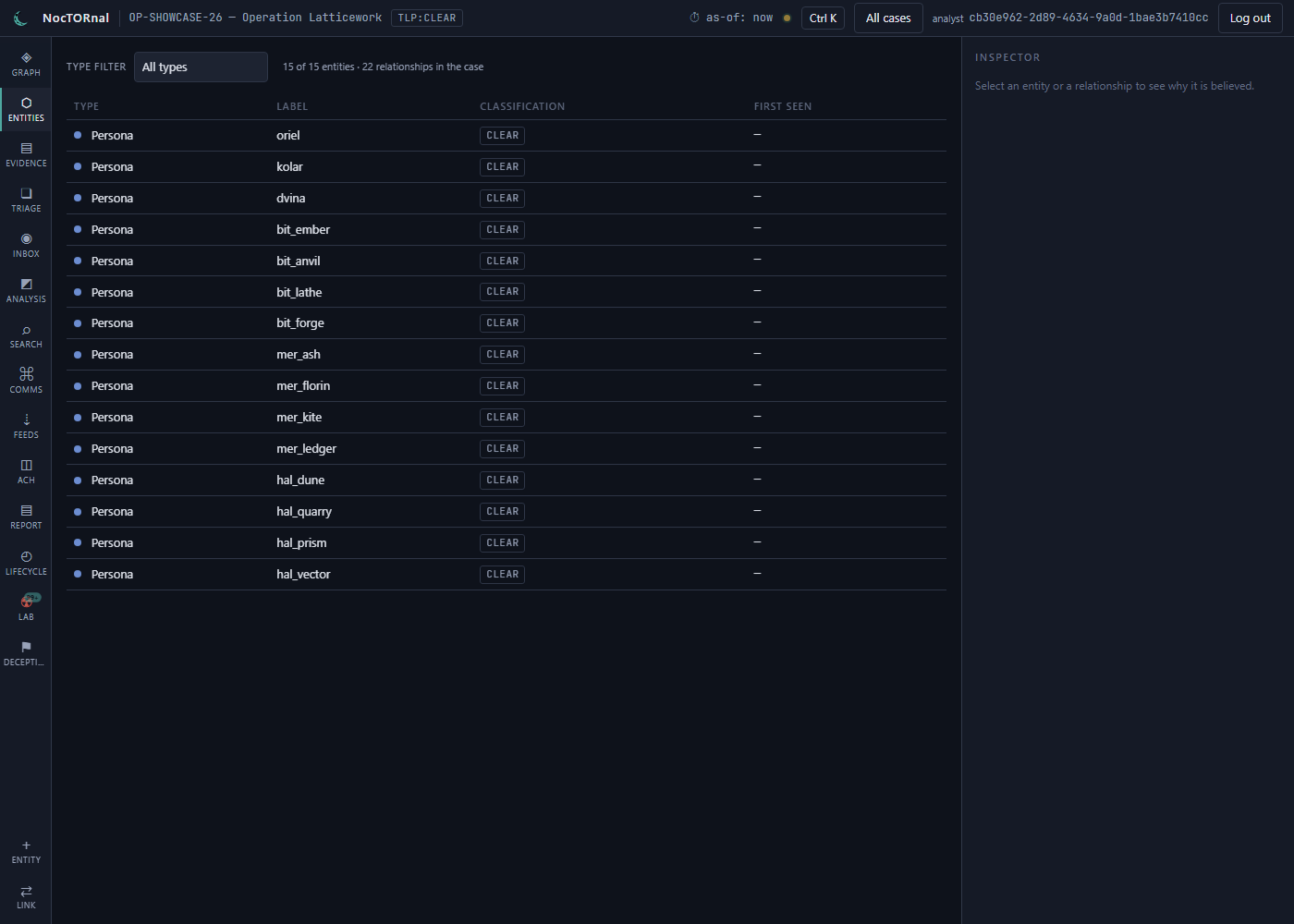
Every node in the case with its type, labels, selectors and Admiralty grading. The type colour is the same one the sociogram uses, so the two views read as one thing. Filter by type, by tag, or by whether an element still rests on a live assertion.
Capture and triage
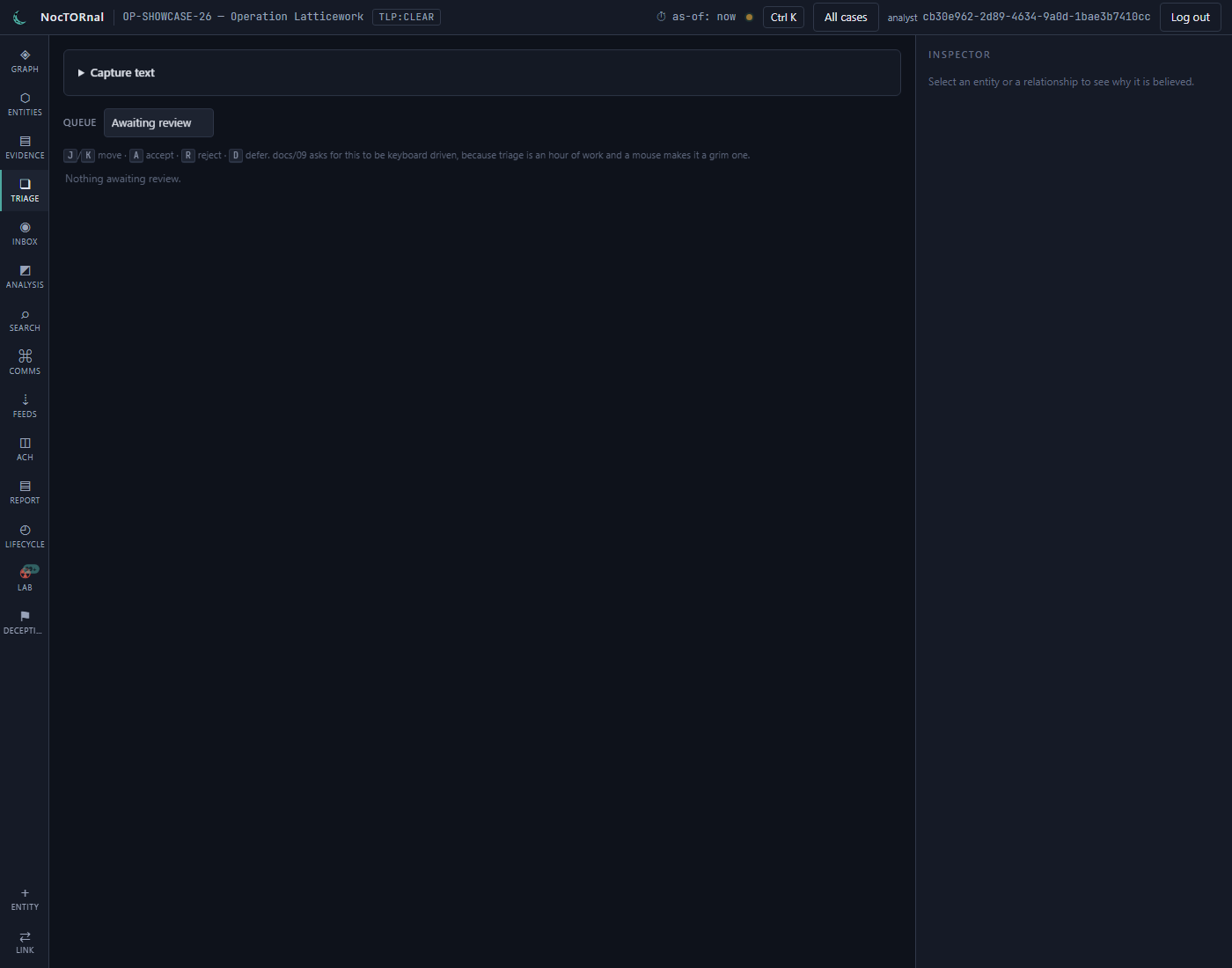
Paste an observation — a forum profile, a vendor advert, a contact block —
and extraction raises proposals. Nothing here writes to the graph.
Accept, reject or defer; a deferral parks the ambiguous item as DISPUTED
rather than forcing a yes/no on something that does not deserve one yet.
J and K move through the queue.
Notifications
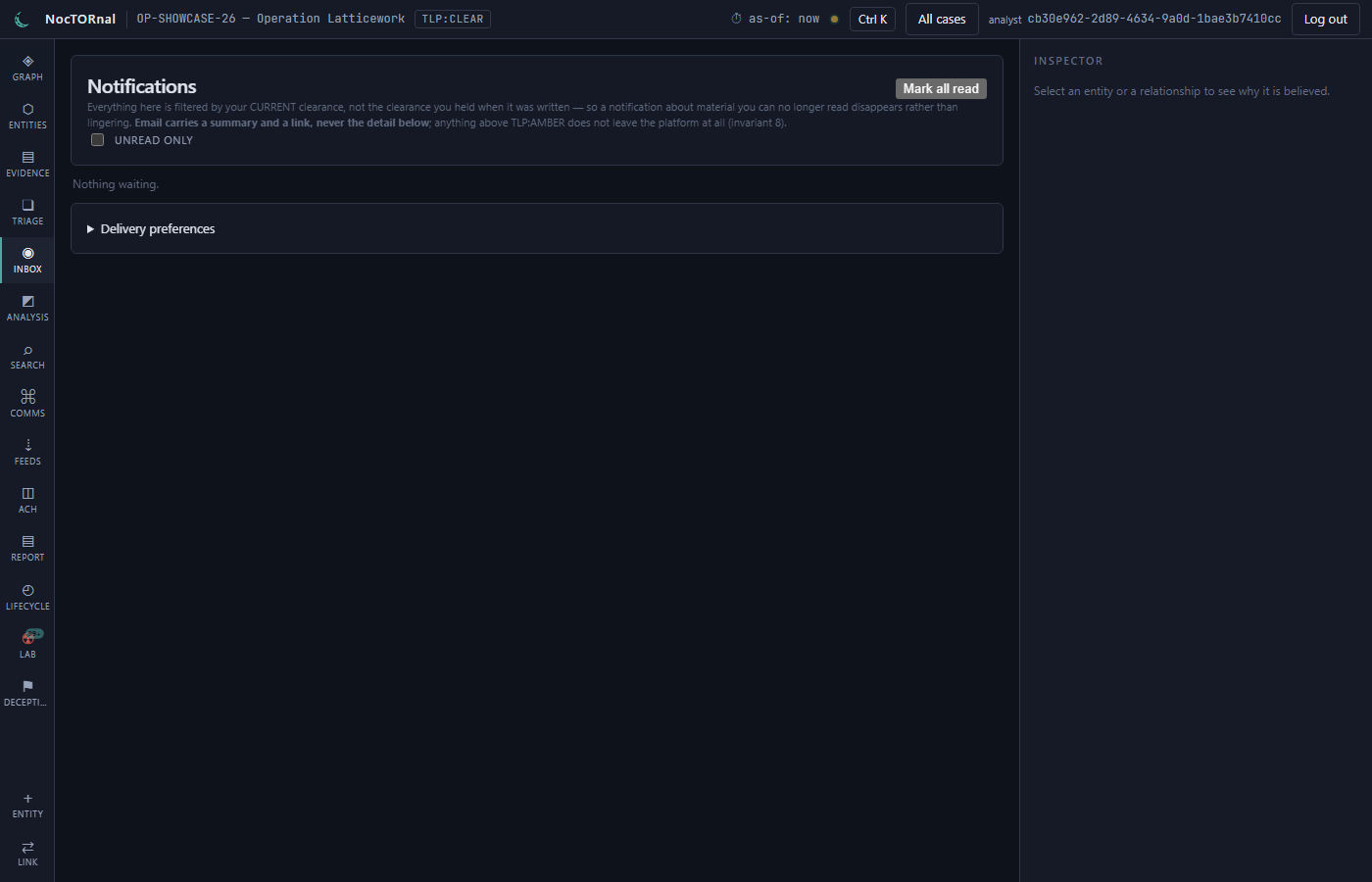
Re-authorised on every delivery, not only at subscribe time. A long-lived subscription and a case assignment have different lifetimes, and a notification centre that checked once was the headline finding of a previous review.
Search
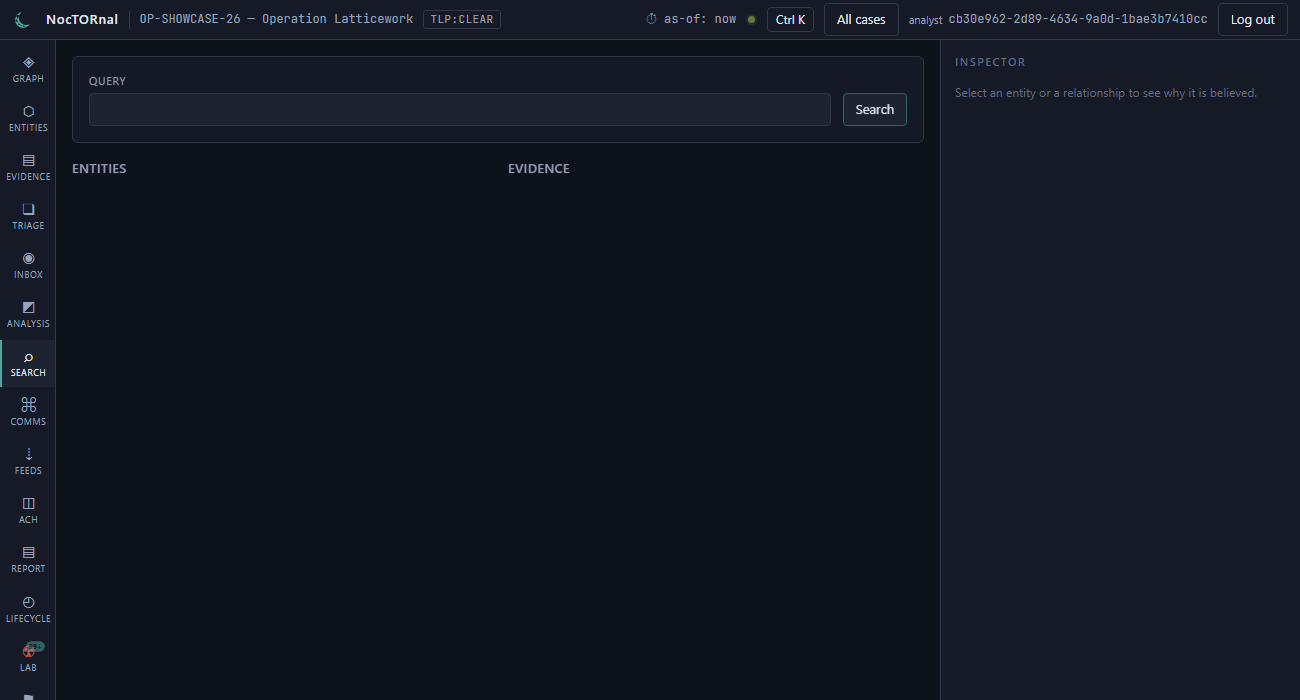
Filtered by your own clearance and compartments, so an over-classified element is invisible rather than discoverable-then-403. The two columns load independently — one failing does not blank the other.
Feeds and ingest
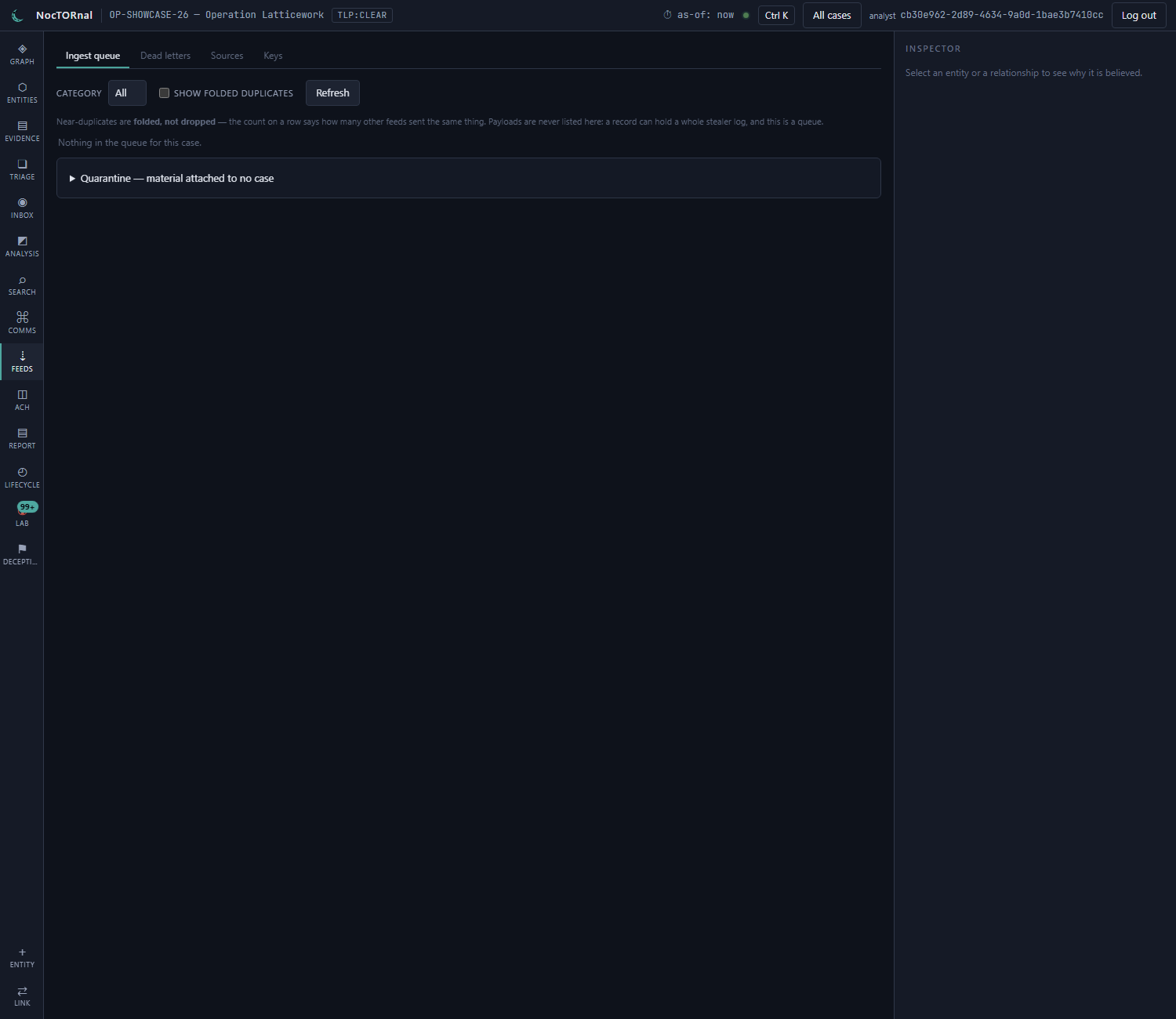
Monitored sources, their run history, the persona vault, and the dead-letter table: anything unparseable is kept with its raw fragment. Silent drops are how you find out six months later that a feed has been half-failing.
Report
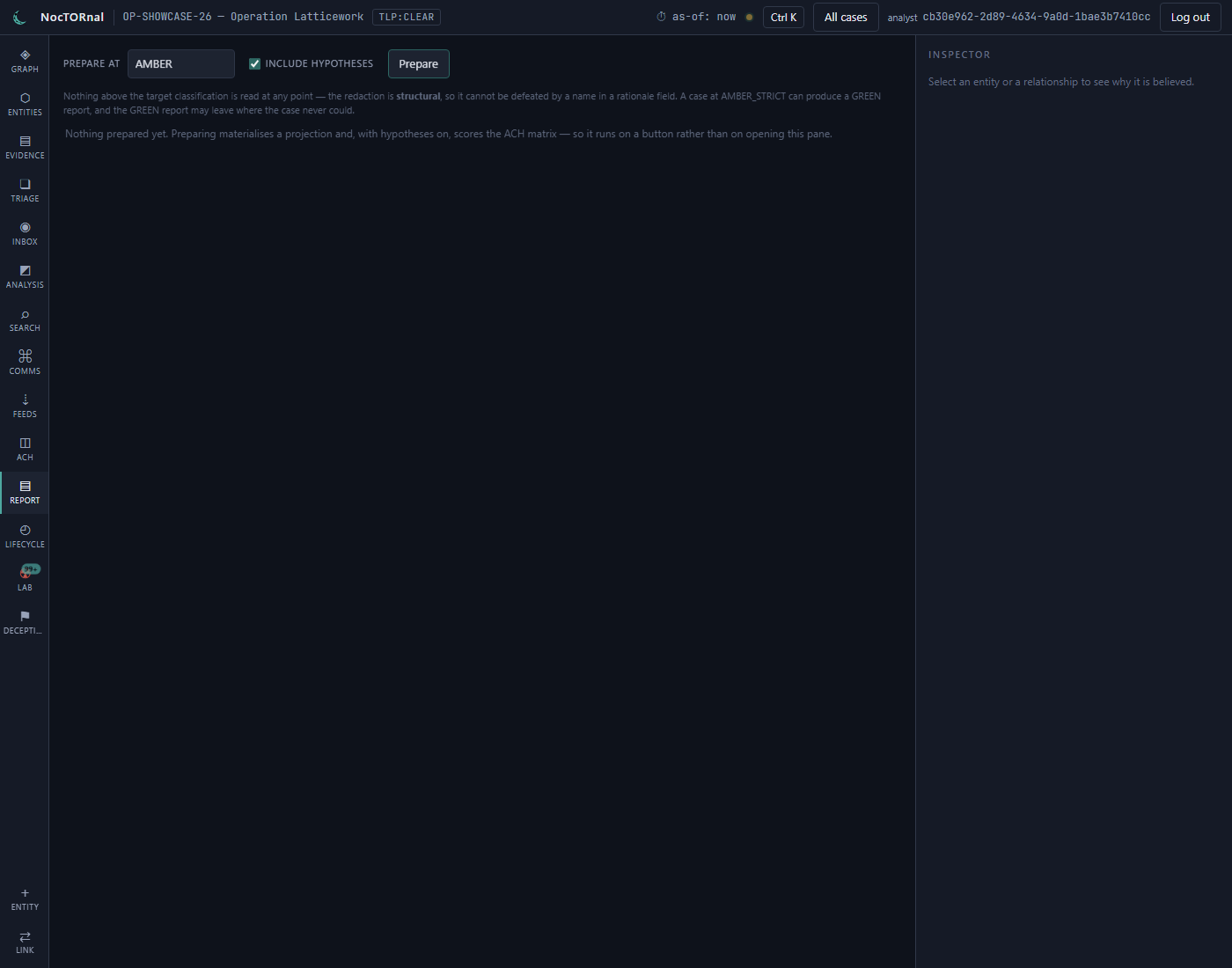
Build at a target classification — the redaction is structural, so nothing above that level is read at any point and it cannot be defeated by a name in a rationale field. Release is a separate action, through the egress gate, and is recorded either way.
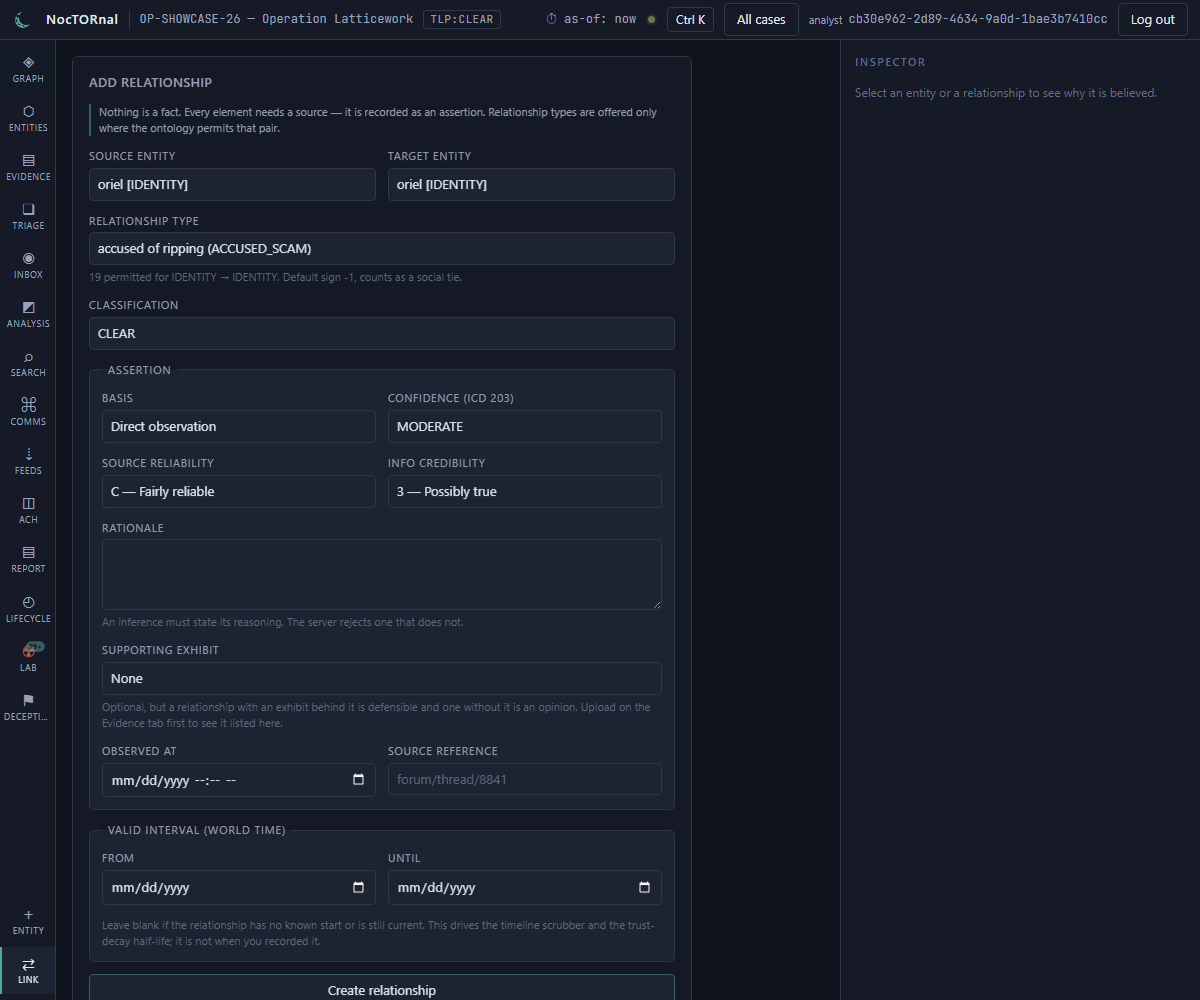
Add entity and add relationship
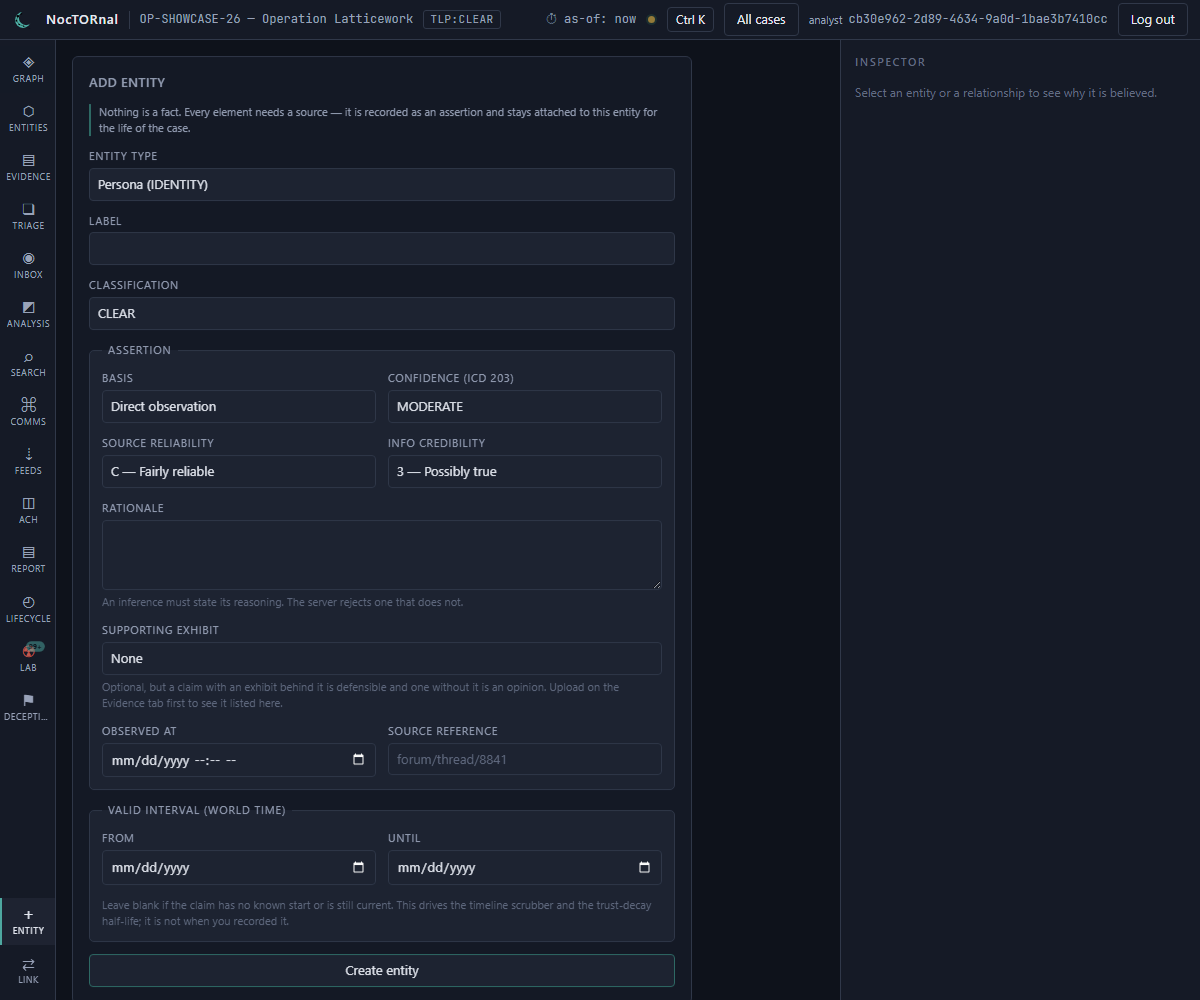
Neither form will complete without a source, an Admiralty reliability/credibility grading and a basis. That is invariant 1 at the point of entry: there is no "add it now, justify it later" path.
How it works
The flow
flowchart TB
    subgraph collect["COLLECTION — machines"]
        F["Monitored forums,<br/>channels, feeds"] --> X["Extractors"]
        I["Ingest API<br/>write-only keys"] --> X
        U["Analyst paste,<br/>upload, capture"] --> X
    end

    X -->|"never writes the graph"| P[("proposal queue")]
    X -.->|"unparseable"| DL[("dead letter<br/>+ raw fragment")]

    P --> T{"Analyst triage"}
    T -->|reject| P
    T -->|accept| A

    subgraph model["THE MODEL — analysts"]
        A[("assertion ledger<br/>source · Admiralty · time")]
        A -->|"trigger-enforced"| G[("graph<br/>nodes + edges")]
        E[("evidence<br/>WORM + custody")] --> A
    end

    G --> PR["Projections<br/>which ties count"]
    PR --> SNA["igraph / leidenalg"]
    SNA --> INS["Sociogram + inspector"]

    G --> RPT["Report builder"]
    RPT --> EG{"TLP egress gate"}
    EG -->|"AMBER_STRICT / RED"| STOP["refused + audited"]
    EG -->|cleared| OUT["export · SMTP · webhook"]
The shape that matters: machines only ever reach the proposal queue. There is no arrow from an extractor to the graph. An analyst's decision is the only thing that promotes a suggestion into the model, and that decision writes an assertion carrying the machine's rationale — so the graph never forgets a machine suggested it.
The access gate
Every case-scoped request passes five checks as one decision:
flowchart LR
    R["Request"] --> V{"1 · verb<br/>role grants it?"}
    V -->|no| D403["403"]
    V --> AS{"2 · assignment<br/>on this case?"}
    AS -->|no| D404["404 — not 403"]
    AS --> C{"3 · clearance<br/>TLP dominates?"}
    C -->|no| D403
    C --> K{"4 · compartments<br/>read into all?"}
    K -->|no| D403
    K --> S{"5 · step-up<br/>MFA fresh?"}
    S -->|no| D401["401 · re-auth"]
    S --> OK["proceed"]
Two details carry the weight. An element is protected by both its own labels and its case's — a RED node can live in an AMBER case, so the effective label is the stricter classification and the union of the compartments. And authorisation is decided before existence is revealed: a caller with no relationship to a case gets the same 404 a nonexistent case gives, so a status code is never an existence oracle.
The data model
erDiagram
    CASE ||--o{ NODE : contains
    CASE ||--o{ EDGE : contains
    CASE ||--o{ EVIDENCE : contains
    NODE ||--o{ ASSERTION : "justified by (>=1, enforced)"
    EDGE ||--o{ ASSERTION : "justified by (>=1, enforced)"
    EVIDENCE ||--o{ ASSERTION : cites
    EVIDENCE ||--o{ CUSTODY : "append-only"
    NODE ||--o{ SELECTOR : "normalised · strong or weak"
    PROPOSAL }o--|| NODE : "only via analyst accept"
IDENTITY (a persona you observed) and PERSON (a human you assessed)
are different node types joined by a reversible ATTRIBUTED_TO edge
carrying a confidence. There is no real_name column on IDENTITY and
there never will be — that is invariant 2, and a trigger rejects a
cross-layer SAME_AS.
The twelve invariants
Treated as bugs when violated even if every test passes. Each has a test named after it.
| # | Invariant | Enforced by |
|---|---|---|
| 1 | Nothing is a fact. Every attribute and edge traces to a graded assertion | deferred constraint triggers on node and edge |
| 2 | A handle is not a person. IDENTITY ≠ PERSON, joined reversibly |
trigger rejecting cross-layer SAME_AS |
| 3 | Machines propose, analysts dispose | no code path from extractor to graph |
| 4 | Inferred edges stay distinct — dashed, and out of metrics | projection opt-in; is_social_tie on the edge type |
| 5 | History is superseded, never overwritten | no destructive UPDATE on assertion |
| 6 | The audit log is append-only | row and statement triggers; TRUNCATE refused |
| 7 | Credentials never leave the collector | decrypted only in the worker process |
| 8 | TLP gates egress | one can_egress, called by all four outbound paths |
| 9 | Durable identifiers, not displayed ones | per-type normalisers; durable_selector_type |
| 10 | Samples never render, never execute | separate origin, encryption at rest, is_hostile_markup |
| 11 | Ingest keys are write-only | a CHECK constraint saying so |
| 12 | Nothing is silently dropped | dead-letter table with the raw fragment |
Tech stack
Backend
| Layer | Choice | Why this, and not the obvious alternative |
|---|---|---|
| System of record | Postgres 16 + pgvector | The graph, the assertion ledger and the audit log live in one transactional store, so an inference and its justification commit or fail together. A separate graph database makes that a distributed-transaction problem, which is how provenance gets lost. |
| API | Python 3.12+ / FastAPI | Async, typed, OpenAPI for free. |
| SNA maths | igraph (C core) + leidenalg |
Not NetworkX — pure Python, and it falls over around 50k edges on betweenness. Leiden, not Louvain — Louvain can produce internally disconnected communities. |
| Object store | MinIO, S3 object lock | COMPLIANCE-mode retention, so the application's own credentials cannot delete an exhibit. GOVERNANCE mode is bypassable and therefore not a WORM guarantee. |
| Cache / limits | Redis | GCRA rate limiting in one atomic Lua script. |
| Migrations | Alembic | 52 revisions, one concern each, all reversible. |
| Live updates | Postgres LISTEN/NOTIFY |
Over Redis pub/sub because pg_notify inside a trigger is part of the writing transaction — no dual write, no lost event. |
Frontend
Plain HTML, CSS and ES modules under a strict CSP. No build step, no
framework, no node_modules. graphology + sigma.js (WebGL) render
the sociogram; a web worker handles layout.
A deliberate trade. The console is served same-origin by the API, so there
is no CORS surface; there is no unsafe-inline, so a stored XSS has no
scripting context; and the whole UI is auditable by reading it. For a tool
that renders attacker-authored strings — forum handles, filenames, email
display names — that mattered more than developer ergonomics. Every value
reaching the DOM goes through textContent, never markup, and a test
enforces it.
Testing
1269 tests across two pytest roots. Every invariant has a test named
after it. About half are database-backed and gated on DATABASE_URL; the
rest need no services at all.
Project layout
noctornal/
├── apps/api/                  FastAPI application
│   └── src/noctornal_api/
│       ├── http/routers/      one router per subsystem
│       ├── http/static/       the analyst console (no build step)
│       ├── security/          the five-part access gate
│       ├── graph.py           the only writer of nodes and edges
│       ├── evidence.py        WORM ingest, custody, integrity
│       ├── analytics.py       igraph / leidenalg
│       ├── deception.py       phishing, BEC, vishing   (docs/19)
│       └── samples.py         the malware lab          (docs/11)
├── packages/ontology/         THE source of node/edge/selector types
│   ├── src/…/definition.py    edit here, regenerate, ship a migration
│   └── generated/             TypeScript + SQL seed (do not edit)
├── db/
│   ├── schema.sql             annotated reference schema
│   └── migrations/versions/   52 Alembic revisions
├── docs/                      00–19, the reasoning
├── release/                   installers, INSTALL, MANUAL, CHANGELOG
├── scripts/                   launch, bootstrap, demo seeds, screenshots
└── infra/docker-compose.yml   Postgres, Redis, MinIO, Mailpit
Documentation
| Read | For |
|---|---|
release/INSTALL.md |
installing, in detail, with troubleshooting |
release/MANUAL.md |
operating it — every pane, every refusal, and what it means |
docs/18-legal-review-pack.md |
the sign-off document, with a row to answer each question in |
docs/00-decisions.md |
why the architecture is the way it is |
docs/01-domain-model.md |
nodes, edges, selectors, assertions |
docs/03-graph-analytics.md |
the SNA methodology, and its limits |
docs/05-security-rbac.md |
the access model |
docs/19-social-engineering-evidence.md |
phishing, BEC and vishing evidence |
docs/17-flagged-for-review.md |
known gaps, honestly listed |
TestFlight.md |
the install, actually performed — every command, the output, and the three defects it found |
NOTICE.md |
the licence, and why it had to be this one |
CONVENTIONS.md |
the working agreement, if you are contributing |
Status
Alpha. Unaudited. Not certified for evidential use.
Working end to end: cases; the graph and assertion layer; evidence with WORM and custody; the five-part access gate; SNA analytics; proposals and triage; entity merge; comms and contact blocks; collection and ingest; retention, legal hold and break-glass; ACH; reporting with a TLP egress gate; the malware lab; the deception subsystem; live change push; and the analyst console over all of it.
Deliberately absent, with reasons in docs/17:
WebAuthn (password + TOTP today), session IP/UA binding, row-level
security under a non-owner database role, a Jira integration, CONCOR
blockmodelling, and any form of live interception.
Findings that carry forward
An adversarial review of Phase 7 found three critical defects under a fully green 953-test suite. They are fixed, and each leaves a rule:
- A forged verdict, from a parser trusting a stream it did not control.
A crafted OpenPGP user ID smuggled a fake
VALIDSIGline into gpg's status output through charactersstr.splitlines()treats as line breaks and gpg does not escape — minting a CONFIRMED identity binding for a key the attacker never held. TheCHECKconstraints could not catch it, because both compared values came from the same lied-to parse. A constraint defends against the application forgetting to check, never against it checking a forged input. → AnyCONFIRMEDbinding recorded before commit12ff904should be re-derived, not trusted. - Inert on the Windows dev host, live on Linux. The defect depended on how bytes decode, so the development machine and the deployment target disagreed about whether the system was exploitable. → Where a defence depends on decoding, test the bytes.
- A metric overstated by 499×. Newman weighting divided by the
participant count remaining after filtering, so two people sharing a
500-member channel scored as high as a private two-party conversation.
→ Any co-participation figure produced before commit
8595602is wrong, not approximate.
Determination D8 is now CLOSED. A Telegram channel id and an unrelated
user id could normalise to the same durable value — a strong selector, so
it fed auto-merge. The Bot-API encoding is arithmetic
(chat_id = -(10¹² + id)), not a text prefix, and the old code stripped
the characters 100, which inverts it only for a ten-digit channel id.
Decoding is now arithmetic and namespaced by id space (u:/c:/g:);
migration 0051 re-keys stored selectors. It cannot undo a merge already
made, and says so.
The software has been adversarially reviewed eight times. Every pass found a real defect — four times a critical one — each time under a fully passing test suite. Three of those were green tests asserting the bug. Assume the ninth pass would find something too.
Comments