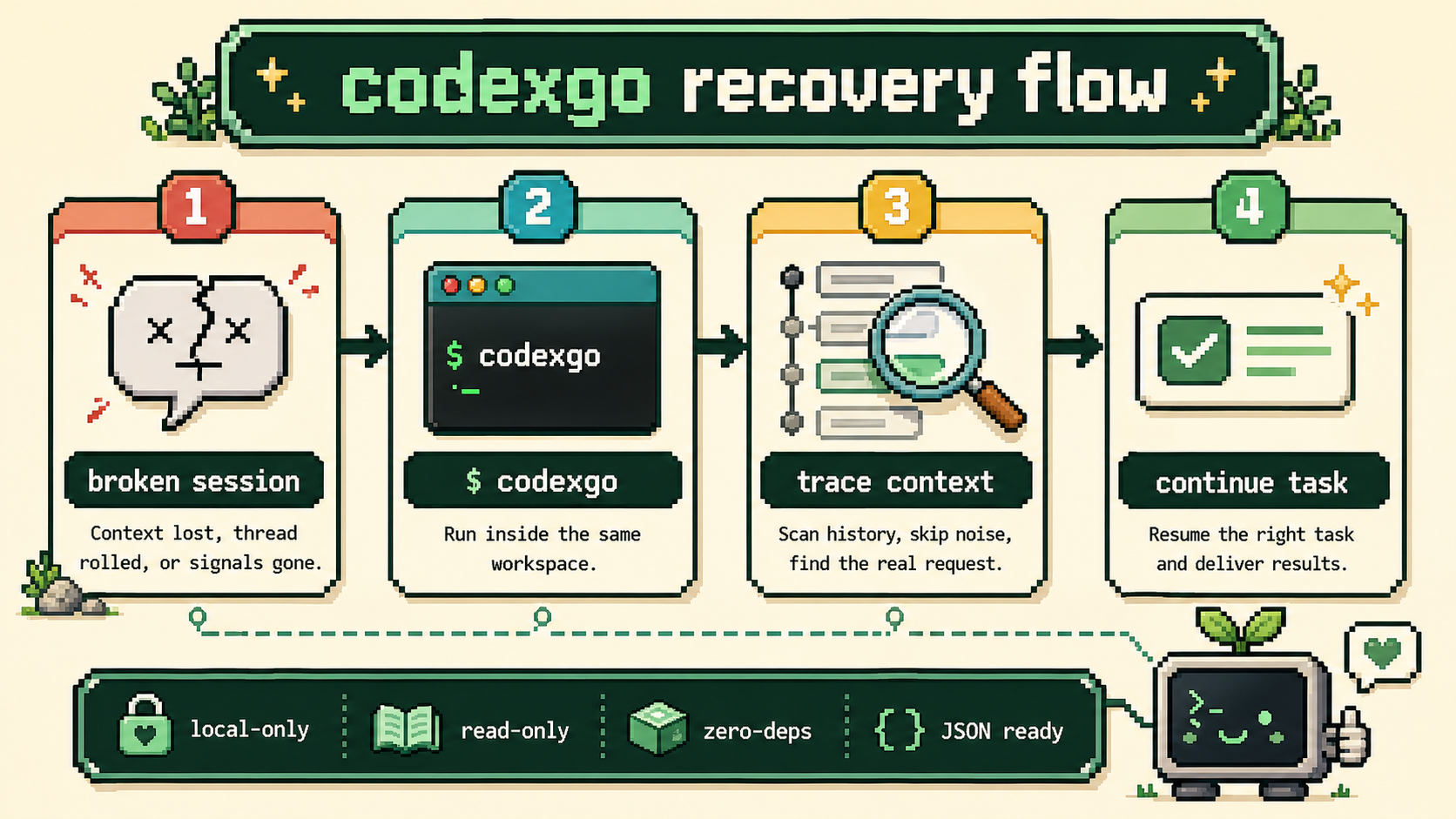
Large language model tooling has exploded over the past couple years. Dozens of wrappers, clients, and automation scripts exist for calling models through APIs. Most of them assume a happy path: request goes in, response comes back. But production workflows are messier. Compaction fails. Context windows overflow. Processes crash mid-request. When that happens, the partial state—what the model was supposed to do, what the last valid request looked like—often disappears. Developers working with Codex or similar request-driven interfaces face this gap: no built-in recovery for the last actionable request when something goes wrong.
codexgo targets exactly that scenario. It is a small Python project sitting at 22 GitHub stars, and its scope is narrow by design. The tool recovers the last actionable Codex request after a compaction failure, crash, or lost context. If your workflow depends on Codex-style request/response cycles and you have no fallback for interrupted states, this fills a specific hole.
Enter codexgo
The project description is concise: recover the last actionable Codex request. That means it is not a general-purpose LLM client. It does not handle streaming, chunking, or prompt management. It focuses on one problem—pulling the last meaningful request out of a broken state so you can reissue it or inspect it.
The use case is clear. Imagine a pipeline where Codex requests are queued and processed sequentially. A crash kills the process before the request finishes. Without codexgo, you lose track of where the pipeline was. With it, you get the last request that was in a state worth acting on. That request can then be re-sent or logged for debugging.
The project is authored under the handle JY0xLU. It is open source and available on GitHub. Given its small star count and narrow focus, it reads as a utility for a specific audience rather than a general-purpose framework.
Under the hood
codexgo is written in Python. That choice makes it easy to integrate into existing Python-based tooling, CI pipelines, or local scripts. The project lives at github.com/JY0xLU/codexgo. Beyond the language, the seed facts do not detail the internal architecture, specific dependencies, or file structure. What can be inferred is that the tool likely reads some form of state file, log, or context store that Codex-style requests leave behind, and extracts the last valid request from that store.
Since the project is small and purpose-driven, the codebase is probably straightforward. Python projects of this size typically have a handful of modules, minimal external dependencies, and a single entry point. If you are already running Codex requests in a Python environment, adding codexgo should not introduce a heavy dependency tree.
Running it
The project repository is the source for installation details. Since it is a Python project, the standard approach applies. Clone the repo or install via pip if a package is published. The install command would follow the typical Python pattern.
git clone https://github.com/JY0xLU/codexgo.git
cd codexgo
pip install -r requirements.txt
After installation, the tool likely runs as a command-line utility. The exact invocation depends on the project's entry point, which would be defined in the repository's setup or main module. Check the repo's README for the precise command.
If you are integrating this into an existing pipeline, you would call it at the point where a crash or compaction failure is detected. The output—presumably the recovered request—can be piped into your reissuing logic or saved to a log.
Who is this for
This tool is not for everyone. If you are building a simple chatbot or a one-off script, you probably do not need request recovery. But if you are running batch Codex jobs, processing queued requests in a production pipeline, or working in an environment where crashes are a realistic risk, the ability to recover the last actionable request matters. It saves you from manually reconstructing what the request was.
The trade-off is scope. codexgo does one thing. It does not manage requests, track history, or provide a full client interface. It recovers. For teams that already have request handling logic in place and just need a recovery hook, that narrowness is a strength. For teams wanting an all-in-one Codex client, this is not it.
codexgo is a small, focused utility with a clear purpose. The source is on GitHub.
Comments