Pre-flight payload QA for Adaptix, powered by LitterBox.
Cheshire is an Adaptix C2 service plugin that bridges the Adaptix client to a LitterBox sandbox. From inside the Adaptix UI, an operator can pick any binary, dispatch it through LitterBox's full analyzer chain (static + dynamic + every reachable EDR profile), and watch the verdict materialize without ever leaving Adaptix.
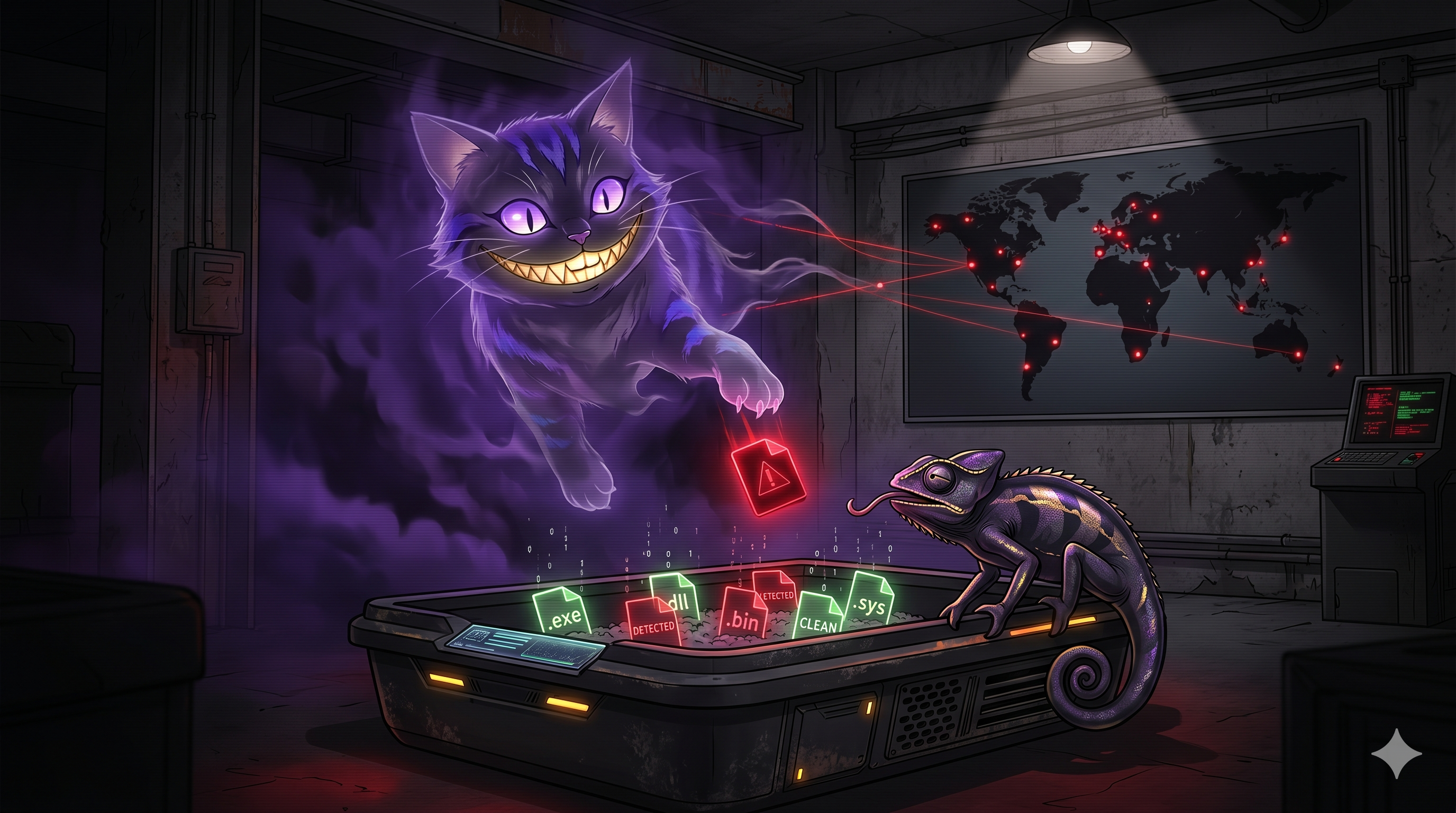
The name follows the project mascot lineage:
- Adaptix → chameleon
- LitterBox → grumpy cat
- The bridge between them → Cheshire (the cat that grins, fades in and out of view, and tells you whether the path ahead is safe).
What it does
| Action | LitterBox endpoint(s) | Result |
|---|---|---|
| Upload payload | POST /upload |
md5 + file metadata |
| Run All | POST /analyze/static/<md5> + /analyze/dynamic/<md5> + /analyze/edr/<profile>/<md5> (×N profiles) in parallel goroutines |
Static, Dynamic, every EDR profile populated as each completes |
| Static only | /analyze/static/<md5> |
YARA / CheckPlz / Stringnalyzer findings |
| Dynamic only | /analyze/dynamic/<md5> |
YARA-mem / PE-Sieve / Moneta / Patriot / HSB / RedEdr findings |
| EDR (multi) | /analyze/edr/<profile>/<md5> per profile + Phase 2 polling on /api/results/edr/<profile>/<md5> |
Per-profile alerts table + comprehensive alert detail (reason, MITRE, API, memory region, call stack, final user module, process, parent, EDR responses) |
| Cleanup | DELETE /file/<md5> |
Removes upload + result folders + per-sample analysis dirs from LitterBox |
| Fleet probe | GET /health |
Sandbox status, scanner inventory, EDR agent reachability — drives the EDR Profiles checkboxes |
EDR Phase 2 polling uses LitterBox's adaptive cadence (2s base, ×1.5 backoff
up to 15s when the alert count is stable, snap back to 2s on movement).
Each poll tick streams a progress event to the client so the live progress
strip can show alert counts ticking up in real time.
Layout
Cheshire/
├── README.md
├── setup_cheshire.sh                       deploy script
└── cheshire_service/
    ├── config.yaml                         service plugin manifest + litterbox_url
    ├── go.mod / go.sum
    ├── Makefile                            builds dist/service_cheshire.so
    ├── pl_main.go                          Go service plugin (HTTP client to LitterBox)
    └── ax_config.axs                       AXScript UI (the dashboard dialog)
The Go plugin is a stateless HTTP relay between Adaptix's
TsServiceSendDataClient and LitterBox's REST API. The AXScript file owns
all rendering — verdict banner, detection summary, per-scanner sub-tabs,
EDR alerts table with click-to-detail.
Setup
1. Bring up LitterBox
Cheshire requires a running LitterBox instance (see the LitterBox repo for installation). Confirm reachability:
curl http://<litterbox-host>:1337/health
2. Configure Cheshire
Edit cheshire_service/config.yaml and set litterbox_url:
extender_type: "service"
extender_file: "service_cheshire.so"
ax_file: "ax_config.axs"

service_name: "cheshire"
service_config: |
  litterbox_url: "http://192.168.88.128:1337"
If litterbox_url is missing the plugin loads but every operator command
returns "Cheshire is not configured: set litterbox_url in service_config".
There is no fallback default.
3. Deploy
bash setup_cheshire.sh --ax /path/to/AdaptixC2
This:
- Copies the source to
AdaptixC2/AdaptixServer/extenders/cheshire_service/. - Adds
./extenders/cheshire_serviceto the Go workspace. - Builds
service_cheshire.sovia the Makefile. - Copies the built
.so+config.yaml+ax_config.axstoAdaptixC2/dist/extenders/cheshire_service/.
4. Register with the Adaptix server
Add a line to AdaptixC2/dist/profile.yaml under
Teamserver.extenders:
extenders:
  - "extenders/cheshire_service/config.yaml"
  ...
5. Restart the server
pkill -f adaptixserver
cd AdaptixC2/dist
./adaptixserver -profile profile.yaml
You should see [cheshire] Initialized — LitterBox at http://... in the
server log, followed by [+] Service 'cheshire' loaded.
In the Adaptix client menu bar, Cheshire → Test with Cheshire opens the dashboard.
Dashboard
┌─ Payload ───────────────────────────────────────────────────────────────┐
│  [Browse...]  /home/op/payloads/beacon.exe                              │
├─ EDR Profiles ──────────────────────────────────────────────────────────┤
│  ☑ Elastic Defend   ● reachable     elastic · WIN-VM01 · nightcity      │
│  ☐ Fibratus         ● not reachable fibratus                            │
├─ Dynamic Analysis Args ─────��───────────────────────────────────────────┤
│  --quiet -p 4444                                                        │
├─────────────────────────────────────────────────────────────────────────┤
│  [Run All] | [Static] [Dynamic] [EDR] | [Cleanup]    Uploaded: ...      │
├─────────────────────────────────────────────────────────────────────────┤
│  🚫 DETECTED — 5 hit(s) across 2 Static, 1 Dynamic [CRITICAL]           │
│                                              ✓ Static  ✓ Dynamic  🔄 elastic (2) │
├─ Detection Summary ─────────────────────────────────────────────────────┤
│  Severity  | Scanner             | Detection         | Detail           │
│  CRITICAL  | Static · CheckPlz   | Trojan:Win64/...  | offset 0x20EF    │
│  CRITICAL  | Static · YARA       | mimikatz_strings  | matched $sek...  │
│  HIGH      | Dynamic · PE-Sieve  | 3 modifications   | 3 IAT hooks      │
│  ...                                                                    │
├─ Static | Dynamic | EDR ────────────────────────────────────────────────┤
│  per-scanner sub-tabs with stat strip + bordered finding cards          │
└─────────────────────────────────────────────────────────────────────────┘
Verdict + scope
⏳ RUNNING — N hit(s) so farwhile any scheduled scanner is in flight.🚫 DETECTED — N hit(s) across X Static, Y Dynamic, Z EDR [maxSev]once every scheduled scanner reaches a terminal state.✓ CLEAN — 0 critical/high/medium detectionsonly if no real hits at any scanner. Informational signals (LOW/INFO) are noted separately, not in the headline.(Static only)/(Dynamic + EDR)etc. is appended when the operator runs an individual scanner instead of Run All — the verdict honestly reflects what was actually executed.
Detection Summary
Aggregates every detection across every scanner into one sortable table. Rows are extracted from the actual JSON LitterBox returns (not generic factor strings):
- YARA / YARA-mem rules with severity + threat name + first matched string identifier
- CheckPlz
initial_threat+scan_results.detection_offset - Stringnalyzer dangerous-category counts
- PE-Sieve
total_suspicious+ per-indicator counts - Moneta non-zero
total_*anomaly counts (Private RWX → CRITICAL, etc.) - Patriot per-finding
level+type+ first 120 chars ofdetails - HSB per-finding severity + type + thread id
- RedEdr Defender events filtered to
category === 'threat' - EDR alerts: rule + severity + process + API summary
Sorted by severity descending, then scanner name.
Auto-cleanup
When the dialog closes, the current sample's md5 is wiped from LitterBox
via DELETE /file/<md5>. No stale samples accumulate between engagements.
Architecture
Adaptix Client (Qt) ──┐
                      │ AXScript service_command("cheshire", "run_all", {...})
                      ▼
Adaptix Server  ──→  service_cheshire.so  ──HTTP──→  LitterBox  ──→  EDR VM
  │                                                       │              │
  │                    streams progress events        Static / Dynamic   │
  │                    + results back via             scanners run on    │
  │                    TsServiceSendDataClient        the LitterBox host │
  ▼                                                       │              │
Adaptix Client renders verdict, detection summary,        │     EDR profile
progress strip, per-scanner detail panels.                ▼     dispatches
                                                  /analyze/edr/<P>/<md5>
                                                  Phase 1: exec on EDR VM
                                                  Phase 2: poll Elastic
                                                          for alerts
The Go service plugin runs each scanner dispatch in its own goroutine, so
Run All issues Static + Dynamic + (one POST per EDR profile) all in
parallel. The AXScript dashboard updates live as each goroutine streams
back progress and result events.
Comments