The tech industry has long been a landscape of high rewards and high volatility. For years, platforms like Glassdoor or Blind have served as the primary repositories for employee sentiment, offering a mix of salary data and cultural reviews. However, these platforms often suffer from a lack of granularity regarding specific, high-impact events like mass layoffs or shifts in management ethics driven by emerging technologies. As automation and AI integration reshape the workforce, there is a growing need for more targeted data regarding how these shifts impact human capital.
A specific focus on AI-driven workforce shifts
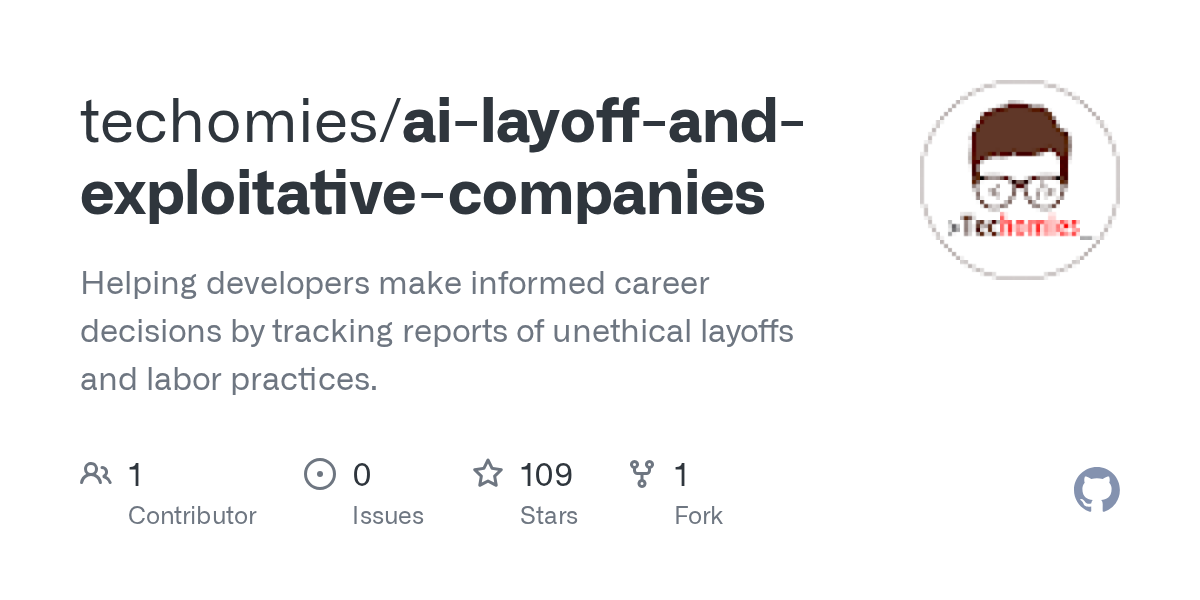
The ai-layoff-and-exploitative-companies repository, currently sitting at 109 stars on GitHub, attempts to fill a niche that general review sites often miss. Rather than acting as a general "rate my boss" tool, it functions as a specialized watchlist. It specifically targets three types of workplace issues: unjustified layoffs (particularly those involving AI replacement without employee transition plans), labor exploitation like forced unpaid overtime, and general management instability.
What sets this project apart is its refusal to rely on vague sentiment. While a standard review site might host a post saying "the culture is bad," this project's design philosophy mandates verifiable evidence. The README explicitly states that "hearsay" is insufficient for inclusion. By requiring links to news articles, screenshots, or reputable forum posts, the project aims to move away from the anecdotal noise that often plagues anonymous review platforms. It attempts to build a database of record rather than a collection of complaints.
The trade-offs of community-sourced data
Using a community-driven repository for career decisions involves inherent risks. The project documentation is very clear about its limitations, noting that the information is not an "absolute objective truth" and is subject to the biases of its contributors. For a developer looking to avoid a toxic environment, this is a double-edged sword. The data is highly specialized and can provide insights into specific company behaviors that broader platforms might overlook, yet it lacks the institutional verification of a formal news outlet or a regulated labor board.
There is also the challenge of maintaining accuracy. To mitigate the risk of libel or defamation, the project includes a "Right of Reply" mechanism. This allows companies listed in the watchlist to provide counter-evidence or feedback via GitHub Issues. If a claim is proven inaccurate, the project commits to updating or removing the entry. This creates a self-correcting loop, but it also means the "truth" of the list is constantly in flux. For a reader, the burden of due diligence remains high; the project is a starting point for research, not a final verdict.
What it ships with
The project is structured as a lightweight, transparent data repository. It does not attempt to be a complex software application, but rather a curated, living document. Its core components include:
- A Structured Watchlist: A central table that categorizes companies by name, provides a summary of the reported issue, links to the supporting evidence, and tracks the last update date.
- Strict Inclusion Criteria: A defined set of rules for what constitutes a valid entry, focusing on layoffs, exploitation, and mismanagement.
- Contribution Guidelines: A framework for developers to submit Pull Requests or Issues, emphasizing neutrality and the mandatory requirement of evidence.
- A Moderation Logic: A mechanism for handling disputes and company feedback to ensure the repository remains a factual resource rather than a platform for harassment.
If you want to try it
Since this is a data-driven repository rather than a compiled software package, there are no specific runtimes or programming languages you need to install to "use" it in the traditional sense. You can simply browse the files via your web browser. If you intend to contribute to the watchlist by submitting Pull Requests or opening Issues, you will need a standard Git workflow and a GitHub account. For the specific procedural steps on how to format your contributions and provide evidence, you should consult the guidelines provided in the project's README.
This project serves as a specialized tool for the modern developer, providing a layer of transparency that is often missing in the rush toward AI integration. It functions best as a secondary research layer to be used alongside traditional job hunting methods. You can find the repository and its current entries at techomies/ai-layoff-and-exploitative-companies.
Comments