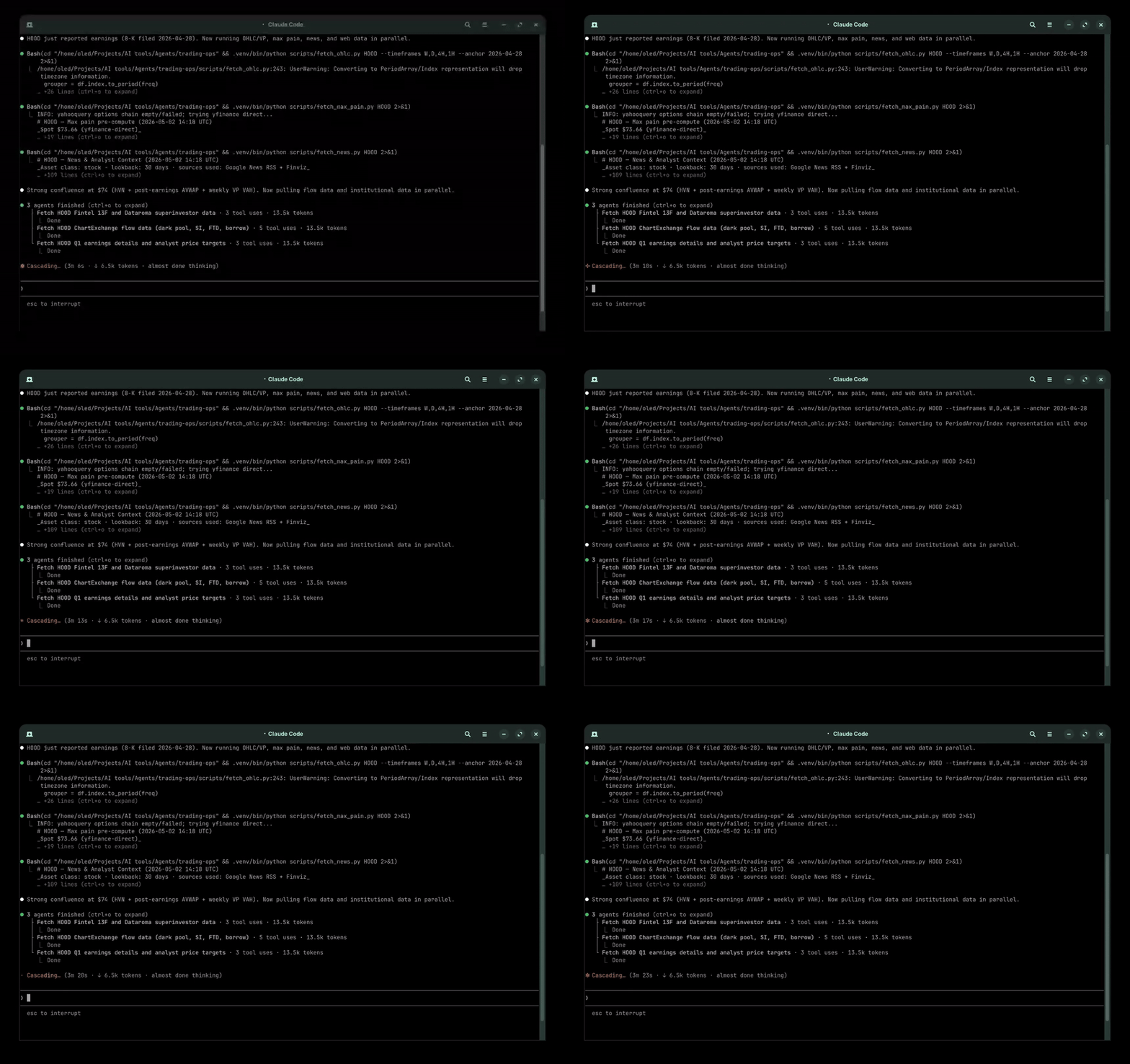
trading-ops provides a structured trading analysis workspace that operates within the Claude Code CLI from Anthropic. Users issue slash commands like /scan AAPL to generate reports on stocks, cryptocurrencies, FX pairs, indices, or commodities. Each scan applies a predefined framework, delivering verdicts such as LONG, SHORT, WAIT, or SKIP, along with ASCII price ladders and trade tables. Outputs save as dated Markdown files locally, enabling searches, version control, and audits without external dependencies.
The project keeps its scope narrow by design. It focuses on research and verdict generation, leaving order execution, alerts, and data integrations to the user or optional add-ons. This separation ensures trading decisions remain under user control. Hosted on GitHub at l3lackcurtains/trading-ops, it has 20 stars and uses Python as its primary language.
Core features
trading-ops generates consistent, framework-based analyses across asset classes. Key elements include:
- Verdict structure: Each report ends with a directive verb, an ASCII ladder marking support/resistance levels, targets (T1/T2/T3), entries, stops, risk-reward ratios, sizing, and time-stops.
- Three time horizons: Positional (weeks to months), Swing (3-15 days), and Day (intraday), with independent verdicts per horizon.
- Audit trails: Scans include timestamps and comparisons to prior runs, noting changes like
Δ since last scanand trigger statuses (fired-correct,fired-stopped,invalidated,stale). - Asset-specific frameworks: Stocks use 6-pillar fundamentals, Volume Profile, and VWAP; crypto covers funding rates, open interest, and liquidation heatmaps; indices include gamma exposure and VIX term structure; FX examines CFTC COT and rate differentials; macro scans assess regime quadrants (Goldilocks, Reflation, Stagflation, Risk-Off).
- Data sources: Relies on nine Python scripts pulling from Yahoo Finance, SEC EDGAR, CoinGecko, Binance, mempool.space, and Google News RSS. Optional free API keys from FRED and Finnhub add macro and analyst data.
A demo GIF in the repository shows a live /scan in action, producing formatted output with upside/downside paths.
Getting it running
Start with the prerequisites: the Claude Code CLI (available at claude.ai/code), Python 3.10 or higher for data scripts, and optionally a free TradingView account for chart screenshots.
Clone the repository:
git clone https://github.com/l3lackcurtains/trading-ops
cd trading-ops
The base setup requires no further steps beyond running Python scripts for data prep—the README notes it "works out of the box." In Claude Code, slash commands trigger scans directly. For example:
/scan AAPL
/scan BTCUSDT
/scan SPX
/scan EURUSD
/scan-macro
/discover
The /discover command runs a Finviz screener tied to the current macro regime. Reports save as Markdown files for local review.
Optional integrations
trading-ops supports additive MCP (likely Model Control Protocol) extensions in Claude Code for enhanced workflows:
- Broker MCPs like Alpaca or CCXT (for Weex/Binance) to place orders from verdicts.
- Chrome MCP for pulling TradingView charts.
- Hermes for 24/7 scans on a VPS with Telegram/Discord alerts.
- Playwright MCP to scrape positions or flow data without APIs.
- Slack MCP to post verdict changes.
Users add these as needed without altering the core framework.
Real-world use cases
Traders monitoring multiple assets benefit from the standardized output. A swing trader might /scan BTCUSDT daily to check perp funding and OI shifts, archiving results for pattern review. Positional investors could use /scan-macro to gauge regime shifts before scanning indices like SPX for gamma levels. The /discover screener helps filter Finviz results by macro context, reducing manual sorting.
For crypto users, scans include ETF flows and liquidation heatmaps; FX traders get CFTC COT and sentiment data. The Markdown archive suits backtesting—grep for verdicts across files to track LONG calls that fired-correct. Day traders value intraday horizons with counter-trend entries marked on ladders.
It's suited for individuals or small teams using Claude Code, especially those preferring local, auditable records over cloud platforms. No paid subscriptions are needed, though free keys improve depth.
Comparisons to alternatives
Few projects match trading-ops' integration with Claude Code and slash-command simplicity. General tools like TradingView scanners or Finviz offer screens but lack structured verdicts and audit deltas. Python libraries such as yfinance or ccxt provide data pulls yet require custom scripting for frameworks. Backtraders like Backtrader or Zipline focus on simulation, not real-time scans.
For AI-assisted analysis, prompts in Claude or ChatGPT can mimic scans but produce inconsistent prose without ASCII ladders or versioning. trading-ops stands out for its asset-tailored frameworks and lean footprint—20 stars reflect its niche status. Heavier platforms like Thinkorswim demand subscriptions and lack Markdown exports.
trading-ops fits disciplined traders who want framework-enforced discipline in Claude Code without built-in execution risks. It skips users needing turnkey brokers or high-frequency setups, as those require MCP add-ons. Source code and assets reside at github.com/l3lackcurtains/trading-ops.
Comments