
Python · JavaScript · CSS · Docker · SQLite · Apache-2.0

 Supported Bug Bounty Platforms
- HackerOne
Quarry syncs and submits through the HackerOne API. Other platforms are not supported yet.
Key Features
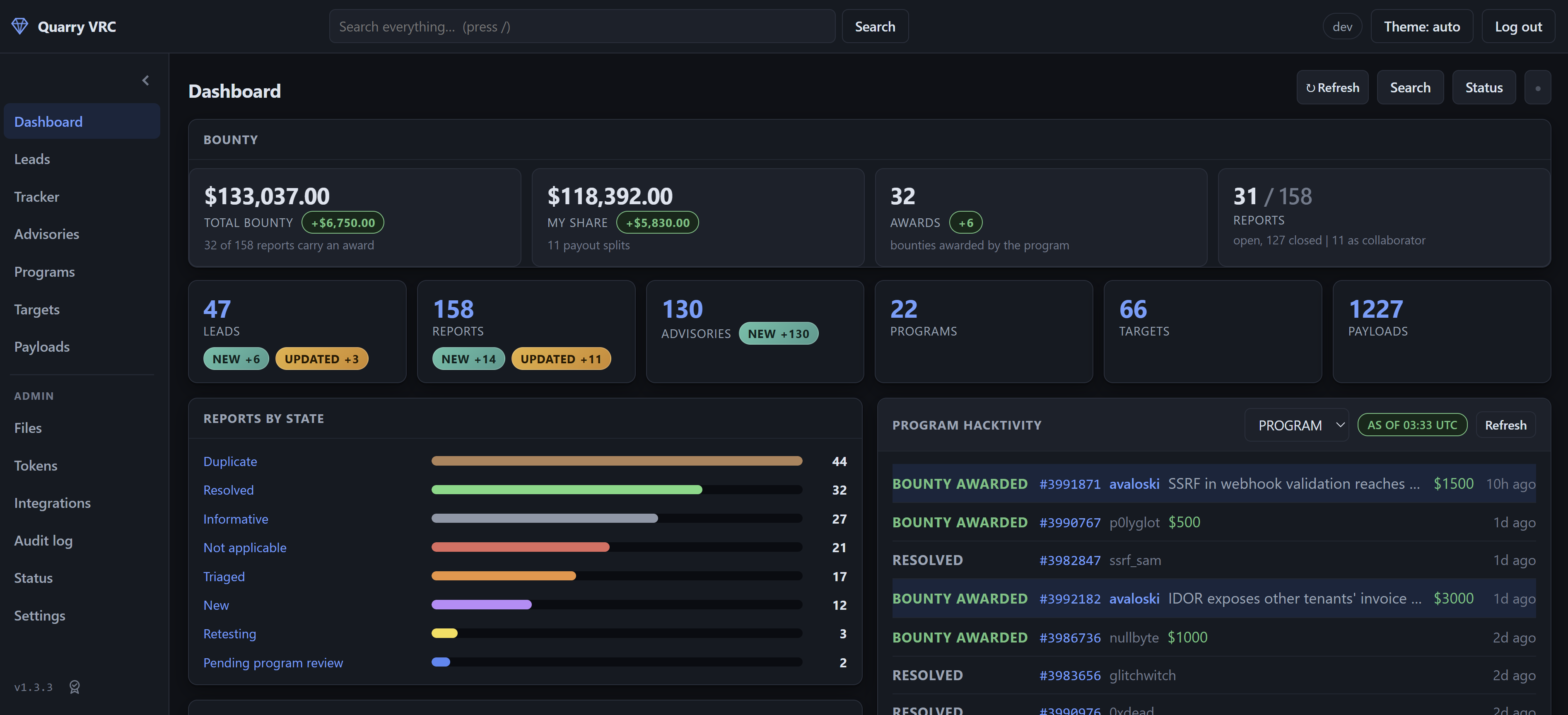
- Your entire hunt on one board. Sync every report, program, bounty and triage thread from the HackerOne API, so the console mirrors your real hunting instead of a spreadsheet you patch by hand.
- Find it, draft it, submit it. File a finished report using the HackerOne API, then watch its state and bounty flow straight back into the Tracker.
- A researcher's arsenal, built in. Full-text search across every lead, report and payload, a payload library cloned from PayloadsAllTheThings, and live CVE/CVSS advisory feeds cross-referenced against your work.
- Native to agentic AI. Every lead, note and payload is plain Markdown on disk, so Claude Code, Cursor or your own agent can read, query and draft your research right alongside you.
Quick Start
git clone https://github.com/skraft9/quarry-vrc.git quarry && cd quarry

# Copy the example environment file (then set QUARRY_ADMIN_PASSWORD; QUARRY_ALLOWLIST is optional)
cp .env.example .env
$EDITOR .env

# Build the image and start the container
docker compose up -d
- Quarry runs as a single container; the code is baked into the image.
- Database, leads and payloads live on Docker-managed volumes, so
docker compose pullupgrades the app without touching your data. - First boot generates a config, a self-signed TLS certificate and an empty database, then prints the URL.
- Open the printed URL, sign in, and connect your HackerOne account in Integrations.
- Full walkthrough in
docs/SETUP.md.
Documentation
docs/USER_GUIDE.mdis the complete manual - every feature, every tab, the CLI and the HTTP API, in one place. Start here when you want more than the quick start.docs/SETUP.md- first-run walkthrough.docs/ARCHITECTURE.md- the one-container, three-volume model.docs/AGENTS.md- driving Quarry with an agentic AI.
Usage
Most of this happens through the UI, but the same operations run on the CLI inside the container
(docker compose exec quarry python3 ...):
# Sync your reports, bounties, states and triage threads from HackerOne
python3 core/h1.py --sync

# Sync each program's guidelines, scopes and visibility
python3 core/h1.py --sync-programs

# Submit a finished report (prints the payload; add --confirm to actually send it)
python3 core/h1.py --submit reports/<slug>.md --program <handle> \
  --weakness cwe-79 --scope "<in-scope asset>" --severity high

# Rebuild the lead and report index from your workspace Markdown
python3 core/ingest.py --rebuild

# Refresh the advisory feeds, and search the payload library
python3 core/advisories.py --sync
python3 core/payloads.py --search "jwt none"
Updating
docker compose pull       # fetch the new image
docker compose up -d      # recreate the container on it
- Your database, leads, config and credentials live on Docker volumes, so upgrading is a pull-and-recreate that never touches your data.
- To pin a specific release instead of tracking the latest, set the image tag in
docker-compose.yml(for exampleimage: ghcr.io/skraft9/quarry-vrc:v1.0.0); every version is tagged on the Releases page.
Requirements
| Requirement | Needed for |
|---|---|
| Docker (with Compose) | Running Quarry. It is the only thing you install. |
| A HackerOne API token | Optional, but the point: it populates the Tracker and enables one-click submit. Paste it in the app. |
Inside the image, Quarry is the Python 3.12 standard library and one HTML page - sqlite3 with
FTS5, ssl, http.server, hashlib. It runs without a framework, a build step or a package
manager. That is a deliberate security decision: a console holding your unreported findings and a
bounty credential carries zero third-party runtime code to audit, pin, or be compromised
through. (git and curl ship only so the payload library can clone its reference and the
container can health-check itself; neither is a language dependency.)
The .env File
| Variable | Meaning |
|---|---|
QUARRY_ADMIN_PASSWORD |
Required. Creates the first admin login on first boot; the server refuses to start without it. |
QUARRY_ADMIN_USER |
The first admin's username. Default admin. |
QUARRY_APP_NAME |
Display name in the top-left brand and the page title. |
QUARRY_PORT |
Host port the HTTPS console is published on. Default 8443. |
QUARRY_ALLOWLIST |
Client IP allow-list, checked before auth on every request. Comma-separated IPs/CIDRs. Empty = open, which is fine for a host only you can reach. |
QUARRY_TLS_MODE |
self-signed (default) generates a local CA + cert on first boot; mounted uses a cert/key you mount into the data volume. |

Core Capabilities
| Tab | What it does |
|---|---|
| Dashboard | Shows what you earned, what moved, and what is still open. |
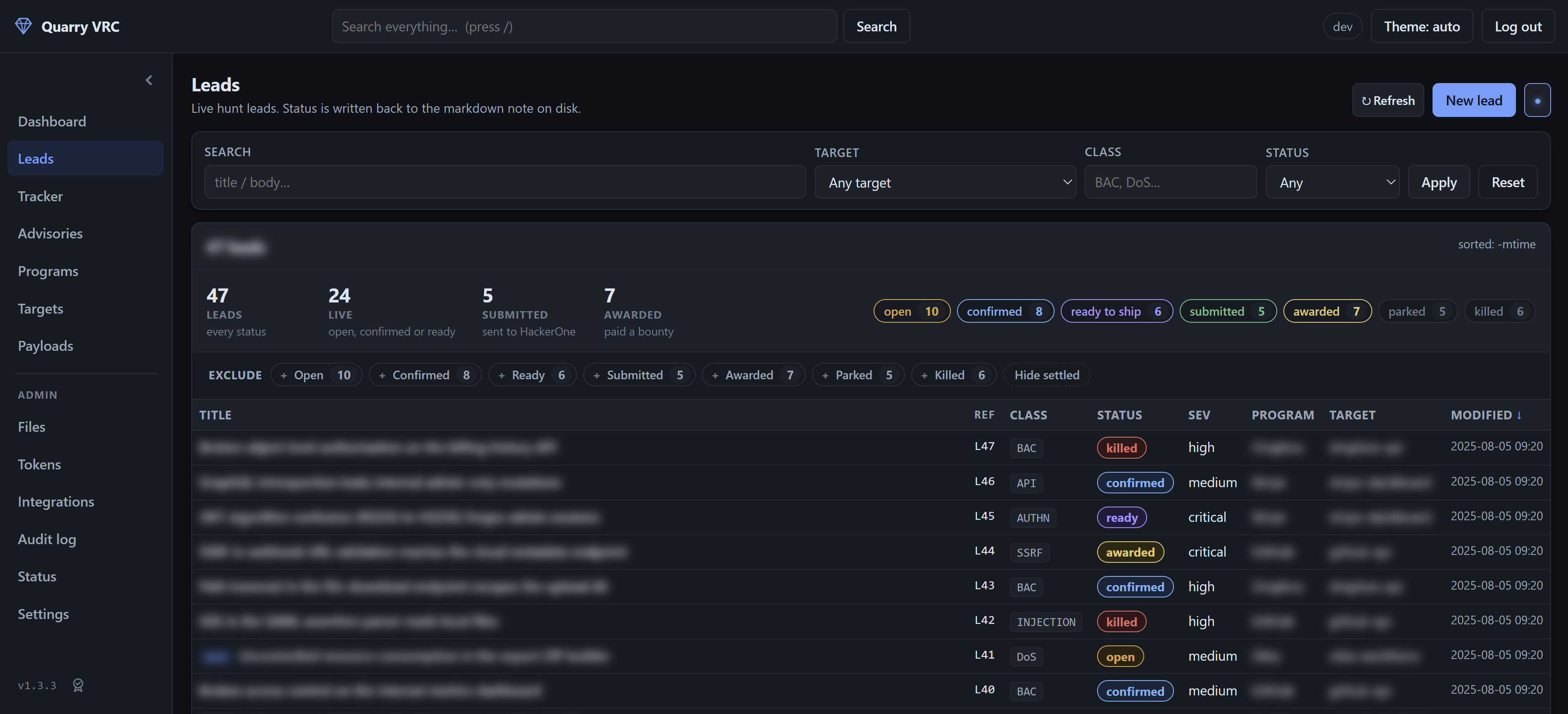
| Leads | Tracks your hunt notes from disk through a status workflow: open, confirmed, ready, submitted, awarded, parked, killed. |
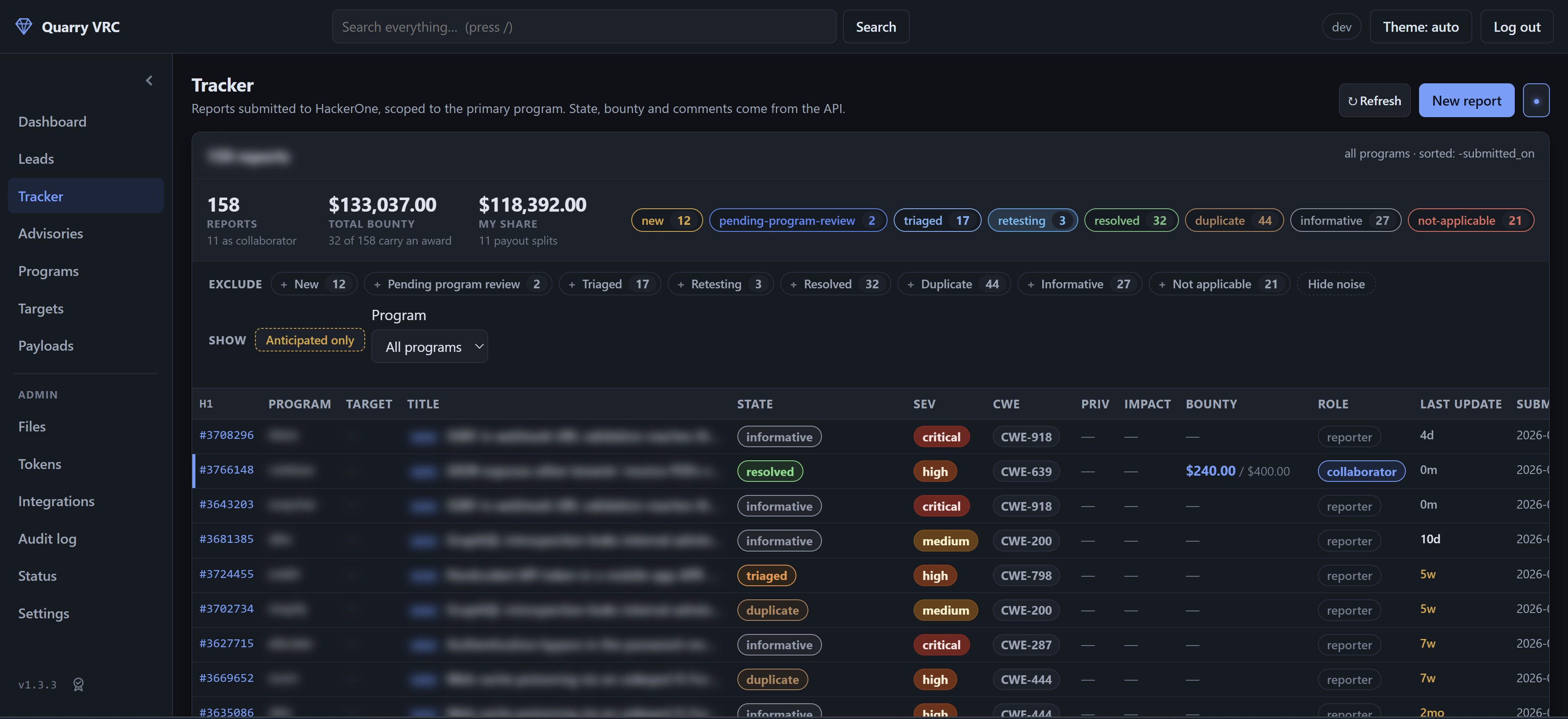
| Tracker | Lists every HackerOne report with state, bounty, CWE, impact, program, target and payout split. |
| Programs | Holds your programs with their scope and rules of engagement; totals awards, average payout and earned. |
| Targets | Maps in-scope assets from HackerOne to the local workspaces your leads are filed against. |
| Advisories | Ingests any RSS/Atom vulnerability feed you configure (CISA, VulDB, or a vendor's) and cross-references it. |
| Payloads | Searches a payload library (one row per documented block), cloned from a public reference and yours to extend. |
| Files | Browses the configured roots with an edit-and-save-back pane; denied paths are shown, not hidden. |
| Certificates | How to trust the container's TLS cert. Reached from the seal icon beside the version in the sidebar footer. |
| Integrations / Tokens | Store your HackerOne credentials write-only; issue Bearer tokens for non-browser clients. |
| Audit log / Status / Settings | Record what happened, report health and the index, and change job cadence. |
 Built for Agentic AI
Quarry is built to pair with an agentic AI - Claude Code, Cursor, or a custom local agent - working alongside you at the console:
- Your research is plain Markdown on disk. Leads, RCAs and notes are files in your workspace volume, so an agent can inspect, query, write and refine them directly - summarizing a lead, drafting a report into your workspace, or reworking a finding - with no API wrappers and no lock-in. The app just indexes what the agent (or you) writes.
- The whole corpus is queryable. SQLite FTS5 full-text search spans leads, reports and payloads, so an agent can pull exactly the context it needs instead of re-reading everything.
- Programmatic access is first-class. Server-side Bearer tokens let external scripts and AI tools query the console over its API - read the Tracker, fetch a lead, check a program's scope - without a browser session.
In summary, Quarry is the memory and context engine, and your agent is the pair. Everything stays on
your box. See docs/AGENTS.md for the full agent guide on how to record a lead the
app will index, query the console over the API, and ship a report to HackerOne.
HackerOne Integration
Quarry talks to the HackerOne API directly, so the console reflects your real hunting instead of a copy you keep in step by hand.
- Sync pulls your programs, scopes, reports, states, bounties, payout splits and triage threads.
- Submit files a finished report to a program straight from the app, with no copy-paste into the web form.
- Read the triage fetches the analyst's actual comment on a closed report, where the reopen condition usually lives.
Your API username and token are pasted once in Integrations, verified against the live API before they are stored, kept server-side, and never rendered back into the page.
Systems of Record
Every entity has exactly one authority, and it is never the database. The SQLite index is a cache and a query layer; it holds no entity it is the authority for.
| Entity | Authority | Rebuilt from |
|---|---|---|
| Reports, bounties, payout splits | HackerOne API | h1.py --sync |
| Program guidelines, scopes | HackerOne API | h1.py --sync-programs |
| Leads, RCAs, follow-ups | Markdown in your workspace volume | ingest.py --rebuild |
| Payloads | A git clone on disk, never vendored | scripts/sync-payloads.sh |
- Storing leads as Markdown on disk is what lets an AI agent read, summarize and draft reports directly in your workspace context.
- Because HackerOne owns your reports, a rebuild never invents or overwrites them.
- Anticipated money is held separately and never summed into the total, so a hand-typed figure can never turn an expectation into a confirmed award.
- One container, all mutable state on named volumes; details in
docs/ARCHITECTURE.md.
 Security Model
Quarry holds your unpublished findings and a bounty API credential. It is built to run on your own machine or a private host you control, and is not hardened for the public internet.
| Control | Detail |
|---|---|
| Zero-dependency runtime | Python standard library only, so there is zero third-party runtime code to audit or be compromised through. |
| IP allow-list, first | QUARRY_ALLOWLIST is checked before authentication and routing; an unlisted address gets 403 and nothing else. |
| TLS always | Self-signed local CA on first boot, or bring your own. |
| PBKDF2-HMAC-SHA256 | 600,000 iterations, per-user salt, constant-time verify; login failures are rate-limited per source. |
| Hashed credentials | Sessions and API tokens are stored as SHA-256, so a database read yields nothing usable. |
| Write-only secrets | Your HackerOne token is stored server-side and never returned by any endpoint. |
| Strict CSP | default-src 'none' blocks inline handlers, remote scripts and remote fonts. The markdown renderer escapes at the boundary and a test suite attacks it. |
Contributing
Two long-lived branches, and every change goes through a pull request so it stays reviewable and
revertable. The full contributor guide is CONTRIBUTING.md; the essentials:
devis the staging branch - work lands here first.mainis what ships;devmerges into it as a release, cut on the GitHub Releases page with a version tag and notes.
git checkout dev && git pull
git checkout -b fix/short-description
# work, then open a PR into dev (not main):
gh pr create --base dev --fill
House rules:
- One change-type prefix per PR, and the branch carries the same one so the history reads the
same for everyone:
feat:(a feature or behaviour change),fix:(a bug fix),docs:(docs only),chore:(tooling or cleanup),security:(a fix or hardening that closes a security finding). Keep the subject imperative and lower-case -feat: add the labs tab. - One PR per kind of change - a feature and a docs change are two PRs, even in one sitting.
- A structured PR body, not a wall of text - a one-line summary, then labelled one-line bullets: what changed (SHA-pinned backticked links), what it resolves, how it was verified.
- Bump
VERSIONin the same PR: a feature moves the minor (1.x.0), a fix, docs, chore or security pass moves the patch (1.0.x). A batch of security fixes released together shares one patch bump and ships as one release with a Security section in the notes. - Link the code you touch in the PR body as a backticked, SHA-pinned hyperlink, and cite other PRs by their number (GitHub renders it as the PR's own title).
- Run
scripts/check-no-private-data.shbefore every PR; it gates against committing secrets or personal data. When the test suites are present, both green too. - Standard library only - no pip, npm or CDN - and ASCII punctuation everywhere. Never commit
a secret or personal data (
.gitignorecovers the known ones). - Versions run on the
1.xline and move up; the official launch opens the2.0train.
Made for hunters and their agents. Apache-2.0
Comments