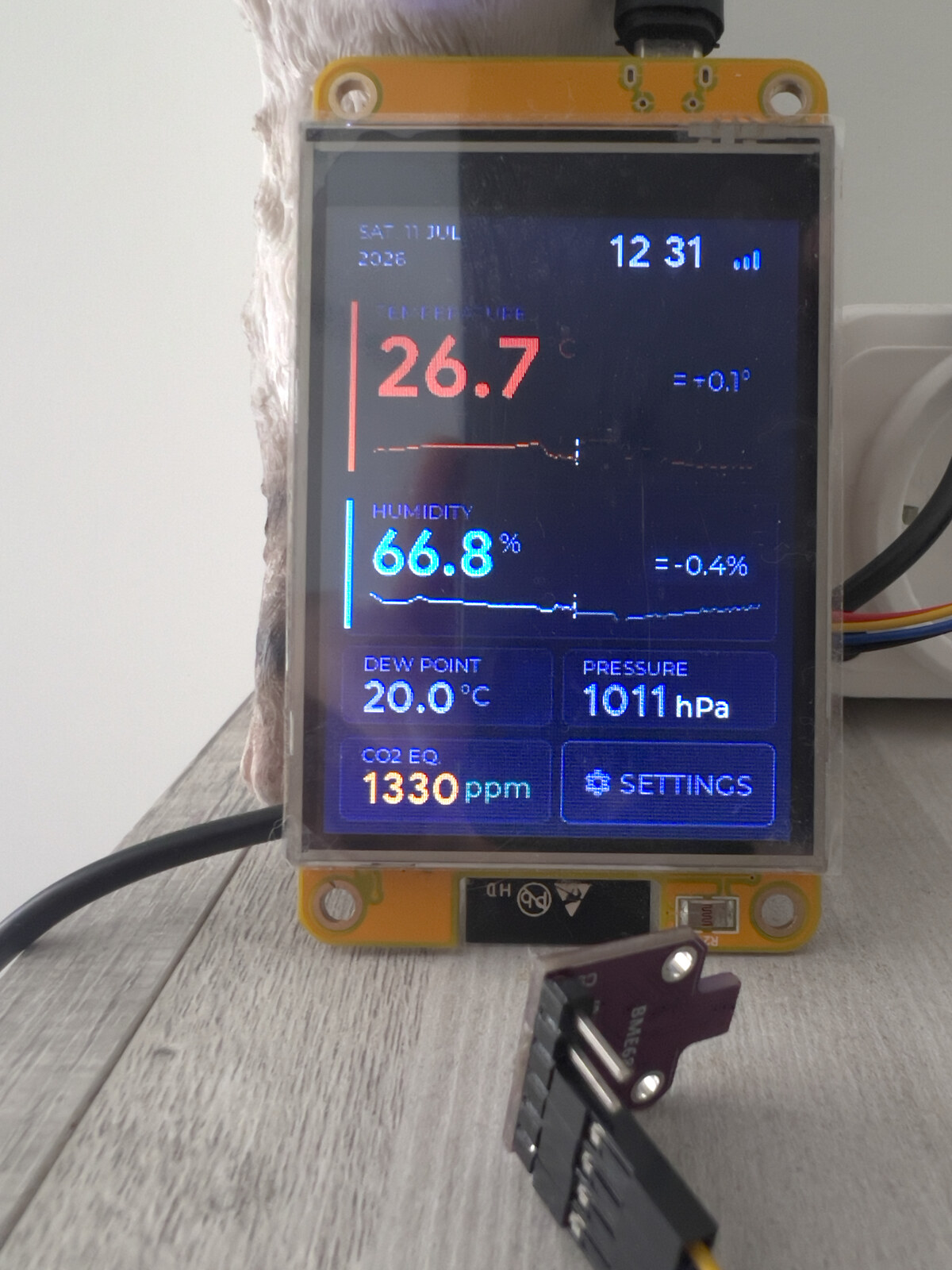
An open-source ESP32-based environmental monitoring station — temperature, humidity, atmospheric pressure, CO2 (equivalent), and dew point, with a built-in touchscreen dashboard, MQTT/cloud integration, and OTA firmware updates.
Features
- Built-in touchscreen dashboard running on an ESP32 CYD (Cheap Yellow Display) board — both ILI9341 and ST7789 panel variants are supported and auto-detected at boot, no configuration needed:
- Date, time, and Wi-Fi signal strength
- Current temperature with a 24-hour graph, trend, and rate of change
- Current humidity with a 24-hour graph, trend, and rate of change
- Calculated dew point
- Atmospheric pressure
- CO2 (equivalent) level, when a compatible sensor is connected
- On-device settings screen
- Automatic I2C sensor detection — no manual configuration needed for supported sensors
- NTP time sync with configurable timezone, refreshed hourly
- Temperature offset compensation for BME680 (-5 °C to +5 °C), useful when the sensor is affected by nearby heat sources
- MQTT integration with ThingsBoard, Domoticz, and Home Assistant (via MQTT Discovery — sensors are auto-detected, no manual entity setup needed)
- OTA firmware updates — automatic update check with on-screen notification, and optional automatic install
- Auto-dimming backlight driven by the onboard LDR (light sensor)
Supported sensors
Sensors are detected automatically over I2C — just wire one up and it's picked up without any configuration.
| Sensor | Measures | Status |
|---|---|---|
| BMP280 | Temperature, pressure | ✅ Supported |
| BME280 | Temperature, humidity, pressure | ✅ Supported |
| BME680 (without BSEC) | Temperature, humidity, pressure, gas resistance, CO2-equivalent based on sensor resistance | ✅ Supported |
| BME680 (with BSEC) | Temperature, humidity, pressure, gas resistance, IAQ / CO2-equivalent | ✅ Supported — requires the proprietary Bosch BSEC library, see Building with BSEC |
| SCD40 / SCD41 | CO2 (direct NDIR measurement), temperature, humidity | ✅ Supported |
| SHT35 | Temperature, humidity (high precision) | 🚧 Planned |
Note on CO2: the BME680 with BSEC reports an IAQ-derived CO2-equivalent, not a direct CO2 measurement. For an actual NDIR CO2 reading, use an SCD40/41 — it reports real CO2 plus temperature and humidity, and (having no barometer) publishes to Domoticz as a Temp+Hum device.
Hardware
- Board: ESP32 CYD (ESP32 with an integrated TFT touchscreen) — CYD boards ship with either an ILI9341 or ST7789 display controller depending on revision; the firmware detects which one is present automatically
- Sensors: any supported I2C sensor from the table above, connected externally via the board's I2C header
- A 3D-printable enclosure that houses the sensor together with the board is planned — see Roadmap
Getting started
Prerequisites
- ESP-IDF v6.0.x — earlier major versions (5.x) are not supported, the driver/component APIs this project relies on differ significantly
- Git
- A supported I2C sensor wired to the board (I2C pins depend on your CYD variant — check
docs/for pinout, if available)
Building with BSEC
If you're using a BME680 and want IAQ / CO2-equivalent output, the project depends on Bosch Sensortec's proprietary BSEC library (built against v2.6.1.0). It is not redistributed in this repository — you need to download it yourself directly from Bosch and accept their license terms:
- Go to the Bosch Sensortec BSEC software page and download the BSEC library.
- Extract the archive and copy its
algodirectory intocomponents/bsec/algo/in this repo, so that these paths exist:components/bsec/algo/bsec_IAQ/inc/components/bsec/algo/bsec_IAQ/config/bme680/bme680_iaq_33v_3s_4d/components/bsec/algo/bsec_IAQ/bin/esp/esp32/libalgobsec.a
- Build as usual with
idf.py build— BSEC is picked up automatically once the library is in place.
If you'd rather not obtain BSEC, disable it before building:
idf.py menuconfig
# → SensorStation3 → uncheck "Enable BSEC air-quality processing for BME680"
With BSEC disabled, BME680 still reports temperature/humidity/pressure/gas resistance and an approximate CO2-equivalent, just without BSEC's IAQ/static_iaq/accuracy outputs. BMP280/BME280 builds are unaffected either way.
Build and flash
git clone https://github.com/ScorpionZZZ/SensorStation3.git
cd SensorStation3

idf.py set-target esp32
idf.py build
idf.py -p /dev/ttyUSB0 flash monitor
Replace /dev/ttyUSB0 with your board's serial port (on Windows, something like COM3).
First boot
- On first boot, open the Settings screen on the touchscreen (default PIN
1234) → WiFi. It scans for nearby networks — pick yours and enter the password on the on-screen keyboard. - Still in Settings, configure timezone, MQTT/ThingsBoard/Domoticz/Home Assistant connection, and sensor options.
- Change the default settings PIN (
1234) immediately after your first boot.
Configuration
All runtime configuration (Wi-Fi, MQTT broker, timezone, temperature offset, etc.) is stored in NVS and managed through the on-device Settings screen — no config file needs to be edited before building.
OTA updates
The device periodically checks for new firmware releases (first at +60 s after boot, then every 6 h) and shows an on-screen indicator when an update is available. The Firmware Update screen ships with a default update URL — http://iot.scorpionzzz.com/sensorstation3/firmware/sensorstation3.latest.bin, pointing at this project's own release server — and also checks immediately — showing the latest available version, or "N/A" if the manifest can't be read — whenever you open that screen or save a new firmware URL. Point it at your own .bin URL instead if you're building and hosting custom firmware. Automatic installation can be enabled in Settings.
Roadmap
- SCD40/41 support (direct CO2 measurement)
- SHT35 support (high-precision temperature/humidity)
- 3D-printable enclosure integrating the sensor inside the case
- Web-based flashing (flash firmware from the browser, no local toolchain required)
Track progress and open tasks in Issues.
Comments