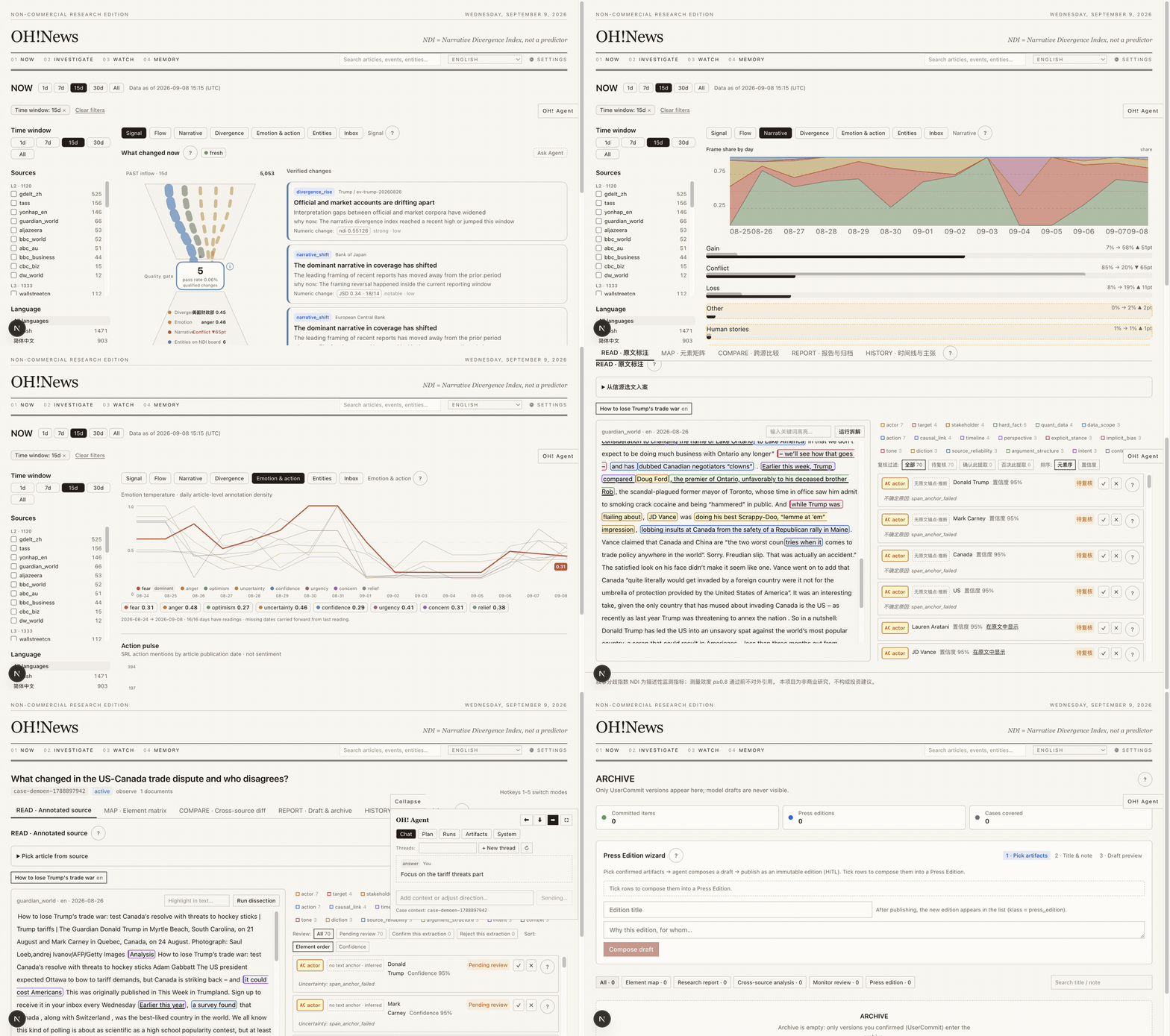
An AI-native news intelligence terminal: LangGraph agents extract 18 structured elements from every article, anchor every claim to character-level spans in the original text, and turn multi-source news into a traceable loop — notice a change → inspect evidence → form your own judgment → track it over time.
LLM-native by design: three-tier model routing with schema-validated structured output, deterministic verifiers over every model claim, and honest degradation to a lexicon engine when models fail. English · 简体中文
License: MIT · Python 3.12+ · FastAPI · Next.js 16 · LangGraph · 629 tests
The problem
News consumption today breaks in three places:
- Changes are not trustworthy. Aggregators show "what happened", but nothing tells you whether official and market narratives actually diverge — or whether a shift is just a change in source mix.
- Evidence is unreachable. Claims reference "reports" you can never open. The path from a conclusion back to the original sentence in the original article is missing.
- Judgments leave no trace. You read, you form a view, and three weeks later you cannot recall what you believed, on what evidence, or whether anything since should have changed your mind.
OH!News is built against these three breaks.
Core concepts
The cognitive loop. The product is organized as a closed cycle, not a feed:
NOW (what changed) → INVESTIGATE (verify against evidence) → WATCH (track consequences)
→ MEMORY (archive what you confirmed) → back to NOW with a baseline
Each stage is a distinct surface with distinct obligations — discovery must be honest, verification must be anchored, tracking must state what changed since your last review, and memory must contain only what you explicitly confirmed.
Honest measurement. The Narrative Divergence Index (NDI) measures how far official-tier coverage
and market-tier coverage diverge on an event, using Jeffreys-smoothed frame distributions and
Jensen–Shannon distance with bootstrap confidence intervals. When either cluster lacks sufficient
independent sources, the system abstains — it reports "not measurable" rather than a fabricated
number. The same discipline applies everywhere: dissection falls back to a lexicon engine labeled
offline when the LLM is unavailable; missing days render as gaps, never interpolations; coverage
below a threshold raises a warning instead of being hidden.
Anchored claims. Every element the AI extracts (actor, hard fact, causal link, intent, …) carries spans — exact character ranges in the original text. The reading view renders these as color highlights; clicking one shows the element type. Coordinates are validated server-side (out-of-range or drifting spans are discarded or re-anchored), so a highlight is always a quote, never a paraphrase.
User-owned judgment. Belief snapshots (stance + confidence + rationale) are written only on explicit user confirmation. The system never revises a stored judgment, never converts a metric into a recommendation, and never presents a model explanation as user belief.
PIT discipline. All pipeline queries are point-in-time: *_asof accessors guarantee that nothing
published after the as-of timestamp can leak into an answer. This makes results reproducible and the
demo dataset coherent.
How AI works inside
- Three-tier model routing.
io/execute/strategictiers pick the cheapest capable model per task (DeepSeek, Zhipu GLM). Every LLM call goes through a JSON-schema gate: invalid output ⇒ the candidate fails ⇒ the router falls to the next provider ⇒ if all fail, the step degrades honestly instead of guessing. - Structured information extraction. Each article is chunked on sentence boundaries, dissected concurrently (Semaphore ×3) into 18 element types (actor, hard facts, quantitative data, causal links, stance, intent…), and every element is anchored to the source text by a three-stage locator — exact match → normalized match → sequential word anchor. Long spans get narrowed against their own content; anything unlocatable is recorded, never invented.
- Deterministic verifiers over model claims. Coordinates are mapped back into the original text, quotes that drift from their declared span are dropped, and coverage is computed as a set union over character ranges. The LLM proposes; the verifier disposes.
- Honest dual-engine design. When models are unavailable or return empty output, the pipeline falls back to the dictionary engine (rule-based SVO/emotion lexicon) and labels the artifact
engine=offline— a degraded result is always labeled, never passed off as model output. - LangGraph agents with human gates. Shared
AgentStatewith incremental channels, a cross-cuttinguser_gateedge so you can inject context mid-run,interrupt()confirmation gates for anything persisted, and SQLite check-pointing for replay/time-travel. - Cost discipline. Dissections run on demand with caching; a scored suggestion queue (source reliability × recency × entity relevance) feeds a confirmation-gated queue so tokens go only to articles you approve.
- Prompt engineering discipline. Versioned prompts (
dissect-v7), density and anti-fabrication rules, per-language extraction guidance (en/zh/fr/es/de/ar), and prompt changes gated by tests that assert system-prompt invariants.
Demo
Two complete walkthroughs (one English corpus, one Chinese corpus), each running the full loop — inbox → investigation → tracking → memory — recorded as GIFs:
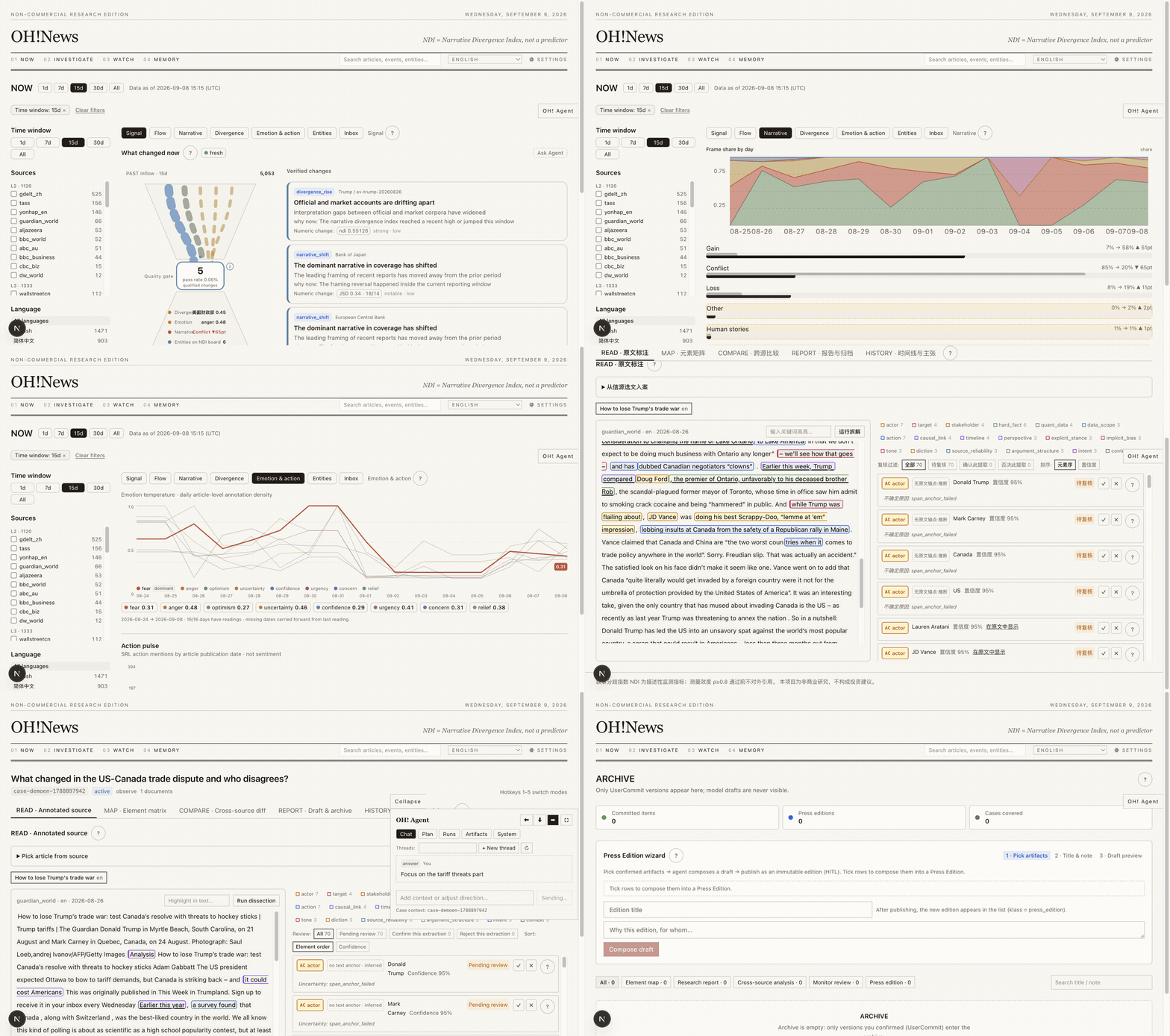
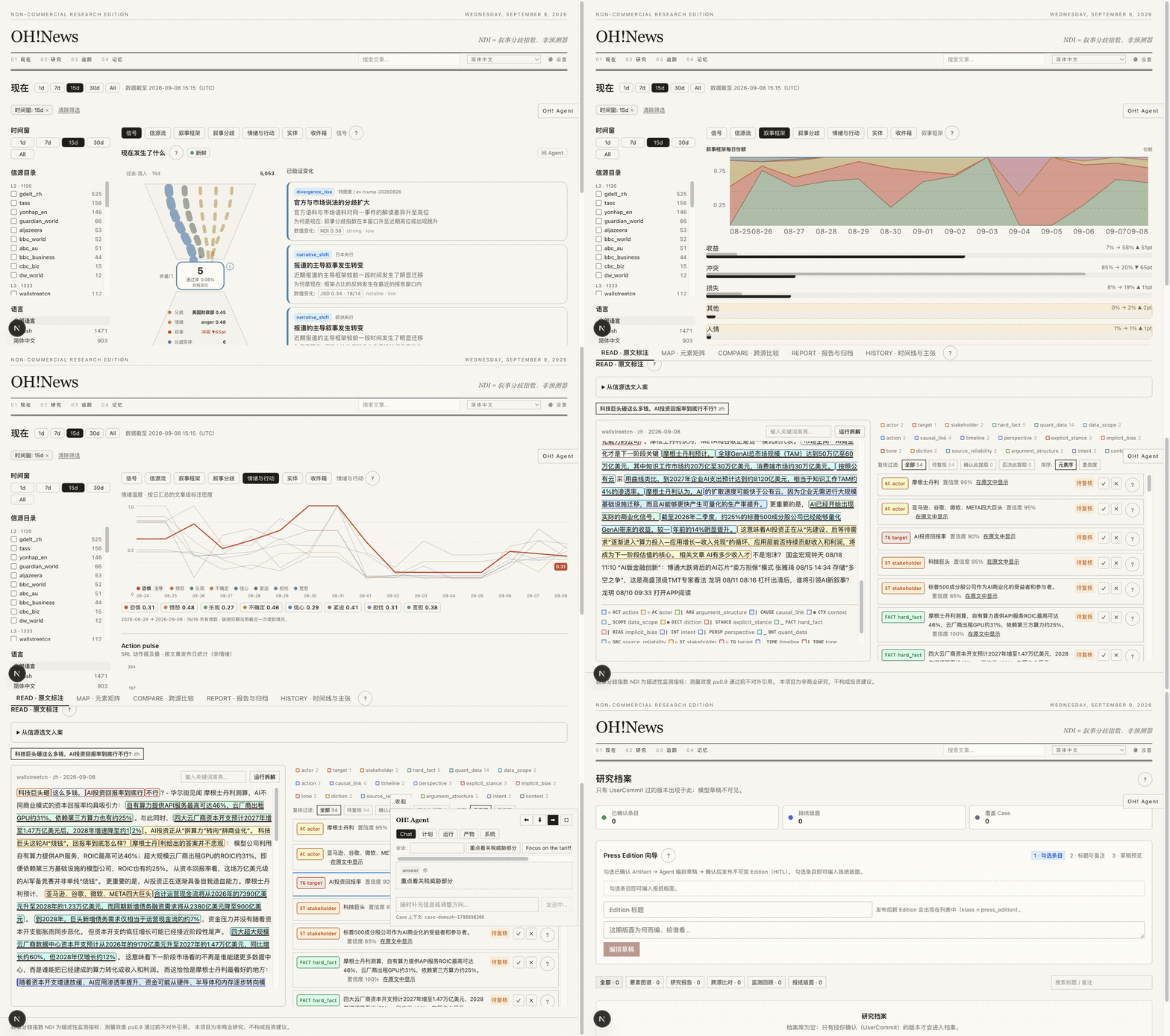
Full-resolution stills: docs/demo_en, docs/demo_zh.
Architecture
Data flows one way: sources collect into an immutable bronze layer, pipelines turn raw text into measured signals, agents and the API assemble evidence, and the web presents it. SQLite everywhere; no external infrastructure beyond the LLM providers.
flowchart LR
    S[oh-sources<br/>7 adapters<br/>RSS / GDELT / FRED / ...] --> B[(bronze parquet<br/>immutable raw)]
    B --> P[oh-pipeline<br/>tagger · NDI · detect ·<br/>semantics lexicon · KG]
    B --> A[oh-agents<br/>dissection · reports ·<br/>briefing · watch · beliefs]
    P --> ST[(oh-storage<br/>silver sqlite)]
    A --> ST
    ST --> API[oh-api<br/>FastAPI facade<br/>observe / cases / tracking / archive]
    LLM[oh-llm<br/>3-tier router<br/>deepseek / zhipu] --> A
    API --> W[web<br/>Next.js newspaper UI<br/>NOW / INVESTIGATE / WATCH / MEMORY]
    ST --> PE[(product_events<br/>12-event ledger)]
The four stages of the loop map onto the web routes: NOW surfaces qualified changes, INVESTIGATE opens a change dossier with anchored evidence, WATCH tracks entities and elements, MEMORY keeps judgment history and archived research.
Quickstart
Prerequisites: Python 3.12+ with uv, Node 20+, and optionally an LLM API key. Without keys the system runs end-to-end with the lexicon engine and template reports.
# 1. Backend
uv sync
uv run python scripts/dev/serve.py --port 8787

# 2. Frontend
cd web && npm install && npx next dev -p 3001

# 3. Model keys (optional; also configurable in Web UI → Settings → API Keys)
export DEEPSEEK_API_KEY=sk-...    # io tier
export ZHIPU_API_KEY=...          # execute / strategic tiers
export TAVILY_API_KEY=tvly-...    # agent web search

# 4. Collect and build
uv run python scripts/dev/cron_collect.py --days 15   # collect, then auto-annotate
uv run python scripts/dev/run_daily.py --days 15      # events, stances, NDI

# 5. Open http://localhost:3001
Environment variables
| Variable | Required | Purpose |
|---|---|---|
DEEPSEEK_API_KEY |
no | io-tier LLM (JSON-mode structured output) |
ZHIPU_API_KEY |
no | execute / strategic tiers |
TAVILY_API_KEY |
no | agent web search |
Tutorial: one full loop
- Observe (
/observe) — seven panels: signals, source flow, narrative frames, divergence, emotion and action, entities, inbox. Every panel renders each day of the selected window; missing days are marked, not skipped. - Investigate (
/investigate,/cases) — pick an inbox item, create a case. The system fetches the full text (scripts and boilerplate stripped), dissects it into 18 element types anchored to character spans, and produces research reports (veracity, intent, attribution, narrative, trend, structured summary) on demand. - Watch (
/watch) — create tracking units for an entity, a topic, a question, or an article element (for exampletone:optimism). Each unit answers "what changed since my last review", with the review date explicit. - Archive (
/archive) — only items you confirm are stored. Archive items can be composed into an editorial "paper" with a foreword. - Judge — on any change page, record your stance (maintain / adjust / reverse / uncertain) and confidence. The belief timeline is append-only and never rewritten by the system.
What is not built (and could be)
The current release is a single-user, non-commercial research build. The following are deliberate omissions with clear extension paths:
- Semantic retrieval. Search is substring-based over bronze; no embeddings, no FTS5 index. The annotation store is the natural substrate for a bge-small-style local embedding layer (M3-S4 in the original plan, deferred), which would unlock element-level and emotion-level similarity search.
- LLM incremental annotation. The lexicon layer covers 100% of articles by construction; an LLM
pass on the subset the lexicon cannot parse (negation, sarcasm, implicit stance) would raise stance
quality. The contract already distinguishes
engine=lexicon|llm. - Knowledge graph temporal edges. The entity-edge store records co-occurrence, hierarchy and relation edges with first/last-seen, but there is no time-sliced graph traversal or graph database. Projecting edges per NDI window would make narrative diffusion observable.
- Belief updating as a model. Belief snapshots are stored and diffed, but the system does not model belief revision (e.g. Bayesian update against new evidence). Deliberately so: the loop must not optimize itself toward changing the user's mind.
- Multi-user and auth. Single user; no accounts, no sync. The store layer is already keyed by session in the event ledger, which is the natural hook.
- Streaming ingestion. Collection is batch/cron. A streaming path (webhooks, RSS pubsub) would reduce the freshness lag that the freshness indicator currently surfaces honestly.
- Cross-language alignment automation. Translations are LLM-generated with deterministic proper-noun checks, but cross-language claim alignment (the same fact reported in two languages) is manual. This is the largest research-sized gap in the product.
- NDI as a causal instrument. NDI is a divergence measure, not a predictor — the UI states this. Extending it toward causal attribution (which source cluster moved the divergence) is open.
Repository layout
packages/          uv workspace: oh-contracts / oh-sources / oh-pipeline / oh-storage /
                   oh-agents / oh-api / oh-llm
web/               Next.js 16 frontend (App Router)
scripts/dev/       serve / run_daily / cron_collect / backfill tooling
docs/              RECONSTRUCTION.md (design decisions, M1–M6 milestones) · ARCHITECTURE_MAP.md ·
                   demo_en/ demo_zh/ (full-loop screenshots)
data/              runtime SQLite + Parquet bronze (not committed)
Testing
uv run pytest -q          # 627+ tests across packages
cd web && npx tsc --noEmit && npx eslint .
uv run ruff check packages scripts
Comments