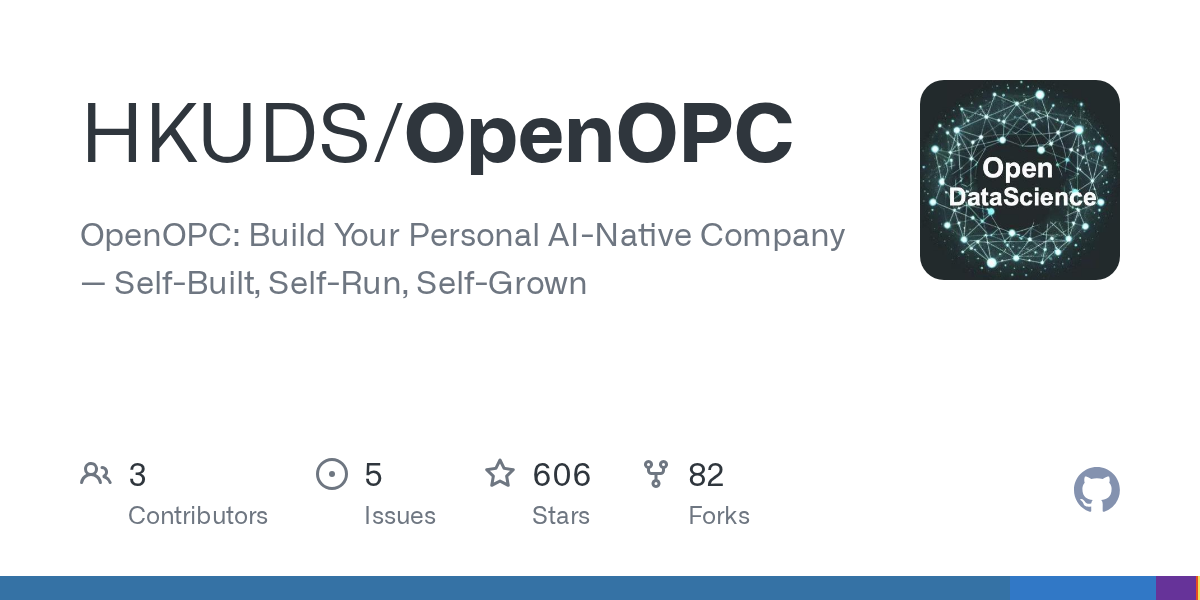
Organizations looking to implement generative AI often face a steep transition from simple chatbots to functional, multi-agent workflows. Standard agent frameworks provide the basic plumbing for LLM communication, but they rarely address the structural reality of how real-world businesses operate. OpenOPC, an open-source project developed by HKUDS with over 600 GitHub stars, attempts to bridge this gap. It positions itself as a framework for building an "AI-native company" by modeling AI agents after traditional corporate departments, complete with defined roles, standard operating procedures (SOPs), and collaborative hierarchies.
The project addresses the chaos of uncoordinated multi-agent systems. Instead of letting independent agents trigger tools at random, OpenOPC structures AI interactions into a digital replication of a corporate environment. This structure helps prevent the logical drift and loop errors common in open-ended agent frameworks, making the system more predictable for complex business workflows.
Key capabilities
OpenOPC structures its functionality around organizational management, allowing users to configure digital workers as cohesive business units.
- Departmentalization: Agents are grouped into specific functional units, such as human resources, product development, or marketing. This mirrors a real corporate structure, ensuring that tasks are routed to agents with the appropriate system prompts and tool access.
- Standard Operating Procedures (SOPs): Rather than relying solely on the raw reasoning of an LLM, OpenOPC enforces structured workflows. Agents follow step-by-step instructions to complete tasks, which improves consistency and reduces hallucination rates during complex operations.
- Hierarchical Decision-Making: The framework supports reporting lines and approval chains. Agents can escalate issues to "manager" agents or pause for human-in-the-loop validation before executing critical actions.
- Dynamic Resource Allocation: OpenOPC manages how agents utilize computational resources, API keys, and external tools, preventing individual agents from monopolizing system bandwidth or running up excessive API costs.
Under the hood
OpenOPC is built primarily in Python, utilizing modern asynchronous programming to handle concurrent agent tasks. The architecture separates the orchestration layer from the execution environment. This design choice ensures that even if an individual agent encounters an error or gets stuck in an execution loop, the broader corporate simulation remains stable.
The framework relies heavily on structured data exchange, typically utilizing JSON schemas to pass messages, state changes, and tool execution parameters between departments. For memory retention, the system supports both short-term conversational memory and long-term vector-based storage, allowing departments to reference historical company data and past project outcomes. Dependencies are kept relatively standard for the Python AI ecosystem, relying on packages for LLM integration, data validation, and asynchronous task scheduling.
Who it fits / Who it doesn't
OpenOPC is highly suited for enterprise architects, software engineers, and system designers who need to automate complex, multi-step business processes that cannot be handled by a single linear prompt. If you are trying to automate software development lifecycles, content marketing pipelines, or customer support escalation paths, the departmental structure of OpenOPC provides a logical, familiar mental model.
However, the project is likely overkill for simpler automation tasks. If your goal is to summarize documents, answer basic customer queries, or run simple single-agent scripts, the overhead of setting up departments, SOPs, and hierarchical reporting lines will introduce unnecessary complexity. Additionally, because the framework relies on coordinated multi-agent interactions, running OpenOPC requires a robust infrastructure and a healthy budget for LLM API tokens, as complex tasks will trigger multiple back-and-forth calls between specialized agents.
Setup, briefly
Getting started with OpenOPC requires a Python environment and access to LLM APIs (such as OpenAI or self-hosted alternatives). The project supports deployment options including Docker, which simplifies the process of spinning up the orchestration engine and its associated database dependencies. Because the setup process involves configuring environment variables, API keys, and department schemas, users should consult the detailed installation guides and configuration templates available directly on the HKUDS/OpenOPC GitHub repository to get their virtual company running.
While many multi-agent frameworks focus purely on developer-centric code execution, OpenOPC takes a organizational approach by translating corporate management structures into software architecture. For teams aiming to scale AI utility beyond isolated chat windows and into structured business operations, this project offers a viable blueprint. You can explore the codebase, view example department configurations, and contribute to the project by visiting the source on GitHub.
Comments