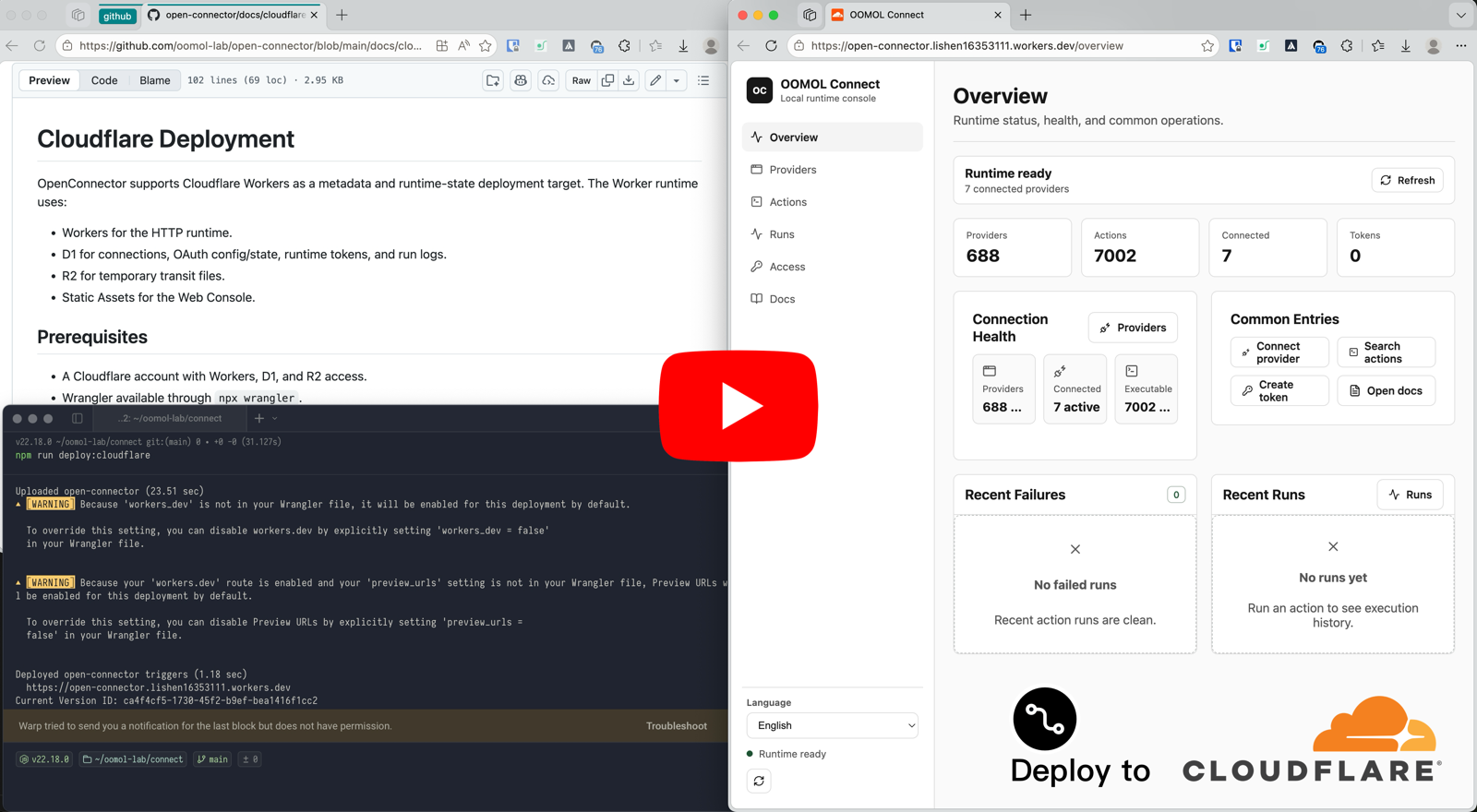
OpenConnector is an open-source alternative to Composio for agent-ready SaaS auth, tools, and integrations. It is a connector layer for agents that need reliable access to user accounts in external apps. It handles auth, tool execution, and agent-ready integrations. The open-source catalog currently includes 840+ providers and 8,300+ prebuilt Actions, runs locally or on Cloudflare-compatible infrastructure, and exposes the same tools through the Connector SDK, MCP, HTTP, OpenAPI, and a local Web Console.
OpenConnector gives agents a controlled path into real products while keeping credentials, scopes, schemas, policies, and run logs inside an inspectable runtime. The gateway, provider catalog, and Action executors are open source, so teams can review contracts, extend providers, and control the deployment boundary.
The open-source catalog is the portion of OOMOL's connector catalog that has completed migration into maintainable provider definitions and executors. The hosted OOMOL product covers 1,000+ providers today. Both surfaces use compatible connector interfaces and Action contracts, so teams can start hosted for speed and later move the same connector layer to private or self-hosted runtime infrastructure.
oo CLI support for the open-source runtime is being added and is targeted for mid-July 2026. Until then, use the SDK, MCP, HTTP API, OpenAPI, and local Web Console paths below.
What OpenConnector Provides
- A working connector catalog: 840+ providers and 8,300+ prebuilt Actions across products such as GitHub, Gmail, Notion, BigQuery, Google Analytics, Supabase, Airtable, Slack, and more.
- Credential handling in one runtime: API keys, OAuth2, custom credentials, and providers that do not require auth.
- Inspectable Action contracts: request/response schemas, required scopes, and lazy-loaded executors live in source.
- Deployment options for different runtime boundaries: local Docker or Node.js for development, plus Cloudflare-compatible deployment on Workers, D1, R2, and Static Assets.
- Agent-facing interfaces: Connector SDK, MCP, HTTP API, OpenAPI, and a local Web Console, with oo CLI support being adapted for the open-source runtime.
- Runtime guardrails for production use: connection identity, scopes, runtime tokens, action allow/block policies, temporary file transit, and redacted run logs.
Where It Fits
OpenConnector fits products where agents need to work inside the tools users already use, with a clear operating boundary for credentials, scopes, schemas, and execution logs. The hosted and open-source versions stay interface-compatible, so the same connector layer can move from OOMOL's hosted service to private or self-hosted infrastructure as deployment requirements change.
- Agent products that need reusable access across work apps, developer tools, data systems, communication platforms, and AI services.
- Products adding agent workflows that need stable, inspectable Action contracts for user app access.
- Teams that want to start hosted for speed and keep a path toward private or self-hosted runtime control.
Developer Tools
| Tool | Purpose |
|---|---|
| Connector SDK | Call connector Actions, proxy upstream APIs, and inspect the catalog from TypeScript apps and agent runtimes. |
| oo CLI | Open-source runtime support is being added and is targeted for mid-July 2026. |
| MCP | Expose app Actions to MCP-capable agent hosts through http://localhost:3000/mcp. |
| HTTP / OpenAPI | Call /v1/actions/* directly or inspect the generated /openapi.json document. |
Provider Coverage Preview
For coverage planning, the full provider list is available in docs/providers.md. This preview highlights recognizable productivity apps, developer tools, analytics products, and AI services from the catalog.
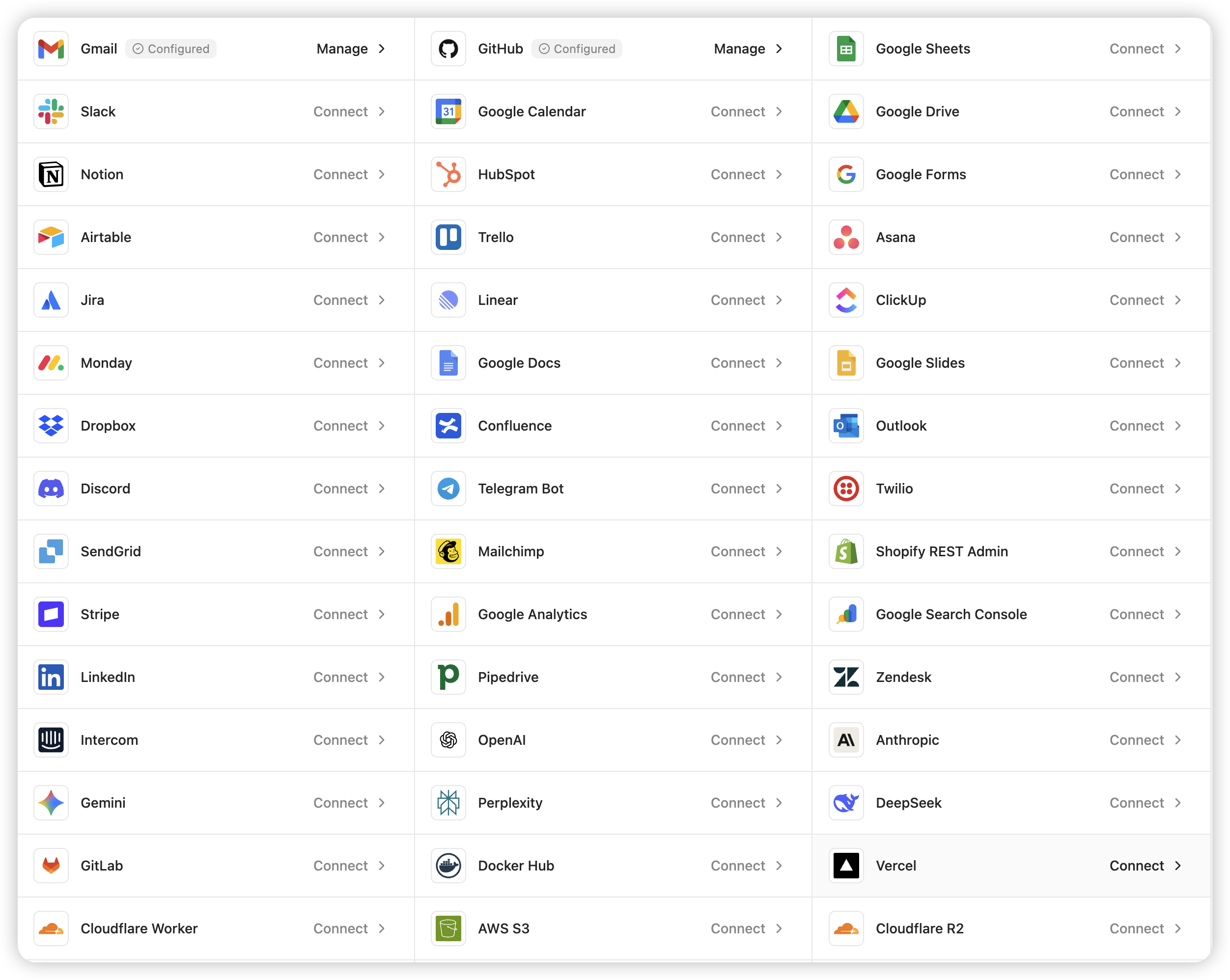
Provider names and trademarks belong to their respective owners and are used only for identification and interoperability.
How It Works
flowchart LR
  Agent["AI Agent / App"] -->|"SDK / MCP / HTTP"| Gateway["OpenConnector Gateway"]
  Gateway --> Auth["Credential & OAuth Boundary"]
  Gateway --> Catalog["Provider Catalog"]
  Gateway --> Actions["Open-source Action Executors"]
  Gateway --> Policy["Tokens, Scopes, Allow/Block Policy"]
  Gateway --> Logs["Run Logs"]
  Actions --> Providers["840+ Providers"]
  Console["Web Console"] --> Gateway
  Cloudflare["Cloudflare Workers, D1, R2"] -. deploy .-> Gateway
Apps and agents discover Actions, inspect schemas and scopes, select a connection alias, and execute through the gateway. Provider secrets stay behind the runtime boundary; agents receive the metadata, safe account labels, and execution results needed for the run.
Usage Paths
| Path | Best for | Includes |
|---|---|---|
| Open-source self-host | Developers and teams that want full control | Local Docker or Node runtime, SQLite storage, MCP, HTTP, OpenAPI, and Web Console |
| Cloudflare-compatible deploy | Teams that want a lightweight hosted runtime | Workers runtime, D1 state, R2 transit files, and Static Assets for the console |
| OOMOL | Teams blocked by OAuth approval or launch deadlines | Hosted auth, runtime, and 1,000+ provider catalog; compatible with the open-source interface for later private or self-hosted deployment |
Cloudflare Quick Start Video
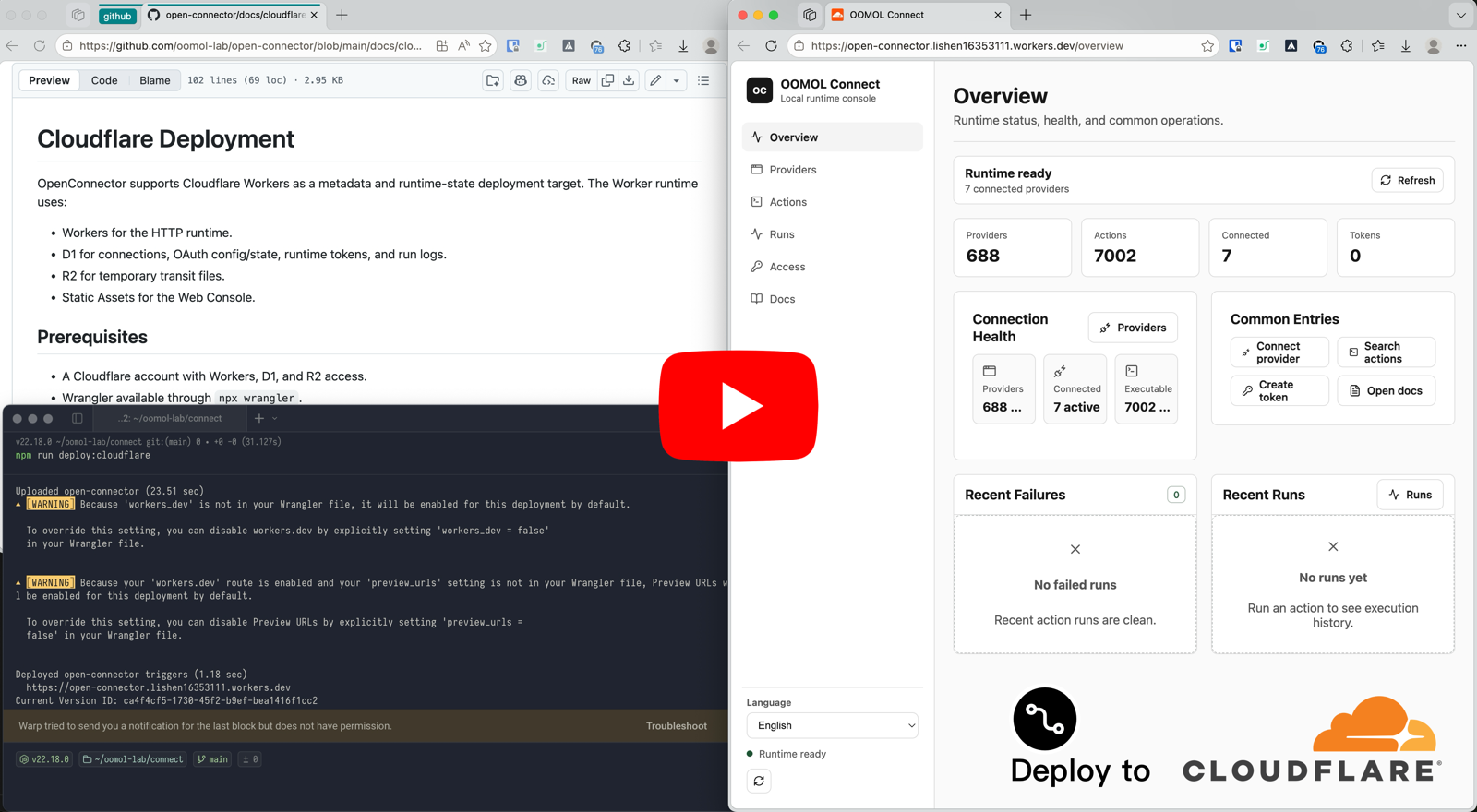
The
Cloudflare Workers deployment walkthrough shows how
to launch OpenConnector on Cloudflare with Workers, D1, R2, and the Web Console. The video follows
the same flow as docs/cloudflare.md: create Cloudflare resources, copy
wrangler.example.jsonc to wrangler.local.jsonc, apply D1 migrations, set required secrets, and
run npm run deploy:cloudflare.
Quick Start
Start the runtime with Docker Compose:
docker compose up --build
Open the local console and generated API reference:
http://localhost:3000
http://localhost:3000/docs
Run a no-auth Action to verify the runtime:
curl -s -X POST http://localhost:3000/v1/actions/hackernews.get_top_stories \
  -H 'content-type: application/json' \
  -d '{"input":{}}'
See docs/quickstart.md for the full local setup, first provider connection, OAuth flow, and runtime settings.
Connect A Provider
GitHub is the simplest credentialed example because it can use a personal access token:
curl -s -X PUT http://localhost:3000/api/connections/github \
  -H 'content-type: application/json' \
  -d '{"authType":"api_key","values":{"apiKey":"github_pat_..."}}'

curl -s -X POST http://localhost:3000/v1/actions/github.get_current_user \
  -H 'content-type: application/json' \
  -d '{"input":{}}'
For OAuth2 apps, named connections, credential encryption, token refresh, and action policies, see docs/credentials.md and docs/configuration.md.
Agent Tool Interfaces
OpenConnector exposes the same Action catalog through several agent-facing interfaces:
- MCP:
http://localhost:3000/mcp - HTTP runtime API:
/v1/actions - OpenAPI document:
/openapi.json - Action guides:
/api/actions/:actionId/agent.md - Web Console examples: cURL, TypeScript, and agent prompt snippets for each Action
See docs/runtime-api.md for endpoint details, response envelopes, auth headers, MCP tools, and Action guide examples.
Web Console
Open http://localhost:3000 after starting the runtime. The console supports provider browsing,
API key and OAuth client configuration, runtime token creation, Action schema inspection, Action
debugging, recent run review, and access to the generated OpenAPI and MCP metadata.
Cloudflare Deployment
OpenConnector supports Cloudflare Workers as a metadata and runtime-state deployment target using Workers, D1, R2, and Static Assets.
See docs/cloudflare.md for resource creation, migrations, secrets, local Worker preview, and remote deployment.
OOMOL And Wanta
Teams can choose the product path that matches their preferred level of runtime ownership. OpenConnector provides open-source self-hosting and deployment control. OOMOL provides hosted auth, runtime infrastructure, and the broader 1,000+ provider catalog while keeping compatible connector interfaces and Action contracts.
For small teams or individuals using a desktop Agent directly, Wanta connects apps through a desktop product experience with team app sharing, permission control, multiple connected accounts, and workspace-specific connections.
Documentation
- Quickstart
- Developer tools
- Provider coverage
- Runtime API and MCP
- Cloudflare deployment
- Configuration
- Credentials and OAuth
- Catalog format
- Verification language
- Contributing
- Code of Conduct
- Security
Development
Use Node.js 22 or newer:
npm install
npm run build:web
npm run dev
Before opening a pull request:
npm run fix-check
npm test
Provider code lives under src/providers/<service>. See
CONTRIBUTING.md for provider contribution rules.
Community
Please keep issues and pull requests focused, respectful, and actionable. Participation in this project is governed by CODE_OF_CONDUCT.md.
Comments