AI agents are shipping to production at an increasing pace. Teams running LLM-powered workflows need something beyond a single notebook to keep these agents organized, versioned, and governed. The tooling around this is still young. Most projects target a specific framework or runtime, which means picking one can lock you into that ecosystem early.
langship.sh positions itself as a different approach. It's a self-hosted platform built for shipping and governing AI agents without tying you to a particular framework. The pitch is multi-runtime support with GitOps-native workflows.
Enter langship.sh
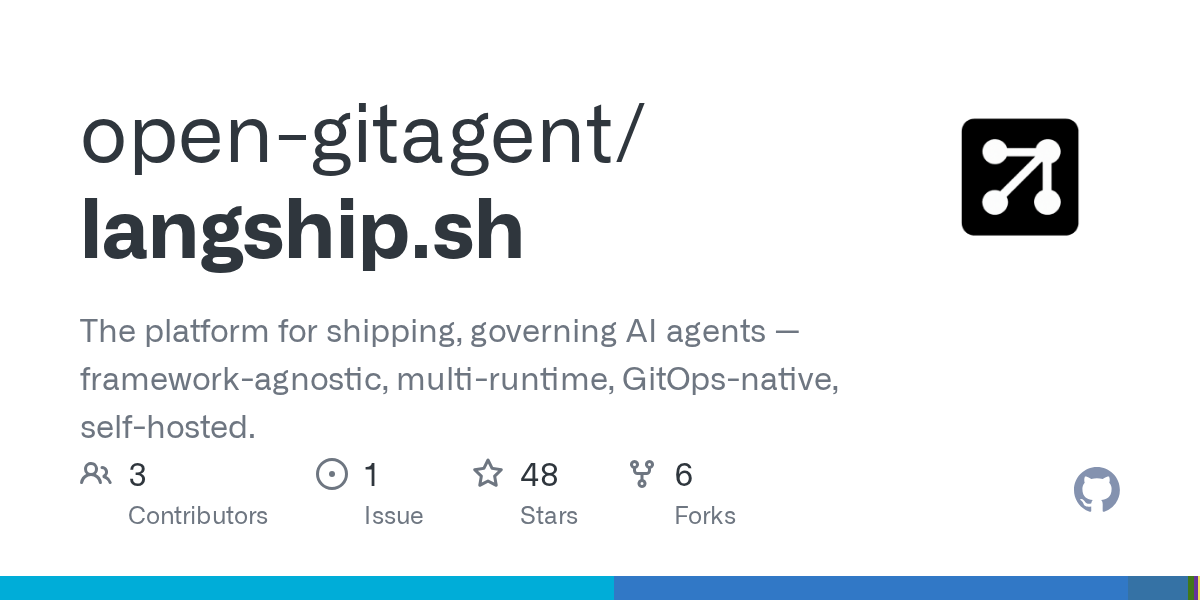
langship.sh describes itself as a platform for shipping and governing AI agents. The emphasis falls on three traits: framework-agnostic design, multi-runtime support, and GitOps-native operation. Everything runs self-hosted, so there's no SaaS dependency.
The project is relatively new. It sits at 48 stars on GitHub as of the last public count, which places it in the early-adopter phase. The website (https://www.langship.sh/) outlines the positioning: you write agent logic, push it through Git, and langship.sh handles deployment and governance across whatever runtime you choose.
If your workflow already uses GitOps for infrastructure, this aims to extend that same model into agent lifecycle management. There's no lock-in to a specific LLM framework or orchestration layer.
Under the hood
The codebase is written in Go. That's the primary language listed. The project lives at https://github.com/open-gitagent/langship.sh and follows an open-source model.
Because the description stresses framework-agnostic and multi-runtime support, the architecture likely abstracts runtime-specific details behind a common interface. GitOps-native means the state of deployed agents is tracked through Git repositories, similar to how ArgoCD or Flux handles Kubernetes resources. The self-hosted requirement means you run the platform on your own infrastructure, not a cloud vendor's.
Given the early star count and the scope described, the project is probably pre-1.0 or recently launched. Documentation depth may be limited compared to more mature tools.
Running it
The project hasn't publicly surfaced detailed installation steps in the seed facts. Based on the Go language and self-hosted positioning, the typical path would involve cloning the repository and running it locally or deploying via Docker. Check the GitHub repo for the current installation method.
git clone https://github.com/open-gitagent/langship.sh
cd langship.sh
From there, consult the project's documentation for build and run commands. Since it's Go-based, a standard go build or binary release pattern is likely.
An honest take
langship.sh addresses a real gap: agent governance without framework lock-in. The GitOps-native angle is distinctive in a space where most tools still assume a single orchestrator. That said, the project is early. With 48 stars and no version history provided in the seed facts, it's hard to assess maturity. If you need something battle-tested today, this isn't there yet. If you're evaluating the space and want to watch how this develops, the source is on GitHub.
Comments