██╗      ██████╗ ████████╗███╗   ███╗
██║     ██╔════╝ ╚══██╔══╝████╗ ████║
██║     ██║  ███╗   ██║   ██╔████╔██║ 👍
██║     ██║   ██║   ██║   ██║╚██╔╝██║
███████╗╚██████╔╝   ██║   ██║ ╚═╝ ██║
╚══════╝ ╚═════╝    ╚═╝   ╚═╝     ╚═╝
Read what your agent wrote - before you say LGTM.
A terminal diff reviewer for agentic coding. It runs in a pane beside your agent, shows what changed as it changes, and lets you point at exact lines when you reply.
You keep your editor. hjkl, w b e, f t F T, / and n, V to
select, zz to centre - the motions already in your fingers, now pointed at the
agent's work.
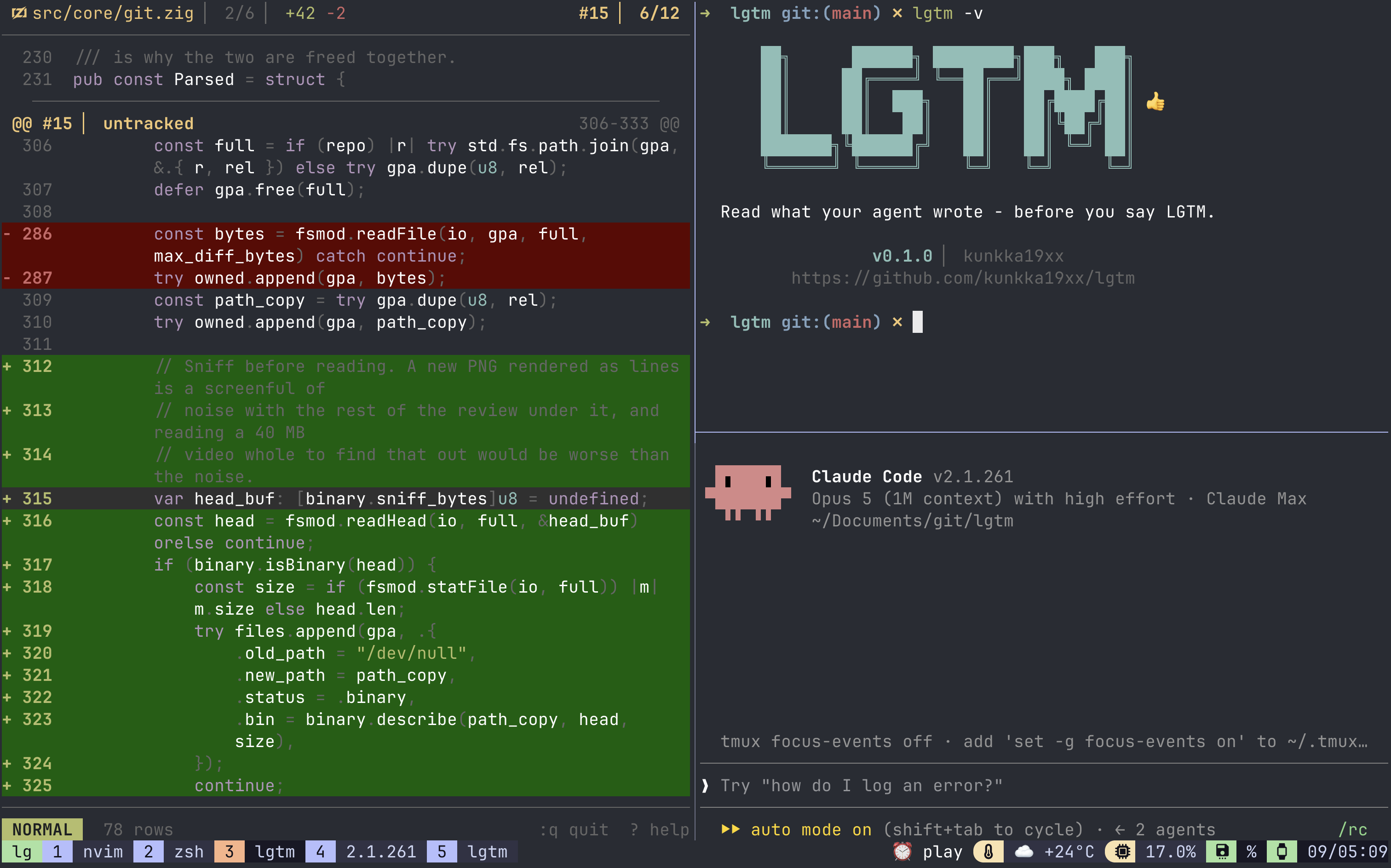
- A pane with your agent and tmux panes inside a window
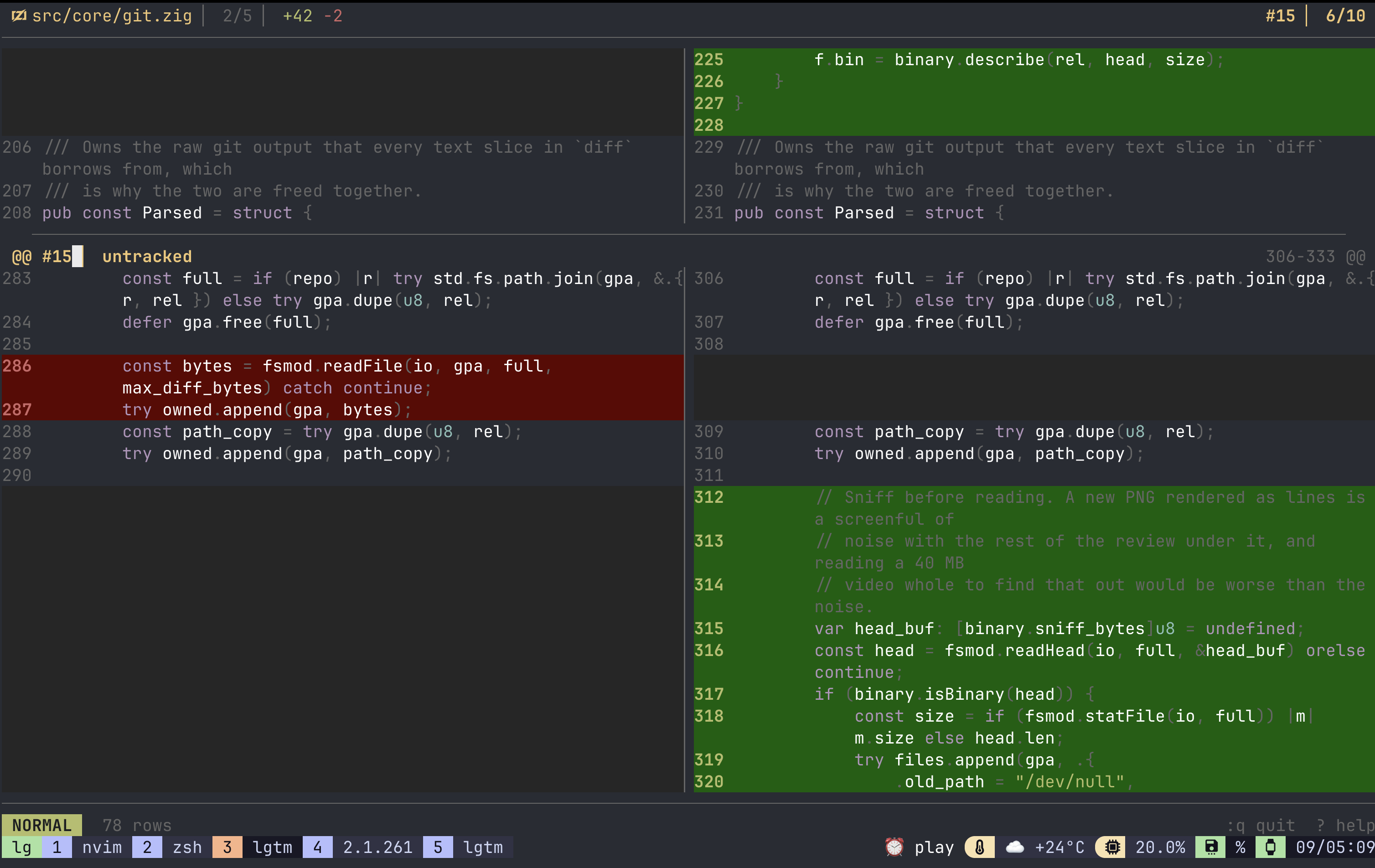
- Side-by-side diff view
Status: pre-alpha, and used daily by its author.
It began a long time ago as a Go tool for reading diffs in a terminal. This is a rewrite in Zig, rebuilt around a coding agent rather than a person: the diff re-renders as the agent writes, references go straight to its input, and comments follow the code when it rewrites the file underneath them. The loop works end to end; the numbers below are measured, not estimated.
Why
Reviewing an agent is not reviewing a person: more code, arriving faster, with
no prior about where the risk is. Without this, the loop goes - the agent edits
six files, you scroll git diff in a pager, you spot something at
src/auth.zig:47, and you retype that path into the chat. lgtm removes
the retyping.
Install
macOS, from the tap:
brew install kunkka19xx/tap/lgtm
Linux, any distribution - the binary is static, so the distro doesn't matter. (Also macOS):
curl -fsSL https://raw.githubusercontent.com/kunkka19xx/lgtm/main/scripts/install.sh | sh
arm64 and x86_64. No sudo: one binary into ~/.local/bin, checked against the
release's checksums. --uninstall removes it.
Nix - the flake ships the binary, not just a dev shell:
nix run --refresh github:kunkka19xx/lgtm          # run once, install nothing
nix profile add --refresh github:kunkka19xx/lgtm  # keep it on PATH
--refresh is not optional: Nix caches what a github: ref points at for an
hour, and without it you can get handed a build you already have.
Upgrading is a different command, and this is the one that catches people:
nix profile upgrade --refresh lgtm
add does not upgrade. A profile entry is locked to the commit it was
installed from, so running the install line again will not move it - add
refuses to install over itself, and --refresh only re-checks where the
github: ref points, not where your entry is pinned. upgrade re-resolves
the URL the entry was added with and re-locks it to whatever main is now.
nix profile list prints the locked commit and store path, which is the
quickest way to see that a stale entry, not the release, is why lgtm -v
still says the old number.
Arch, from the AUR: lgtm-bin (the release binary) or lgtm-git (builds
main), with any helper or makepkg -si from a clone.
From source - needs Zig, the version pinned in
.zigversion:
make local          # build and install to ~/.local/bin
make clean-local    # remove it, restoring whatever it displaced
make dev            # install as lgtm-dev, beside a packaged lgtm
make clean-dev      # remove that one
You also need git. tmux is optional: without it, references go to the
clipboard over OSC 52, which works over SSH.
Configure
Nothing to write: lgtm runs on defaults, and lgtm --init drops a commented
starter when you want to change one. Settings load from
~/.config/lgtm/config.toml, then .lgtm/config.toml in the repo, merged key by
key. A bad key is reported on the status line; it never stops the tool starting.
[review]
ignore = ["package-lock.json", "**/*.pb.go"]   # generated files .gitignore can't hide

[presets]
why  = "why this approach?"
perf = "is this hot path allocating?"

[ui]
icons = "nerd"        # or "unicode", "ascii"
comments = "inline"   # or "marker": just the gutter dot

[theme]
name = "gruvbox"      # seven bundled; `lgtm --theme-preview` shows them all

[keys]
next_hunk = ["]h", "<Space>nh"]
compose_presets = ["<C-p>"]   # the box's keys are bindings too
Every key is remappable, inside the compose box as well as outside it - only the vim motions are fixed, because in a text box every printable key is data.
Guide is install, the loop and every key. Configuration is every setting, command name and theme slot.
Numbers
Measured on macOS arm64, ReleaseFast, in this repository:
| Binary | 766 KB, one dependency (libSystem) |
| Frame | 0.30 ms at 80x26 |
| Re-diff | 40 ms: one git diff plus the parse |
| Re-anchoring comments | 100% across the fixture set (24/24), 1.8 ms per 50 |
Everything durable is a plain file in .lgtm/ - comments as jsonl, reviews as
markdown. Kill it and restart it; you lose scroll position.
Snapshots are ordinary git objects under refs/lgtm/**. That namespace is
invisible to git branch and git status, though git log --all walks every
ref and will show them. git show refs/lgtm/<session>/3:src/auth.zig reads a
file out of one without lgtm installed, and deleting the refs is all it takes to
be rid of them.
Comments