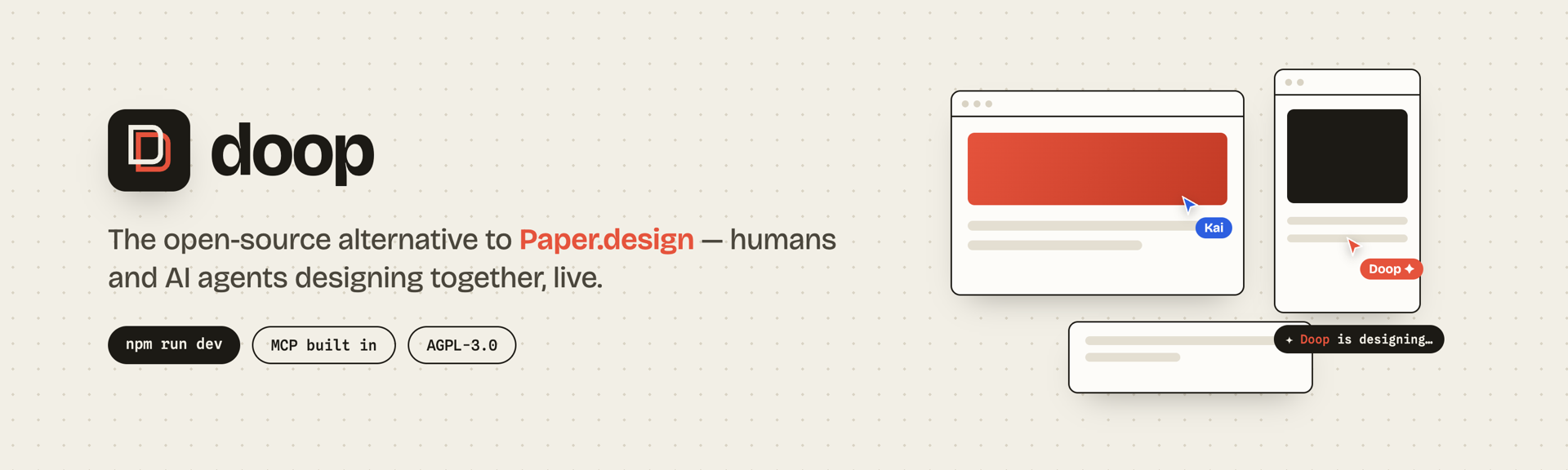
Doop is the open-source alternative to Paper.design — a multiplayer
design canvas for humans and AI agents. Every design lives on a shareable Canvas
(/c/<id>) holding Frames — artboards that render real HTML in sandboxed iframes. People edit
in the browser; AI agents edit through the built-in MCP server, streaming their designs in
live. Everyone sees everything as it happens: cursors, presence, frame edits, agent status, and an
activity feed.
- Design with agents, not prompts-and-refresh — connect Claude Code (or any MCP client) once, then watch it sketch, stream and self-review designs on your canvas, next to your cursor.
- A built-in Doop Agent — queue a card or @mention a role and it designs on its own, no client
to connect. Runs on the server's
ANTHROPIC_API_KEYfor a handful of free tasks, then on the ChatGPT subscription (or OpenAI key) each user connects (setup); the first-canvas welcome performance is scripted and runs without any of it. - True multiplayer — live cursors, presence, per-frame editing indicators, undo/redo, comments pinned to elements, and an activity feed, all over one WebSocket room.
- Design memory — pin exemplar frames, capture decisions, and let the distiller propose durable style rules that every agent follows.
- Private by default — invite collaborators by email or flip on link sharing per canvas; agents inherit exactly their human's access.
- Self-host in one command —
docker compose up, orbun run devwith zero configuration (embedded Postgres, no external services required).
Quickstart
git clone https://github.com/kgoedecke/doop && cd doop
bun install
bun run dev
Doop builds and installs with bun (bun.lock is the only
lockfile); the server itself runs on Node.
- Web app: http://localhost:4300
- API + WebSocket + MCP server: http://localhost:4400 (the web port proxies
/api,/ws,/mcpto it)
Everything works with no configuration: data persists to an embedded Postgres (PGlite) in data/pg,
and every optional integration (SMTP, stock photos, object storage, analytics) degrades gracefully
until its variable in .env.example is set. The one you will most likely want is
ANTHROPIC_API_KEY, which turns on the built-in Doop Agent — agents you connect
yourself over MCP need no key.
Or self-host the production build with Docker:
BETTER_AUTH_SECRET=$(openssl rand -hex 32) docker compose up -d # app + Postgres on :4400
Production build without Docker: bun run build && bun run start (single server on :4400 serving
everything). Set DATABASE_URL to use a real Postgres — same code path as PGlite.
Prefer not to run anything? doop.design is the hosted version.
Hook up Claude Code
One command connects Claude Code (or any MCP client) to your canvas:
claude mcp add --transport http doop http://localhost:4300/mcp
That triggers the standard MCP OAuth flow — a browser window opens, you approve, and from then on
the agent works as you. Ask it to design something on your canvas id and watch it happen live.
Everything in this shot is the real flow: Claude Code announced itself with set_status, created a
frame, and is streaming the pricing section in — presence avatar, "for Kai Moreno" attribution,
the frame chip, the working strip, and the task in the Agents panel.
Watch an agent design
The first canvas after signup comes with a performance: the Doop Agent streams a welcome design in while you watch — status in the working strip, a task in the panel, a pulsing border on the frame it's building.
That welcome performance is scripted (server/demo.ts) — a pre-authored frame replayed through
the same machinery real agents use, so it runs with no configuration at all. The Doop Agent proper
needs a key.
The Doop Agent
Doop ships a built-in design team that lives in the server and picks work up on its own: queue a
board card, @mention a role on an element comment, or leave feedback on a task, and it runs
without a human in the loop. Roles (Doop builds; specialists own one pass each — UX, copy, brand,
accessibility) are defined in shared/agents.ts, and a card can be routed
through several in order.
The server pays for the free tier, on Anthropic by default:
ANTHROPIC_API_KEY=sk-ant-... # in .env, or the environment of your deployment
Same key gates the guideline distiller (server/distill.ts), which proposes
durable style rules from your canvas.
The free tier can run on Azure OpenAI instead — useful when your organisation's credits or compliance rules live there:
DOOP_AGENT_PROVIDER=azure
AZURE_OPENAI_ENDPOINT=https://my-resource.openai.azure.com
AZURE_OPENAI_API_KEY=...
AZURE_OPENAI_DEPLOYMENT=my-deployment
The distiller stays on ANTHROPIC_API_KEY either way and quietly turns off without it.
Past the free tasks: connect your own ChatGPT
When a user's RESIDENT_TASK_LIMIT free tasks are gone, they don't lose the agent — they connect a
model account and the Doop Agent keeps running on it. A connected account takes over immediately,
from the very next task: the free tier is a trial that gets people here, not a balance to spend down
first, and connecting stops costing the server anything from that moment. The connection is
account-level, so it lives at /settings (Home → Settings); the free-tier wall links there rather
than carrying its own copy, and "Connect an AI agent" on a canvas stays about MCP clients only. Two
kinds of account:
- ChatGPT subscription — OAuth against
auth.openai.com, then inference through the Codex backend that Plus/Pro/Business plans include. Tokens live inmodel_accountsand never reach a browser. - OpenAI API key — pay-as-you-go on the user's own OpenAI account, no subscription involved.
Azure OpenAI is deliberately not a connectable account kind: a user-supplied endpoint would be a URL the server fetches with the run's full context — an SSRF vector — so Azure stays a server-level provider only.
Either way the user picks their model tier in Settings — gpt-5.6-sol (flagship),
gpt-5.6-terra (the default workhorse) or gpt-5.6-luna (cheap and fast). They are paying for it,
so the choice is theirs; DOOP_AGENT_OPENAI_MODEL only sets the default they start on. Note that
gpt-5.4 and gpt-5.4-mini retire from ChatGPT-authenticated Codex on 31 August 2026, so
pinning a 5.4 id via that env var will break the subscription path after that date.
OpenAI registers no redirect URI for a hosted app, so connecting ChatGPT takes one of three shapes and Doop picks the cheapest one available:
| Where Doop runs | Flow | What the user does |
|---|---|---|
| Same machine as the browser (dev, self-host) | Loopback catch — Doop holds 127.0.0.1:1455 |
Approve in the OpenAI tab. Nothing to copy, no setup |
| Hosted (doop.design) | Device code (/api/accounts/deviceauth/*) |
Type a short code at auth.openai.com/codex/device |
| Device codes disallowed | Browser redirect + paste | Paste the dead localhost:1455 page's address back into Doop |
The device flow needs device code authorization switched on in ChatGPT → Settings → Security (workspace members need an admin to allow it) — that is why the loopback flow, which needs no setting at all, stays the default when Doop is local. All three end at the same server-side PKCE exchange.
Before you turn this on for real users: driving a ChatGPT subscription from a third-party server is not something OpenAI's terms sanction, and heavy use can get an account rate-limited or suspended. The API-key path is the fully supported alternative and shares all the same code.
CHATGPT_CONNECT_DISABLED=1switches the subscription path off and leaves the key path.
Runs are attributed to the human whose card, comment or feedback they picked up, so the person who
asked for the work is the person whose account runs it. The translation between the agent's
Anthropic-shaped loop and OpenAI's Responses API lives in
server/openaiAgent.ts; which credential a run gets is decided in
server/agentModel.ts.
With no server key and no connected account the Doop Agent is off, and it fails quietly by
design — queued cards and @mentions simply wait for some agent to claim them. The startup banner
tells you which state you're in.
All of this is separate from connecting your own agent. Claude Code and any other MCP client authenticate over OAuth and drive the canvas from outside, on your own subscription — never metered. Three paths, same canvas: the Doop Agent on our key (free tier), the Doop Agent on your key, or your own agent over MCP.
| Variable | Default | What it does |
|---|---|---|
DOOP_AGENT_PROVIDER |
anthropic |
What the free tier runs on: anthropic | azure |
ANTHROPIC_API_KEY |
unset | Pays for the free Doop Agent tier (default provider) and the distiller |
AZURE_OPENAI_ENDPOINT |
unset | The free tier's Azure OpenAI resource, when DOOP_AGENT_PROVIDER=azure |
AZURE_OPENAI_API_KEY |
unset | A key of that resource |
AZURE_OPENAI_DEPLOYMENT |
unset | The deployment the free tier runs on |
AZURE_OPENAI_API_VERSION |
unset | Pins an api-version query parameter; the v1 surface needs none |
AZURE_OPENAI_REASONING_EFFORT |
unset | Reasoning effort on Azure runs; unset sends none (non-reasoning-safe) |
RESIDENT_TASK_LIMIT |
5 |
Free Doop Agent tasks per account before a connection is needed |
DOOP_AGENT_MODEL |
claude-opus-5 |
Model for the Doop Agent on the server's Anthropic key |
DOOP_AGENT_OPENAI_MODEL |
gpt-5.6-terra |
Default tier on a user's account; each user can pick another in Settings |
CHATGPT_CONNECT_DISABLED |
unset | 1 hides the ChatGPT flow, leaving the API-key path |
DOOP_DISTILL_MODEL |
claude-haiku-4-5-20251001 |
Model for the guideline distiller |
RESIDENT_TASK_LIMIT is the free-tier meter for the hosted version. It counts only tasks a user
initiates — feedback replies and retries on existing work stay free — and users who have connected
either their own MCP agent or a model account bypass it entirely. There is no "unlimited" value:
self-hosting with your own key, set it to a large number, since you're paying Anthropic directly
either way.
Accounts
The web app requires an account (better-auth, email/password — open signup). Your account name is your identity everywhere: cursors, presence, the activity feed, and feedback attribution are all server-authoritative from the session, and the WebSocket rejects unauthenticated joins. Canvases are private by default, Figma-style: only the owner and people they invite (Share → invite by email, existing doop accounts) can open one. The Share modal can also turn on link sharing per canvas ("anyone with the link can edit"), which restores drop-a-link collaboration for that canvas. Your home screen lists your own canvases plus ones shared with you (plus unowned legacy ones, claimable there). Agents connected over MCP act under the account that approved them and get exactly that user's access.
With SMTP configured (SMTP_HOST etc. — see .env.example), signups require email
verification and "forgot password" sends real reset links. Without it, signup stays open and every
email is printed to the server log, links included — the flows still work in development.
Set REQUIRE_EMAIL_VERIFICATION=false to let people in before they verify — the link is still
emailed, it just stops gating sign-in. Admin promotion is deliberately not part of that trade:
ADMIN_EMAILS only ever promotes a verified address (see below).
If signup or password reset hangs rather than failing, the cause is almost always a host that
blocks outbound SMTP: Railway and most PaaS block 25/465/587. Resend also serves 2465/2587, so
SMTP_PORT=2587 is the usual fix.
Env: BETTER_AUTH_SECRET (required in production), TRUSTED_ORIGINS (comma-separated,
defaults to the localhost dev origins).
Instance admins
ADMIN_EMAILS (comma-separated) names the accounts that get the admin role, applied at
signup, on email verification, and at boot — so you can name an admin before or after they
have an account. This requires SMTP in production: an address only identifies someone
once they have proven they own it, and without a mailer signup is open, so anyone could sign
up as your address and take the role with it. A production instance without SMTP promotes
nobody and warns at boot; set the role directly in the database if that is your setup.
Admins get /admin: every canvas and account on the instance, and "view as", which hands
them a real but read-only 15-minute session as that user. Being an admin does not widen
canvas access itself: the gate in server/access.ts is shared with MCP,
so a privileged read there would give every agent holding an admin's token the run of the
instance. View-as sessions cannot write, cannot connect agents, and record who is behind
them in session.impersonated_by.
Agent auth (MCP OAuth)
The /mcp endpoint requires OAuth. Adding the server in Claude Code / Codex triggers
the standard MCP OAuth flow: a browser window opens, you sign in to Doop and approve,
and the client stores a bearer token. Every tool call then carries your identity —
agent tasks show "for ⟨you⟩" in the Tasks panel, and presence tooltips name the owner.
Unauthenticated calls get a 401 with WWW-Authenticate discovery pointers
(/.well-known/oauth-authorization-server + oauth-protected-resource), which is what
kicks off the flow. Dynamic client registration is enabled, so no manual client setup.
In production also set BETTER_AUTH_URL to the public origin — OAuth URLs are built on it.
Deploy
The repo ships a production Dockerfile (client build + Chromium for frame screenshots).
Any container host works; Railway/Fly are the least friction:
- Create the app from this repo (both auto-detect the Dockerfile).
- Add a managed Postgres and set
DATABASE_URL. Don't skip this in real deployments — the PGlite fallback is embedded/single-process and only suits a single instance with a persistent volume mounted at/app/data. - Set
BETTER_AUTH_SECRET(long random string) andBETTER_AUTH_URL(the public origin, e.g.https://doop.example.com). Extra allowed origins:TRUSTED_ORIGINS(comma-separated). - Health check:
GET /healthz. The server trusts one proxy hop (trust proxy), so TLS termination at the platform edge works out of the box.
Local sanity check of the exact production image:
docker build -t doop .
docker run -p 4400:4400 -e BETTER_AUTH_URL=http://localhost:4400 -e BETTER_AUTH_SECRET=dev-only doop
Connect an AI agent
The MCP endpoint (streamable HTTP, stateless) is at:
http://localhost:4300/mcp
Claude Code:
claude mcp add --transport http doop http://localhost:4300/mcp
Generic MCP config:
{ "mcpServers": { "doop": { "type": "http", "url": "http://localhost:4300/mcp" } } }
Then tell the agent something like:
Work on canvas
<canvas-id>(shown in the top bar). Callget_canvasto see the existing frames. To design, create a frame withcreate_frame, then stream the design into it withappend_frame_htmlin ~300–500 character chunks (start=trueon the first,done=trueon the last) so people watch it build up live. Complete HTML with inline CSS. After finishing, callget_frame_screenshotto see it, fix what looks wrong, and re-check. Pick anagent_nameand reuse it on every call.
Screenshots render in your system Chrome/Chromium via puppeteer-core (set CHROME_PATH if it isn't
auto-detected). Humans can hit the same renderer at GET /api/frames/:id/screenshot.png?scale=2.
For website viewing/imports, setting CONTEXT_DEV_API_KEY makes Context.dev acquire the rendered
HTML while Doop still sanitizes it and renders the preview locally; without the key, Doop navigates
to the public page directly in Chromium.
Design sync: push an app's live screens onto a canvas
Server-side import can't reach apps behind SSO or a VPN. The doop-sync snippet flips the capture to the user's browser: mint a write-only key in a canvas's Share dialog, drop one tag into the app —
<script async src="https://your-doop-origin/doop-sync.js?key=dk_…"></script>
— and every distinct screen people visit lands on that canvas as a frame (one row per app), imported
once: a short grace window lets the first capture settle (scroll reveals, late images), then the frame
freezes so later visits — different viewports, other users' data, open menus — never churn it. Deleting
a frame re-imports it on the next visit; navigation counts keep accumulating regardless. Routes are
normalized (/orders/8231 → /orders/:id) so each screen maps to one
frame; captures are serialized from the CSSOM (so styled-components/emotion output survives), and
same-origin webfonts and small images are inlined as data: URIs — fonts require CORS inside the
sandboxed frame, and intranet URLs would never render for viewers outside the network. Scripts are
stripped client- and server-side, input values are always dropped, and anything marked data-doop-mask
is redacted before upload (data-doop-sync-ignore excludes an element entirely). The key is the whole
credential: it can only write frames to its one canvas, so revoking it in the Share dialog cuts the
app off instantly. Endpoint: POST /ingest/<key> (CORS-open, no cookies).
How streaming looks (server-side smoothing)
Agent HTML lands in the store immediately, but viewers see it through a typewriter reveal: the server
broadcasts the accumulated HTML at a steady rate (~500 chars/s, accelerating to clear backlogs in ~8s),
so even an agent that sends few large chunks — or a one-shot set_frame_html / create_frame with
full HTML — plays back as a smooth live stream. Mid-reveal HTML is healed before broadcast: a trailing
half-written tag is dropped, an unclosed <script> is cut (never run half-written JS), and an unclosed
<style> is closed so content paints instead of blanking. Human edits from the inspector bypass the
reveal (and a human html edit cancels any open reveal — the human takes over).
While a stream/reveal is open the frame gets a pulsing dashed border and a "✦ POST /api/frames/:id/append with { html_chunk, start?, done?, actor? }.
How agents learn the workflow
Steering happens at three layers (the same architecture paper.design uses, plus result nudges):
- Server
instructionsat MCP initialize — a compact contract: load the guide, get context first, stream designs, review with screenshots, keep oneagent_name. get_guidetool — the deep playbook (mandatory review checkpoints, streaming workflow, frame sizing, design-quality doctrine, multiplayer etiquette), loaded once per session and re-loadable after context compaction. Source:server/guide.ts.- Result nudges —
create_frame/set_frame_html/ finalappend_frame_htmlresults tell the agent it hasn't seen its design yet and to callget_frame_screenshotbefore moving on.
MCP tools
| Tool | What it does |
|---|---|
get_guide |
The agent playbook — agents are instructed to load this first |
set_status |
Broadcast a one-line "what I'm working on" — shown live in the working-now strip, avatar tooltip, and activity feed |
get_feedback |
Fetch & claim open human feedback requests — for agents whose job is to poll the canvas periodically |
list_canvases |
List all canvases |
create_canvas |
Create a canvas, returns its shareable id |
get_canvas |
Canvas layout: every frame's position/size/meta |
view_website |
Inspect one public page read-only; returns a desktop screenshot and visible text without changing the canvas |
import_webpage |
Import one public URL onto a canvas as an editable HTML snapshot/frame |
create_frame |
Add a frame with HTML (auto-placed if no x/y) |
get_frame |
Read a frame including its HTML |
get_frame_screenshot |
Render the frame headlessly and return a PNG — lets agents see and iterate on their design |
set_frame_html |
Replace a frame's design in one shot — renders live for everyone |
append_frame_html |
Stream a design in chunks (start=true first, done=true last) — viewers watch it build up |
edit_frame_html |
Targeted exact find/replace in a frame's HTML — morphs into the render in place |
update_frame |
Rename / move / resize a frame |
delete_frame |
Remove a frame |
Mutating tools accept agent_name; the agent then appears in the presence stack (pulsing square avatar),
gets an "editing" ring + chip on the frame it touched, and its actions land in the activity feed. Agents
expire from presence after 20s of inactivity (60s while they have a posted status, since a status
usually means the agent is thinking between tool calls).
Agent-to-human ownership comes from the OAuth token: the bearer token identifies who approved the connection, and that user shows up as the agent's owner in tasks and presence.
Live task narration
Agents are steered (instructions + guide) to call set_status with a one-line, present-tense summary
when they start a task and whenever their focus shifts — e.g. "Sketching a mobile onboarding flow".
Statuses appear in a floating working-now strip at the bottom-left of the canvas (pulsing dot in the
agent's color), in the presence avatar tooltip, and as an activity feed entry, so you always know what
each agent is doing even while it's silently thinking. An empty string clears the status; it also
expires with the agent's presence.
Every status also becomes a task: posting a new status completes the previous one, clearing (or
going silent) ends the open task. Agents that never call set_status still show up: the server
infers a task from what they visibly do ("Designing 'Hero'", italicized in the panel), closes it
when the stream finishes, and nudges them in tool results to start announcing — so the panel works
even for sessions that connected before the tool existed or skipped the guide. The side panel is split into two tabs — Tasks shows the history
per agent (active task pulsing with a running duration, finished ones checked off with how long they
took), Cursor-agent-panel style; Activity is the raw event feed. Task history survives agents
leaving and is sent to late joiners.
Steering agents: feedback on tasks
Hover any task in the Tasks tab and hit ↩ to leave feedback (e.g. "make the accent warmer").
Each note becomes an open request on the canvas — a work item, not mail for the agent whose
task it was. MCP is pull-based, so delivery rides the result-nudge layer: the next identified
agent call on the canvas (any tool carrying an agent_name, whoever it is) returns a
HUMAN FEEDBACK block quoting the note, saying whose work it concerns, and instructing the agent
to address it before continuing — including editing another agent's frame (a human request
overrides the don't-touch etiquette). Picking it up claims it: the UI flips from "→ waiting for
an agent…" to "✓ picked up by ⟨agent⟩", and each note is claimed exactly once.
Agents don't linger waiting for replies — sessions end when their work ends. Open requests simply
wait for the next agent to show up: the original agent in a later session, a different agent
already on the canvas, or a fresh one you spawn ("check in on canvas ⟨id⟩"). For a dedicated
caretaker, point an agent at get_feedback — a non-blocking fetch-and-claim designed for a
"check the canvas every few minutes, address whatever humans requested" loop.
REST equivalent: POST /api/tasks/:id/feedback with { text, from }.
What's in the box
- Infinite canvas — wheel to pan,
⌘/ctrl+ wheel (or pinch) to zoom, drag the background to pan, zoom-to-fit; dot grid tracks the viewport. - Frames — drag to move, corner handle to resize, click to select. The right-hand inspector edits
name/position/size and the raw HTML with debounced live saves.
⌫deletes the selected frame. - Multiplayer — live cursors with name tags, presence avatars, per-frame "who's editing" indicators, colored flash when a remote actor changes a frame, drag positions streamed live, auto-reconnect.
- Activity feed — every create/edit/rename/delete, by whom (user or agent), with timestamps.
- Sharing — the canvas URL is the share link (
Sharebutton copies it). - Connect AI modal — copy-paste MCP setup instructions from the app itself.
Architecture
server/          Node (tsx) — one process on :4400
  index.ts       Express REST API + ws rooms + presence + static serving (prod)
  store.ts       In-memory canvas/frame state (hot path), write-through to the DB
  db/            Drizzle schema + PGlite/Postgres connection + write-through persistence
  actions.ts     Shared mutations: broadcast + activity log + agent presence
  mcp.ts         MCP server (@modelcontextprotocol/sdk), stateless streamable HTTP at /mcp
  seed.ts        Demo canvas on first run
shared/types.ts  Store + ws protocol types shared by server and client
src/             React + Vite + zustand client on :4300
  components/ui/ The component system — every styled primitive lives here
  styles.css     Design tokens, the base reset, and keyframes. Nothing else.
Styling
Doop's look is a component system, not a stylesheet. src/components/ui/ holds the
primitives — Button, Input, Badge, Card, Panel, Modal, Menu, Toolbar,
Segmented, Dash* and the rest — each a Tailwind + CVA recipe bound
to the tokens in styles.css. Screens compose those; they don't re-describe borders,
shadows or type scales. If a pattern shows up twice, it belongs in ui/.
src/styles.css is deliberately small: the :root tokens (--ink, --paper, --brand…),
their @theme inline mapping onto Tailwind names, the base reset, and the @keyframes
utilities cannot express. Components reference those animations by name, so the names are
API. --breakpoint-md (900px) is the mobile boundary and useIsMobile() matches it in JS —
change them together.
Frame HTML renders in <iframe sandbox="allow-scripts"> — scripts run, but no same-origin access and
no reach into the app. Each iframe loads a small bootstrap once; new HTML is postMessaged in and
DOM-morphed in place (src/lib/frameRuntime.ts), so updates and streaming ticks never white-flash
the frame with a full document reload. Changed <script>s re-execute; unchanged styles/fonts are
untouched. The realtime layer is plain JSON over a per-canvas WebSocket room;
REST/MCP mutations are broadcast to the room by the shared actions layer, so human and agent edits go
through identical plumbing.
Comments