The academic and technical details of this project will soon be presented to the literature by @Root0ne. The idea for the project was inspired by his work. Many thanks to @Root0ne.
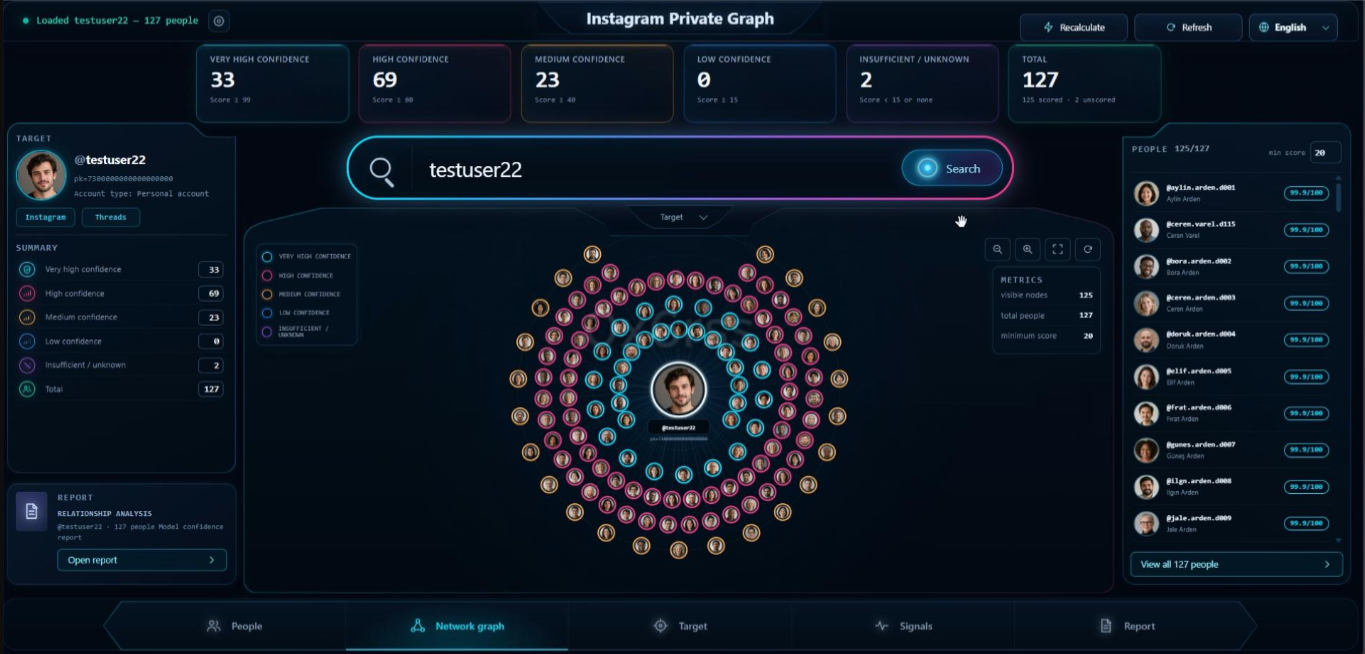
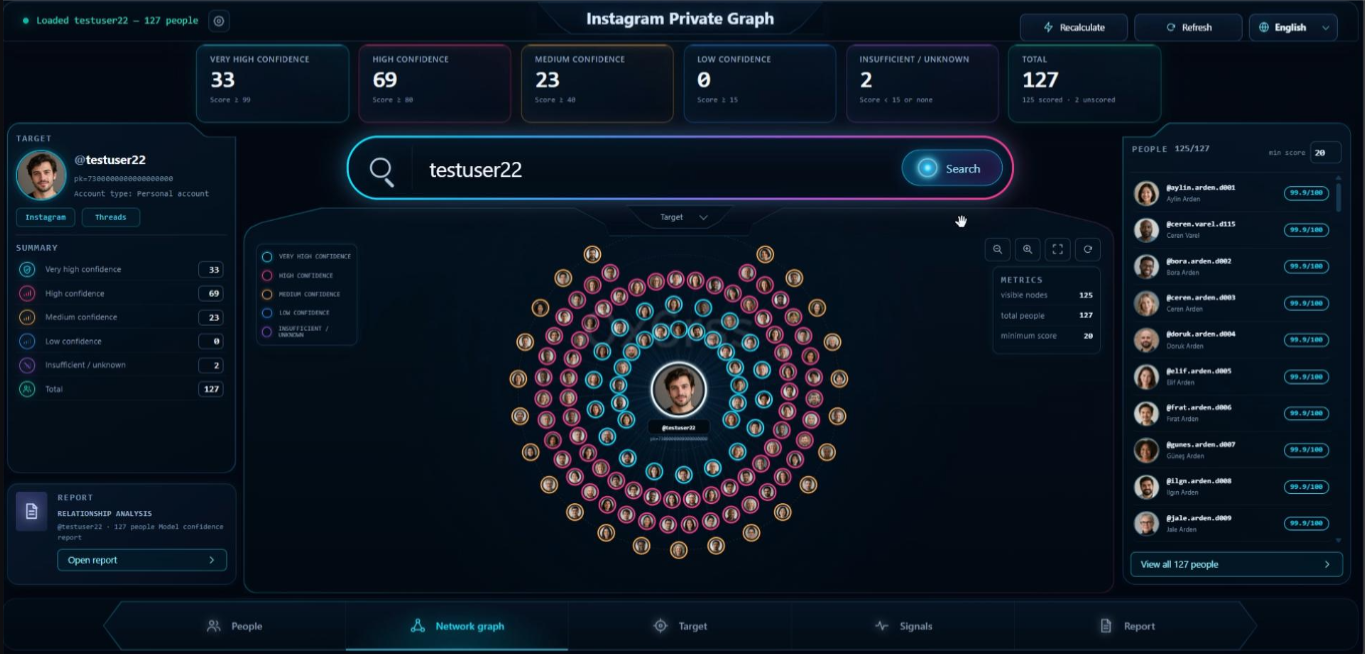
This project is a local research application for the social-media portion of authorized OSINT investigations. It collects information visible to an authenticated Instagram session, stores evidence locally, and produces a ranked candidate list, radial network visualization, target summary, signal summary, and human-readable report.
The final purpose is to assist case triage, hypothesis generation, and corroboration in legitimate OSINT work. It is not an identity-resolution system, follower-list bypass, surveillance service, or source of factual relationship declarations.
Interface preview
Read this before use
The displayed numbers are algorithmic model-confidence scores. They are not verified facts, calibrated probabilities, or proof that two people follow, know, communicate with, or are close to each other. The graph is a visualization of candidate scores; a drawn line is not a confirmed Instagram follow edge.
Use a dedicated, authorized, low-value test account. Do not use a primary, personal, business, creator, or irreplaceable account. Automated requests to undocumented Instagram endpoints can cause rate limiting, forced login, checkpoint challenges, session invalidation, temporary restrictions, or a permanent account ban. There is no ban-proof request rate.
For a private target, the test account must already be a genuine, accepted follower with lawful access. This project does not bypass private-account access controls and must not be used to send deceptive follow requests. For a public target, following is not always technically required, but a legitimate and established viewing relationship usually produces more interpretable signals.
Newly created, empty, or inactive viewing accounts have little stable ranking history and often receive generic onboarding suggestions. Newly created target accounts also have sparse evidence. In both cases, expect lower coverage, greater uncertainty, and potentially more false positives. An accepted follow does not turn the viewer's own suggestions into the target's followers.
Security notice
An Instagram sessionid is equivalent to authenticated account access. Never
commit it, paste it into an issue, send it in chat, include it in a screenshot,
or capture it with a browser cookie-export extension. If it has ever appeared
in a log, terminal recording, archive, cloud share, or diagnostic output, log
out all Instagram sessions, rotate the test-account password, and collect a
fresh cookie pair.
Keep the application bound to 127.0.0.1. It has no remote-user login or TLS
and intentionally refuses non-loopback hosts. Do not expose port 8000 through a
router, tunnel, reverse proxy, container port, LAN address, or public cloud VM.
Raw artifacts may contain usernames, numeric account identifiers, names, profile text, inferred connections, timestamps, and cached avatars. Store them in a non-synced, encrypted location with access limited to the case team. The project directory in a OneDrive, Dropbox, iCloud, or Google Drive folder is not an appropriate place for live cookies or case evidence.
Requirements
- Python 3.10 or newer; Python 3.11 or 3.12 is recommended for dependency compatibility
- A Chromium-family browser or Firefox/Safari for obtaining your own cookies
- An authorized Instagram test account
- Internet access for dependency installation and authorized collection
- At least 500 MB of free space for the Python environment and browser runtime, plus separately planned capacity for case artifacts and avatar cache, which can grow without a fixed upper bound
The project has no Windows-only runtime dependency. start.py is the single
cross-platform launcher. The former start.cmd wrapper has been removed.
Installation
Download or copy the project, open a terminal, and change into the
instagram-osint-app directory. No repository URL is assumed here.
Windows PowerShell
These commands avoid PowerShell activation-policy issues by calling the virtual environment's Python executable directly:
py -3.12 --version
py -3.12 -m venv .venv
.\.venv\Scripts\python.exe -m pip install --upgrade pip
.\.venv\Scripts\python.exe -m pip install -r requirements.txt
.\.venv\Scripts\python.exe -m playwright install chromium
Copy-Item .env.example .env
Edit .env, then start the application:
.\.venv\Scripts\python.exe start.py --skip-deps
macOS
python3 --version
python3 -m venv .venv
./.venv/bin/python -m pip install --upgrade pip
./.venv/bin/python -m pip install -r requirements.txt
./.venv/bin/python -m playwright install chromium
cp .env.example .env
chmod 600 .env
./.venv/bin/python start.py --skip-deps
On Apple Silicon, use a native arm64 Python installation when possible. If the
browser cannot open automatically, add --no-browser and open the local URL
manually.
Linux
python3 --version
python3 -m venv .venv
./.venv/bin/python -m pip install --upgrade pip
./.venv/bin/python -m pip install -r requirements.txt
./.venv/bin/python -m playwright install --with-deps chromium
cp .env.example .env
chmod 600 .env
./.venv/bin/python start.py --skip-deps
playwright install --with-deps is intended for Debian/Ubuntu-style systems
and may request administrator privileges for system libraries. On another
distribution, install the equivalent Chromium runtime libraries through that
distribution's package manager, then run python -m playwright install chromium.
Launcher behavior and options
Without --skip-deps, start.py checks both imports and declared minimum
versions, then runs an upgrade from requirements.txt if a package is missing
or outdated. With --skip-deps, startup stops instead of accepting an unsafe
or unsupported version. Explicit installation followed by --skip-deps is
more predictable and avoids an unexpected package install at launch.
Existing environments must be upgraded after pulling or copying this version:
python -m pip install --upgrade -r requirements.txt
python -m pip check
Use the virtual-environment Python path shown for your operating system in
place of python. In particular, curl-cffi must be version 0.15.0 or newer;
older releases include a known redirect-related SSRF vulnerability. The
requirements use reviewed minimum-version constraints rather than a
cryptographic lock file. For evidence-sensitive deployments, create and review
a lock file with hashes for the exact platform, repeat dependency auditing, and
archive that environment manifest with the case record.
python start.py [--host HOST] [--port PORT] [--no-browser] [--skip-deps]
                [--env-file PATH] [--artifacts PATH]
--port 8010selects another local port if 8000 is busy.--no-browseris useful on a server or headless desktop.--env-filekeeps credentials outside the project directory.--artifactskeeps case data outside the project directory.--hostaccepts loopback addresses only. Leave the default unchanged.
The default interface is http://127.0.0.1:8000.
Stop the application with Ctrl+C.
Recommended private storage layout
The simplest setup uses .env and data/artifacts inside the project. For
real case work, keep both outside cloud-synced folders.
Windows example:
$caseRoot = Join-Path $env:LOCALAPPDATA 'instagram-osint-private'
New-Item -ItemType Directory -Force $caseRoot | Out-Null
Copy-Item .env.example (Join-Path $caseRoot '.env')
.\.venv\Scripts\python.exe start.py --skip-deps `
  --env-file (Join-Path $caseRoot '.env') `
  --artifacts (Join-Path $caseRoot 'artifacts')
Use Windows file-security properties, EFS where appropriate, and BitLocker on the containing drive to restrict this directory to the authorized user.
macOS/Linux example:
mkdir -p "$HOME/.config/instagram-osint" "$HOME/.local/share/instagram-osint"
cp .env.example "$HOME/.config/instagram-osint/.env"
chmod 700 "$HOME/.config/instagram-osint" "$HOME/.local/share/instagram-osint"
chmod 600 "$HOME/.config/instagram-osint/.env"
./.venv/bin/python start.py --skip-deps \
  --env-file "$HOME/.config/instagram-osint/.env" \
  --artifacts "$HOME/.local/share/instagram-osint/artifacts"
Check that these directories are not included in a cloud backup or shared home folder.
Obtaining the Instagram cookie values
Only obtain cookies from your own authorized test account.
IG_SESSIONID and IG_DS_USER_ID are required. IG_CSRFTOKEN, IG_MID,
IG_IG_DID, and IG_DATR are supplementary and may be left empty when the
corresponding cookie is not present. The application attempts to obtain missing
supplementary cookies during its initial Instagram session warmup.
- Sign in to https://www.instagram.com using the dedicated test account.
- Open browser developer tools.
- In Chromium browsers, open Application, then Cookies, then
https://www.instagram.com. In Firefox or Safari, use the equivalent Storage or Web Inspector Storage panel. - Locate the cookies listed below. Some supplementary cookies may not be present in every browser session.
- Copy each complete Value exactly as displayed. Do not URL-decode it and do not include the cookie name.
- Put the values from the same browser profile and authenticated session into the matching variables:
| Browser cookie | Environment variable | Requirement |
|---|---|---|
sessionid |
IG_SESSIONID |
Required |
ds_user_id |
IG_DS_USER_ID |
Required |
csrftoken |
IG_CSRFTOKEN |
Optional |
mid |
IG_MID |
Optional |
ig_did |
IG_IG_DID |
Optional |
datr |
IG_DATR |
Optional |
IG_SESSIONID=replace_with_the_complete_sessionid_value
IG_DS_USER_ID=replace_with_the_separate_numeric_ds_user_id_value
IG_CSRFTOKEN=replace_with_csrftoken_if_present
IG_MID=replace_with_mid_if_present
IG_IG_DID=replace_with_ig_did_if_present
IG_DATR=replace_with_datr_if_present
Do not add export, do not add inline comments, and do not share the completed
file. Quoted values are accepted but unnecessary. If a supplementary cookie is
not shown, leave its value empty as it appears in .env.example. Values found
during warmup are used in memory and are not written back to .env.
Cookies expire or change after logout, password changes, security checkpoints,
and some Instagram session refreshes. When replacing a session, replace
IG_SESSIONID and IG_DS_USER_ID together. Stop collection immediately if
Instagram presents a challenge or forced-login page.
Quick start
- Start the local application using the platform command above.
- Open the local interface if it does not open automatically.
- Confirm the default language or choose English, Turkish, Simplified Chinese, or Russian in the upper-right language selector. English is the default and the selection persists locally.
- Enter an Instagram username without
@. - Open analysis settings, keep Fast mode and depth 5 for the first run.
- Select Search and watch the summarized progress window.
- Review the People, Network graph, Target, Signals, and Report tabs.
- Corroborate every material finding against independent, lawfully obtained evidence before using it in a case record.
Accepted usernames match [A-Za-z0-9._]{1,30}. URLs, display names, hashtags,
email addresses, and names beginning with @ are not accepted in the search
box.
Interface guide
Header controls
- Search starts a new online collection run for the entered username, then recomputes the local model and loads the result.
- Saved target switches between analyses already present in the artifact directory.
- Recalculate rebuilds model outputs from saved artifacts. It does not make a fresh Instagram collection.
- Refresh reloads the current saved result.
- Exclude weak algorithmic suggestions removes suggestion-only candidates that have no supported corroboration during both fresh-query scoring and manual recalculation. It cannot remove every false positive.
- Language changes interface labels and generated human summaries. Raw usernames and source records are never translated.
Analysis settings
Fast mode enables the default collection phases:
- Presence: target profile and viewer-relative access indicators
- Chain: repeated related-account recommendation samples
- Internal: target and viewer-relative account metadata
- Reciprocal: reciprocal recommendation overlap, not confirmed follows
- Banyan: viewer-to-target share-suggestion context; the viewer's other share-sheet users are not treated as target connections
Selecting all phases also enables DSA/transparency, schema inflation, archeology, tagged content, news/inbox, and follow-graph probes. Some are legacy or frequently unavailable because Instagram changes or gates undocumented endpoints. An HTTP 400, 404, empty response, or gated response is not evidence that the underlying fact does not exist.
Network depth is the number of repeated discovery/chaining requests. It is not graph-hop depth and does not change graph zoom. The interface offers 5 through 15 and defaults to 5. Values 6 through 15 increase request volume, runtime, and the chance of rate limiting or account restriction. Use depth 5, run one target at a time, and increase only when the case need justifies the risk.
People
- Search by username or full name.
- Set a minimum model-confidence score.
- Include or exclude Very high, High, Medium, Low, and Insufficient tiers.
- Filter for private accounts or accounts with Instagram's blue verification badge.
- Sort the table and select a row to open a short evidence explanation.
The model tier named verified in raw JSON is a legacy internal label. It does
not mean the account has a blue badge and does not mean the inferred
relationship has been verified by Instagram.
Network graph
- Minimum score controls which candidates are drawn.
- Zoom in, zoom out, fit, and reset change only the visualization.
- Stronger model scores are placed closer to the target; color indicates the score tier.
- Selecting a node synchronizes it with the People list.
Every target-to-person line is an inferred association produced for display. It is not a follower, following, message, contact, identity, or real-world relationship edge unless separately confirmed by a direct and reliable source.
Target
Shows consolidated target profile, visibility, account, history, platform, and viewer-relative information. A value may be absent because the profile is private, no relevant content is active, the test account lacks access, an endpoint is gated, or Instagram changed its response. Geographic inference is especially uncertain and must never be reported as the person's actual location without independent corroboration.
Signals
Shows which source artifacts were available and how much information each collector returned. Source availability is context, not accuracy. More rows do not automatically mean a conclusion is true.
Report
Provides a human-readable target summary, ranked candidate list, short signal descriptions, model tiers, and a client-rendered graph snapshot. JSON, CSV, node/edge CSV, GEXF, and text exports remain available for technical review. Spreadsheet exports neutralize formula-like profile text, but exported case data must still be treated as untrusted input.
How the model works
The application separates collection, normalization, inference, and display:
flowchart LR
    A[Authorized test-account session] --> B[Username and target PK]
    B --> C[Selected collection phases]
    C --> D[Target-scoped local artifacts]
    D --> E[Normalize candidates by numeric PK]
    E --> F[Repeated-appearance model]
    E --> G[Independent target-scoped context]
    F --> H[Algorithmic association score]
    G --> H
    H --> I[Confidence tier or Unknown]
    I --> J[People table, radial graph, report, exports]
1. Collection and scope
Each query resolves a target numeric PK and writes UTF-8 JSON under that target's artifact directory. Selected phases may observe repeated recommendation appearance, profile context, accessible likes/comments, tags/co-tags/mentions, viewer-relative friendship state, notifications, story references, and other source-specific fields.
Numeric PK is the primary candidate key. Usernames and display names can change and are treated as descriptive metadata. The target itself is removed from the candidate registry.
Viewer-bound data requires special handling. Autocomplete/bootstrap rankings, friendship flags, inbox state, and share-sheet rankings describe the signed-in test account's perspective. They must not be silently relabeled as the target's followers or friends. Unscoped global captures are rejected, and third-party viewer rankings are excluded from target-person scoring.
A partial query refreshes only its selected phases; it does not prove that unselected artifact files are current. Recalculation can therefore combine the newly selected observations with older target-scoped files still present in the same directory. For time-sensitive case work, use a new artifact directory per collection event, record the viewer, target PK, selected phases, and timestamp, and compare runs explicitly. Confirm the target identity again if a username may have been renamed or recycled.
2. Repeated-appearance estimate
The principal numeric estimate uses how often a candidate appears in successful discovery runs. Duplicate rows inside one run count once. Failed calls do not count as negative observations.
For Phase 32, the current model begins with a binomial likelihood comparison:
L1 = BinomialPMF(k, n, 0.70)
L2 = BinomialPMF(k, n, 0.16)
base_score = L1 / (L1 + L2)
Here k is the number of successful runs containing the candidate and n is
the number of successful runs. The constants are hand-set assumptions, not
rates measured on a published benchmark. If Phase 32 is absent, a separate
Phase 28 repeated-module fallback uses its own hand-set visibility assumptions.
Historical unions are candidate archives and are not allowed to accumulate
repeatability confidence across sessions.
Some target-scoped interaction signals can provide heuristic confidence floors. This makes the result a hybrid heuristic/Bayesian model, not a pure Bayesian posterior. Evidence weights retained in technical output are trace metadata; they are not simply summed into the displayed score. Several collected fields are explanatory context only and do not alter the number. A raw follow-graph response, when available, also remains source evidence until its exact scope and direction are independently validated; its presence alone does not silently raise a candidate score.
3. Tiers
Current compatibility labels are:
| Raw tier | Interface meaning | Score range |
|---|---|---|
verified |
Very high model confidence | 99 to 100 |
high_probability |
High model confidence | 80 to less than 99 |
medium_probability |
Medium model confidence | 40 to less than 80 |
low_probability |
Low model confidence | 15 to less than 40 |
noise |
Insufficient or weak signal | 0 to less than 15 |
unknown |
No valid score-producing observation | Not scored |
These thresholds are display buckets, not evidentiary standards. A 99 does not mean a measured 99 percent real-world probability, zero false positives, or a confirmed one-hop relationship. Scores from different viewers, sessions, depths, selected phases, or dates are not directly comparable.
For backward-compatible JSON and CSV schemas, an unknown row carries a
numeric score value of 0, together with score_valid: false. That zero is a
storage placeholder, not an observed low score; interfaces and downstream
analysis must use score_valid and the unknown tier before interpreting the
number.
In this project, “one hop” means a candidate for the target's immediate online social neighborhood under model assumptions. It does not establish follow direction, personal acquaintance, intimacy, shared identity, or offline contact.
4. Validation requirements
Before treating scores as calibrated probabilities, test the model on a de-identified dataset with lawful ground truth and report at least:
- Precision and recall at each tier
- False-positive and false-negative rates
- Brier score or another probabilistic scoring rule
- A calibration curve comparing predicted bands with observed frequencies
- Results separated by public/private target, viewer relationship, account age, depth, selected phases, and time
Until such validation exists, use the output only to prioritize manual review.
Output files
The default location is:
data/artifacts/<username>/
Processed outputs are normally written to:
data/artifacts/<username>/relationships/
  relationships_ranked.json
  relationships_ranked.csv
  nodes.csv
  edges.csv
  graph.gexf
  relationship_report.txt
Raw phase artifacts and avatar_cache may also be present in the target
directory. graph.gexf requires NetworkX. The interactive graph and report
snapshot are rendered by the browser; node and edge exports are persistent
technical representations.
Do not publish these files. Apply the case's access-control, minimization,
retention, disclosure, and secure-deletion rules. Delete data when authority or
retention expires. .gitignore excludes .env and data/artifacts, but an
ignore rule cannot protect a file that was previously copied or distributed.
Rate-limit and account-safety guidance
- Begin with Fast mode and depth 5.
- Run only one query at a time. The local server rejects overlapping analysis jobs, but separate application instances can still create parallel traffic.
- Do not script loops or immediate retries.
- Stop on HTTP 429, 401/403 changes, checkpoint/challenge responses, forced login, or unusual account notifications.
- Allow a substantial manual cooldown; Instagram does not publish a guaranteed safe interval for these endpoints.
- Higher depth and All/deep mode materially increase requests.
- Empty, 400, 404, or gated results are not proof of absence.
- Reauthenticate only the dedicated test account after confirming it is safe to continue.
Instagram can change undocumented endpoints and response schemas without notice. A workflow that succeeds today may become incomplete or unsafe later.
Troubleshooting
Target PK could not be found
Confirm the username, confirm that sessionid and ds_user_id are a fresh pair
from the same test-account session, and confirm the account has legitimate
visibility to a private target. Do not hammer retries.
HTTP 401, 403, challenge, or forced login
Stop the application. Review the test account in a normal browser. If the session was invalidated, create a fresh cookie pair only after resolving the checkpoint. Do not try to evade the platform response.
HTTP 429
Stop all collection and allow a manual cooldown. There is no universally safe wait period and no guarantee that the account will remain unrestricted.
HTTP 400, 404, or empty data
The endpoint may be removed, gated for that session, changed, or legitimately empty. Treat the result as unavailable, not as evidence that an account, relationship, or event does not exist.
Playwright cannot find Chromium
Run the platform-specific Playwright installation command from the Installation section using the same virtual-environment Python executable.
Port 8000 is in use
Windows: .\.venv\Scripts\python.exe start.py --port 8010
macOS/Linux: ./.venv/bin/python start.py --port 8010
Then open http://127.0.0.1:8010.
Browser does not open
Start with --no-browser and open the printed loopback URL manually.
Project structure
frontend/                  Local HTML, CSS, JavaScript, icons, and i18n
backend/                   Local HTTP API and Instagram collectors
backend/relationship_engine/  Normalization, inference, reporting, exports
data/artifacts/            Default raw and processed local data
start.py                   Cross-platform launcher
requirements.txt           Python dependencies
.env.example               Credential-file template without secrets
Disclaimer and acceptable use
This software is an independent research and analytical aid and is not affiliated with, endorsed by, or supported by Meta or Instagram. It is provided without any warranty of accuracy, completeness, availability, fitness for a particular purpose, or legal admissibility.
Use it only on accounts and data you own or are lawfully authorized to investigate. Comply with applicable law, consent requirements, privacy and data protection duties, platform terms, professional rules, and organizational case policy. Do not use it for stalking, harassment, doxxing, coercion, impersonation, unauthorized monitoring, credential theft, access-control bypass, or automated targeting.
No score, graph edge, geographic estimate, avatar inference, account-age estimate, follower inference, or generated report is a legal conclusion or standalone evidence. A qualified human investigator must review provenance, scope, freshness, alternative explanations, and independent corroboration before any operational, legal, employment, safety, or identity decision.
Comments