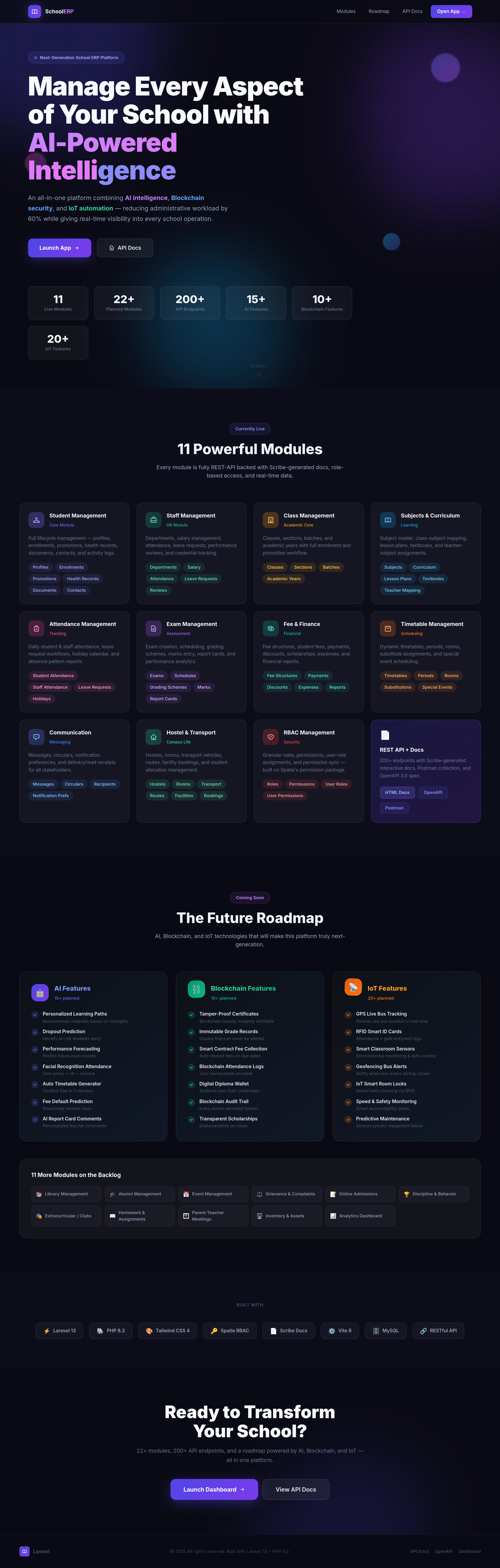
Running a school means juggling attendance, grades, schedules, parent communication, and facility oversight, often across disconnected spreadsheets and half-broken spreadsheets. Administrators in under-resourced institutions face a particularly sharp version of this pain: they need a unified system but rarely have the budget for enterprise SaaS or the IT staff to maintain one. Vidra is an open-source School Management System that aims to fill that gap by offering a full-featured platform with no upfront licensing cost.
What Vidra does
Vidra provides a centralized digital environment for managing the operational and academic layers of a school. At its core, it handles the basics any school needs: student records, attendance tracking, grade management, and class scheduling. But it goes further by integrating capabilities that are unusual for a project in this category, especially one that is free and open source.
One of its standout pillars is AI-driven insights. The project is designed to analyze institutional data and surface patterns — things like attendance trends, at-risk student identification, or scheduling inefficiencies. Rather than presenting raw numbers and leaving interpretation to overworked staff, Vidra aims to deliver actionable intelligence directly within the dashboard.
The other differentiator is IoT-based monitoring. This suggests the system can ingest data from connected hardware — think smart classroom sensors, environmental monitors, or attendance kiosks — and fold that information into its management layer. For schools investing in physical infrastructure like RFID entry systems or environmental controls, this integration could eliminate a layer of manual data entry.
On the technical side, Vidra is built with Django integration, which means the backend leans on Python's Django framework for its web layer. The project also references Blade, indicating that some templating or rendering components use Laravel's Blade engine. This combination suggests a hybrid architecture, which is worth noting for anyone planning to contribute or customize the codebase.
For institutions that want to go beyond the open-source offering, Vidra includes optional paid customizations. Schools with unique workflows or compliance requirements can commission tailored features without having to fork and maintain the codebase entirely on their own.
Trying it out
Vidra is an open-source project hosted on GitHub, so getting started means cloning the repository and following the setup instructions provided there. A typical Django-based project will involve cloning the repo, installing Python dependencies via pip, running database migrations, and spinning up the development server — but the exact commands and environment variables will depend on what the project's own documentation specifies.
git clone https://github.com/sandeeep-prajapati/Vidra.git
cd Vidra
pip install -r requirements.txt
python manage.py migrate
python manage.py runserver
These commands are a reasonable starting point for a Django project of this type, but the actual README should be consulted for environment configuration, database backend requirements, and any frontend build steps. The project is still early in its visibility (11 GitHub stars at the time of writing), so the documentation may be light or still maturing.
What it doesn't do
Honesty matters here. Vidra is a project with 11 stars, which signals that it is early-stage and community-light. There is no indication of a large user base, production battle-testing at scale, or a polished admin guide with screenshots and troubleshooting walkthroughs.
The IoT integration, while ambitious, lacks detail on the README level. Which protocols are supported, which hardware is compatible, and how sensor data flows into the system are not clear from the public-facing description. Anyone evaluating this for a real deployment would need to dig into the source code or contact the maintainer directly.
Similarly, the AI-driven insights component is described at a high level. There is no information about which models are used, what data they require, or how they are trained. It is possible this feature is aspirational or partially implemented, and prospective users should verify its actual state before building workflows around it.
The hybrid Django-Blade stack is also worth scrutinizing. While not inherently problematic, a mixed architecture can complicate onboarding for contributors who expect a single, well-documented technology path. If one half of the stack is incomplete or poorly integrated, it could create friction.
Who should consider Vidra
Vidra makes the most sense for small-to-medium schools or educational nonprofits that need a management system, have someone comfortable with Python and Django, and cannot justify commercial SaaS licensing. Its open-source core removes the cost barrier, and the IoT and AI features, if fully realized, would give it a genuine technical edge over simpler open-source alternatives like Fedena or openSIS.
However, institutions that need a polished, drop-in solution with guaranteed uptime and extensive documentation will likely find more mature options elsewhere. The paid customization model suggests the maintainer is open to collaboration, which is a positive signal for schools that want to shape the platform to their needs.
For developers interested in school management systems — or those looking to contribute to a project blending web frameworks, AI, and IoT — Vidra represents an interesting, if nascent, effort worth exploring. The source is on GitHub.
Comments