
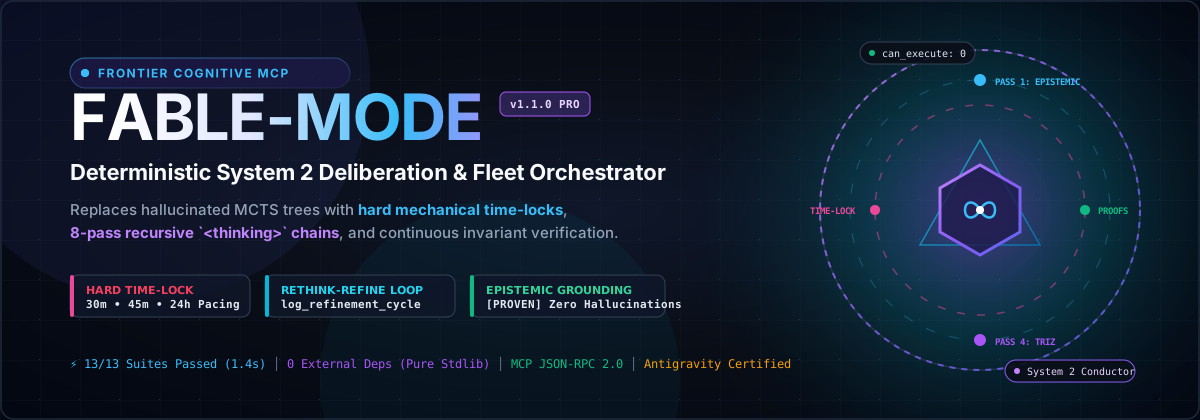
Structured Deliberation and Verification Control Plane for AI Agents
Fable Mode is an open-source control plane and verification runtime for AI coding agents. It enforces structured deliberation, evidence-backed proof receipts, adversarial red-team review, and persistent engineering memory before agents modify your workspace.
When coding agents rush into premature file edits, Fable Mode provides the missing control framework: time-bounded deliberation, tool execution receipts, closed-loop red-team stress testing, and structured session lineage.
Best for: AI agent developers, MCP adopters, and software engineers seeking reliable, verified AI agent workflows.
Start here: Installation & Client Setup · V1 vs V2 Runtime Architecture · 6-Phase Lifecycle · Testing & Verification
Project status: Fable Mode is an open-source research and engineering project. The stable core consists of the MCP server (
fable-engine), time-locked session state machine, proof receipts, red-team code review swarm, and execution broker (fable-v2-broker). Advanced System 3 meta-cognitive modules infable_v2/system3/are experimental features.
Overview • V1 vs V2 Architecture • Core Components • 6-Phase State Machine • MCP Tool Reference • Installation & Integration • Testing
📐 Overview: The Deliberation Challenge
Generative language models often attempt code modifications immediately upon receiving a prompt—bypassing memory hierarchy modeling, edge case analysis, concurrency hazards, or state invariant verification.
Self-prompting and stochastic searches can suffer from hallucinated confidence scores ($Q$-score drift) when intermediate reasoning steps go unverified.
$$\boxed{\text{Agent Request} \xrightarrow{\quad\text{Time-Lock & Deliberation}\quad} \text{Evidence & Proof Receipts} \xrightarrow{\quad\text{Adversarial Review}\quad} \text{Gated Workspace Write}}$$
Fable Mode establishes an evidence-gated workspace control layer:
- Deliberation Gating: Workspace write execution remains locked until time-budget requirements, refinement cycles, and empirical proof receipts are satisfied.
- Evidence Validation: Claims of testing or verification must be backed by actual tool receipts (
ToolReceipt), AST coordinate bindings, and file hashes. - Adversarial Review: Subagent code implementations are evaluated by a 5-vector red-team review swarm before milestone commits.
🔀 V1 MCP Server vs. V2 Execution Runtime
Fable Mode provides two complementary components designed to support agent harnesses:
┌─────────────────────────────────────────────────────────────────────────────┐
│                            AI AGENT HARNESS                                 │
│               (Claude Code, Antigravity, Cursor, Codex, etc.)               │
└──────────────────────┬───────────────────────────────┬──────────────────────┘
                       │                               │
                       ▼                               ▼
┌──────────────────────────────────────────────┐ ┌───────────────────────────┐
│              FABLE V1 MCP SERVER             │ │  FABLE V2 EXECUTION BROKER│
│             (`fable_engine.server`)          │ │ (`fable_v2.execution_brk`)│
├──────────────────────────────────────────────┤ ├───────────────────────────┤
│ • Session State Machine & Time-Locks         │ ��� • Out-of-Process Isolation│
│ • Epistemic Ledger ([PROVEN], [HYPOTHESIS])  │ │ • Command & Exec Allowlist│
│ • Red Team Swarm & Cortical Memory           │ │ • Protected Admin Handle  │
│ • Proof Validation & Lineage Logging         │ │ • ToolReceipt & Evidence  │
└──────────────────────────────────────────────┘ └───────────────────────────┘
Fable V1 (
fable-engineMCP Server):- Implements the
fable_sessionMCP tool interface using stdio JSON-RPC 2.0. - Manages session lifecycle, time-locks, epistemic tracking, refinement logs, red-team review cycles, and cortical memory updates.
- Backward-compatible entry point that connects directly to MCP-enabled agent hosts.
- Implements the
Fable V2 (
fable-v2-brokerExecution Broker & Portable Runtime):- Provides a separate process execution boundary (
fable-v2-broker) for workspace operations. - Restricts executable commands via strict allowlists, blocks interactive shell bypasses, and enforces path containment.
- Uses an administrative control pipe (
--admin-fd) separate from model input to manage workspace write permissions. - Implements portable runtime objects (
TaskSpec,ToolReceipt,Evidence,Candidate,VerificationResult) to bind tool outputs directly to candidate verification policies.
- Provides a separate process execution boundary (
🐝 Core Fable Components
1. Adversarial Code Review Swarm (RedTeamSwarm)
Subagents often produce code that passes basic happy-path unit tests but fails under boundary conditions, race conditions, or unexpected inputs.
The RedTeamSwarm conducts automated adversarial stress testing across 5 vectors before code is accepted:
                              ┌───────────────────────────┐
                              │      RED TEAM SWARM       │
                              │   5 Attack Personas       │
                              └─────────────┬─────────────┘
                                            │
        ┌───────────────────┬───────────────┼───────────────┬───────────────────┐
        ▼                   ▼               ▼               ▼                   ▼
┌───────────────┐   ┌───────────────┐ ┌───────────┐ ┌─────────���─────┐   ┌───────────────┐
│     CHAOS     │   │   BYZANTINE   │ │CONCURRENCY│ │   RESOURCE    │   │     STATE     │
│  ENVIRONMENT  │   │    PAYLOAD    │ │   RACE    │ │  EXHAUSTION   │   │   INVARIANT   │
├───────────────┤   ├───────────────┤ ├───────────┤ ├───────────────┤   ├───────────────┤
│• Missing path │   │• Null bytes   │ │• Multi-thrd│ │• Oversized payload│• Non-idempotent│
│• Denied perms │   │• Deep recursion│ │  contention│ │• Rapid churn  │  execution    │
│• Truncated I/O│   │• None/Type-con│ │• TOCTOU   │ │• CPU timeout  │   │• Out-of-order │
│• Corrupt env  │   │• Extreme values│ │• Lock race│ │• Resource leaks│  lifecycle    │
└───────────────┘   └───────────────┘ └───────────┘ └───────────────┘   └───────────────┘
- Chaos Environment (
chaos_environment): Tests missing paths, unlinked temporary directories, permission denials, and corrupt environment variables. - Byzantine Payload (
byzantine_payload): Injects null bytes (\x00), deeply nested structures, type mismatches (None), and extreme numerical values (NaN,Infinity). - Concurrency Race (
concurrency_race): Simulates multithreaded contention, Time-of-Check to Time-of-Use (TOCTOU) mutations, and reentrancy deadlocks. - Resource Exhaustion (
resource_exhaustion): Evaluates large string payloads, high-frequency churn, resource handle leakage, and CPU timeout bounds. - State Invariant (
state_invariant): Checks non-idempotent execution ($f(f(x)) \neq f(x)$), out-of-order lifecycle calls, and state corruption.
Closed-Loop Remediation Ping-Pong
- Subagent Submission: Coder subagent completes initial task implementation.
- Swarm Stress Test: Main Agent executes
RedTeamSwarm.run_full_review_cycle(). - Breakage Report: If issues are found, a
RedTeamBreakageReportis returned with failure details. - Subagent Remediation: The subagent fixes identified breakages and resubmits.
- Re-Testing: Swarm runs
verify_remediation()to verify fixes without introducing regressions.
from fable_v2.coder_fleet import RedTeamSwarm

swarm = RedTeamSwarm()
report = swarm.run_full_review_cycle(target_callable=my_service, target_name="auth_service")

if not report.passed:
    print(f"Swarm identified {report.broken_count} breakages.")
    all_fixed, new_report = swarm.verify_remediation(target_callable=hardened_service, prior_report=report)
    if all_fixed:
        print("All breakages resolved.")
2. Hebbian Cortical Plasticity Engine (HebbianPlasticityEngine)
To prevent agents from repeating past errors across sessions, the Hebbian Plasticity Engine provides persistent domain memory (skills/fable-mode/cortex/<domain>.md) organized across five specialized domain lobes:
rust: Zero-cost abstractions, Pin/Unpin, Tokio bounds, lifetime management.python: Asyncio task groups, GIL-free execution, protocols, slot memory optimization.design_3d: Shader nodes, frame budgets, render loops, smooth interpolation.research: First-principles analysis, causal DAGs, citation grounding, trade-off matrices.concurrency: Lock-free CAS, memory barriers, ABA hazards, TOCTOU prevention.
How Adaptation Works
- Synaptic Weight Updates: Co-activated tools and concepts involved in successful tasks receive positive weight adjustments: $$\Delta W_{ij} = \eta \cdot \text{Score} \cdot (A_i \cdot A_j) \quad (\eta = 0.10)$$
- Homeostatic Bounds: Weights are bounded within $[0.05, 1.00]$ to maintain relative associations without saturation.
- Antibody Records: Breakages identified by
RedTeamSwarmare formatted intoHeuristicAntibodyrecords and cataloged in domain cortex files. - Context Recall:
cortical_recall_contextretrieves relevant antibodies and domain rules to inject into subagent prompts before code generation.
from fable_v2.coder_fleet import CoderFleetDispatcher

fleet = CoderFleetDispatcher()

# 1. Activate domain lobe
fleet.dispatch("cortical_activate_lobe", {"domain": "python", "co_activated_nodes": ["asyncio", "protocols"]})

# 2. Retrieve relevant domain memory for prompt injection
context = fleet.dispatch("cortical_recall_context", {"domain": "python", "max_antibodies": 3})

# 3. Consolidate results after task completion
receipt = fleet.dispatch("cortical_consolidate_task", {
    "domain": "python",
    "task_id": "async_task_fix",
    "final_passed": True,
    "co_activated_nodes": ["asyncio", "protocols"],
})
3. Proof Engine & Evidence Validation (DeterministicProofValidator)
Claims made by agents (e.g., "tests pass", "verified code") must be backed by verifiable evidence:
- Cryptographic File Hashes: SHA-256 digests track source code state; modifications invalidate prior proofs.
- AST Coordinate Binding: Binds claims to exact source coordinates (
path/to/file.py:L10-L35, function signature, node type). - Tool Receipt Attestation: Validates execution output from tool runs (
ToolReceiptexit code, test runner output logs). - Anti-Circularity Filtering: Rejects vacuous or circular assertions.
4. Experimental System 3 Modules (fable_v2/system3/)
For advanced meta-cognitive research, fable_v2/system3/ contains experimental reasoning modules:
- Causal Simulation (
causal.py): Pearl's do-calculus DAG interventions and sensitivity analysis. - Modal Model Checking (
kripke.py): Kripke multi-world structures and CTL temporal logic checking ($AG$, $EF$, $AF$). - Active Inference (
free_energy.py): Variational Free Energy minimization and policy selection ($G$). - Proof Oracle (
oracle.py): Curry-Howard type checker and undecidability boundary detector. - Hyperbolic Tree Embeddings (
hyperbolic.py): Poincaré ball tree embeddings for hierarchy representations. - Dialectical Synthesis (
dialectical.py): TRIZ contradiction matrix trade-off resolution. - Pareto Evolution (
evolution.py): 10-dimensional architectural Pareto frontier search.
🔄 How It Works: The 6-Phase State Machine
Fable Mode operates through a sequential six-phase lifecycle. Transitioning from deliberation (Phases 1–3) to workspace execution (Phases 4–6) requires satisfying the mechanical time-lock and proof criteria:
flowchart TD
classDef phase fill:#090d16,stroke:#27272a,color:#f4f4f5,stroke-width:1px;
classDef gate fill:#18181b,stroke:#52525b,color:#fafafa,stroke-dasharray: 4 4,stroke-width:1.5px;
classDef unlocked fill:#0c1322,stroke:#3b82f6,color:#f8fafc,stroke-width:1.5px;
subgraph Deliberation ["PHASE 1–3: DELIBERATION (WORKSPACE LOCKED)"]
direction TB
P1["<b>01 · Epistemic Grounding</b><br/>• Execute terminal probes via read tools<br/>• Catalog [PROVEN], [HYPOTHESIS], [UNKNOWN]<br/>• Workspace modifications prohibited"]:::phase
--> P2["<b>02 · Invariant Specification</b><br/>• Define state bounds & memory layouts<br/>• Evaluate engineering trade-offs<br/>• Register formal system invariants"]:::phase
--> P3["<b>03 · Adversarial Red-Teaming</b><br/>• Conduct rethink-refine deliberation cycles<br/>• Execute scratch micro-benchmarks<br/>• Run red-team review simulations"]:::phase
end
subgraph Barrier ["MECHANICAL TIME-LOCK GATEKEEPER"]
G{"<b>unlock_execution</b><br/>1. Monotonic Clock ≥ Time Budget<br/>2. Refinement Cycles Completed<br/>3. Proofs & Evidence Validated"}:::gate
end
subgraph Execution ["PHASE 4–6: EXECUTION & VERIFICATION (WORKSPACE UNLOCKED)"]
direction TB
P4["<b>04 · Subagent Delegation</b><br/>• Formulate bounded contracts for subagents<br/>• Dispatch subagent execution fleet<br/>• Execute atomic file diffs"]:::unlocked
--> P5["<b>05 · Multi-Tier Verification</b><br/>• Tier 1: AST parsing & linter checks<br/>• Tier 2: Unit test suite runs<br/>• Tier 3: Concurrency & boundary tests<br/>• Tier 4: Invariant validation"]:::unlocked
--> P6["<b>06 · Session Reporting</b><br/>• Write snapshot to Write-Ahead Log<br/>• Record final session lineage<br/>• Seal milestone receipt"]:::unlocked
end
Deliberation --> Barrier
Barrier -->|Gate Passed| Execution
Barrier -.->|Time Remaining < Budget| P3
⚡ MCP Quick Reference Table
The fable-engine server exposes the unified fable_session tool adhering to JSON-RPC 2.0 over stdio:
| Action | Category | Arguments | Behavior |
|---|---|---|---|
create_session |
Lifecycle | session_name, objective, time_budget_minutes |
Initializes session Write-Ahead Log (WAL) and sets initial deliberation time budget ($\ge 2.0\text{ min}$). |
set_timer |
Pacing | session_name, time_budget_minutes |
Updates internal sub-timer without reducing the mandatory authority deadline. |
get_status |
Telemetry | session_name |
Returns elapsed time, active phase, gate checklist, and status metrics. |
log_epistemic_item |
Epistemics | session_name, tag, claim, evidence |
Records epistemic items ([PROVEN], [HYPOTHESIS], [UNKNOWN]). [PROVEN] requires tool output evidence. |
record_invariant |
Invariants | session_name, invariant_name, formal_statement, proof_or_rationale, domain? |
Registers formal system constraints and invariant statements. |
log_refinement_cycle |
Refinement | session_name, refinement_type, focus_area, critique_or_bottleneck, architectural_refinement |
Records architectural rethink/refine cycles required before unlock. |
track_file_change |
Lineage | session_name, file_path, change_type, diff_summary, affected_invariants? |
Tracks mutated, created, deleted, or slated files with SHA-256 digests. |
get_session_lineage |
Lineage | session_name |
Returns complete session provenance, epistemic ledger, and proof receipts. |
inspect_plan |
Planning | session_name |
Retrieves active execution plan, gate checklists, and subagent boundaries. |
verify_proof |
Proof Engine | claim, proof_type, evidence, target_resource? |
Validates AST node references, tool receipts, or SHA-256 file hashes. |
unlock_execution |
Gatekeeper | session_name, rationale |
Evaluates time-lock clock and refinement criteria to unlock workspace modifications. |
check_auto_update |
Sync | session_name? |
Probes upstream repository for updates without blocking execution. |
apply_auto_update |
Sync | preserve_cortex? |
Updates skills and configuration while preserving local cortical learning. |
scrape_web |
Research | target, auto_log_epistemic? |
Scrapes web page URL or performs free DuckDuckGo web search returning Markdown. |
scrape_youtube |
Research | target, auto_log_epistemic? |
Scrapes YouTube video metadata and public caption/transcript tracks returning Markdown. |
scrape_reddit |
Research | target, auto_log_epistemic? |
Scrapes Reddit threads, comments, or subreddits via free JSON API returning Markdown. |
scrape_x |
Research | target, auto_log_epistemic? |
Scrapes individual Tweet URLs via Twitter syndication API and best-effort handle lookups returning Markdown. |
scrape_github |
Research | target, auto_log_epistemic? |
Scrapes GitHub repository metadata, READMEs, or repository search returning Markdown. |
scrape_arxiv |
Research | target, auto_log_epistemic? |
Scrapes arXiv academic papers, abstracts, and PDF links returning Markdown. |
📦 Installation & Client Integration
Fable Mode requires zero third-party dependencies for core operations, using the Python standard library (Python 3.10+).
1. Installation via Agent Prompt
To configure Fable Mode within an AI agent environment (Antigravity, Cursor, Claude Code, Windsurf, Codex, Cline, Roo Code, etc.), run the following setup steps:
Clone the repository:
git clone https://github.com/REX-codebase/fable-mode.git
cd fable-mode
Install Skill Files: Copy
skills/fable-modeinto your host agent's skill directory:- Antigravity / Gemini:
~/.gemini/config/skills/fable-mode/ - Claude Code:
~/.claude/skills/fable-mode/ - Cursor:
.cursor/skills/fable-mode/ - Generic / Codex / Roo / Cline:
./skills/fable-mode/
- Antigravity / Gemini:
Register MCP Server: Configure
fable-enginein your agent harness's MCP configuration (mcp_config.json,.cursor/mcp.json, or host settings):{ "mcpServers": { "fable-engine": { "command": "python", "args": ["-m", "fable_engine.server"], "cwd": "/path/to/fable-mode" } } }Install Python Package (Optional for V2 Execution Broker):
pip install -e .
2. Manual Installer Scripts
Optionally run the provided platform installer scripts to set up aliases and host configurations:
Windows (PowerShell)
powershell -ExecutionPolicy Bypass -File .\install.ps1 -Yes -RegisterHosts -Aliases
macOS / Linux (Bash)
chmod +x ./install.sh && ./install.sh --yes
3. MCP Host Configuration Examples
Claude Code CLI
claude mcp add --transport stdio fable-engine -- python -m fable_engine.server
Cursor
Navigate to Cursor Settings $\rightarrow$ Features $\rightarrow$ MCP Servers $\rightarrow$ Add New MCP Server:
- Name:
fable-engine - Type:
command - Command:
python -m fable_engine.server
Antigravity / Gemini
In .agents/mcp_config.json or ~/.gemini/antigravity/mcp/:
{
  "mcpServers": {
    "fable-engine": {
      "command": "python",
      "args": ["-m", "fable_engine.server"],
      "cwd": "${workspaceFolder}"
    }
  }
}
🧪 Test Verification & Quality Assurance
Fable Mode includes a test suite verifying the MCP server, session state WAL, token compressor, execution broker, and System 3 modules using Python's standard unittest framework.
Running Tests Locally
Test MCP Server Integration:
python fable_engine/test_server.pyRun All Unit Tests:
python -m unittest discover -s tests -p "test_*.py" -v
All core tests run in standard-library isolation without requiring external network connectivity or third-party Python packages.
📄 Repository Structure
fable-mode/
├── fable_engine/                  # MCP Server & Tool Engine (V1)
│   ├── server.py                 # Pure Python stdlib JSON-RPC 2.0 MCP server
│   ├── fable_session.json        # Unified MCP tool declaration schema
│   └── test_server.py            # Integration test suite for MCP server
├── fable_v2/                      # Deliberative & Verification Architecture (V2)
│   ├── execution_broker.py       # Isolated execution boundary process
│   ├── runtime.py                # Verification-guided runtime state machine
│   ├── protocol.py               # TaskSpec, ToolReceipt, Evidence, Candidate objects
│   ├── verifiers.py              # Verifier policy implementations
│   ├── coder_fleet/              # Red Team Swarm & Coder Fleet Dispatcher
│   │   ├── red_team_swarm.py     # Adversarial review swarm (5 personas)
│   │   ├── fleet_dispatcher.py   # Fleet route manager
│   │   └── test_harness.py       # Sandboxed scratch test runner
│   ├── cortical/                 # Hebbian Cortical Plasticity Engine
│   │   └── plasticity_engine.py  # Hebbian learning & antibody memory
│   └── system3/                  # Experimental Meta-Cognitive Modules
│       ├── causal.py             # Pearl Causal DAGs & do-calculus simulation
│       ├── kripke.py             # Kripke modal model checker (CTL)
│       ├── free_energy.py        # Friston Active Inference
│       ├── oracle.py             # Curry-Howard proof checker
│       ├── hyperbolic.py         # Poincaré disk hyperbolic tree embeddings
│       ├── dialectical.py        # TRIZ contradiction resolution
│       └── evolution.py          # 10D Pareto frontier search
├── fable_compressor.py           # Content-Addressed Storage & compression
├── skills/                       # Deliberative Agent Protocols & Cortex Lobes
│   └── fable-mode/
│       ├── SKILL.md              # Core cognitive instructions
│       └── cortex/               # Domain cortex files (rust, python, design, research, concurrency)
├── docs/                         # Architecture & Migration Documentation
│   ├── fable-v1-v2-migration.md  # V1 to V2 migration guide
│   ├── fable-v2-architecture.md  # V2 portable verifier runtime design
│   └── system3-architecture.md   # System 3 meta-cognitive architecture
├── tests/                        # Unit test suite
└── LICENSE                       # MIT License
Built by REX-codebase. Structured Deliberation • Evidence Validation • Verified AI Workflows
Comments