oh-my-kimi, or OMK, provides a production-ready multi-agent orchestration layer for the Kimi Code CLI (K2.6). It acts as a control plane that coordinates Kimi agents for coding tasks, using isolated Git worktrees, DAG-based execution plans, evidence-based quality gates, skill hooks via MCP, and local graph memory for persistence. Built in TypeScript for Node.js 20+, the project has 64 GitHub stars and runs as an npm package (@oh-my-kimi/cli at version 1.1.9). Kimi handles writing and merging code, while OMK manages verification, isolation, and operator oversight to address common agent pitfalls like premature completion claims or context corruption in parallel runs.
The project exists because standalone AI coding agents often declare tasks finished without proof, lose track across sessions, or clash when running multiple instances. OMK enforces boundaries: agents must provide files, diffs, summaries, or passing commands through evidence gates before a run ends. It keeps Kimi in authority for core changes, treating other models (if used) as advisory for review or research.
Core features
OMK structures agent workflows around these elements, all integrated into the CLI:
- Isolated worktrees: Each run or parallel agent gets a Git worktree to prevent context pollution; changes stay scoped until manual review or merge.
- DAG and ensemble planning: Supports directed acyclic graph execution for task dependencies or ensemble methods for parallel strategies.
- Evidence gates: Blocks completion until agents submit verifiable outputs like modified files, command results, or summaries.
- Local graph memory: Stores session data including goals, decisions, risks, commands, files, evidence, and concepts in a persistent graph for long-running projects.
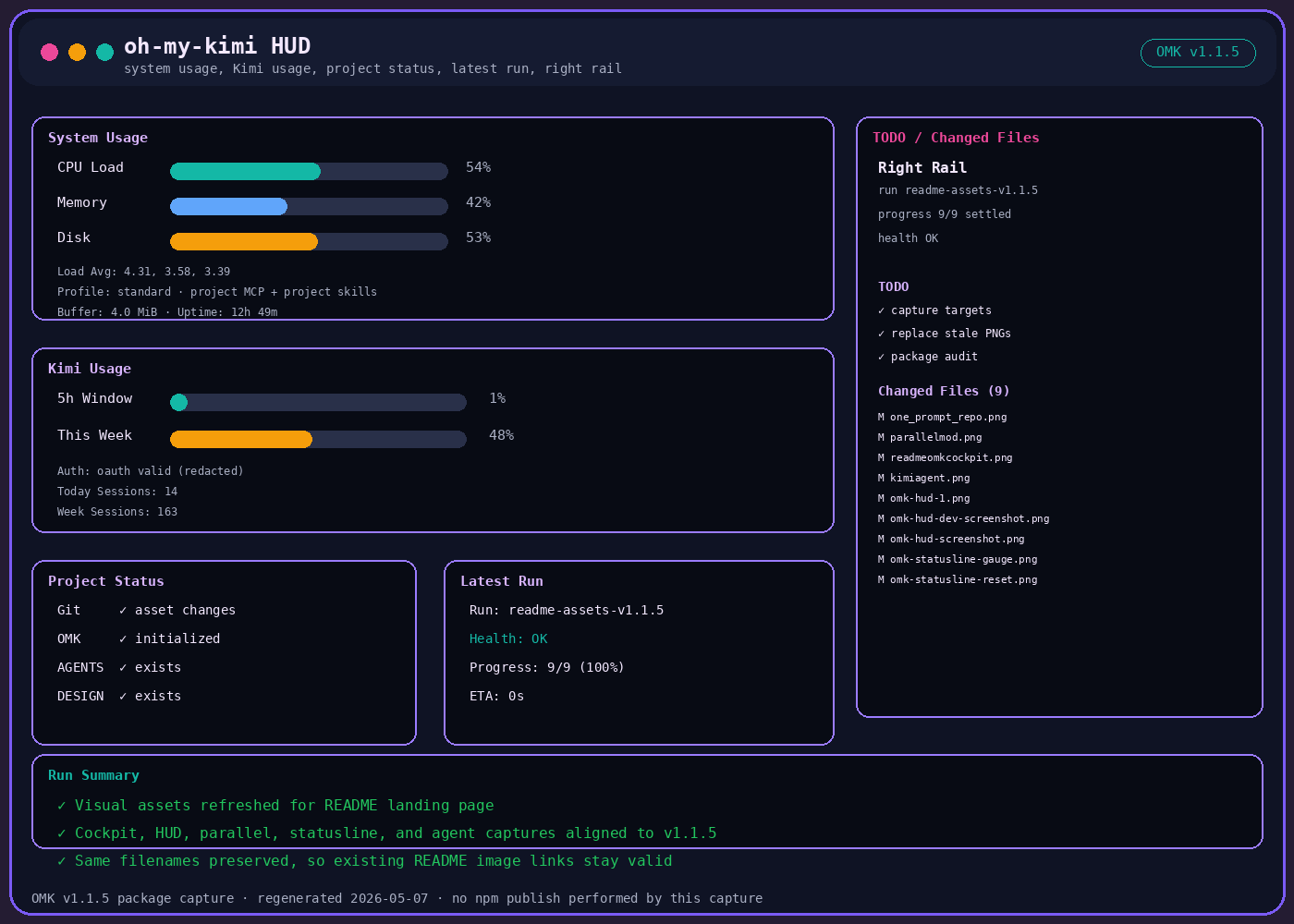
- Live HUD and cockpit: Real-time interface shows run state, TODOs, ETA, token usage, active workers, and file changes for operator intervention.
Additional safety comes from zero-config hooks and a verified runtime per its MseeP.ai security badge. The CLI labels alpha features clearly in help output.
Getting it running
OMK installs globally via npm, targeting Node.js 20+. No Docker or complex dependencies appear in the docs.
Start with these commands:
npm install -g @oh-my-kimi/cli
omk init
omk doctor
omk chat
The init sets up the environment, doctor checks prerequisites like Kimi Code K2.6, and chat launches a basic interactive session. For multi-agent use:
omk parallel "refactor auth module with tests"
omk verify --json
omk summary-show
omk cockpit
parallel spins up a team with worktrees and planning. verify runs quality gates (JSON output available), summary-show displays graph memory insights, and cockpit opens the live dashboard. Runs stay in the current directory by default, using Git for isolation. Stable core works daily; experimental orchestration shows in CLI help.
Check status badges for CI (GitHub Actions on main), latest releases, npm downloads, and MIT license.
Who this is for
Developers relying on Kimi Code CLI for code generation fit best. If you handle repetitive refactors, module testing, or multi-step features where agents need coordination without overwriting each other, OMK adds structure. It suits solo coders or small teams shipping verified changes—run a parallel task on auth refactoring, inspect diffs in worktrees via cockpit, then merge post-verification.
Use cases from the docs include bounding long sessions (graph memory recalls prior decisions), parallel QA (evidence gates catch incomplete work), and operator control (HUD tracks usage spikes). It's Kimi-native, so no prompt engineering or multi-model swaps needed. Teams avoiding vendor lock-in but wanting agent safety gates find value here.
How it compares
OMK differentiates as a Kimi Code-specific harness, not a general prompt library or multi-LLM orchestrator. It skips "model buffets" by centralizing authority with Kimi for writes/merges, using others only for scoped roles like research.
General alternatives include Auto-GPT or LangChain agents, which offer DAGs but lack Kimi integration, worktree isolation, or built-in evidence gates. For Git-focused agents, tools like Aider provide pair-programming but without graph memory or cockpits. OpenDevin runs browser-based agents in sandboxes, heavier on infra than OMK's CLI focus. If you need Docker-heavy setups, those pull more resources; OMK stays lightweight at npm scale (npm downloads tracked on badge).
OMK weighs in via TypeScript/Node, lighter for CLI users than Python agent frameworks like CrewAI. Drawback: ties to K2.6, so non-Kimi users skip it.
OMK targets Kimi Code users needing verified multi-agent runs without chaos. Not for casual prompting or model-agnostic setups—grab the source at https://github.com/dmae97/oh-my-kimi and test omk doctor first.
Comments