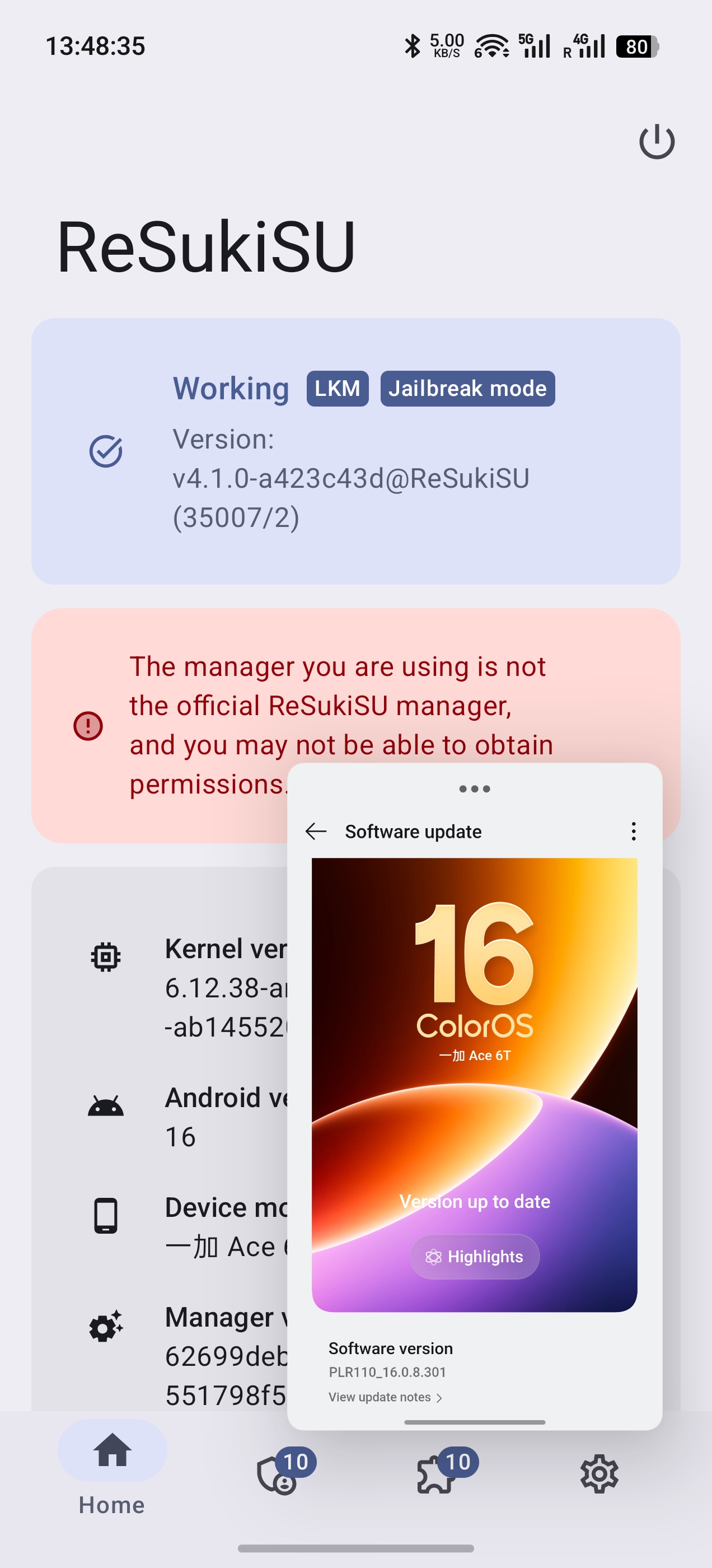
Kernel exploit for OnePlus/OPPO/realme devices with locked bootloader. Achieves root + KernelSU installation without unlocking bootloader or modifying boot image. Runtime auto-detection of kernel version with multi-device offset table.
Vulnerability
CVE-2026-43499 — Futex PI (Priority Inheritance) Use-After-Free
Affects Linux kernel 2.6.39 ~ 7.1. Fixed in mainline 7.1 (commit 3bfdc63936dd). Android GKI 6.12.x remains vulnerable.
The pselect6 syscall copies fd_set data onto the kernel stack. When combined with the futex PI waiter mechanism, a freed stack frame can be reclaimed as an rt_mutex_waiter structure. The rb-tree rebalance during PI chain walk then writes controlled values to arbitrary kernel addresses.
Supported Devices
Verified
| Device | SoC | Kernel | Status |
|---|---|---|---|
| OnePlus Ace 6T (PLR110) | SM8845 | 6.12.38-...-ab14275539 |
Working |
| OnePlus Ace 6T (PLR110) | SM8845 | 6.12.38-...-ab14552068 |
Working |
Offsets Extracted (pending device test)
| Device | SoC | Kernel | Notes |
|---|---|---|---|
| OnePlus 15T (PLZ110) | SM8845 | 6.12.38-...-ab14552068 |
Same kernel as Ace 6T. QEMU verified SP diff=-64. |
| OnePlus 15 (OP615) | SM8845 | 6.12.23-...-ab14541642 |
Offsets from OTA boot.img |
| OnePlus 13 (IN2060) | SM8750 | 6.6.89-...-abogki446052083 |
QEMU verified SP diff=-64. Use PSELECT_SHIFT=-2. |
Not Feasible (stack layout incompatible)
The pselect stack overlay only works when the freed rt_mutex_waiter lands within the user-controllable region of the stack_fds buffer. Where the waiter lands is determined by the compiler output (PGO + LTO), not the kernel version. See Stack Layout for details.
| Device | SoC | Kernel | Waiter Word | Reason |
|---|---|---|---|---|
| OPPO Find X9 Ultra | SM8750 | 6.12.58 | 14 | task/lock in zeroed area |
| realme RMX5070 | SM6650 | 6.1.141 | 13 | task/lock in zeroed area |
| realme RMX3852 | SM8635 | 6.1.141 | 13 | Same branch as RMX5070 |
| OPPO Pad 5 (OPD2502) | MT6878 | 6.1.134 | 13 | Same branch as RMX5070 |
Stack Layout Feasibility
With NFDS=320, the kernel's core_sys_select allocates a 256-byte stack_fds buffer:
stack_fds:  0    5    10   14 | 15   20   25   29
            ├─in─┤─out─┤─ex──┤ ├res_in┤res_out┤res_ex┤
            ◄── USER CONTROLLED ──►│◄── KERNEL ZEROED ──►
The exploit writes fake waiter fields (task, lock) into the fd_set input bitmaps. For this to work, the waiter's task and lock fields must fall in the controllable zone (words 0-14).
Ace 6T ✅ (waiter at word 2):
  ░░████████████████░░│░░░░░░░░░░░░░░░░░░
    ▲waiter      t  l │
    task/lock controllable

RMX5070 ❌ (waiter at word 13):
  ░░░░░░░░░░░░░████│██████████████░░░░░░
                 ▲  │    t     l
               waiter  task/lock ZEROED
Feasibility rule: waiter word + 11 (lock offset in rt_waiter_node) must be ≤ 14. Maximum feasible waiter word is 3.
The waiter position is determined by the compiler's stack frame layout (PGO + LTO + BOLT optimization profiles), which varies per SoC branch. Same kernel version can have different layouts on different SoCs.
PSELECT_SHIFT
Different kernels place the waiter at different positions within the controllable zone. Use PSELECT_SHIFT to adjust:
# Default (Ace 6T, 6.12): shift=0
/data/local/tmp/a/e

# OnePlus 13 (6.6): shift=-2
PSELECT_SHIFT=-2 /data/local/tmp/a/e
Exploit Flow
Write 1 (mode=1)  →  SELinux enforcing = 0
                      (low byte of kernel ptr = 0x00)

Write 2 (mode=2)  →  task->cred = init_cred
                      (uid=0, all capabilities)

Root shell         →  ksud late-load (KernelSU LKM)
                   →  su -c load_policy (fix SELinux policycap)
                   →  dynamic manager registration
Bootstrap Mode (phone standalone)
App (seccomp)  →  Write 1 (no perf needed)
               →  mini-adb connect TCP 5555 (RSA auth)
               →  adb shell: full exploit (perf works, no seccomp)
               →  root → KSU → network fix
Auto-Boot (via ReSukiSU integration)
BOOT_COMPLETED → BootCompletedReceiver
  ├─ su available → skip (soft reboot / already rooted)
  └─ no root → GhostlockService → setsid exploit --bootstrap
Build
NDK=/path/to/android-ndk
$NDK/toolchains/llvm/prebuilt/linux-x86_64/bin/aarch64-linux-android35-clang \
  -O2 -Wall -Isrc/core -Isrc/devices -DTARGET_CONFIG_H="target.h" \
  src/core/main.c src/core/util.c src/core/slide.c \
  src/core/fops.c src/core/pipe.c src/core/root.c \
  src/core/miniadb.c \
  -o ghostlock -fPIE -pie -pthread
Prerequisites
ksud (required for KSU installation)
GhostLock only provides root. KernelSU installation depends on ksud — a binary that contains embedded kernelsu.ko modules for each KMI version. The root script finds ksud on device and calls ksud late-load --kmi android16-6.12.
| Method | Steps |
|---|---|
| ReSukiSU APK (recommended) | Install ReSukiSU or this fork. Official release bundles libksud.so. |
| CI release | Download ksud-aarch64-linux-android.zip from ReSukiSU CI |
Without ksud, the exploit achieves root (uid=0) but KSU won't be installed and
suwon't persist.
Setup (one-time)
adb tcpip 5555
adb push ~/.android/adbkey /data/local/tmp/a/adbkey
adb push ghostlock /data/local/tmp/a/e && chmod 755 /data/local/tmp/a/e
After first successful jailbreak, persist.adb.tcp.port=5555 is set via resetprop — subsequent boots are fully automatic.
Usage
/data/local/tmp/a/e                        # Full exploit (adb shell)
/data/local/tmp/a/e --bootstrap            # Phone standalone (app context)
/data/local/tmp/a/e --write1               # SELinux disable only
PSELECT_SHIFT=-2 /data/local/tmp/a/e       # Override stack layout shift
Important: Run within 30 seconds of boot for best KernelSnitch timing reliability.
Adding New Devices / Kernel Versions
Only boot.img is needed — no root, no device access required.
Extract offsets from boot.img
# 1. Extract kernel
python -c "import struct; d=open('boot.img','rb').read(); open('kernel','wb').write(d[4096:4096+struct.unpack_from('<I',d,8)[0]])"

# 2. Global symbols (kallsyms)
python tools/extract_target.py    # 28 offsets, auto-validated

# 3. Struct fields (BTF)
python tools/extract_btf.py kernel  # 57 offsets, auto-validated

# 4. Add to offsets.h, rebuild
Coverage: 103/103 offsets from boot.img
| Source | Count | Method |
|---|---|---|
| kallsyms (global symbols) | 28 | extract_target.py |
| BTF (struct fields) | 57 | extract_btf.py |
| Derived (same struct, different usage) | 9 | Automatic |
| Constants (fixed values) | 12 | No extraction needed |
Adapting to non-OnePlus devices
The core exploit is device-agnostic. Adaptation may require:
- Different
VA_BITS(48 vs 39) → updatetarget.hmemory layout - Different timing parameters → tune
common.h - Different ashmem implementation (C vs Rust) → update symbol matching
- Different
PSELECT_SHIFT→ determine via QEMU kprobe test
Files
| File | Description |
|---|---|
src/core/main.c |
Exploit entry, Write 1/2, bootstrap, root script |
src/core/fops.c |
pselect route, PI write mechanism |
src/core/util.c |
Heap spray, kernelsnitch, slab drain |
src/core/miniadb.c |
Mini ADB client (TCP + RSA auth) |
src/core/common.h |
Timing parameters, macros |
src/core/target.h |
Memory layout, struct field constants |
src/devices/offsets.h |
Aggregates all device offset tables |
src/devices/<device>/offsets.h |
Per-device kernel offset entries |
src/slide.c |
SLIDE kernel address leak |
src/pipe.c |
Pipe buffer manipulation |
src/root.c |
Root shell setup |
tools/extract_target.py |
Offset extraction from kallsyms |
tools/extract_btf.py |
Struct offset extraction from BTF |
tools/check_feasibility.py |
Stack layout feasibility checker |
Comments