MOVO Community Edition
A self-hosted enterprise Agent platform built on DeepSeek Harness (DSH).
English · 简体中文
Official website: https://www.himovo.com · Documentation · Quick start · Community
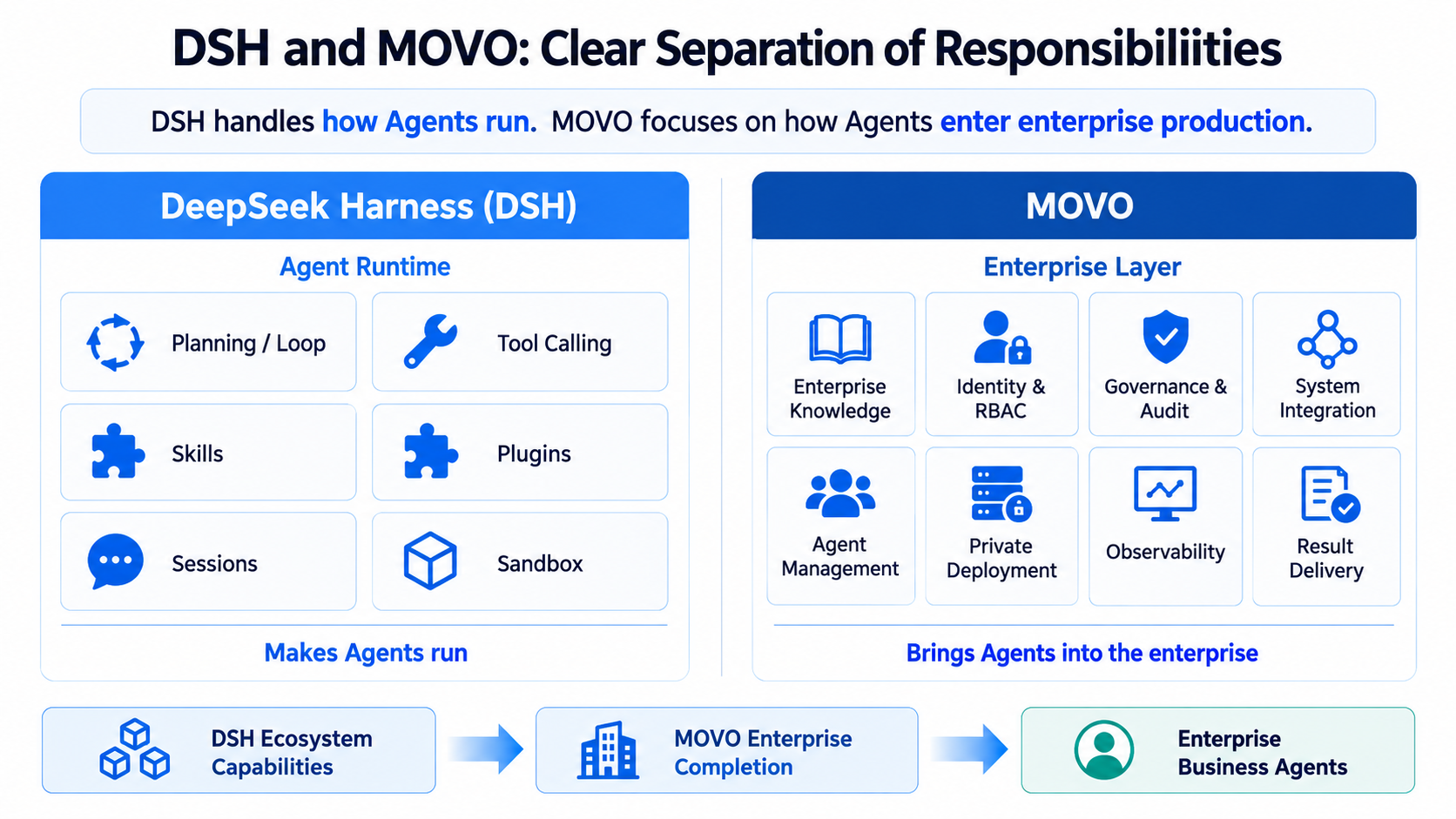
MOVO brings DSH Agents from development experiments into enterprise production. It combines the DSH Runtime, Skills, Tools and MCP ecosystem with a deployable user workspace, enterprise knowledge, identity and access control, administration, governance and file delivery.
In one sentence: DSH runs the Agent; MOVO brings the Agent into enterprise production.
This repository contains the self-hosted MOVO Community Edition.
If MOVO is useful to you, consider giving the project a ⭐ Star. It helps more developers discover it.
Start in 5 minutes
With Git and Docker Desktop (or Docker Engine with Docker Compose v2) installed:
git clone https://github.com/himovo/movo.git
cd movo
chmod +x movo
./movo up
Then open:
http://localhost:3000/admin/setup
The launcher pulls the official prebuilt images, waits for the services to become healthy and prints the setup address. No .env file or local image build is required. Windows users should run MOVO inside an Ubuntu WSL 2 distribution; see the Windows installation guide.
Product demo
See MOVO in action in the complete product walkthrough:
The video opens in your browser and can be played directly without downloading it first.
Why MOVO
Running an Agent demo is very different from operating an Agent platform for a team. MOVO provides the product and infrastructure layer around DSH so you can move into real use without assembling authentication, knowledge, administration, governance and delivery systems yourself.
- Stay native to DSH. Use the official DSH Runtime, Skills, Tools, MCP integrations and sub-agent capabilities instead of adopting a disconnected proprietary runtime.
- Deploy a complete product. Start the user workspace, admin console, APIs, document processing, retrieval and infrastructure together with Docker Compose.
- Keep control of models and data. Connect your own model providers and keep application data, knowledge and runtime services in your deployment.
- Serve users as well as developers. Give employees a usable workspace while administrators manage accounts, models, knowledge, capabilities, quotas and audit records.
- Grow without rebuilding the foundation. Begin with the self-hosted Community Edition and retain the same shared source foundation as deployment requirements expand.
If you only need a low-level Agent runtime, DSH may be enough. Choose MOVO when you need to turn that runtime into a deployable, manageable product for real users.
What MOVO provides
| Capability | What you can do |
|---|---|
| DSH-native Agent runtime | Use planning, tool calls, Skills, sub-agents and governed execution through the bundled DSH Runtime Host. |
| Enterprise knowledge and research | Search internal documents and public sources, run multi-round research, retain citations and inspect supporting evidence. |
| Document and multimodal intelligence | Parse PDF, DOCX, XLSX, PPTX, CSV and Markdown files, including images, charts and other visual content. |
| Content and file generation | Create reports, articles, PPTX presentation files, spreadsheets, PDFs and Markdown deliverables. |
| Skills, Tools and MCP | Reuse workflows and connect HTTP or MCP services to business systems. |
| Automation and governance | Schedule tasks, require approval for sensitive tool actions, trace executions and retain generated artifacts. |
| Enterprise administration | Manage organizations, users, roles, models, knowledge, Skills, Tools, audit records and runtime health. |
Typical use cases include enterprise knowledge Q&A, policy and project-material retrieval, multi-source research, competitive analysis, report and presentation generation, spreadsheet processing, translation, template filling and controlled system integration.
Community Edition
A tenant created by the self-hosted setup flow is marked as community:
- no member-count limit;
- billing and commercial plan enforcement are disabled;
- self-managed model connections are enabled;
- data and runtime services remain in your own deployment.
The repository includes the Web user workspace, administration console, conversation and Agent APIs, DSH Runtime Host, document parser and retrieval services, and Docker deployment configuration.
Browser Agent and Code Agent
The self-hosted Web workspace supports chat, research, knowledge, files and content generation. To use Browser Agent or Code Agent, install MOVO Desktop and connect it to your self-hosted MOVO service.
MOVO Desktop provides the local browser session, code workspace, project terminal and Git integration required by these capabilities. It is distributed separately as proprietary software; its source code is not included in this repository and is not part of the Community Edition source release.
| Capability | Self-hosted Web | MOVO Desktop |
|---|---|---|
| Chat, research and enterprise knowledge | ✓ | ✓ |
| Document understanding and content generation | ✓ | ✓ |
| Browser Agent | — | ✓ |
| Code Agent, local projects, terminal and Git | — | ✓ |
| Requires a self-hosted MOVO service | ✓ | ✓, connects to that service |
| Source included in this repository | ✓ | —, distributed separately |
Architecture
flowchart LR
    U[User workspace] --> G[Gateway]
    A[Admin console] --> G
    G --> C[Chat API]
    G --> M[Admin API]
    C --> D[DSH Runtime Host]
    C --> P[Document services]
    M --> P
    C --> S[(MongoDB / Redis / Weaviate)]
    M --> S
    P --> S
The default Docker Compose deployment starts 12 services: the gateway, two Web applications, three application APIs, the DSH Runtime Host, a document worker, MongoDB, Redis, Weaviate and a one-time secret bootstrap service.
Deployment and operations
Requirements and platform notes
- Git
- Docker Desktop, or Docker Engine with Docker Compose v2
- at least 8 GB of available memory
- at least 20 GB of available disk space for images and application data
- network access to GHCR and Docker Hub during the initial image pull
- credentials for at least one compatible model API to complete setup
The quick-start command above works on Linux and macOS. ./movo up pulls the published MOVO and infrastructure images sequentially and keeps retrying network failures until the pull succeeds or the user presses Ctrl+C. The first startup downloads several container images and can take some time, especially when access to GHCR or Docker Hub is slow. Normal users do not need to build the images locally.
On Windows, use Docker Desktop with WSL 2 and Ubuntu. Check that Ubuntu exists with wsl -l -v, then enter it explicitly with wsl -d Ubuntu; do not run MOVO from a prompt beginning with docker-desktop:. See the complete Windows installation guide.
You can also start the same official prebuilt images directly with docker compose up -d, including from Windows PowerShell or Command Prompt. Neither command requires an .env file, but native Compose pulls in parallel and does not provide the launcher's continuous retry loop or readiness wait. To build and start local images from source instead, use ./movo up --build.
Open:
http://localhost:3000/admin/setup
The setup wizard checks the deployment and guides you through creating the organization and initial accounts, connecting a default chat model, and optionally configuring embedding, reranking, vision, image generation and Web search providers. Provider credentials are encrypted before storage.
After setup:
| Entry | Default URL | Purpose |
|---|---|---|
| User workspace | http://localhost:3000/ |
Conversations, research, knowledge, files and content generation |
| Admin console | http://localhost:3000/admin/ |
Users, models, knowledge, Skills, Tools and governance |
| Setup wizard | http://localhost:3000/admin/setup |
First-run initialization only |
Common operations
./movo status
./movo logs chat-api
./movo restart
./movo update
./movo backup /path/on/a/large-disk/movo-backup
./movo down       # Stop containers and preserve data
./movo down -v    # Permanently delete MOVO data after confirmation
For production, pin a release tag instead of using latest. See Docker deployment for image selection, upgrades, backup and restore, reverse proxy configuration and the production baseline.
Configuration
The default local deployment does not require an .env file. To change the public port, canonical URL, image version or volume prefix:
cp .env.example .env
MOVO_PORT=3000
MOVO_VOLUME_PREFIX=movo
MOVO_IMAGE_PREFIX=ghcr.io/himovo/movo
MOVO_VERSION=vX.Y.Z
PUBLIC_BASE_URL=https://movo.example.com
Keep MOVO_VOLUME_PREFIX stable after first startup. DNS, TLS certificates and the external reverse proxy remain the deployment operator's responsibility.
Build from source
Building locally is intended for contributors and developers. Build and start the source tree with:
./movo up --build
To build the images without starting the services:
./movo build
Source builds download Playwright, LibreOffice, Docling and model assets, so they need substantially more time and disk space than the prebuilt-image path.
Repository layout
| Path | Component |
|---|---|
apps/user-web/ |
Vue 3 user workspace |
apps/admin-web/ |
Vue 3 setup and administration console |
services/chat-api/ |
FastAPI conversation, task, Agent, Skill and DSH gateway |
services/chat-api/dsh/runtime-host/ |
Node.js DSH Runtime Host |
services/admin-api/ |
FastAPI organization, user, model and platform management API |
services/document-parser/ |
Document parsing, preview, retrieval API and worker |
deploy/ |
Bootstrap and gateway configuration |
Comments