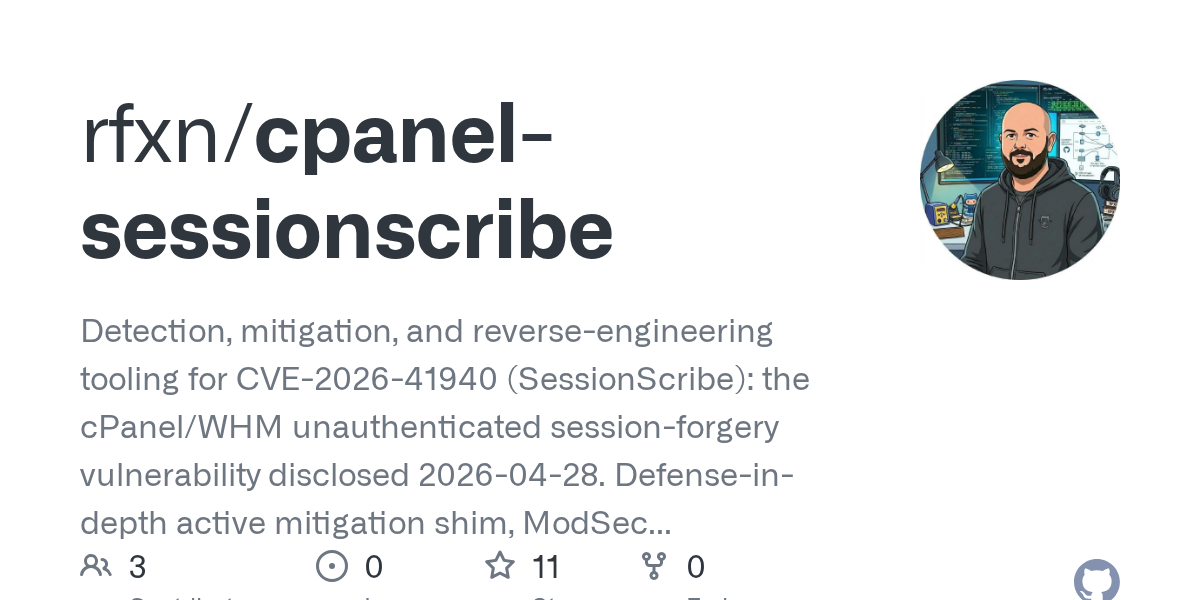
CVE-2026-41940, disclosed on April 28, 2026, is an unauthenticated session-forgery vulnerability in cPanel and WHM. An attacker with no credentials can forge session tokens and impersonate authenticated users. On a shared hosting environment, that means a malicious actor could log in as another customer, access their files, modify settings, or extract data — without ever touching a password. Patching takes time. In the window between disclosure and update, operators need something to detect attempts, slow attacks down, and gather evidence.
How it solves it
cpanel-sessionscribe is a shell-based toolkit built specifically around this flaw. It bundles five distinct components under one roof, each targeting a different phase of the attack lifecycle.
The active mitigation shim provides a defense-in-depth layer that sits between the vulnerable session handling and the cPanel service itself. It intercepts and validates session tokens before they reach the application. Alongside that, a ModSecurity rule pack drops into the web application firewall to flag known exploit patterns in HTTP traffic.
For operators who suspect a server is already under attack, there is a remote probe. This tool sends crafted requests to a target cPanel instance and reports whether the session-forgery vector is accessible from the outside. If the probe succeeds, the server is still vulnerable and should be addressed immediately.
On the host side, an IOC scanner looks for indicators of compromise — files, logs, or process traces that suggest exploitation has already occurred. Finally, a per-tier RE snapshot collector gathers reverse-engineering artifacts. This is aimed at researchers or administrators who want a point-in-time capture of the vulnerable code path for offline analysis.
The entire project is written in Shell and distributed under GPL v2. It targets cPanel/WHM installations running the vulnerable version of the session handling code.
Trying it out
The project lives at GitHub. Clone it and run the included setup script to place components where they belong.
git clone https://github.com/rfxn/cpanel-sessionscribe.git
cd cpanel-sessionscribe
./setup.sh
After setup, each component can be invoked from the scripts directory. The remote probe and IOC scanner are the fastest way to confirm whether a server is at risk. The ModSec rule pack installs into the ModSecurity configuration directory and requires a service restart to take effect.
No containers, no compiled binaries. The tool runs directly on the host, which is a deliberate design choice to avoid adding a dependency surface on top of an already complex cPanel stack.
What it doesn't do
This is not a patch. cpanel-sessionscribe does not fix the underlying vulnerability in cPanel itself. It provides detection and a stopgap, not a cure. If the cPanel team releases a version with the flaw removed, that should be installed as soon as possible.
The toolkit also does not provide a general-purpose security monitor. Its scope is narrow: CVE-2026-41940 and related session-forgery vectors. It will not catch unrelated misconfigurations or other exploits.
The reverse-engineering snapshot collector captures artifacts for analysis but does not perform automated vulnerability scoring or exploit generation. It is a data-gathering tool, not an offensive framework.
Shell-based tools can be fragile when cPanel updates change file paths or service names. Operators should expect to review the scripts after any major cPanel upgrade.
Who should pick this up
If you manage a cPanel or WHM server and have not yet applied the vendor fix for CVE-2026-41940, cpanel-sessionscribe gives you a practical way to assess exposure and buy time. The remote probe tells you if the attack surface is live. The ModSec rules catch traffic patterns without needing to understand the exploit internals. The IOC scanner surfaces whether someone has already walked through the door.
It is lighter than a full SIEM integration and faster to deploy than writing custom detection logic from scratch. That said, for environments that prefer a turnkey WAF vendor or a commercial incident-response platform, those options exist too. This project fills a specific gap for operators who want to act immediately with something they can audit themselves.
The source is on GitHub and the research page is at rfxn.com.
Comments