What this project does
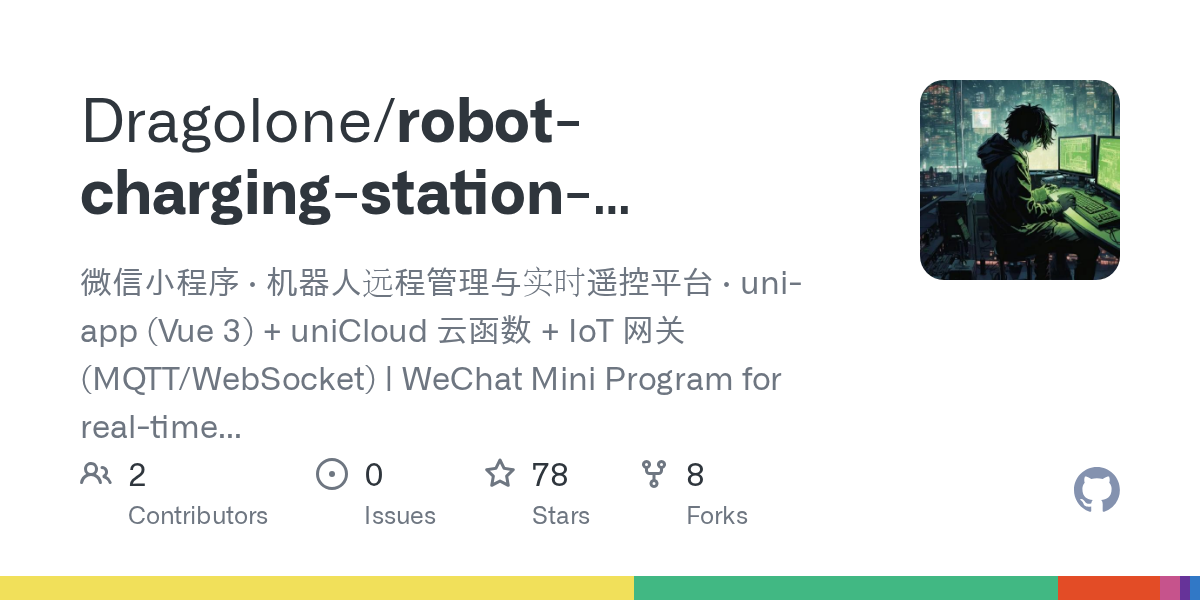
Managing a fleet of robots — even a small one — involves real-time monitoring, remote control, and keeping hardware like charging stations in check. Dragolone/robot-charging-station-miniprogram is an open-source WeChat Mini Program built to serve as a remote management and teleoperation platform for robots. It targets a specific but common pain point: operators need a lightweight, always-available interface to check robot status, send commands, and manage charging infrastructure without deploying heavy desktop software or custom hardware dashboards.
The project is built entirely on uni-app with Vue 3 for the front end, uses uniCloud serverless functions for backend logic, and communicates with robots through an MQTT/WebSocket IoT gateway. That combination means the entire stack — client, API layer, and real-time messaging — lives inside the WeChat ecosystem, accessible from any phone in China without a separate app install.
Core features
- Real-time robot monitoring — Status data flows from robots to the mini program via MQTT and WebSocket, giving operators a live view of each unit's state, position, and operational health.
- Remote teleoperation — Users can send direct control commands to individual robots from within the mini program, enabling manual override or guided navigation without physical proximity.
- Charging station management — The platform tracks docking and charging status across a fleet, providing visibility into which robots are charging, idle, or low on battery.
- Fleet-level dashboard — Multiple robots can be managed from a single interface, allowing operators to oversee the entire fleet rather than connecting to units one at a time.
- Serverless backend — Built on uniCloud, the backend scales without managing dedicated servers. Cloud functions handle authentication, data routing, and business logic.
Getting it running
The project relies on the WeChat developer tooling and the HBuilderX IDE that uni-app uses. To get a local copy up:
# Clone the repository
git clone https://github.com/Dragolone/robot-charging-station-miniprogram.git

# Navigate into the project directory
cd robot-charging-station-miniprogram

# Install dependencies
npm install

# Run in the HBuilderX editor or via the CLI
# The project is structured as a standard uni-app Vue 3 project,
# so it can be served with:
npx vue-cli-service serve
Note: Because this is a WeChat Mini Program, full testing requires the WeChat DevTools simulator or a physical device with a registered mini program app ID. The uniCloud backend also needs to be deployed through the HBuilderX platform or the uniCloud web console. MQTT broker configuration for the IoT gateway will depend on the specific robot hardware and messaging infrastructure in use.
Who this is for
The obvious audience is anyone running a fleet of mobile robots — whether in warehouse logistics, campus delivery, floor cleaning, or inspection. Small-to-mid-size deployments where operators need a phone-based control panel rather than a dedicated workstation are the sweet spot.
It also fits developers exploring how to bridge IoT hardware with WeChat's mini program ecosystem. The uni-app + uniCloud stack is a common pattern in Chinese commercial IoT products, and this project serves as a working reference for that architecture. Researchers and student teams building robot fleets for competitions or demos may find it useful as a starting point for remote management interfaces.
Because the mini program runs inside WeChat, there is no app store approval process or separate installation friction for end users. That makes it practical for handing off to non-technical operators who already live in the WeChat environment.
How it compares
For teams not invested in the WeChat ecosystem, alternatives exist at different points on the complexity spectrum. Dronecode Ground Control (now QGroundControl) offers mature fleet management for UAVs with a desktop and mobile interface, but it is purpose-built for drones and far heavier. ROSBridge combined with a custom web dashboard can achieve similar remote control and monitoring capabilities, but requires more assembly — there is no out-of-the-box mini program, and the developer handles all real-time plumbing manually.
This project's differentiator is its all-in-one, lightweight delivery model. The entire operator experience lives inside a chat app, the backend is serverless, and the IoT layer speaks MQTT out of the box. It trades the depth of enterprise-grade fleet platforms for simplicity and zero-install access.
Summary
Dragolone's robot charging station mini program is a focused, opinionated tool. It does not try to be everything for every kind of robot — it targets WeChat-native, MQTT-connected fleets and gives operators a live remote interface with minimal infrastructure overhead. The 77 GitHub stars reflect a niche but real demand, particularly among Chinese-speaking developers and small robotics teams. The JavaScript codebase and uni-app structure are approachable for anyone familiar with Vue 3. If your use case involves managing a handful of mobile robots and you want an interface that anyone with WeChat can open instantly, this project is worth a look. The source is on GitHub.
Comments