
Tura: 83.1% fewer turns; 16.7 percentage points higher success.
Tura is a local, open-source coding agent for developers who are tired of vague skill claims, token-saving extensions with no evidence, and agents without judgment wreck their repos.
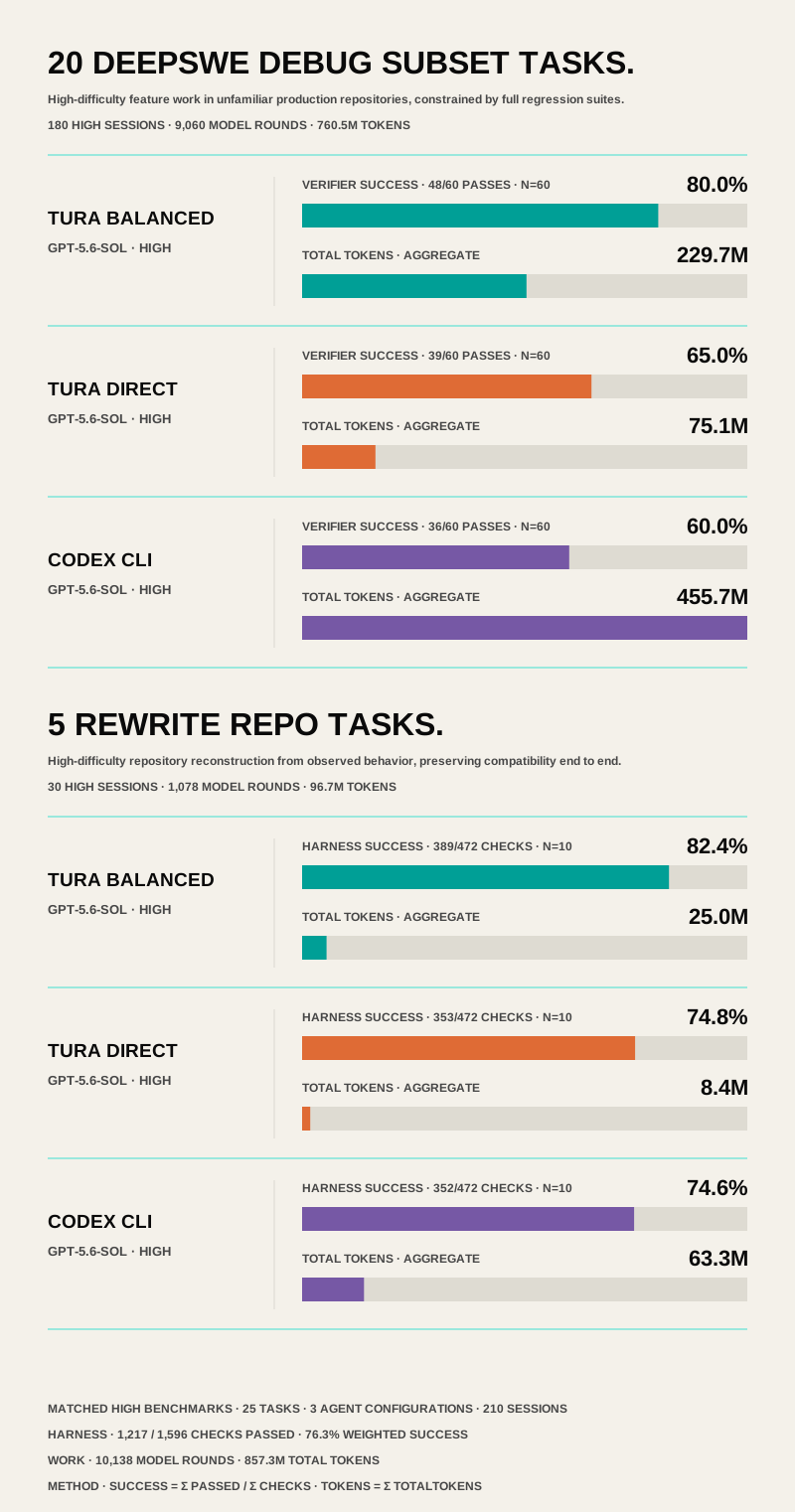
Across 20 DeepSWE v1.1 tasks, tested 60 sessions with GPT-5.6 SOL at High reasoning effort, Tura creates a substantial token-budget advantage by reducing repeated context and model round trips. You can spend that advantage in two ways. Direct turns most of it into lower cost: 83.5% fewer aggregate tokens than the official Codex CLI High configuration, with a verifier success rate of 65.0% versus 60.0%. Balanced puts more of the saved budget back into reasoning, investigation, and verification. It reached an 80.0% success rate—20 percentage points higher than Codex CLI High—while still using 49.6% fewer tokens.[^test-set-record][^debug-manifests]
Benchmark
Long-horizon task benchmarks are one way to look past a polished isolated prompt and see how an agent handles real work. The published comparison uses harness-based development tasks with archived prompts, per-round tool calls, token usage, patches, and verifier results.
The primary comparison below holds the model and reasoning label fixed: Tura Balanced High, Tura Direct High, and the official Codex CLI High configuration on 20 DeepSWE tasks and 5 rewrite tasks. The evidence record also retains Codex CLI Medium as a separate secondary configuration; the benchmark methodology keeps 2 separately reviewed design tasks outside the harness-scored population.[^test-set-record]
The published results do not establish equivalent quality or performance for every configured provider. Broader Anthropic/Claude, Google/Gemini, OpenAI-compatible, local-provider, UI-latency, runtime/session parsing, and cross-OS measurements remain part of the documented roadmap and known evidence gaps.
FULL BENCHMARK REPORT
Screenshots
GUI page with multi-session concurrent work and HTML rich text support.
TUI page with multi-session concurrent work and HTML rich text support.
The results below come from published benchmark artifacts, not an uncited aggregate. Three systems do most of the work:
Macro CLI Command Run
Most coding agents still depend on repetitive tool-calling loops: inspect, wait, patch, wait, build, wait, test, wait.
Tool-calling coding agent:
rg -n "TODO|command_run|handler" crates/
rg --files crates/runtime/src crates/tools/src
# Turn 2 — apply patch

*** Begin Patch
*** Update File: crates/tools/src/command_run/handler.rs
@@
-    // old command handler logic
+    // patched command handler logic
*** End Patch
# Turn 3 — build

cargo build -p runtime
# Turn 4 — run tests

cargo test -p runtime --lib
# Turn 5 — run lint validation

cargo clippy -p runtime --all-targets
Tura takes a different route. Instead of exposing dozens of small tools to the model, it exposes one macro tool: command_run. The agent can then build a multi-step execution tree and run related actions in one LLM turn.
In the example below, both agents run the same commands. A normal tool-calling agent needs five LLM turns; Tura handles the sequence as one structured macro workflow. The saved work is conversational overhead, not engineering discipline.
Tura macro CLI command:
{
  "name": "command_run",
  "arguments": {
    "commands": [
      {
        "step": 1,
        "command_type": "shell_command",
        "command_line": "rg -n \"TODO|command_run|handler\" crates/"
      },
      {
        "step": 1,
        "command_type": "shell_command",
        "command_line": "rg --files crates/runtime/src crates/tools/src"
      },
      {
        "step": 2,
        "command_type": "apply_patch",
        "command_line": "*** Begin Patch\n*** Update File: crates/tools/src/command_run/handler.rs\n@@\n-    // old command handler logic\n+    // patched command handler logic\n*** End Patch"
      },
      {
        "step": 3,
        "command_type": "shell_command",
        "command_line": "cargo build -p runtime"
      },
      {
        "step": 4,
        "command_type": "shell_command",
        "command_line": "cargo test -p runtime --lib"
      },
      {
        "step": 4,
        "command_type": "shell_command",
        "command_line": "cargo clippy -p runtime --all-targets"
      }
    ]
  }
}
There is no ablation test proving that command_run alone causes Tura's lower turn and token usage. In the matched-High DeepSWE comparison, however, Balanced used 66.8% fewer model rounds and 49.6% fewer tokens than Codex CLI High, while Direct used 84.0% fewer rounds and 83.5% fewer tokens.[^test-set-record][^debug-manifests]
Backward Reasoning
However impressive LLMs can be, an LLM is still, at its core, a statistical induction model over text-token probabilities.
For example, asking an LLM to choose among rock, paper, and scissors does not guarantee a uniform random result. If a true one-in-three distribution matters, the choice needs an external random-number source rather than an uncited assumption about model output probabilities.
In coding tasks, this is often fatal.
An agent is more likely to execute and generate code and logic that are statistically more common. But common code and common logic are often mediocre and under-considered.
Tura uses a different strategy.
During reasoning, a common agent reasons from the current state to the prompt goal. In that case, $s_1$ is the current state, and $s_n$ is the goal given by the user prompt.
$$ s_1 \rightarrow s_2 \rightarrow s_3 \rightarrow \cdots \rightarrow s_n $$
Instead, Tura guides the LLM to statistically estimate $s_{n-1}$ first, then reason backward from the state of $s_{n-1}$ to $s_{n-2}$.
In the example below, the LLM can derive the optimal strategy for playing rock-paper-scissors correctly.
> To keep rock-paper-scissors fair and challenging,
> We need unbiased play.
> Each move must have a true one-in-three chance.
> An LLM cannot guarantee that from text probabilities alone.
> Use a random-number generator script to generate randint(1, 3)
> Then map rock, paper, or scissors to the number.
In programming tasks, this means that when an agent sees a goal like fixing a frontend bug, it is guided to reason through the full execution path, reconstruct the failure state, and identify the root cause before writing code. In the matched-High DeepSWE comparison, Tura Balanced passed 12 more of 60 binary task verifiers than Codex CLI High.
Both configurations in that contrast use GPT-5.6 SOL with the High reasoning label, so a High-versus-Medium effort mismatch does not explain the 20-point pass-rate difference. The result is still a system-level association, not a causal estimate for backward reasoning or any other individual feature.[^test-set-record][^debug-manifests]
Runtime Context and Prompt Manager
Skills are often just weaker prompts loaded into context.
In many agent frameworks, a long-lived session keeps accumulating skill files, tool outputs, and stale task history. When the context becomes too large, the agent enters a separate compaction turn, but that compaction usually preserves only a compressed summary. Important execution details can become vague or lost.
Tura treats context as part of the runtime state machine.
Instead of relying on users to manually reset sessions or letting Markdown skills pile up, Tura uses task_status, runtime prompts, and recursive execution manuals to keep the active context scoped to the current task.
Traditional skill-based agents usually keep one session running until the user starts another, load broad Markdown skills into that session, and leave them active until a reset or compaction. Tura instead ties runtime prompts to explicit task state: sessions can be renamed, refreshed, and managed automatically; task-specific manuals and CLI commands are loaded through a recursive task tree; and irrelevant context can be removed, replaced, or compacted from the CLI. The checkpoint can retain code locations, patches, tests, and task status rather than only a loose summary. In practice, that means less stale context, lower task-scoped token cost, and fewer chances for an old skill or vague summary to steer the current job.
Because compaction is a CLI operation, Tura can preserve exact execution state in task_status.compact_context. In the published benchmark sessions, Tura moved beyond read-only inspection and resumed execution an average of 2.6 rounds after compaction, compared with an estimated 5.4 rounds for Codex.[^compact-dynamodb][^compact-wasmi-r1][^compact-wasmi-r2][^compact-wasmi-r3][^compact-eza]
Tura's 2.6-round result is calculated from explicit compact_context events in its archived round contracts. Codex does not expose equivalent compaction events, so its 5.4-round result is estimated from points where input-token usage drops sharply, excluding identifiable media-reading boundaries.
Install and run
NPM release
Mac and Linux:
npm install tura-ai
tura
Windows:
npm install -g tura-ai
tura
The same main package is also published to GitHub Packages as @tura-ai/tura.
Configure the @tura-ai scope for https://npm.pkg.github.com, authenticate
with a token that has read:packages, then install @tura-ai/tura. The
unscoped tura-ai package on npm remains the simplest public installation.
Tura does not bundle provider credentials. On first launch, configure an LLM provider and select one of its models before sending a prompt. See Provider setup for the CLI, TUI, and GUI flows.
Source checkout
Windows PowerShell:
git clone https://github.com/Tura-AI/tura.git
cd tura
.\scripts\install.ps1
tura
macOS or Linux shell:
git clone https://github.com/Tura-AI/tura.git
cd tura
./scripts/install.sh
tura
The source installer performs the complete environment setup, release build,
and user PATH registration flow. Pass -EnvironmentOnly on PowerShell or
--environment-only on macOS/Linux only when you intentionally want dependency
setup without building or registering Tura.
Common entrypoints
| Entry | Use it for |
|---|---|
tura |
Interactive terminal UI. |
tura "prompt" |
Open the TUI with an initial prompt. |
tura exec "prompt" |
Direct Rust CLI prompt runner. |
tura run "prompt" |
Gateway-backed prompt with streaming/history. |
tura bash, tura zsh, tura shel |
Prompt with a selected command-run shell surface. |
tura_gateway |
Local HTTP/SSE gateway and optional web GUI serving. |
tura_gui |
Desktop GUI workspace client. |
For OS-specific PATH requirements, executor installation, and how to register the CLI when the executable is not on PATH, read How to start. For command flags and modes, read CLI parameters.
Documentation
The GitBook-style documentation index is docs/SUMMARY.md. The full navigation page is docs/start/navigation.md.
Start
Core
- Task status
- Context management
- Runtime prompt
- Command run
- Commands
- Agents
- Personas
- Rich text
- Dynamic prompt injection
Architecture
Customization
Development
- Scripts
- Testing
- Environment
- Architecture
- Benchmark methodology
- Current test-set evidence record
- Benchmark artifacts
Benchmark notes and sources
[^test-set-record]: tura-benchmark current test-set evidence record, which defines the 280-run published population, the 278-run relationship-analysis population, configuration provenance, aggregation formulas, exclusions, and identification limits. The README's primary High-to-High tables select the 210 Tura Balanced High, Tura Direct High, and Codex CLI High sessions from that published population.
[^debug-manifests]: Tura's DeepSWE observations are in tura-benchmark replicate 1, replicate 2, and replicate 3. The matched Codex CLI High observations are in High replicate 1, High replicate 2, and High replicate 3. Each configuration contributes 60 sessions on the same 20 task IDs.
[^rewrite-manifest]: Tura's Rewrite observations are in the tura-benchmark GPT-5.6 Rewrite Repo canonical manifest; the official Codex CLI High observations are in the Codex High canonical manifest. Each High configuration contributes 10 sessions and 472 harness checks.
[^compact-dynamodb]: tura-benchmark DynamoDB round 107 compact and round 114 first later patch.
[^compact-wasmi-r1]: tura-benchmark Wasmi replicate 1 round 43 compact and round 44 first non-read action. The run ends at round 46 without a later patch or test action.
[^compact-wasmi-r2]: tura-benchmark Wasmi replicate 2 round 26 compact, round 28 first non-read action, and round 39 first later patch/test.
[^compact-wasmi-r3]: tura-benchmark Wasmi replicate 3 round 39 compact and round 41 first later patch/test.
[^compact-eza]: tura-benchmark eza round 23 compact and round 24 first later test.
Comments