Multiplayer survival titles represent some of the most unforgiving environments in modern PC gaming. Among them, Facepunch Studios' Rust stands out for its high-stakes mechanics, where losing a firefight can erase hours or days of accumulated resources. This intense competitive pressure has driven a persistent ecosystem around game utilities, memory analysis tools, and input automation scripts.
Within this domain, tools generally split into two distinct architectural approaches: internal hooks and external utilities. Internal tools inject code directly into the target game process, allowing direct function calls and memory manipulation, but they carry significant exposure to memory scanners. External utilities operate outside the game's immediate memory space, reading process memory or handling input simulation from an isolated user-space or kernel-level application.
Enter Rust-External-26
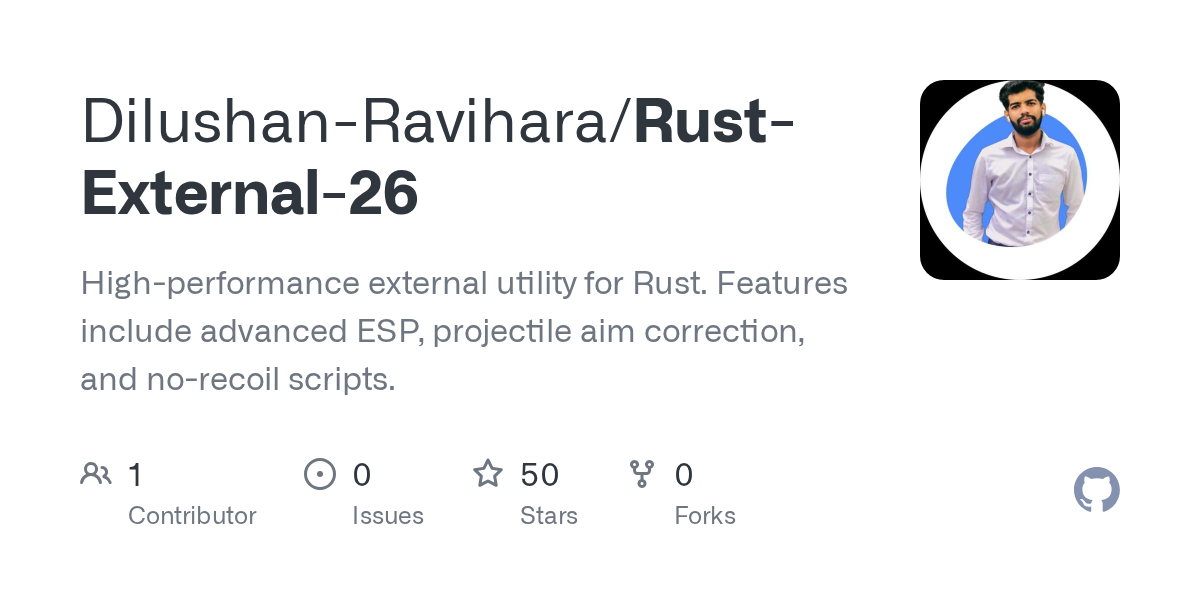
The project Rust-External-26, maintained by Dilushan-Ravihara on GitHub, sits squarely in this external tooling category. Built as an open-source utility with 50 stars on GitHub, the repository outlines an external suite explicitly focused on performance and tactical assistance for Rust.
The project focuses on three primary functional areas: advanced Extra Sensory Perception (ESP), projectile aim correction, and automated recoil reduction. Rather than attempting to rewrite engine behavior from within, the utility positions itself as a lightweight, high-performance external companion designed to calculate game state data and assist the player during combat encounters.
The interesting bits
The core of the tool rests on its visual overlay capabilities, referred to in the repository as advanced ESP. In external tooling architectures, ESP typically works by opening a handle to the game process, parsing entity lists from system memory, and projecting coordinates onto a transparent desktop overlay. By rendering independently of the game's DirectX or Vulkan pipeline, external ESP avoids hooking the game's direct rendering swap chain, minimizing the footprint left inside the game client's runtime space.
Projectile aim correction represents another notable technical focus. Rust features intricate ballistics mechanics, where ammunition types exhibit distinct travel times, drag coefficients, and gravity drops across long distances. Implementing projectile correction externally requires reading target velocity, distance, and player orientation, then calculating the required angle offset to land a shot on a moving entity. The utility handles these trajectory calculations to predict impact points before firing.
The third pillar listed in the project is its no-recoil scripting capability. Recoil compensation in modern shooters involves offsetting the continuous upward and horizontal weapon kick that occurs during sustained fire. External implementations usually monitor active input states and inject compensating mouse-movement deltas, countering the weapon's spray pattern without modifying the game's client-side recoil tables directly.
Caveats
Despite the technical interest surrounding external game utilities, several operational realities must be considered.
The repository does not specify its primary programming language in its top-level metadata, leaving prospective reviewers to inspect the codebase directly to evaluate implementation details like memory access routines or dependencies.
Operating any external automation or memory-reading tool in Rust carries severe risks. The game relies on Easy Anti-Cheat (EAC) alongside server-side heuristic tracking. Modern anti-cheat systems continuously monitor open handles, memory read patterns, unexpected overlay windows, and synthetic mouse inputs. Even if an external utility avoids direct DLL injection, pattern analysis and signature scans frequently flag public repositories.
Furthermore, Rust receives frequent weekly and monthly engine updates. These patches consistently shift memory offsets, update entity structures, and alter weapon ballistics. Public utilities that do not receive active, immediate maintenance quickly break after official game updates, requiring manual offset updating and recompilation.
If you want to run it
Anyone looking to explore the codebase will need a configured development environment suitable for compiling Windows system utilities and interacting with memory management APIs. Because specific setup instructions, dependency lists, and binary targets are maintained directly within the repository itself, users should consult the project documentation for concrete build steps rather than attempting unguided execution.
For developers and researchers studying game security models, ballistic calculation algorithms, or external overlay techniques, the project provides a focused reference implementation. You can inspect the source code and documentation at Rust-External-26.
Comments