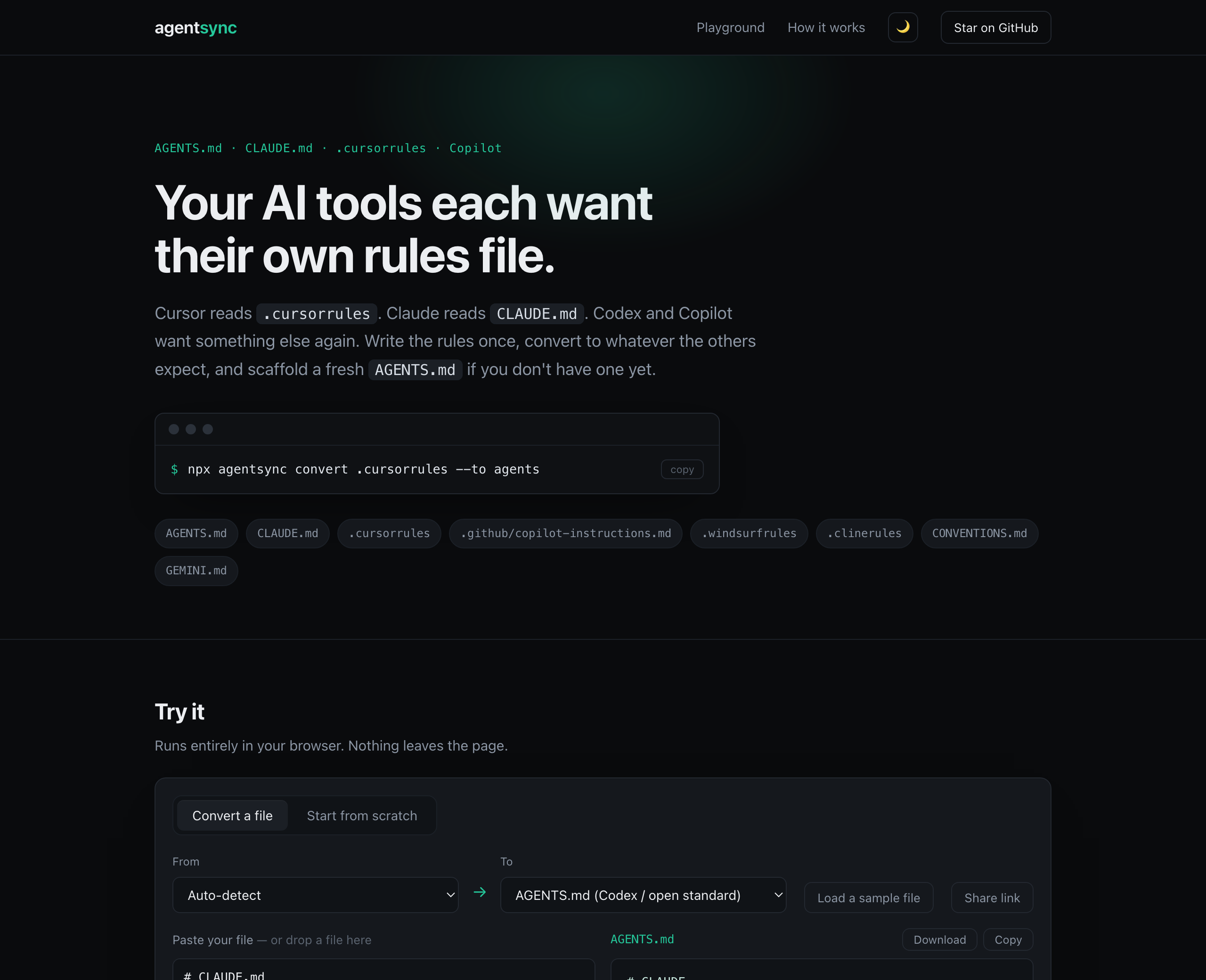
One source of truth for your AI coding-agent rules.
🔗 Live playground: https://panishandsome.github.io/ai-rules-sync/
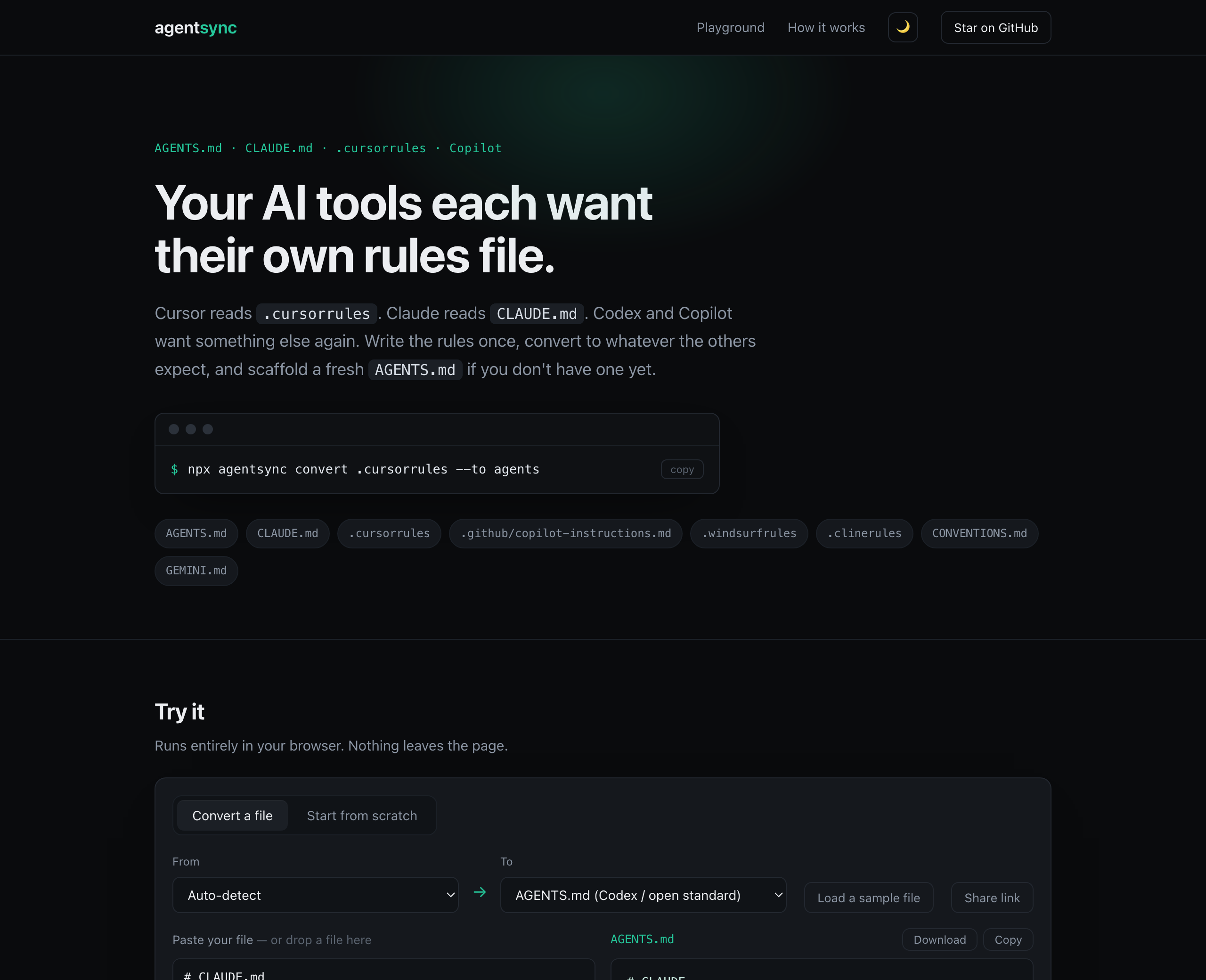
Codex reads AGENTS.md. Claude Code reads CLAUDE.md. Cursor reads .cursorrules.
Copilot reads .github/copilot-instructions.md. Keeping them in sync by hand is
tedious and they drift. agentsync converts between all of them — or
generates a clean AGENTS.md from a short spec.
Zero dependencies. The exact same engine (src/core/agentsync.js) powers both the
CLI and the browser playground.
Install
npm install -g @panishandsome/agentsync   # installs the `agentsync` command
# or run without installing:
npx @panishandsome/agentsync --help
Or just clone and run from source — there are no dependencies:
git clone https://github.com/PanisHandsome/ai-rules-sync
cd ai-rules-sync
node bin/agentsync.mjs --help
Set it up in one command
agentsync setup
That's the lazy path. In your repo it: generates AGENTS.md (by scanning the
project), writes an agentsync.json, runs the first sync, and installs a git
pre-commit hook so every commit keeps the files in sync. From then on you just
edit AGENTS.md and commit. Use agentsync setup --auto to let the hook accept
edits to any rule file, or --no-hook to skip the hook.
Quick start (manual)
# Point it at your repo and let it write AGENTS.md for you
agentsync init

# Convert an existing rule file
agentsync convert .cursorrules --to agents -o AGENTS.md
agentsync convert CLAUDE.md --to copilot

# Generate from explicit fields instead of scanning
agentsync generate --name my-app --language TypeScript --framework Next.js \
    --test "pnpm test" --build "pnpm build" -o AGENTS.md

# Check an AGENTS.md for stale commands / missing paths
agentsync lint AGENTS.md
Keep one source of truth, sync the rest
Write AGENTS.md once and let the other tools' files be generated from it. Create
the config (it auto-detects which rule files you already have):
agentsync sync --init # writes agentsync.json
{
  "source": "AGENTS.md",
  "targets": ["CLAUDE.md", ".cursorrules", ".github/copilot-instructions.md"]
}
agentsync sync            # regenerate every target from AGENTS.md
agentsync sync --watch    # regenerate on every save
agentsync sync --check    # CI: exit non-zero if anything is out of sync
Make it automatic with a pre-commit hook (so the committed files are always in sync):
npx husky init
echo "npx agentsync sync && git add -A" > .husky/pre-commit
Edit only AGENTS.md from then on — the other files are generated outputs.
Don't want to be tied to one file? Use --auto
With --auto you can edit whichever file your current tool prefers (CLAUDE.md in
Claude Code, .cursorrules in Cursor, AGENTS.md in Codex…). agentsync tracks a
snapshot in .agentsync-state.json, figures out which file you changed, and
regenerates the rest from it:
agentsync sync --auto
If you edited two files since the last sync, it stops and asks which one wins:
agentsync sync --auto --source CLAUDE.md
Hook it up the same way: echo "npx agentsync sync --auto && git add -A" > .husky/pre-commit.
Merge existing files into one
Already have several rule files? Fold them into a single AGENTS.md:
agentsync merge CLAUDE.md .cursorrules -o AGENTS.md
Try it in the browser
→ https://panishandsome.github.io/ai-rules-sync/ — paste any rule file on the left, see the converted output on the right, or switch to Generate mode and fill in a short form. Runs entirely client-side; nothing is uploaded.
To run the playground locally:
npm run web # → http://localhost:5173
Supported formats
| id | file | tool |
|---|---|---|
agents |
AGENTS.md |
Codex / open standard |
claude |
CLAUDE.md |
Claude Code |
cursor |
.cursorrules |
Cursor |
copilot |
.github/copilot-instructions.md |
GitHub Copilot |
windsurf |
.windsurfrules |
Windsurf |
cline |
.clinerules |
Cline |
aider |
CONVENTIONS.md |
Aider |
gemini |
GEMINI.md |
Gemini CLI |
qwen |
QWEN.md |
Qwen Code |
Run agentsync formats to list them.
How it works
Every format is parsed into one normalized intermediate representation (sections,
intro, file globs, warnings), then rendered into the target format. Adding a new
tool means writing one parser and one renderer — nothing else changes. Tool-specific
constructs that don't translate (Cursor's globs frontmatter, Claude's @path
imports) surface as warnings instead of being silently dropped.
Flat, heading-less rule files are classified semantically: command lines, style
notes, and prohibitions are sorted into proper Build & test commands, Code style
and Do not sections rather than dumped into one blob.
CLI reference
agentsync init [dir] [-o <out>] [--force]
agentsync sync [--check] [--watch]
agentsync convert <file> [--to <fmt>] [--from <fmt>] [-o <out>] [--json]
agentsync merge <file> <file> ... [--to <fmt>] [-o <out>] [--json]
agentsync generate --name <n> [--language ..] [--framework ..] [--test ..] [-o <out>]
agentsync lint <file> [--strict] [--json]
agentsync detect <file> [--json]
agentsync formats
Tests
npm test
Comments