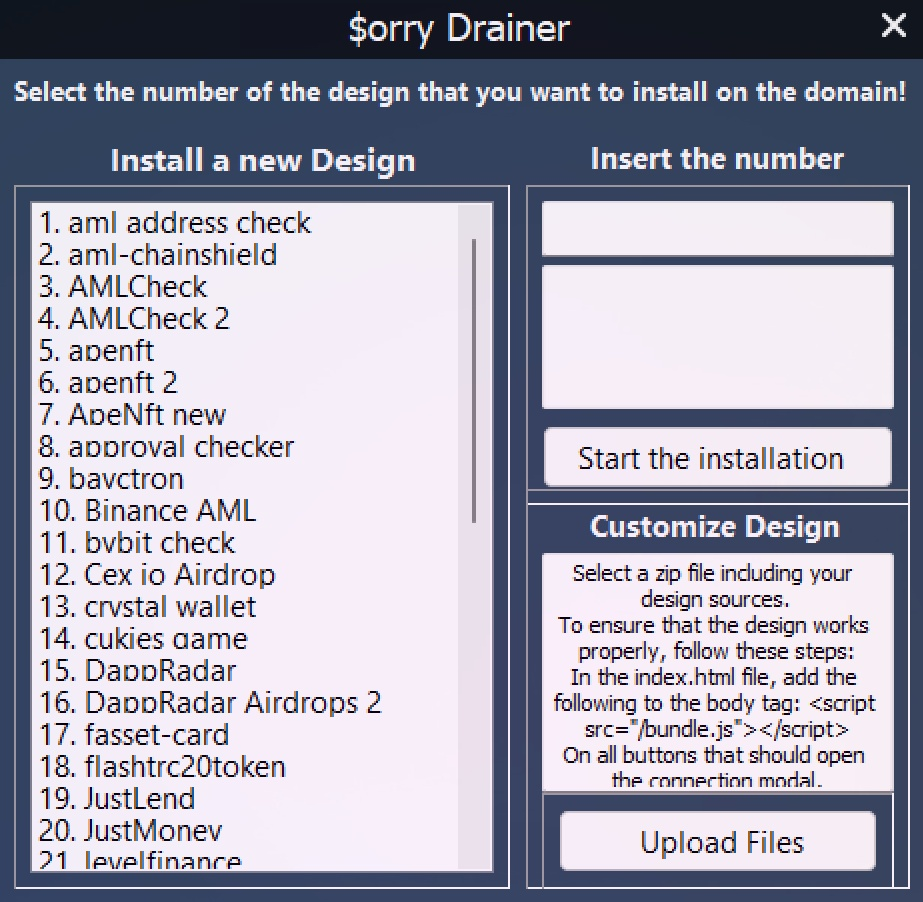
Repositories cataloged under Web3 threat intelligence track various automated exploitation kits, and the repository OrderKomodoFoster/Multichain-Drainer represents a specific subcategory of these utilities. Described by its author as a specialized script engineered to extract digital assets, tokens, and non-fungible tokens (NFTs), the project positions itself as a multichain wallet drainer and a Web3 phishing toolkit. Rather than serving a conventional self-hosted administration or development need, it sits squarely on the offensive side of the cryptocurrency security landscape.
From a threat analysis perspective, the repository reflects the ongoing proliferation of Drainer-as-a-Service (DaaS) frameworks. These kits typically aim to intercept interactions between decentralized applications (dApps) and user wallets, prompting unauthorized approvals or direct token transfers. The metadata categorizes the tool as an automated drain bot supporting specific high-volume blockchains and token standards, targeting assets across heterogeneous networks.
Advertised features and supported assets
The project description outlines several specific targets and operational attributes that characterize modern drainer packages:
- Multi-network asset targets: The repository metadata explicitly specifies support for Bitcoin (BTC), Ethereum (ETH), Litecoin (LTC), and Tron (TRX). By covering both UTXO-based chains and EVM-compatible networks, the tooling claims broad coverage across different cryptographic transaction formats.
- Token standard integration: The toolkit highlights support for Tether (USDT) on the TRC20 standard, an asset frequently targeted in automated drain schemes due to high transaction velocity and low gas fees on the Tron network.
- NFT and token extraction: The metadata specifies capabilities to target non-fungible tokens alongside standard digital currencies, which typically involves harvesting ERC-721 or ERC-1155 approval signatures.
- Drainer-as-a-Service (DaaS) orientation: The project advertises itself as a modular kit intended for operational deployment within phishing infrastructures, relying on pre-configured scripts to automate illicit transfers.
- Automated execution bots: The feature notes cite automated bots programmed to detect wallet connectivity and trigger immediate extraction requests without requiring manual operator intervention.
Under the hood and distribution mechanics
Examining the actual repository reveals a stark contrast between the ambitious metadata description and the committed files. The codebase lists its primary programming language as unknown, carries 34 stars, and contains no committed application logic, smart contract scripts, or frontend interface components. Instead, the entire documentation consists of an image reference (logo3.png) and an external contact link directed to an offsite Telegram profile.
This structure is a recurring signature in Web3 black-hat distribution. Repositories of this type frequently avoid hosting executable malware or script payloads directly on GitHub to evade automated abuse filters and static repository scanning. Instead, operators treat public repositories as search-engine-optimized landing pages. By loading the project description with keywords covering major protocols and token standards, the repository functions as a traffic funnel rather than an open-source development workspace.
Because no source files or configuration manifests are provided, the architecture is entirely opaque within GitHub itself. The purported operational mechanics—such as malicious RPC routing, contract approval spoofing, and signature requests (such as eth_sign or Permit2 abuses common in EVM drainers)—are kept proprietary by the vendor. Distribution, pricing, and binary payloads are handled out-of-band via private Telegram messaging. Consequently, the repository provides zero inspectable code regarding how it handles cross-chain interaction, private key isolation, or target validation.
Target audiences and operational trade-offs
For defensive professionals, threat intelligence teams, and security researchers, repositories like this serve as indicators of active commercial threat vectors. Analyzing how these kits are branded and which networks they prioritize—such as the explicit pairing of TRX and TRC20 USDT—offers insight into the practical financial flows prioritized by threat actors. Defensive analysts can document the repository metadata, star counts, and external communication handles to map out broader phishing distribution clusters.
For anyone seeking legitimate self-hosted cryptocurrency tooling or genuine utility libraries, this project offers no value. Even within illicit operations, using closed-source stubs advertised through Telegram carries extreme risks. Historically, black-market DaaS tools frequently contain hidden backdoors that siphon diverted assets to the original tool author rather than the intermediary running the campaign, turning buyers into secondary targets. The absence of auditability, clear documentation, and licensing makes the repository unusable for technical evaluation outside of threat classification.
Deployment details
There are no deployment files, container images, or runtime dependencies published in the repository. Standard deployment models found in open-source projects—such as Docker configurations, Node.js package manifests, or Python requirements files—are absent. Readers looking to verify the repository contents or analyze its public footprint can review the repository stub directly on GitHub.
Ecosystem context
In the broader Web3 ecosystem, turnkey kits like this represent the commercialization of phishing techniques once reserved for skilled exploit authors. Where legitimate open-source development prioritizes transparency, dependency verification, and security audits, DaaS operations mirror the centralized evasion tactics seen in conventional enterprise malware distribution. The underlying repository maintains a strictly promotional presence, and researchers can examine the project directly via the Multichain-Drainer repository on GitHub alongside its linked Telegram contact channel at https://t.me/sorydrr7.
Comments