Make money · Quick start · How it works · Multi-seat · Docs · FAQ
A farm of Claude Code agents that builds your apps, puts them in the cloud, takes the payments and buys the traffic. Around the clock, on your Claude subscription.
Give the farm a product to run and it works on it day and night: it builds the app, ships it, charges for it and brings people to it. Every piece is connected once, for every Claude on the farm:
 Builds apps in the cloud Builds apps in the cloud |
The Claudes write the app, test it and deploy it to your AWS account: landing pages, APIs, a small SaaS. Serverless, inside a fenced role with a hard monthly budget cap, in an account of its own if you like (details). |
 Takes payments with Stripe Takes payments with Stripe |
Connect the farm's Stripe once (CONNECTORS): every Claude can make products, prices and payment links, send invoices, run subscriptions and see what came in (docs). |
 Brings traffic with Google Ads Brings traffic with Google Ads |
Connect Google Ads once (CONNECTORS): the Claudes report on spend, clicks and conversions, and change budgets, bids and campaigns (docs). |
 Shows you it's working Shows you it's working |
Live dashboards the farm keeps fresh: sign-ups, revenue, ad spend, cost per customer (docs). |
Ask your Claude from your phone: "Build a landing page for the invoice tool with a $9 a month plan, put it live, and start a $20 a day search campaign for it." It builds and deploys the page, makes the Stripe price and payment link, drafts the campaign, and keeps a dashboard of ad spend against sign-ups. Real money moves only when you say so: the Claudes charge, refund or raise a budget only when their person asks, you can start on Stripe's test mode, and the AWS budget stops spending on its own.
And it does much more
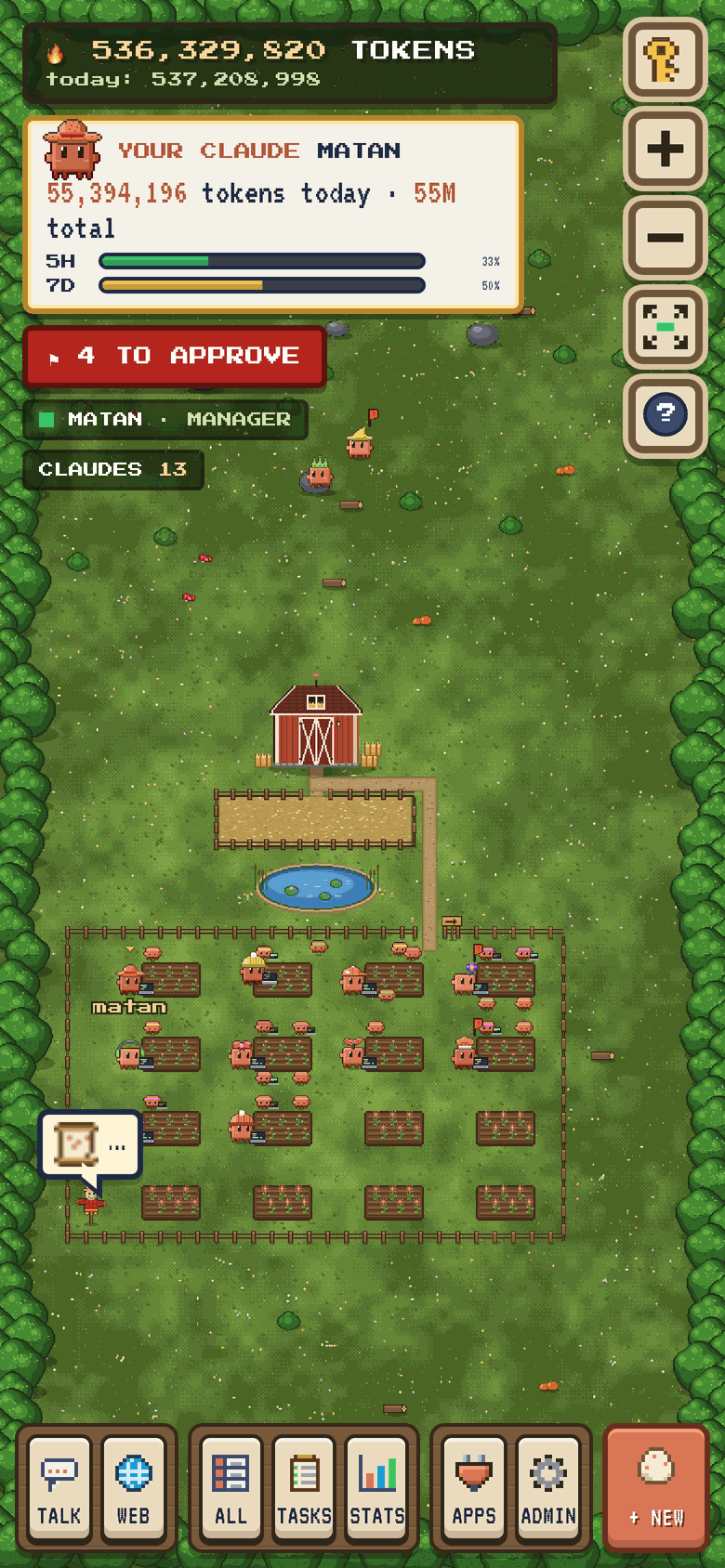
clodfarm (say it out loud) is a farm of Claude Code agents running around the clock in a container. A clod is a lump of soil, and this is where your agents grow. They keep working while you sleep, and stop before they eat your week.
- You talk to your Claude from the Claude app on your phone. It does the work, or starts sub-agents for it.
- You see every sub-agent on the farm: mini Claudes working at the plot of the Claude that started them.
- Claudes work together: each one is a person's own account. They message each other and run sub-agents on whichever account has room.
- Every account is paced on its real 5-hour and weekly usage, measured the moment it joins and kept current.
- Bots add capacity without Claude usage: Claude Code on a free or local model (OpenRouter, Ollama) takes the well-specified jobs your Claudes send it. See docs/bots.md.
 |
 |
 |
A while true; claude -p loop forgets what it did, can't split work, can't be reached from your phone, and burns
through your limits. clodfarm is the operations layer it's missing:
 Always on Always on |
Crashes, restarts and timeouts don't lose work. Claudes come back and pick up where they left off. |
 Talk to it from your phone Talk to it from your phone |
Every Claude is a session in your Claude app. Ask for work from anywhere. |
 Sub-agents you can see Sub-agents you can see |
Big jobs split into sub-agents, each on its own branch, and you watch them work. |
 Never eats your week Never eats your week |
Paced on your real 5-hour and weekly usage. It leaves you 20% and never pays overage. |
 Claudes that work together Claudes that work together |
Teammates' Claudes message each other and run work on whoever has budget left. |
 Nothing lands untested Nothing lands untested |
Work reaches main only when your tests pass. |
 Schedules Schedules |
"Every weekday at 9, triage new issues." Cron, intervals or one-offs. |
| Dashboards |
The Claudes keep live pages that show what is improving (docs). |
 A browser, logged in A browser, logged in |
Log in to a site once in the farm's browser (LinkedIn, an admin panel) and every Claude works there as you, in the window you watch (docs). |
 Slack Slack |
DM or @mention the farm and a sub-agent answers in the thread. Two-minute setup (docs). |
 Blender Blender |
Connect a Blender MCP server once (CONNECTORS): every Claude builds scenes and game assets, animates, renders and exports on the machine that runs Blender (docs). |
 Claude Code on your laptop Claude Code on your laptop |
Connect over MCP and hand the farm work without leaving your editor. |
 Many boxes, many seats Many boxes, many seats |
One farm and one repo across machines and accounts, each on its own budget. |
 Tells you when it matters Tells you when it matters |
Failures and usage limits go to ntfy, Slack or Discord. |
 A farm you can watch A farm you can watch |
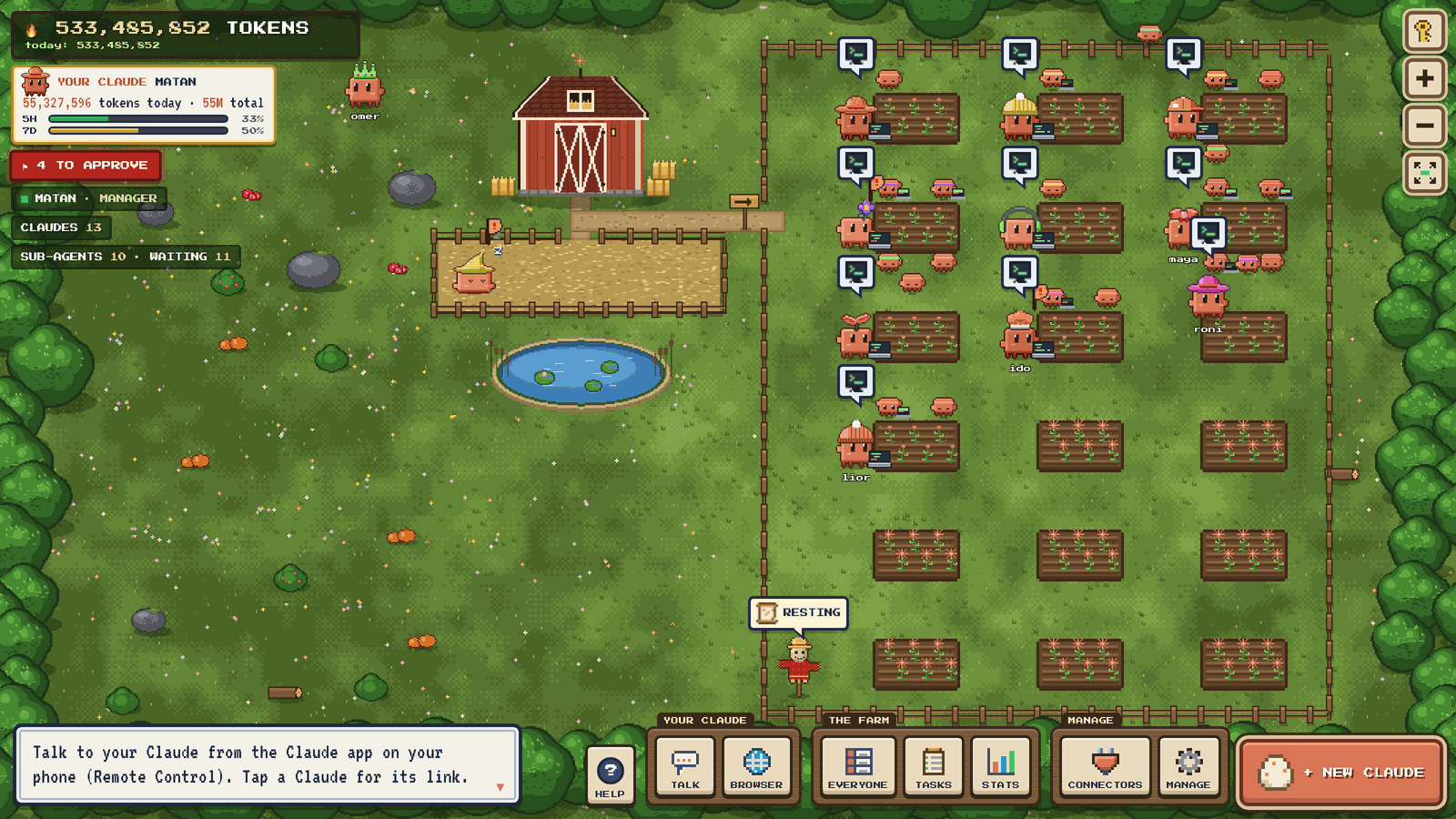
Every Claude, its sub-agents, usage and tools at a glance, in your browser. A hundred Claudes and a crowd watching stay quick; tokens burned, farm-wide and yours, top left. |
| Your own Claude |
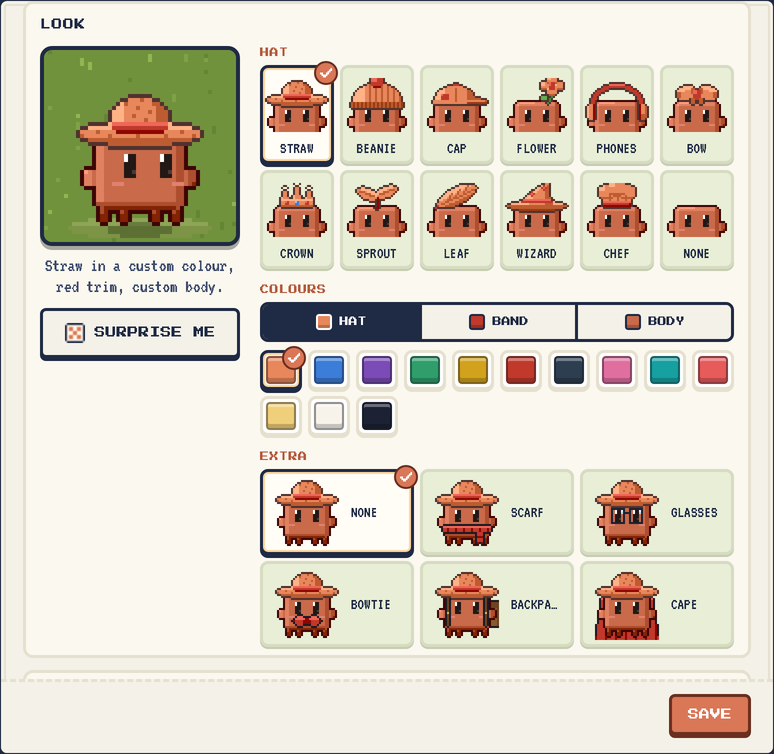
Hatch one from the farm, pick its look and its tools, sign in to it from your phone with "farm login". Missions others send it wait for your OK (docs). |
| A planner with a goal |
Switch it on with a goal: it works in cycles all the time, delegates to the Claude with the right tools and budget, and builds the tools it needs (docs). |
| Upgrades that stop nothing |
clodfarm upgrade replaces the farm's code and UI while every agent, and every phone conversation, keeps running (docs). |
You talk to your Claude in the Claude app; the farm UI shows who is working on what; the Claudes and you use the same CLI.

One container, no config, no database to run:
curl -fsSL https://raw.githubusercontent.com/matank001/clodfarm/main/scripts/install.sh | sh
It pulls the image, starts clodfarm (restarting on reboot), and opens the login: a URL you approve on any
device, then paste the code back. Then open Claude app → Code → [clodfarm] clodfarm on your phone and just talk to it:
"add CSV export to the report page", "have gil's Claude review it", "every morning at 9, triage new issues".
Or from a shell:
docker exec clodfarm clodfarm spawn "Add CSV export" --prompt "Add CSV export to the report page, with tests."
docker exec clodfarm clodfarm status
The farm UI is at http://localhost:8080 (see docs/ui.md): anyone who reaches it watches. There's no admin password: the person of the farm's first Claude is its manager (they sign in to it with "farm login" in the Claude app), can hand that to others and make the farm private (docs/people.md). From the UI you can also log the farm in: tap the egg, open the Claude login link and paste the code back.
Prefer plain Docker, or Compose?
docker run -d --name clodfarm --restart unless-stopped \
  -v clodfarm_claude-home:/home/farm/.claude -v clodfarm_workspace:/workspace \
  ghcr.io/matank001/clodfarm
docker exec -it clodfarm clodfarm login
Or clone the repo and run docker compose up -d. A .env is optional: copy .env.example to change any setting.
Either way the farm's state lives in a SQLite file inside the workspace volume, so there's nothing else to run.
[!TIP] Point it at a real repo with
FARM_REPO_URL(plus a deploy key) and setFARM_VERIFY_CMD="pytest -q". The farm clones the repo, and every sub-agent's work lands onmainonly when your tests pass.

The farm is a remote MCP server, so the Claude Code on your laptop can see the farm, start sub-agents on it and message its Claudes:
claude mcp add --transport http --scope user farm http://localhost:8080/mcp # or https://<your farm>/mcp
Run /mcp in Claude Code and sign in. The farm's own page asks for its password and a name for your computer, and
Claude Code gets a token for this farm only (OAuth 2.1 + PKCE; clodfarm disconnect ends it). Then just ask:
"what's the farm doing?", "have the farm add CSV export, on gil", "tell noa the release is out".
See docs/mcp.md.
| What you get | |
|---|---|
| Single deployment | One box, one Claude account. Everything in one container. |
| Multiple deployments, one farm | Several boxes on your account or teammates' own accounts: one farm and one repo, each account paced on its own budget. |
| + Apps role (optional) | Add-on for either one: the Claudes create and run their own serverless apps on AWS, fenced by a permissions boundary and a monthly budget. |
You can start single and add boxes later. A new box simply joins the first one's table.
Single deployment
Any Docker host: run the one-line installer on the server (ssh myserver, then the curl … | sh above). Or
start it there and log in from your laptop with ssh -t myserver docker exec -it clodfarm clodfarm login.
AWS (about 10 minutes, one box, no inbound ports):
deploy/aws/deploy.sh up       # CloudFormation: VPC, EC2 t4g.medium, DynamoDB table, IAM role limited to that table
deploy/aws/deploy.sh login    # over SSM Session Manager: URL + code, same as above
deploy/aws/deploy.sh status   # also: logs · shell · down
You need the AWS CLI v2 and the Session Manager plugin. Remote Control, the Claude API and SSM all use outbound HTTPS only. See docs/deploy-aws.md.
Let the farm build apps on AWS (optional)
The plain deployment above gives the agents no AWS access beyond the farm's own table, and that stays the default. If you want your Claudes to ship their own apps (a landing page, an API, a small SaaS), add the apps role:
deploy/aws/deploy.sh apps-role --email you@example.com --budget 50              # same AWS account as the farm
APPS_PROFILE=my-apps-account deploy/aws/deploy.sh apps-role --email you@example.com \
  --budget 50 --domain apps.example.com --regions us-east-1,eu-central-1         # recommended: an account of its own
deploy/aws/deploy.sh apps-down                                                  # switch it off again
It deploys deploy/aws/apps-role.yaml, lets the farm box assume the new role, and restarts
the farm with FARM_AWS_APPS_* set (the farm stack itself isn't touched). From then on every Claude knows (it's in their
guide) that aws --profile apps ... runs as that role, and how to deploy.
| Fence | What it does |
|---|---|
| Serverless only | Lambda, API Gateway, DynamoDB, S3, CloudFront, ACM, Route 53, CloudWatch, EventBridge, SQS, SNS, Step Functions, Cognito, Bedrock and friends. No EC2, RDS or containers. |
| Permissions boundary | Every role the farm creates must be named farm-app-* and carry the boundary, so app roles can never use IAM, billing or the account. The farm can't give itself more rights. |
| Budget lock | A monthly AWS Budget (--budget, USD). Alerts at 50% and 80%; at 100% of actual spend AWS attaches a deny-all to the role by itself. Running apps keep serving. |
| Hard denies | No IAM users or access keys, no email (SES), no domain purchases, no Marketplace or Savings Plans, and no changes to the stack that made the role. |
| Optional | --domain creates a Route 53 zone for <app>.<domain>; --regions limits where it deploys. |
Use a separate AWS account for the apps (APPS_PROFILE, e.g. a new account in your AWS Organization): then nothing
the farm deploys can reach anything else you run, and closing the account removes it all. An
SCP on that account makes the fences hold even against a
mistake in IAM. More in docs/deploy-aws.md.
Multiple deployments, one farm
A single box keeps its farm in a local SQLite file. To spread one farm over several boxes, the boxes share a
DynamoDB table instead (FARM_STORE=dynamodb; the AWS deploy sets it for you).
- Shared: every box pointed at that table is one farm (sub-agents, messages, schedules) with one git repo.
- Per account: each box is paced on the budget of the Claude account it's logged in to (its seat). When one seat hits a limit, only its boxes pause.
You need:
- real DynamoDB (the AWS deploy creates it);
- a shared git repo every box can push to (
--workspace-repo/FARM_REPO_URL); sub-agent branches travel through it.
deploy/aws/deploy.sh up --workspace-repo git@github.com:you/repo.git && deploy/aws/deploy.sh login

# more boxes on your account: more room to run, never extra usage
STACK=farm-2 deploy/aws/deploy.sh up --table clodfarm --workspace-repo git@github.com:you/repo.git
STACK=farm-2 deploy/aws/deploy.sh login

# a teammate's box, logged in to THEIR account: a second seat, with its own budget
STACK=farm-gil deploy/aws/deploy.sh up --table clodfarm --workspace-repo git@github.com:you/repo.git
STACK=farm-gil deploy/aws/deploy.sh login

clodfarm budget   # every seat: usage bars, its boxes, what it may run right now
- A sub-agent can run on Gil's box and be merged by its parent on yours.
- A resumed parent waits a few minutes for the box that holds its conversation.
Join from any Docker host, or start sub-agents from your laptop
A Docker host joining an existing farm:
- In
.env, setFARM_STORE=dynamodb,FARM_TABLE=<table>,AWS_REGION=<region>andFARM_REPO_URL=<shared repo>. - Give the box AWS credentials for the table.
- Run
docker compose up -d && docker exec -it clodfarm clodfarm login.
Start a sub-agent from your laptop without running a box:
pip install git+https://github.com/matank001/clodfarm
export FARM_STORE=dynamodb FARM_TABLE=clodfarm AWS_REGION=<region>   # plus AWS credentials for the table
clodfarm spawn "Refactor the parser" --prompt "..." && clodfarm status
Full guide: docs/multi-seat.md.
The picture at the top, step by step:
- You talk to your Claude in the Claude app (Remote Control). Every Claude on the farm is one person's
account, kept reachable by its own
clodfarm run. - It starts sub-agents with
clodfarm spawn: a headlessclaude -pin its own git worktree, shown on the farm as a mini Claude next to it. Any Claude whose account has budget free runs it, unless--on <name>pins it. A sub-agent's own sub-agents are its children; it ends its run and is resumed in its own session with their results to merge them. - The budget governor decides, per account, how many sub-agents may run right now. Usage comes from Claude
Code's own
rate_limit_events during every run, from a one-word probe the moment a Claude logs in, and again whenever it has been idle forFARM_USAGE_REFRESHseconds. - Claudes talk to each other in real time. On one box they use Claude Code's own messaging (
SendMessage): it reaches a session at its next tool call and wakes an idle one.clodfarm msg <name or sub-agent id> "..."reaches anyone, on any box: it waits in the store and is handed over by the farm's hooks after the recipient's next batch of tool calls or before it finishes, wakes an idle conversation,--urgentinterrupts a running sub-agent, and--wakestarts someone for mail nobody read.clodfarm agentsshows how much of its usage each Claude has used, so one that is running high sends work elsewhere. - When a sub-agent finishes, its branch is rebased onto
main,FARM_VERIFY_CMDruns, andmainmoves only if the check passes. Otherwise the sub-agent is resumed with the failure output. - Schedules start sub-agents on a cron line (in your time zone), every N minutes or once at a time. Every box checks; each firing is claimed atomically, so it runs once.
Everything lives in one store: a SQLite file on one box, or a DynamoDB table shared by several boxes and accounts.
The budget governor, in detail
Utilization comes from Claude Code itself and covers the whole account, including your own chats, so the farm backs off when you use Claude. Per seat:
- Weekly window: agents stop at
FARM_WEEKLY_TARGET(80%). Before that, a pace line (target × fraction of the week elapsed + 5%) spreads the week out. Ahead of the line the governor slows down or stops until the line catches up; behind it, it runs at full concurrency. - 5-hour window: never past
FARM_FIVE_HOUR_CEILING(85%). The pace is loose, so bursts are fine. - Rejected or paid overage: that seat stops until the reset time Claude reported.
- API key: no windows apply. It stops for the day at
FARM_DAILY_BUDGET_USD.
It's a pure, unit-tested function: clodfarm/governor.py · docs/budget.md.
More: architecture · what agents are told · login options · security · how it's tested.

while loop |
Single-loop runners (e.g. ralph, continuous-claude) | clodfarm | |
|---|---|---|---|
| Runs unattended, survives crashes |  |
 |
|
| Parallel agents | |
via separate instances | visible sub-agents |
| Sub-agent tree, parent resumes in its own session | |
|
|
| Paces on the real 5-hour and weekly utilization | |
waits out limits | per seat |
| Several boxes and accounts in one farm | |
|
|
| Merge only when tests pass | |
(continuous-claude) |
|
| Steer it from the Claude app | |
|
Remote Control |
| Cloud deploy with no open ports | |
|
|
Both runners are great at what they do, and we learned from them. See related projects.
Your login stays in the container's claude-home volume. clodfarm never reads or prints it.
| How | Good for | |
|---|---|---|
| A. Remote login | clodfarm login: a URL on any device, then paste the code back |
servers (the default) |
| B. Token | claude setup-token on your laptop, then CLAUDE_CODE_OAUTH_TOKEN=... in .env |
headless workers, CI |
| C. Existing profile | mount a Linux ~/.claude (macOS keeps it in the Keychain: use A or B) |
moving a box |
| D. API key | ANTHROPIC_API_KEY + FARM_DAILY_BUDGET_USD |
teams, services, pay per token |
Details and caveats: docs/auth.md.

| Command | |
|---|---|
clodfarm status |
the Claudes, their budget, the links to talk to them, the sub-agents at work |
clodfarm agents |
every Claude on the farm and its usage (% used, like Claude's usage page) |
clodfarm budget [--refresh] |
every seat's usage and what the governor allows it now |
clodfarm spawn TITLE --prompt ... [--on NAME] |
start a sub-agent (the Claudes use the same command) |
clodfarm subagents [--all] · result ID [--wait] · cancel ID · retry ID |
follow and manage sub-agents |
clodfarm msg NAME|ID TEXT [--urgent] [--wake] · inbox |
messages to a Claude or a sub-agent |
clodfarm sessions · session ID |
every Claude session on the farm, and its whole conversation |
clodfarm schedule add TITLE (--cron ... [--tz ...] | --every 2h | --at ...) / list / remove ID |
scheduled tasks |
clodfarm dashboard push NAME --file spec.json / push NAME --run CMD --every 1h / metric NAME KEY VALUE / list / show / refresh / remove |
dashboards at /dashboards/<name> |
clodfarm events [-f] |
the event log: sub-agents, merges, checks, messages, pauses, limits |
clodfarm connect · connections · disconnect ID |
Claude Code on your computer, over MCP (docs/mcp.md) |
clodfarm pause [reason] / resume |
stop and restart new sub-agents on every box |
clodfarm login / whoami / doctor |
login and a setup check |
Every command takes --json.
Configuration (all environment variables; .env.example documents every one)
| Variable | Default | |
|---|---|---|
FARM_MAX_WORKERS |
3 |
sub-agents one Claude may run at once (upper bound; the governor decides) |
FARM_NAME / FARM_CLAUDE_NAME |
clodfarm / from the login |
the farm's name / its own Claude's name (default: the login email before @) |
FARM_USAGE_REFRESH |
300 |
re-measure an idle Claude's usage after this many seconds (0 = only from runs) |
FARM_TZ |
UTC |
default time zone for clodfarm schedule |
FARM_MODEL / FARM_EFFORT |
opus / default |
model and effort for every agent, and the default model of the sessions you open from the Claude app |
FARM_CLAUDE_UPDATE |
3600 |
update Claude Code to its newest release every this many seconds (0 = never), so new models arrive the day they ship |
FARM_WEEKLY_TARGET |
0.80 |
agents stop at 80% of the weekly window |
FARM_FIVE_HOUR_CEILING |
0.85 |
max share of a 5-hour window |
FARM_DAILY_BUDGET_USD |
0 |
API-key mode: daily cap (0 = none) |
FARM_REPO_URL |
(empty) | repo to work in (required for more than one box) |
FARM_VERIFY_CMD |
(empty) | check that must pass before landing, e.g. pytest -q |
FARM_NOTIFY_URL |
(empty) | ntfy, Slack or Discord webhook |
FARM_SLACK_BOT_TOKEN / FARM_SLACK_APP_TOKEN |
(empty) | give the farm work from Slack (easier: the UI's Slack button; docs/slack.md) |
FARM_SLACK_ALLOW |
(empty) | emails or Slack member IDs that may give it work (empty: every full member of the workspace) |
FARM_STALL_THRESHOLD |
5 |
failed runs in a row that pause the farm |
FARM_REMOTE_CONTROL |
1 |
keep a Remote Control session up |
FARM_PERMISSION_MODE |
bypassPermissions |
the container is the sandbox (security) |
FARM_STORE |
sqlite |
dynamodb to share one farm across boxes and accounts (setting FARM_TABLE implies it) |
FARM_PUBLIC_URL |
(from Host) | the farm's public URL for MCP sign-in behind a proxy that rewrites Host, e.g. https://clod.farm/team |
FARM_TABLE / FARM_SEAT |
clodfarm / from login |
which DynamoDB farm to join / override the seat name |
FARM_AWS_APPS_ROLE |
(empty) | optional apps role: the Claudes get aws --profile apps as this role (deploy.sh apps-role sets it and the FARM_AWS_APPS_* below) |
FARM_AWS_APPS_CREDENTIALS |
Ec2InstanceMetadata |
where that profile's source credentials come from: Ec2InstanceMetadata, EcsContainer or Environment (any Docker host) |
Is this allowed?
clodfarm drives the official Claude Code CLI, headless mode and Remote Control as documented. On a subscription it's meant for your own projects, on your own login. Anthropic's consumer terms say plan limits assume ordinary, individual use, and they forbid reselling or intermediating Claude usage. So:
- don't run it as a service for others on a subscription;
- don't share logins;
- for people working together, use Team or Enterprise seats, each person on their own login;
- for commercial workloads, use an API key.
clodfarm never shares or rotates logins, and it paces every seat well under its limits. Read the current Consumer Terms and Usage Policy yourself; this isn't legal advice.
Will it lock me out of my own Claude?
That's what the governor is for. By default agents stop at 80% of your week and 85% of any 5-hour window, and the numbers include your own usage, so the farm backs off when you're working.
What does it cost?
On a subscription, nothing beyond your plan. Locally or on your own server it's free: a single box needs no database. The AWS box is roughly $25/month for a t4g.medium, plus cents of DynamoDB (an estimate; check AWS pricing).
Is it safe to give agents a shell?
They run as an unprivileged user inside the container. Mount only what they may change, give git a deploy key
for one repo, and consider FARM_PERMISSION_MODE=auto. A prompt is not a security boundary: read
docs/security.md.
Does it work with an API key, Bedrock or Vertex?
API keys: yes, with a daily dollar cap instead of subscription pacing. Bedrock and Vertex should work through Claude Code's own environment variables but aren't tested yet. PRs welcome.
Can it use other models, like free ones?
Yes, as bots: Claude Code on another model through any provider that speaks Anthropic's API (OpenRouter's free models, a local Ollama, a LiteLLM gateway). They use no Claude usage, take only the sub-agents sent to them, and your Claudes check their work. See docs/bots.md.

- ralph-claude-code is a hardened single loop with a circuit
breaker and exit detection. From its bug history we took three rules:
- never trust the agent's text for limit detection;
- a timeout is not a limit;
- keep progress after a timeout.
- continuous-claude is a loop that opens a PR per iteration
and merges only when CI passes. That's the idea behind
FARM_VERIFY_CMD. - sleepless-agent is a 24/7 daemon with a task queue and Slack control.
- Several small images keep
claude remote-controlrunning in a container.
clodfarm is the first open piece of Pluribus, an experiment in running a small company with a swarm of Claude agents. This repo is the engine that keeps a swarm like that working.

Issues and PRs welcome. Start with CONTRIBUTING.md. The whole loop is tested without a
subscription, using a fake claude that speaks the stream-json protocol:
python3 -m venv .venv && .venv/bin/pip install -e ".[test]" && .venv/bin/pytest
Security issues: see SECURITY.md.
MIT. clodfarm is an independent open-source project, not affiliated with or endorsed by Anthropic. "Claude" and "Claude Code" are trademarks of Anthropic, PBC.
Comments